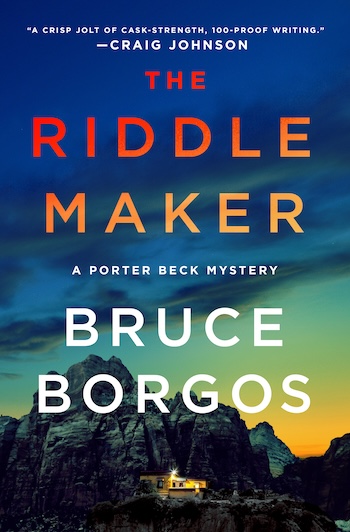
 Tomorrow, Minotaur Books will publish The Riddle Maker, the fourth Porter Beck novel by Bruce Borgos. To celebrate this latest instalment in the acclaimed mystery series, the publisher has allowed CR to share an excerpt with our readers. Perfect for existing fans of the series, of course, but also a good for newcomers who want to get a taste of the author’s work.
First, here’s the synopsis:
Nevada sheriff Porter Beck receives an anonymous riddle leading him to a body hidden for decades, leading Beck and his team in a chase to unravel riddles that will help them uncover and stop a long-time serial killer.
Porter Beck is the sheriff of Lincoln County, Nevada, a vast expanse of desert and mountains best known to the outside world for the top-secret installation called Area 51. Just down the highway sits a weathered mailbox where UFO believers leave messages for aliens. But this time, the message is for Beck.
It’s a riddle. And when Beck and his team decipher it, the answer leads them to the shrinking waters of Lake Mead and an oil drum chained to the bottom. Inside are the remains of someone missing for more than fifty years, someone tied to Beck by a thread of DNA stretching deep into his own past.
Enter Jett Lowell, a pint-sized but fearless FBI profiler who believes Beck’s riddle is connected to one she received seventeen years earlier, shortly before the disappearance of someone close to her.
Convinced they are hunting a serial killer, Beck and Jett follow a trail of riddles from the deserts of Nevada to the mountains of Arizona, and finally to the red rock wilderness of Utah, racing to uncover a chain of murders spanning generations before the killer unleashes a final, horrendous act decades in the making.
*
March 26 — Day 2
The Nevada Vision and Research Institute was new and unfinished, the two- story building still loosely bolted on to Las Vegas Horizon Hospital, and as Beck sat next to Charlie in the second of three waiting areas, he was a little unnerved with all the construction noises going on. He had already finished the initial exam with the eye chart. Nothing had changed there. In good light, his vision was still pretty normal. Like most people his age, he could read the letters on the chart until the print on the lower lines got so small it took an electron microscope to make them out. Next came the visual-field test, his face pressed uncomfortably into a machine—tiny lights he was supposed to see moving from the outside of his vision in toward the center. Beck wasn’t sure he saw any of those, and by the time he exited that room, he was more depressed than ever.
The rods in his eyes, those cells that gave him peripheral vision and allowed him to see in the dark, were slowly becoming toast. He’d first noticed the problem when he was attached to the American embassy in Moscow and he was having trouble making his way after sunset on the cobblestone streets of Old Arbat without bumping into the souvenir stalls. After an attempt to exfiltrate a high-level Russian military source failed miserably, he went for an eye exam and got the “golden boot” and a free ride back to the States, his military career over.
Seven years later, he was getting the same bad news every six months.
Next came the taping of gauze over each eye, which reminded him he was on a slow crawl to permanent darkness. This is what things would look like in the future. He would have to rely on Columbo, his guns- and- ammo sniffing Labrador, to be his eyes and legs. Char lie would be raising this baby largely on her own, with Beck unable to offer help in any meaningful way. Even changing a diaper might be beyond his abilities.
When they walked him into the next room and removed the gauze, the room was black. Someone he couldn’t see inserted con tact lenses into his eyes, lenses attached to wires. She flashed bright lights into Beck’s brain and told him he was measuring the electrical activity generated by Beck’s retinas in response to the light, and that would allow them to assess the health of his retinal cells. Then it was off to the final waiting area. They sat there, Charlie reading a handout on retinitis pigmentosa, and Beck mentally picking out the leather recliner that would eventually become his place of business. Ten minutes later, they both went in to see the doctor.
Dr. Celeste Raynor-Wilkes was a fast talker, about seventy miles per hour but gusting up to one twenty. The graduate of the Wilmer Eye Institute at Johns Hopkins University spoke so fast her words tumbled over each other like water rushing through a broken dam, and it was so hard to keep up that Beck found himself squinting, trying to read her lips. He was fairly certain she was explaining the ocular waterboarding he’d just been through.
“I’m sorry,” she said, finally taking a breath. “Am I talking too fast? I do that sometimes. Please let me know if I’m talking too fast.”
Beck didn’t catch all of that, so Charlie answered for both of them. “Yeah, if you could pump the brakes a little, that would be great.”
Dr. Celeste Raynor-Wilkes, she of the hyphenated name, First of Her Field, Pioneer of Visionary Frontiers, Protector of Retinas and Keeper of Sight, Master of the Laser’s Precision, and Ruler of the Realm of Ophthalmology, was apparently used to more deference.
“Hmm,” she said simply, and sat back in her sleek office chair.
“ ‘Pump the brakes.’ Yes.” Her dark hair was short, cut like a boy’s with a part on the side. She was still in her thirties, which made Beck wonder all over again why he had come. When you see a doctor that’s significantly younger than you, you’re somehow certain that he or she is like a mechanic who hasn’t worked on enough cars to tackle your specific engine problem.
“Okay,” she said, and Beck could tell it was taking all her effort to control the rate of her speech, “I was saying that not a lot has changed in terms of how we treat your disease. Treatment options for RP are very limited. The good news is that your vision hasn’t gotten any worse over the last year. You can continue taking the vitamin A, but honestly the data isn’t definitive on its effectiveness.”
My disease. A dry, nervous swallow rasped in Beck’s throat, loud enough for both Charlie and the doctor to hear. She had stated the good news. That meant there was bad news.
“You said my vision doesn’t seem to have gotten any worse. For the most part, I would agree. But then I have the occasional day where I really struggle to see. I bump into things more. I don’t see them.”
“That’s… unusual,” Raynor-Wilkes said with a tight smile, her pen tapping against the clipboard. “But sometimes patients misinterpret their own symptoms.” She didn’t say hypochondriac patients, but it hung in the air regardless. “RP has more of a linear progression. We don’t see sharp declines. And I can tell you that your vision is essentially no different than the results your former doctor sent over when he retired and recommended you start seeing me.”
Beck made a mental note to send his former eye doctor a card with a special thank- you for setting him up with someone barely out of high school who had a passive-aggressive insistence about everything. The frustration bubbled up inside him, and he kicked himself for exposing Charlie to the disappointment that lay ahead for both of them.
“You mentioned that was the good news,” Charlie said, using her trained detective voice. “Is there bad news?”
*
Bruce Borgos’s The Riddle Maker is out tomorrow, published by Minotaur Books in North America and in the UK.

