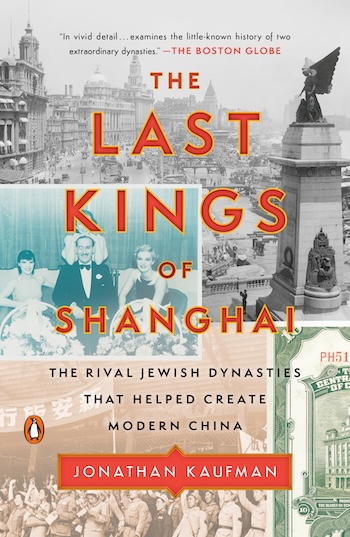
 The story of two Jewish families and how they helped shape China in the 19th Century
An epic, multigenerational story of two rival dynasties who flourished in Shanghai and Hong Kong as twentieth-century China surged into the modern era…
Shanghai, 1936. The Cathay Hotel, located on the city’s famous waterfront, is one of the most glamorous in the world. Built by Victor Sassoon—billionaire playboy and scion of the Sassoon dynasty—the hotel hosts a who’s who of global celebrities: Noel Coward has written a draft of Private Lives in his suite and Charlie Chaplin has entertained his wife-to-be. And a few miles away, Mao and the nascent Communist Party have been plotting revolution.
By the 1930s, the Sassoons had been doing business in China for a century, rivaled in wealth and influence by only one other dynasty—the Kadoories. These two Jewish families, both originally from Baghdad, stood astride Chinese business and politics for more than 175 years, profiting from the Opium Wars; surviving Japanese occupation; courting Chiang Kai-shek; and losing nearly everything as the Communists swept into power. In The Last Kings of Shanghai, Jonathan Kaufman tells the remarkable history of how these families participated in an economic boom that opened China to the world, but remained blind to the country’s deep inequality and to the political turmoil at their doorsteps. In a story stretching from Baghdad to Hong Kong to Shanghai to London, Kaufman enters the lives and minds of these ambitious men and women to forge a tale of opium smuggling, family rivalry, political intrigue, and survival.
The book lays bare the moral compromises of the Kadoories and the Sassoons—and their exceptional foresight, success, and generosity. At the height of World War II, they joined together to rescue and protect eighteen thousand Jewish refugees fleeing Nazism. Though their stay in China started out as a business opportunity, the country became a home they were reluctant to leave, even on the eve of revolution. The lavish buildings they built and the booming businesses they nurtured continue to define Shanghai and Hong Kong to this day. As the United States confronts China’s rise, and China grapples with the pressures of breakneck modernization and global power, the long-hidden odysseys of the Sassoons and the Kadoories hold a key to understanding the present moment.
I read Jonathan Kaufman’s excellent The Last Kings of Shanghai back in February. I’ve been recommending it to pretty much everyone I’ve spoken to since then, so I decided to also put together a very quick review for CR. If you are interested in China, East Asian history, and also international trade, then I would highly recommend this book.
The book recounts the history of two Jewish families who found fame and fortune in China: the Sassoons and the Kadoories. Through their stories, readers will learn more about China’s history and evolving political and social situations, the decline of the British Empire, and the impact of global war on pockets of foreign residents in China. Even if you don’t have any prior knowledge of this region and timeframe, Kaufman does an excellent job of providing all the details to provide an engaging history; all while never getting bogged down in minutiae. In fact, at ~300 pages, this is a tightly written and very satisfying read.
The Sassoon family is one I was already familiar with — first, via Siegfried Sassoon, the poet (who, I learned in this book, had distanced himself from his family and the source of its wealth), but later as I read more about the West’s history with China. Kaufman provides some fascinating details and context for the Sassoon family’s origins, starting in Baghdad and following them to India and then China. We learn about the family’s decades-long attempts to gain acceptance in British high society (ultimately successful), while they amassed a huge fortune and amount of influence in the region and on the British economic elite. The colourful individuals who led the family through the ups and downs of history, the tumultuous Chinese politics of the era, are well-drawn in Kaufman’s book.
The second family, the Kadoories, were beneficiaries of the Sassoons’ philanthropic endeavours, gaining an education through one of the Sassoon schools. I knew nothing about them before reading this. The family followed a similar path to the Sassoons (albeit following somewhat in the latter’s wake), working in various areas connected to the opium trade, and also international/British trade with China. Also excluded from the upper echelons of the elite, the Kadoories nevertheless carved out an influential and powerful position for themselves in China and, ultimately, Hong Kong — where the family helped establish the electricity grid that would, over the next decades, expand into China and help set the country on its current path. (This, I thought, was one of the most interesting takeaways from the book.)
Kaufman does a fantastic job describing the lives of key members of the two families, as well as their many business and political interests over the course of decades. He brings the individuals and the locations to life on the page, always cognizant of the impact foreign businesses had on the Chinese people; and not just those who ended up working with foreign businessmen.
This is a fascinating and well-written history. Definitely recommended.
*
Jonathan Kaufman’s The Last Kings of Shanghai is out now, published by Penguin in North America and Little, Brown in the UK.
Kaufman’s latest book is When America Roared, about “how five decisions in the 1980s built the America we live in today”. It’s out now, published by Viking. (I’ll be reading this very soon.)

