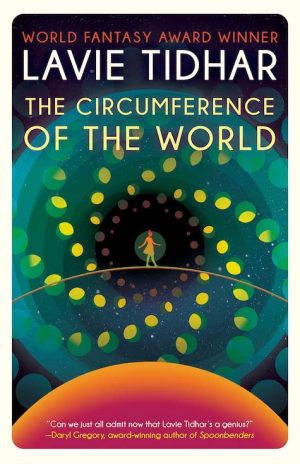
 Next month, Tachyon Publications will publish The Circumference of the World, the latest mind-bending novel from Lavie Tidhar, and they have provided CR with an excerpt to celebrate the upcoming release. An author whose name on the cover indicates a must-buy/-read, this latest book looks like it’ll be as intriguing and original as his others. Before we get to the excerpt, let’s first check out the synopsis:
Caught between realities, a mathematician, a book dealer, and a mobster desperately seek a notorious book that disappears upon being read. Only the author, a rakish sci-fi writer, knows whether his popular novel is truthful or a hoax…
Delia Welegtabit discovered two things during her childhood on a South Pacific island: her love for mathematics and a novel that isn’t supposed to exist. But the elusive book proves unexpectedly dangerous. Oskar Lens, a science fiction-obsessed mobster in the midst of an existential crisis, will stop at nothing to find the novel. After Delia’s husband Levi goes missing, she seeks help from Daniel Chase, a young, face-blind book dealer.
The infamous novel Lode Stars was written by the infamous Eugene Charles Hartley: legendary pulp science-fiction writer and founder of the Church of the All-Seeing Eyes. In Hartley’s novel, a doppelganger of Delia searches for her missing father in a strange star system. But is any of Lode Stars real? Was Hartley a cynical conman on a quest for wealth and immortality, creating a religion he did not believe in? Or was he a visionary who truly discovered the secrets of the universe?
*
The Lens of the World
15.
When the Chase boy left, Oskar Lens stared into the shadows.
“Do you think I can’t see you?” he said. He was talking to us. “Do you think I’m stupid?”
He clutched his head, why could he not remember, he just once. . . .
The shadows whispered back to him, hungry, aroused. If they were there at all. We told you, we do not exist.
What, the shadows whispered, what?
“I just want to, just once, remember her face.”
Your mother’s?
“Yes. No. I don’t know!” Lens said. “I can remember a room, a dark room. It is a small bare room and it is cold. There are no windows. There are many voices, which come and go, but few remain. I remember the smell of cheap cigarettes and rancid cooking oil. I remember pain. But that’s all it is.”
All?
“And I remember a soft hand, once, stroking my cheek. It must have been hers, don’t you think? It must have been.”
But the shadows had no answer; or if they did, we would not say.
Oskar Lens prepared to shed, at last, his mortal form.
How hungry he made us. So hungry.
What is a man but the sum of his memories?
The man who called himself Oskar Lens had lived in London for some years. He had a small yet profitable empire. He regularly gave to charity. He considered himself a respectable businessman. Or at least he would have, if he believed he was still Oskar Lens, and that he hadn’t already died billions of years in the past.
It was an irrational belief. He knew it, for Lens was above all a rational man, a man of facts, of repeatable results. Kill a man and that man is dead, and this Lens had proven time and time again, but what happened to that man after death? That Lens didn’t, couldn’t, know.
Nothing, he would have thought. Death was the end.
Unless, as he came to believe, the knowledge of his being, the data, could somehow be reconstructed: creating not himself but some doppelganger, its old reality reassembled around it like the backdrop in a theatre.
This was what he feared the most. This was what, deep in his heart, he believed. And this was the problem, he reflected, with belief: it did not need to be rational, it did not need to be independently verifiable, it did not require proof or repeatable results. It just was, a belief, a faith that things were the way they were—or not the way they were. He couldn’t change the way he felt, the things he believed he knew. He couldn’t shake the feeling that he was not himself.
His psychiatrist, Dr Knight, told him he had a rare form of delusional misidentification syndrome, a loose, umbrella term for a range of existential-doubting conditions. She told him he had a sort of reverse Capgras Delusion, which was a person’s belief that someone close to them had been replaced by an identical clone. Lens had liked Dr Knight, until he began to discern, behind her eyes, the flittering shadows of the nightmares, watching him and laughing, and he knew that he was no longer safe. The eaters had been moving through his life more and more openly in recent times.
He knew only the book could eventually save him. And in that he had failed.
For a long time he had to pretend he was still himself: he had to act as though he believed the world was still real and not a simulacrum.
But he did not have to pretend anymore.
We taste him eagerly, though parts of him are missing:
In the prison, cigarettes stood for rubles, which they were not allowed to have. Lens remembered, still, the trial. The judge was a dour-faced Georgian, with the ruddy complexity of a dedicated drunk, the kind eyes of a Stalin. All the while that he was being interrogated, Lens never said a single word. The list of his crimes astonished even himself. Murder and racketeering, grave-robbing, extortion, usury, the importation of capitalist jeans, public urination, and living off immoral earnings. The accusation of grave-robbing referred to his brief service in Afghanistan. How much any of it was true he would not say. He would not say a damned word.
“You are filth,” the judge said in sentencing, “you are the scum of the earth, the lowest of the low, the worm which rots the ground. For your crimes against Mother Russia and the ideals of communism, and for the hurt and misery you’ve caused to countless lives, cur, mongrel, dog, you will be sent to Siberia, to a prison reserved exclusively for murderers such as yourself, and may you die there, and may you never be released, not if I have a say in your fate, Comrade Lens, which I do. Take him away and good riddance,” the judge said.
It was summer. Only later would he experience the harsh Siberian winters so beloved of the novelists and poets, for whom Siberia was a sort of metaphorical soul, a landscape which embodied its people. Now Lens experienced the slow passing of the prisoner transport along the solitary road, in which almost no other vehicle passed. He was kept at the back, shackled and bound, and yet he could see. There was a small grille and a window and the air was warm and scented with flowers: it was a curiously hopeful aroma and he inhaled it greedily.
“You’re a big one aren’t you” the guard said admiringly. They stopped by the side of the road and the prisoners were let out, lined up in a row, each with his dick out, pissing into the shrubbery. Lens saw a white crane fly over the distant trees, its wings spread wide as it swooped and dove away from them. The other prisoners talked amongst themselves but Lens said nothing, still: he had nothing to say. Ever since he was a child he had kept his own company, in his mind the thoughts were safe, contained. The others on the transport with him were not of the Bratva, the Brotherhood, they were common criminals or, worse, politicals.
Lens had no time for agitators. He did not believe in systems or utopias. The world was what it was, how it was made, the mark of a man was what he made of it and how he conducted himself before his maker. Vaguely Lens recalled a boy who might have been himself, big for his age, a man’s hand enveloping his, as they walked through a quiet neighbourhood, climbed the stairs of a worker’s block to a flat on the third floor where men gathered in silence to read from a book, only their lips moving, their heads bowed as they prayed.
“You must remember who you are,” the man who might have been his father whispered, but Lens did not understand—he had always known who he was, he had always been himself. A few weeks later he watched as militsiya swooped on that same building, dragged men out of the door and into a waiting van. What happened to that boy, who may have been himself, he didn’t know: there were missing periods, days and months blackened like the pages of a book under a zealous censor’s pen.
But he watched the crane swoop away until it disappeared on the distant horizon. He inhaled the scent of bark and resin, the good earth, pines, he luxuriated in that feeling of pissing outside. For a moment he was free, as free as one could get in this world and more free than some.
“Move it, move it, you bastards, we haven’t got all day,” the guard shouted, and hit them with his club, a random act of cruelty that seemed to catch even him by surprise.
“You poor rotten bastards,” he said, and spat on the ground.
Back inside they baked as in an oven; all Lens could smell now was his fellow prisoners’ sweat, their odour, their farts. Their conversation was crude, hushed, angry, despairing. Lens withdrew from them into his own mind. In there it was cool and calm, the transport and its cargo receded until Lens was alone.
They traversed the plains as the sun set and rose, crossing time zones, stopping, starting, with only the armed guards up front for surly company, and never a hamlet in sight. Once, only, as they stopped for a desultory break and were given their meal outside, the guards watching, did Lens see a village, a few wooden houses piled together like kindling and, in the distance, the railway tracks.
Their journey from Moscow lasted three days.
The other prisoners were dropped off separately, outside the gates of an isolated work camp, nothing for miles but sky. It was the sky he remembered, for they did not make the sky like they did over Siberia, a sky that rolled and rolled until it reached the Gobi, a sky under which dinosaurs walked and men laboured and died. A sky full of stars.
It was late at night when the transit van at last reached the prison, but time had no meaning now: time lay suspended, frozen, and Lens was like a seed, a pod washed for aeons in the currents of galactic space, drawn at last by the inexorable pull of a lode star.
He was pulled from the van, not roughly.
It was then that he saw the stars, so many stars. One did not see them in Moscow, not under the Stalinskie Vysotki, the Seven Sisters that were Stalin’s high-rises, not in the city lights, not in the city’s fog. It was here, only here and in places like it, the wilderness where man feared to go, that the stars were truly visible, and Lens glared at them with a special kind of love, and a special kind of hatred. Then he was moved along, handed over to the prison warden, an old general with a boyar’s moustache and holy eyes like Lenin’s, and he told Lens this:
“Welcome, my son. Welcome to Penal Colony Number Six, your home now and forever, where neither God nor the Devil dwell but only you and I. Take a good look at the sky, my son, take a good long look at the stars above Siberia, for they are the last thing you will see for a very long time. Guards, blind him.”
Lens tried to resist and got a gun butt to the back of the head. They placed the blindfold over him. He couldn’t see. All was black.
The warden said, “Forget your old life, citizen, forget lovers, girlfriends, mother, children, the wind’s caress, the sound of rain when you walk down the street when you are free. Forget the rude cries of gulls over the Moskva, forget the smell of good earth and the leaves blowing on the wind in Gorky Park. Forget it all, forget the world, renounce it, for you are out of it, a body out of space and time. Forget your sins. All are sinners here. Remember only to obey, in everything, immediately and without question. Think no bad thoughts. Act no bad deeds. Obey and live. Rebel and you will die. That is all. Guards, take him.”
He was led bent over double, blinded. He saw and knew nothing, but he heard the savage growls of dogs. He was led inside and the gates shut behind him. He heard the prison truck driving away. Their long road back to Moscow. But there was no Moscow, there had never been a Moscow, and would never be again. There was nothing but Penal Colony Number Six, nothing but this black hole under cold cruel skies, and there was no one but himself; there never was.
They took him inside and stripped him and searched him and washed him: the shock of the water made him gasp. A doctor examined him. The light in the room was sickly and yellow. There were no windows. He was chained to the bed.
“You might live,” the doctor said, dispassionately. “But then who knows, I’ve seen bigger men turn bitches or die. Are you a suka, prisoner? Are you a bitch?”
Lens said nothing. The doctor cast a practiced eye over Lens’ tattoos, reading his curriculum vitae.
“Four times inside already, huh?” he said. “Well, it doesn’t matter. This is the last prison you’ll ever be inside.”
Lens thought, You are right about that.
“Murder, arson, robbery, good with a knife, killed at least one inmate inside—what were you, some sort of contract killer for the Bratva? No, you don’t have to tell me, citizen. I think I like you. I think I like your odds. I’ll tell you what, I’ll back you. We have a pool, you see. I’ll put fifty rubles on you, citizen, and another fifty that you kill someone here before too long. It’s all right, the warden’s not here, you’re amongst friends, now.”
He laughed. “Kill that rodent Mikhail, if you have to pick somebody. He’s dirty, he keeps asking for treatment, he’s got the clap, you see, the dirty little whore.”
Lens said nothing.
The doctor said, “Oh, take him away.”
They pushed him bentover double, down a long corridor with the stench of dying men behind each door. They shoved him into a cell and locked it.
Now he could see.
After a while he slept.
16.
“I don’t understand the meaning of the tattoos,” Dr Knight said to him; they were sitting in her office, long before he had first began to suspect that she was eaten; when he still trusted her.
Lens shrugged, strangely discomfited. “What is there to understand,” he said. Remembered days in other prisons, other terms.
The tattoo needle was a sharpened paperclip, the ink was mixed from urine and scorched rubber. The pain of it meant nothing to Lens. He liked the pain, it reminded him he was alive. Days spent under the needle, marking his body like a map.
He got rid of most of the tattoos, later, when he established himself in London. Had them removed with lasers, had loved the idea of it, like something out of an early Eugene Hartley paperback, his heroes of the spaceways with their laser guns.
“They can tell who you are, what you’ve done?”
Every murder, every prison term, inked on his skin. That runt, Mikhail, the strangler, he had a pair of eyes tattooed low on his stomach, which meant its own kind of thing. Lens did not murder him, the doctor lost his bet and never forgave Lens for costing him money.
In Siberia before they put him in isolation his body had become a map of sorts, a star chart pointing the way to an unknown region of space. The coffins he kept only for a while, in the days after Siberia he had added to the tally, though their record remained only in his mind. The skull and crossbones of his life sentence he had removed; the pointed stars of his rank in the Bratva were now faded scars.
There was no more honour among thieves, he thought, there were no more true vory v zakone, no real thieves-in-law. The fall of the USSR turned them all into common criminals. He kept only one old, faded tattoo. The Madonna and child, the mark of his youthful entry into the brotherhood. He no longer remembered how or when it had been placed upon him. It was just another mark from a past that was lost.
“They’re just notations,” he told Dr Knight. “Maybe they mattered much, I don’t remember.”
She frowned. “Your memory,” she said. “It’s not unusual for severe trauma to cause memory loss. It is hardly surprising that—”
“It is not a condition.”
When she frowned the V resembled a child’s drawing of a gull. “Your beliefs are somewhat unusual,” she said.
“Do you think I’m crazy?”
“That is not a word we use much, these days,” she said. The V disappeared when she smiled. “I have read some of the literature of the Church of God’s All-Seeing Eyes. I understand their innermost teachings are kept secret, for high-level initiates. However there is a remarkable similarity between their doctrines and your. . . .” She hesitated.
“Delusions?”
She let the moment linger. “Is that what you think?” she asked him, gently.
“No. I don’t.”
“There is a difference,” Dr Knight said, “between belief and experience. To believe in God is one thing. To actually experience manifestations of God is another. Do you understand?”
“I am not stupid, Dr Knight.”
“It does read awfully like a science fiction novel,” she confided. “Black holes and simulated realities and. . . .”
Outside her office window a bird sang, and the sun momentarily appeared from behind a cloud. In the light of the sun her face was almost beatific.
“Aliens,” she said.
“The eaters,” Lens said.
“What matters,” she said, “is that you believe in them. You believe yourself to be a simulacrum. An imperfect copy of the man who was once Oskar Lens. Is that correct?”
“You know it is.”
“And I am . . . what?”
“The same. A reconstruction. We are all light in God’s—”
“All-Seeing Eyes. Yes. You said. I must ask, Mr. Lens—Oskar—why are you not, yourself, a member of the Church?”
“I believe in the word. I do not believe in the Church.”
He knew how she looked at him. A sort of puzzlement. She was not the first he’d spoken to, though the only one he’d really felt a connection with, of a sort. It wasn’t that she understood but that she tried. Others just prescribed him medicines, pills that did nothing but give him more bad dreams. In the penal colony he never dreamed. Dreams were too dangerous, there. In the cells, on waking, they were not allowed to sit or lie down. There was nothing to do but pace the length of the cell, back and forth, back and forth for countless hours. In such a place everyone went a little crazy who was not so to begin with.
“And if I am not a simulacrum, then what?” Dr Knight says.
Lens shrugged. “A memory,” he said. “My memory, or someone else’s, even. There are others, here, in this cell.”
“And if not that?”
Something in her eyes. It was the first time he noticed it. How had he never noticed it before?
“Then you are one of them,” he said.
She shook her head. Her eyes were gold and flecked with black.
“You believe you are still in your cell?” she said.
“No—what gave you that impression?”
“You used the word just now.”
“Everything can be a cell,” Lens said.
“You believe you have been—reincarnated? Inside the event horizon of a black hole?”
Something in her eyes. A whisper. But he did not pay it attention, not then.
“I already told you—”
“You must realise how that sounds.”
“So you do think I’m crazy.”
Her smile was rueful. “That’s all the time we have for today,” she said.
At first they kept him in the general population He lived in the dormitories with the others. They worked in the timber yard, cutting wood. His bunk mate was Leonid, the Mad Dog of Chernobyl. Mad Dog was a serial killer, eighteen women over nine years, or that was what they got him on at least. He claimed, with pride, his tally was much higher. They kept company still when the news came of the nuclear accident. It was the only time he saw Mad Dog confused. On the grainy television in the communal area the announcer said only that a reactor malfunctioned; people might have died. Mad Dog shook his head, No, no—he was convinced World War Three had broken out at last, this was but the first stage, or worse, he said, aliens, aliens with their super weapons destroyed Chernobyl.
Unofficially, rumours ran rife, of a vast radiation cloud spreading across Europe, of a no-go zone, the military isolating the city, no one coming in or out, and Mad Dog wept, “All those beautiful women,” he said, “all gone, how can this be?”
When Lens finally killed him it was with a sharpened stick of wood stolen from the lumberyard and hidden, he did it with detached, emotionless strokes, into the neck. When he pulled it out Leonid’s warm blood sprayed his hands. Mad Dog was no loss to anyone, but Lens did not kill him for his crimes. He killed him because after Chernobyl he began to detect in Leonid’s eyes the fleeting shadows of the eaters.
Perhaps Leonid had been a man once, or perhaps he, too, was but an imperfect memory of Lens’, corrupted in the now. One way or the other, after that they transferred him to the isolation ward. They kept him in a cell five meters across and two wide. He was all alone, but he thought he preferred it that way. He had more time to think.
In the dormitories, sometimes, he could not hear himself think. One hour a day they transferred him to a larger cage where, through a wire mesh, he could see the sky. In winter the air was an extraordinary minus forty degrees. It was so cold it was as though the frozen air crept into Lens’ body and took residence in his blood. Always he heard the dogs, patrolling. The clear sound of the bell that announced each morning. Perhaps he went a little mad. Who didn’t?
“I killed a woman with a knife,” an old-timer confessed, and stroked his bald head. “Why waste a bullet.”
Lens paced. One, two, three steps, and turn, and one, two, three steps, and turn. Sometimes he stared for hours at the wall. In the dormitories he could play chess, he could read books, he worked. He abstained from the sex there was for offer or for sale. He ate bread and soup. Sometimes, in the exercise yard, he looked up through the wire mesh, hoping to see a white crane again, flying. But the birds did not fly over Penal Colony Number Six.
Sometimes at night, too, the sound of a gunshot as one of the death-row inmates was finally executed.
Time had lost its meaning. Time was an untruth. Once, a group of prisoners cornered him in the rec area, the television set murmuring in the background. They held shivs.
“For Leonid,” Bogdan said.
Lens protested: “He was not a vor, he was nothing.”
“He was well-liked,” Bogdan said.
Another said, “He had an ass like a woman,” and two of the men laughed.
Lens said, “You have no authority.”
Bogdan lunged with the shiv and Lens broke his fingers, the sound they made was like dry old wood. He pulled Bogdan to him, put the shiv to his eye and left the pointed end there, touching the cornea.
“You have no authority,” he said again.
“Don’t,” Bodgan said. Lens shoved the shiv in, cut the man’s eyeball out neatly.
Bogdan screamed: he didn’t scream before. The eyeball, severed from the retinal artery with a flick of the wrist, plopped wetly on the ground, where Lens stepped on it. He pushed Bogdan away from him.
“Do you recognise my authority?” he said.
One by one the men moved away. Bogdan was taken to the infirmary. The same doctor who lost money on Lens kept Bogdan alive, an eye patch now covered the man’s empty socket. Later, they sent him to the execution chamber and put a bullet in the back of his head and carted his corpse outside.
Time passed, outside. Inside it was much the same. Lens ate bread, soup. He read Kolpakov, Yefremov, Asimov, Heinlein, and Clarke, the Strugatskys and Lem. He cut planks of wood in the lumberyard. He witnessed Kirill as he failed to operate the cutter correctly and his arm disappeared under the blade, bringing forth a fine spray of red mist. He witnessed Abram Abramovich beaten to a pulp by the guards, standing over him in a circle, their clubs rising and falling, no sound but their heavy breathing and Abram Abramovich’s hoarse breath, until it fled. Later in his cell Lens found a tooth embedded in the sole of his shoe. He read Jules Verne.
Every morning they were assembled for roll call under a cold blue sky. They were an island floating alone in a vast space for which there were no charts. He read Wells and Shelley, Kazantsev and E.E. “Doc” Smith. He murdered Andrei Ionescu, the “Butcher of Brasov,” because Mikhail, the stuka, paid him to do it. They sent Lens back to isolation.
When, or how, he got hold of the book, he couldn’t later tell you.
*
Lavie Tidhar’s The Circumference of the World is due to be published by Tachyon Publications in North America and in the UK, on September 5th.
Also on CR: Interview with Lavie Tidhar (2019); Excerpts from Neom and The Best Of World SF, Volume 1; Reviews of The Violent Century and By Force Alone
 Civilian Reader