On Strong Female Characters & Sherlock Holmes’s Modern Successor?

First up, a hat-tip to Abhinav for sharing the link on Facebook, which is where I spotted it [everyone should check out his reviews on his blog, on Founding Fields, and follow him on Twitter].

Sophia McDougall has written a very good piece for the New Statesman, with an attention-grabbing headline: “I hate Strong Female Characters”. It’s an interesting article, and addresses what a lot of society views as a ‘Strong Female Character’, and the double-standards that exist when characterising a hero or heroine as ‘strong’. The whole article is well worth reading, so off you go and read it…

One paragraph in the piece got me thinking. Not really about the topic of the article, but something related to an example McDougall used to make part of her argument:

“Is, say, Sherlock Holmes strong? In one sense, yes, of course. He faces danger and death in order to pursue justice. On the other hand, his physical strength is often unreliable – strong enough to bend an iron poker when on form, he nevertheless frequently has to rely on Watson to clobber his assailants, at least once because he’s neglected himself into a condition where he can’t even try to fight back. His mental and emotional resources also fluctuate. An addict and a depressive, he claims even his crime-fighting is a form of self-medication. Viewed this way, his willingness to place himself in physical danger might not be ‘strength’ at all – it might be another form of self-destructiveness. Or on the other hand, perhaps his vulnerabilities make him all the stronger, as he succeeds in surviving and flourishing in spite of threats located within as well without.”

This made me wonder if there were any female characters that I’d read (recently or otherwise), who maybe adhered more to this archetype of (anti-)hero. And, I actually think I’ve come up with a speculative-fiction contender for the modern successor of Sherlock Holmes. There is, after all, a female character who can be described similarly to McDougall’s Sherlock. To reiterate:

“Sherlock Holmes gets to be brilliant, solitary, abrasive, Bohemian, whimsical, brave, sad, manipulative, neurotic, vain, untidy, fastidious, artistic, courteous, rude, a polymath genius.”

Who am I talking about? Chess Putnam, from Stacia Kane’s Downside Ghosts series (published by Voyager in the UK and Del Rey in the US).

KaneS-DG-1to5UK

Downside Ghosts UK Covers

Chess is an addict, she is a gifted (supernatural) detective, she can be alternately abrasive and vulnerable, she can handle herself in a fight (against ghosts and against corporeal antagonists). She sometimes manipulates those around – on the job, but also as a way of hiding her substance abuse. She’s certainly brave, charging ahead into situations that would make me bug out, screaming like a petrified kitten. Even regarding the more ‘mundane’ elements in the above description, Chess can tick them off: Bohemian (she lives in a converted church on the wrong side of the tracks), vain, neurotic, untidy, and fastidious (in her spell-making, for example). I haven’t yet seen anything that suggests Chess is quite a “polymath genius”, but she has a considerable breadth of skills. At the same time, sometimes Chess needs help from “sidekicks”, and has a couple of her own Watsons – most notably Trouble Terrible,* who she does not always treat well or fairly.

So. There we have it. Chess Putnam is our contemporary Sherlock Holmes. Anyone have any other suggestions who could fill that role?

Downside Ghosts Series: Unholy Ghosts, Unholy Magic, City of Ghosts, Sacrificial Magic, Chasing Magic

Downside Short Stories: Finding Magic, Wrong Ways Down, Home, Close To You

*

* Update: The original version of this post got the name wrong. Apologies to Stacia!

***

Incidentally, Sophia McDougall is the author of the Romanitas trilogy – Romanitas, Rome Burning, and Savage City (published by Gollancz) – which you should all be sure to read, as well.

McDougallS-RomanitasTrilogy

Guest Post: And Now For Something a Little Different – James Lovegrove on AGE OF GODPUNK

Lovegrove-AgeOfGodpunkMy latest Pantheon book, Age Of Godpunk, is not like the others. For a start, it’s an omnibus of three novellas, not a novel. But it isn’t military-SF either. If anything, the three tales are urban fantasy. The themes are the same, though: gods and men and the interaction between them; the nature of belief; acceptance of and/or rebellion against divine authority.

I have to say that all three novellas are pretty personal, too.

They have a setting in common: the city of London. Now, London is a place about which I am more than a little ambivalent. On the one hand, I love to visit our capital and avail myself of the many cultural, culinary, retail and social amenities it has to offer. On the other hand, I’ve lived there at various periods of my life and never felt truly at home or comfortable. I’m from East Sussex. I belong near the south coast, in a county with hills and trees. After any trip up to the Big Smoke, I’m always happy – relieved, even – to return to fresh air and vistas.

So the Age Of Godpunk novellas reflect my mixed feelings about London. They also reflect my mixed feelings about belief, faith and religion. Each of them can be read on two levels. You can take the appearance of the various deities in them at face value, the metaphysical manifesting as real, literal beings. Or you can view them rationally and empirically, with the gods existing only in the minds of the protagonists, phantoms, fantasies, delusions.

More specifically, each novella touches on themes drawn directly from my own life. These are the most personal stories I’ve written in ages, if not ever.

Lovegrove-AgeOfAnansiThe first of them, Age Of Anansi, is about storytelling, which is the thing I try to do for a living. Anansi is the spider god of African tradition, a liar and a trickster, a woefully inept would-be adulterer, and more often than not the hapless victim of his own schemes – ensnared by his own webs. The tales told about him crossed the Atlantic in slave ships and came to America, where they mutated over time and metamorphosed into the Br’er Rabbit fables.

In Age Of Anansi, his spirit apparently possesses a stuffy London-based barrister who is then cajoled into attending a once-every-generation contest among trickster gods in California. In many ways the contest is like an SF convention, but with every attendee attempting to outsmart and outshine the others. So, just like an SF convention, in fact.

Lovegrove-AgeOfSatan2Age Of Satan sketches the life of a young man from school in the late 1960s to the present day. He believes he has sold his soul to the Devil, sort of by accident, but gradually learns that there’s more to the Lord of the Flies than the Bible would have us think. Although the character, Guy, is born about a decade and a half before I was, he attends an all-male boarding school, as I did, and he travels to Thailand, as I did. He’s kind of an avatar for my younger self, sharing many of the passions and anxieties I had while growing up.

As for the third novella, Age Of Gaia, it may be regarded as a sequel of sorts to my 1999 novella How The Other Half Lives, which was one of the first titles to be published by the wonderful boutique imprint PS Publishing. That tale was about a plutocrat who keeps a man locked in his cellar and brutally abuses him in order to ensure himself continued good fortune and enhance his already obscene wealth. Gaia features another plutocrat, Barnaby Pollard, who has made his billions from oil and coal, heedless of the environmental damage that fossil fuels cause. He meets a woman and develops a relationship with her that directly affects both his business and his attitude towards Mother Nature.

There’s a scene in the story which reimagines an event from my own childhood. I was perhaps twelve years old when a bypass was built, circumventing my hometown. The road was driven straight through a patch of countryside where I and my friends regularly played. We had regarded this place as ours, a rural sanctuary, a wild spot where we, too, could be wild. The people of the Highways Agency (or whatever it was called back then) didn’t know that, nor would they have cared if they had.

I took the road building as a personal insult and mourned the fact that fields and woods had been bulldozed and two lanes of tarmac laid down in their place. When something similar happens to the young Barnaby Pollard, however, I show him celebrating the event, applauding the arrival of speed and progress and not giving a damn about any lost greenery. It’s a formative moment in his life, a pivotal experience, which has ironic echoes later on in the story.

As a rule I try to avoid bringing myself into my fiction. I don’t consider my life to be that interesting, and anyway I prefer to write about the unreal and the fantastic, the things that aren’t as opposed to the things that are. Somehow, though, with these three novellas I just couldn’t help it. The personal crept in, almost without my realising. With hindsight, I think that’s one of their great strengths.

***

Pantheon Series (Novels): Age of Ra, Age of Zeus, Age of Odin, Age of Aztec, Age of Voodoo

Age of Gaia will be published on September 12th 2013, by Solaris. For those of you in reach of London, Blackwells on Charing Cross Road is holding a launch event a week earlier, on September 5th. Jared Shurin, of the cult genre website Pornokitsch, will hold an evening in conversation with the author.

Be sure to check out James Lovegrove’s website for more information on his novels and so forth.

Quick Q&A with SNORRI KRISTJANSSON

Here’s a quick interview with Snorri Kristjansson, author of Viking-tastic Swords of Good Men, which was published at the beginning of August, by Jo Fletcher Books…

Let’s start with an introduction: Who is Snorri Kristjansson?

Teacher, writer, lover of cake, mild-mannered Viking and all-round enthusiast.

Your latest novel, Swords of Good Men, was recently published by Jo Fletcher Books. How would you introduce the novel to a potential reader?

As a subversive, gritty, Grimdark-with-a-heart genre-buster, straddling the realms of Historical Fiction and Fantasy like a mythical God – or an action book with Vikings. Depends, really.

KristjanssonS-SwordsOfGoodMen

Is it part of a series?

It is indeed! Book 2 is currently finished and at the being-beaten-with-sticks-until-it-behaves stage. Work starts on Book 3 at the end of the month.

What inspired you to write the novel?

An abundance of time, a lack of employment and a couple of ridiculous coincidences.

And where do you draw your inspiration from in general?

All around. An awful lot goes in, gets mixed somewhere about an inch behind the right ear and comes back out in idea form. Some of them aren’t very good at all.

Why are Vikings so cool?

Big question. Short answer: A combination of beliefs, actions, ingenuity, style and individuality. Shorter answer: ’coz they are. Wanna fight?

How were you introduced to genre fiction?

We are all children of Tolkien, I suppose. Stacks of Raymond Feist and David Gemmell followed.

Kristjansson-FantasyIntro

How do you enjoy being a writer and working within the publishing industry?

It’s great. My publisher and her army of Book Ninjas are a terrifying joy to behold. 

Do you have any specific working, writing, researching practices?

I write well in cafés, but I haven’t had the luxury of establishing rituals yet. The time will come, though.

KristjanssonS-AuthorPicWhen did you realize you wanted to be an author, and what was your first foray into writing?

I’ve been writing for a long, long time, but never really viewed it as my Main Thing until relatively recently, when I totaled up the years and brain-miles spent doing text work of one sort or another.

Do you still look back on it fondly?

I’m not big on looking back, truth be told. I’m a forward kinda guy.

What’s your opinion of the genre today, and where do you see your work fitting into it?

The genre’s main problem is that there are way too many clever storytellers out there pumping out great and glorious work, and I don’t have the time to read it all. This is serious, so I would like fellow authors to be less awesome, thank you kindly.

What other projects are you working on, and what do you have currently in the pipeline?

The conclusion to the Valhalla Saga, an outline of another thing that I can’t speak about, a couple of film things with cool kids that I can also not speak about and various other things. This list might have been more interesting in mime.

Sykes-TomeOfTheUndergatesWhat are you reading at the moment (fiction, non-fiction)?

Tome of the Undrgates by Sam Sykes, which is great fun.

I completely agree! What’s something readers might be surprised to learn about you?

I have done a full 50 minute standup show on a warship.

What are you most looking forward to in the next twelve months?

Oh, that list is LONG, but right at this moment I’d say, “Not being in the state of moving house”, which will happen very soon. Oh, and cake.

Myriad Thoughts On (un)Professionalism, DNFs, Why Do We Do It, What Value We Have, and ultimately a FFS…

[Or: I’m having a bit of a grumble, as insomnia keeps me awake in the wee hours…]

A courageously anonymous commenter has got me thinking about this whole blogging lark. Specifically, the idea of bloggers being “professional” or, more commonly, “unprofessional” when their opinion doesn’t conform to your own. I’ve also been thinking more about the comment Anne Rice made on Facebook, and which I in turn commented on earlier in the week, about the power of reviewers.

I have been reviewing things I loved (and some things I loathed or felt indifferent about) since before blogs really were a thing. I used to print a monthly music magazine when I was in university – interestingly, its name, MWRI, is a Terry Pratchett reference (“Music With Rocks In”, from the excellent Soul Music). It was a fanzine. It took a lot of work, cajoling, personal expense, and printer cartridges to get noticed by record labels and, eventually, to receive free advance albums, gig tickets, and interview opportunities. Then I discovered Blogger, and eventually blogs became a Thing. They Arrived. Record labels, publishers, and more took notice. Some blogs, the busier and earlier ones, have massive followings relative to their newer peers (I don’t like using the term “competitors”).

But. I think, perhaps self-deprecatingly or -consciously, newer blogs (especially since the explosion in numbers) have impact collectively rather than individually. Largely, this is because much of our readership is comprised of the choir to which we preach. I think this is good. It generates debate, discussion, and it can create change – or, at the very least, disseminate change-making ideas and opinions.

This is how review blogs have value: collectively, they paint a picture of how a novel, album, movie, TV series, or who-knows-what-else is received from a diverse cross-section of the reading/viewing/consuming public. I do not believe a single blog review can have a massive impact on a novel’s or album’s success. Newspapers and magazines, however, can have a great impact on whether or not a novel can be a success or not – or, perhaps, if it can become a mega-seller or phenomenon, etc. (Not exclusively, of course, as there are plenty of examples of word-of-mouth successes.) There is, I believe a good reason for individual blogs not having as much impact as some people seem to think.

That relates, in part, to the idea of “professionalism”. I don’t know of any blogger who considers themselves a professional reviewer, unless they also contribute to syndicated columns, or outfits with money behind them (national newspapers and the like). Above all, bloggers do what they do because they are fans. Fans of a genre, or a particular media, or even a particular author/artist/director/or whatever. We come from all walks of life – academics, government employees, techies, teachers, bricklayers, accountants, even writers and other creative types, to name but a few. I don’t think any (ok, just to be careful, many) would consider ourselves anything other than fans, who want to write about and discuss their passions. This indicates a level of non-professionalism, which may (in my opinion) reduce the level of impact we can have on an individual basis.

The “amateur” status of blogs, therefore, should always be remembered. If a blogger, on their personal blog, writes something about a book, movie, album, or whatever that they didn’t like, or were unable to finish because it was in some way flawed in their opinion, then… Well, it’s their right to do so. To do so is by no means “wrong” or “unprofessional”. It is their opinion. There is probably nothing that irritates reviewers more than anonymous commenters who “concede” that we “have the right to our opinion”, only to then attempt the internet equivalent of a bitch-slap.

It shows a stunning lack of impulse control, arrogance that we need their permission to write what we want on the internet, and a strange belief that we seem to have great power. Which we do not. Nor do we believe we do, on an individual basis. (At least, I hope not…)

Are there “unprofessional” things a blogger can,do? Certainly. Lying, for example. Or misquoting, misattributing, and plagiarising. These are more unethical, though, and are wrong in every walk of life and not just professional environments.

That being said, after you’ve been around long enough, and assuming you’re not a complete asshole or troll (or both), you’ll acquire something of a readership. Whether it’s massive or miniscule, you develop a belief in what your readers want. Mostly, in my experience, they want honesty, regardless of what that honesty is. Don’t like a book? They’d rather you wrote that, instead of lying or dissembling, just to keep in with the cool kids, avoid hurting someone’s feelings, or avoid pissing off publishers just so you can stay on their review lists. People can smell bullshit a mile off. It doesn’t wash.

Now, those hard truths also have to be backed up. If you just spend a post slagging off a writer or their work, but never give a coherent reason, then you’ll probably be written off as a crazy lunatic troll. Rightly so. But, if you state an opinion, explain why you reached that opinion (with some allowance for hyperbole in both negative and positive situations), then you’ve done what your review is supposed to do. No reviewer owes readers, writers, publishers any more than their honest opinion. That’s it. And nobody has any justification to pick up a loudhailer, or hit the CapsLock and scream (anonymously) YOU’RE WRONG MOTHERFUCKER YOU DESERVE TO BURN IN HELL BECAUSE THE VOICES TOLD ME SO! That shit will just make people pity you. Or, if you keep hammering away at it in repeated comments, we might think you’re actually the author, a member of the author’s family, or someone connected to their publisher… Which is most likely not the case. But we’re suspicious bastards, and there are plenty of instances of it actually being true…

Someone said on Twitter that this sort of behaviour would make them boycott an author, if their fans acted this way. I don’t think this is a good idea. I think no book can truly be judged from a review (despite some reviewers’ exceptional writing abilities and talent). And certainly no author should be punished for a single fan’s… exuberance. By definition, every review is suspect: they are opinionated, bias, flawed. Many have stated agendas (some bizarre, most understandable and/or rational). But they are pure opinion.

A reviewer who believes s/he has written the definitive word on a novel, album, or movie displays a towering, misplaced arrogance. Thankfully, I believe the vast majority recognise that we are each just one of a cacophony of voices attempting to be heard (some try much harder than others) over the even greater (perhaps greatest) cacophony that is the internet.

So yeah. Let’s all learn that “disagrees with me” is not the same as “unprofessional”. Because really all you’re doing by throwing that accusation around is proving that you’re illiterate. Or connected to the person who created whatever’s being reviewed. Or off your meds.

So just knock it off, engage the filter, and exercise some self-control. You’re giving Anonymous people a bad name everywhere.

Guest Post: “Caught in a Storm, Weather & Ancient Warfare” by William Napier

Napier-BloodRedSeaJust back from a week sailing round Corsica and Sardinia. Gorgeous weather first four days, swimming, snorkelling, and a lot of cheap rosé. I read Alison Weir’s book on the Wars of the Roses. Highly recommended. Then, on Thursday afternoon, the sky turned black and a huge wind got up. We headed fast for what should have been safe anchorage in a north-east-facing inlet at Spalmatore, having been told the usual stormy August westerly was on its way… Big mistake. The storm came straight out of the north east, and the boat started to buck around like a wild mustang with behavioural issues.

We’d tied up to two buoys for extra stability but now the waves were broadside on, the boat rolling terribly, and we had to stagger out in the big swell and loose off one of the buoys so the boat could at least swing round and pitch into the coming sea.

Around 1am the storm broke and it was spectacular. Lightning over the mountains of Corsica that went on for a good two hours, truly retina-scorching, then hailstones the size of marbles. A full Mediterranean summer storm, astonishingly violent. The next day, the sky was blue again, the seas still pretty big but a fine wind and a whole day of brilliant sailing, the deck at 45° all the way.

At times during the night it had been genuinely frightening, as well as exhilarating. Danger survived always makes you feel more alive. But it also made me think how the old mariners, those who sailed the Mediterranean in Homer’s time, or the time of Lepanto, must have coped. No wonder they believed in monsters, prayed so fervently to their gods. We might have been badly chucked around for a while, but we had lifejackets, SatNav, radio. There was never any real danger. If you’re a writer, then all experiences, even the hard ones, are good material, and this was a powerful reminder of just how tough and courageous our sailing forefathers were.

During the Battle of Lepanto, in October, the weather was also pretty rough. Hard to imagine how the Christians and the Turks managed not only to control their galleys in those big seas, but handle the guns with relative accuracy as well. No wonder they had to come so close and fire at such close range. The result was the most terrible carnage, with a casualty rate on that single day, 7th October 1571, of some 40,000: a figure never again equaled until the First World War. And as for historical significance, I would argue that Lepanto’s was greater than either Hastings or Waterloo. The future of much of Europe, not just the Balkans, might have been far more Ottoman and Muslim had it swung the other way. It should be better known. 

And there are many reasons why we might remember the desperate bravery of the men who fought on both sides, from the dashing aristocrats like Don John of Austria, to the hard bitten captains like Uluch Ali, to those indomitable warrior-monks, the Knights of St. John, to the poor emaciated bastards chained to the oars down below. And our mild little summer storm last week was another reminder of that.

***

The Last Crusaders: Blood Red Sea is part of Napier’s Clash of Empires series. It is out now, published by Orion in the UK. Here’s the synopsis:

1571. Chained to a slave galley in the heart of the Mediterranean, it seems that English adventurers Ingoldsby and Hodge might have finally run out of luck. But as former Knights of St John, they’ve survived worse, and while the men around them drop dead at their oars, they’re determined to escape.

By a miracle of fate, they find their way back to dry land and freedom – but unable to return home. With the Ottoman Empire set on strangling the crusading Christian power before it can take root, hostilities between East and West – Muslim and Christian – are vicious and deadly.

And as the sun rises on one day in October, five hours of bloodshed will change the course of history. Once again, the two Englishmen find themselves living on borrowed time…

Craig Ferguson Interviews Stephen Fry (back in 2010). It was Really Interesting…

I’m going to share this video without any commentary, save that it was really interesting, and I like them both as actors, comedians, and interview subjects. They spend a fair amount talking about depression, manic depression, alcoholism. And internet trolling. It’s something they both know a fair bit about. It’s a frank conversation. Really good. Enjoy.

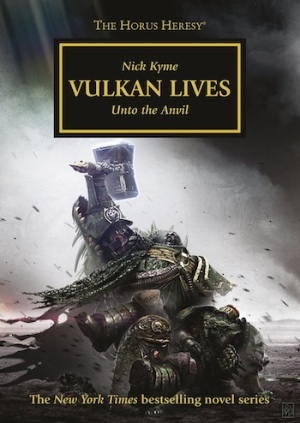
Review: VULKAN LIVES by Nick Kyme (Black Library)

KymeN-HH26-VulkanLivesA superb, different Horus Heresy novel

In the wake of the Dropsite Massacre at Isstvan V, the survivors of the Salamanders Legion searched long and hard for their fallen primarch, but to no avail. Little did they know that while Vulkan might have wished himself dead, he lives still… languishing in a hidden cell for the entertainment of a cruel gaoler, his brother Konrad Curze. Enduring a series of hellish tortures designed to break his body and spirit, Vulkan witnesses the depths of the Night Haunter’s depravity, but also discovers something else – a revelation that could change the course of the entire war.

How does one review a novel that packs in so very many revelations? With great difficulty, as it happens… Vulkan Lives is a great novel. It is a superb addition to Black Library’s New York Times-bestselling sci-fi series. It is a superb example of intelligent, thoughtful science fiction. It’s not flawless, true, but I loved it. I have a feeling it won’t be met with universal acclaim from the more action-oriented sections of the WH40k fan-base, but I think it does a great job of fleshing out some hitherto overlooked events and questions of the era. Continue reading

DC Villains Month: Mr. Freeze, Joker & Court of Owls

I don’t really know what’s going on with “Villains Month” (I haven’t been following comics news as closely these past couple of months, partly because I’ve been reading my favourite series a couple months behind). It seems to be a way to release three extra issues of certain DC comics in a month. Not sure if they’ll tie in directly to the main series story-arcs, or if they’ll work as interesting asides, or side-stories for fans who would like a little bit more.

Whatever the reason/purpose of these issues, I was browsing DC’s press site, and found some interesting artwork, which I thought I’d share here.

First up, this rather good domestic Mr. Freeze page, from Batman: Dark Knight #23.1 – Mr. Freeze:

BatmanDarkKnight-23.2-Interior1

Writer: Justin Gray & Jimmy Palmiotti
Artist: Jason Masters
Cover: Guillem March

Next, two twisted and intriguing pages featuring the Joker and the Ape House, from Batman #23.1 – Joker

Batman-23.1-InteriorJoker

Batman-23.1-InteriorJoker2

Writer: Andy Kubert
Artist: Andy Clarke
Cover: Jason Fabok

And finally, this very moody, sinister page from Batman & Robin #23.2 – Court of Owls:

Batman&Robin-23.2-Interior1

Writer: James T. Tynion IV
Artist: Jorge Lucas
Cover: Patrick Gleason & Mick Gray

Three Awesome Comic Covers: EARTH 2 #14-16 (DC Comics)

Earth2-14-Crop

I’ve only read the first volume of DC’s Earth 2. There was some great stuff in it (artwork in particular), but also some things that didn’t quite work for me. I’ve been told by a couple of other reviewers that some of the things that niggled are longer-term plot-points – an example of my approach to reading comics perhaps not being the best for seeing the wider picture.

Regardless, it’s a series I’m intrigued by, offering as it does an alternative DC Universe. The series is written by James Robinson. If I ever needed an excuse to catch up and keep reading it, though, the covers for issues #14-16 are it:

Earth2-14

Cover by Kenny Martinez

Earth2-15

Cover by Juan Doe

Earth2-16

Cover by Juan Doe

I love these covers! The colours, the weathered-vintage style, the slight Soviet-influence. Really striking. I have no idea what the story is, by this point, but there are the (rather cryptic) synopses for the issues:

#14The bells of war ring loudly as Green Lantern, The Flash and Doctor Fate attack Steppenwolf head on – with the future of Earth 2 hanging in the balance.

#15Dr. Fate, Red Arrow, The Flash, Green Lantern and The Atom all fall victim to the Hunger Dogs of Apokolips as the war against the forces of Steppenwolf continues.

#16The war against Steppenwolf and the Hunger Dogs is over… all hope is lost!

The first two of these issues have been published, and #16 will be published October 2nd 2013. I will start saving up to catch up… now.

Reviews, Debuts, Vampires, A Different Time…

Rice-InterviewWithTheVampire1I have been a fan of Anne Rice’s Vampire Chronicles ever since I picked up Interview with the Vampire in 1999. I was living in New York at the time, and I went to Barnes & Noble on 51st & Lexington (in the CitiCorp Building), and came across the series. Even though I hadn’t read any of the novels, by this point I had seen the movie, starring Tom Cruise, Brad Pitt, Antonio Banderas, and a scene-stealing Kirsten Dunst. I really enjoyed it (and still do), so I thought I’d give the series a try. I proceeded to read all of the volumes then in print, and then bought each new book on day of release.

I didn’t think the first novel was perfect, and I found the fact that it was written as a conversation slightly strange – I was young and not very well-read or refined at the time. Nevertheless, it planted the seed that has had me eagerly await any new book by Anne Rice ever since. I consider the first two sequels, The Vampire Lestat and Queen of the Damned, as one of my five favourite novels of all time (I can’t read one without immediately reading the next, so I consider them as a single book).

Time to get to the point of the post: I have also been reviewing books for almost seven years, and movies and music for a few years more than that. I therefore found this post on Anne Rice’s Facebook feed, attached to a link, rather interesting:

Interview with the Vampire was actually a flop when it was published, severely hurt by a negative New York Times review by Leo Braudy. I’m not sure a review can kill a book today. But this was 1976, a different world. And a first novel, especially a very unusual one, was I think tragically vulnerable to the power of the Times… Now 37 years later Interview is (I’m grateful to say) an unqualified success and is still in print in hardcover as well as in paperback…

Rice-InterviewWithTheVampire2Sadly, the review is behind the New York Times pay-wall (which I still couldn’t read, despite supposedly having access to a specific number of articles per month…). Nevertheless, and perhaps a little strangely, Barnes & Noble’s listing for the book has the following quotation from Leo Braudy, apparently from “Books of the Century, The New York Times, May, 1976”:

“Anne Rice’s publishers mention the Collector and the Other, but it is really The Exorcist to which Interview with the Vampire should be compared, and both novelist William Peter Blatty and filmmaker William Friedkin, whatever their faults did it much better… The publicity tells us Rice is a ‘dazzling storyteller.’ But there is no story here, only a series of sometimes effective but always essentially static tableaus out of Roger Corman films, and some self-conscious soliloquizing out of Spider-Man comics, all wrapped in a ballooning, pompous language.”

I thought it was interesting that Rice said she’s “not sure a review can kill a book today”. I think she’s probably right. Not only is the internet allowing critiques, criticism and praise to spread all over the world, but also the fact that negative reviews only seem to generate extra interest in books. Take two (admittedly unusual) examples: 50 Shades of Grey, or Dan Brown’s The Da Vinci Code (which got, effectively, a bad review from the Vatican = publisher’s Holy Grail).

I also think Braudy is wrong his statement that “there is no story” in the novel. There’s quite a lot, actually. Yes, it’s “static”: it’s a book-length interview. What was he expecting? I don’t understand the Spider-Man connection, but it stands out, no? I don’t know the other references he presents, so I can’t speak to those. The connection to The Exorcist is an interesting one, but I don’t know either the book or movie version of that story well enough.

I’m sure this would have been a more interesting post if I’d had access to the review, but there we go [and if I hadn’t been writing it during a bout of insomnia, at 3:30am]. I’ll keep trying to get the text, and see if it adds anything to the discussion. Or, at the very least, offer some interesting quotations from it as/when I find them.

What do you think? Can negative reviews kill books today? If not, why not?