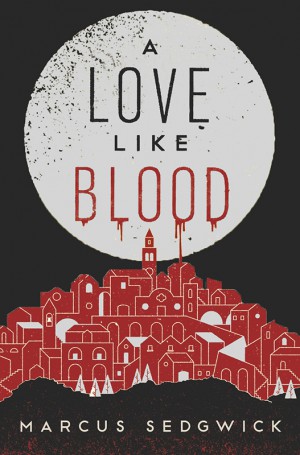
“A Love Like Blood” by Marcus Sedgwick (Mulholland)

Sedgwick-ALoveLikeBloodA gripping, chilling psychological thriller

“I’ve chased him for over twenty years, and across countless miles, and though often I was running, there have been many times when I could do nothing but sit and wait. Now I am only desperate for it to be finished.”

In 1944, just days after the liberation of Paris, Charles Jackson sees something horrific: a man, apparently drinking the blood of a murdered woman. Terrified, he does nothing, telling himself afterwards that worse things happen in wars.Seven years later he returns to the city – and sees the same man dining in the company of a fascinating young woman. When they leave the restaurant, Charles decides to follow…

A Love Like Blood is a dark, compelling thriller about how a man’s life can change in a moment; about where the desire for truth – and for revenge – can lead; about love and fear and hatred. And it is also about the question of blood.

This wasn’t what I was expecting. I had expected a good novel, with perhaps a supernatural component. Instead, what I found was an excellent psychological thriller about obsession and the science and mythology of blood. Sedgwick’s first novel for adults is damned good, and a must-read of the year. Continue reading

An Interview with MATTEO STRUKUL

Italian author Matteo Strukul stops by to talk about his first novel in English, The Ballad of Mila, his broad and varied influences, his inspirational home country, why Chuck Wendig is a “badass wizard”, and much more…

MatteoStrukul-AuthorPicLet’s start with an introduction: Who is Matteo Strukul?

First of all, thank you so much Stefan for this opportunity to talk about my work. Well, about myself… I’m a man who loves life and rock ’n’ roll music (The Black Crowes, Rival Sons, Buckcherry and all the old stuff like Led Zep or Skynyrd). I adore American pulp-crime fiction authors (Jim Thompson, James Crumley, Joe R. Lansdale, among others), but at the same time I read so many European authors and literature (Friedrich Schiller, Wolfgang Goethe, Robert Louis Stevenson, Emilio Salgari), I love Italian red wine like Raboso or Grinton and I love my land that is Veneto in the Northeast of Italy. I’m so lucky to grow up in this area in towns like Padova, Venezia, Verona – so full of arts and beauty, I must confess that it’s an amazing place and for that reason I love to write about my land in my novels.

Your novel, The Ballad of Mila, is due to be published in March by Exhibit A. How would you introduce the novel to a new reader? Is it part of a series?

Yes it is, it’s the first novel in an on-going series, Exhibit A has already bought English rights of the second one, and I’m writing the third exactly NOW. Well, The Ballad of Mila is a kind of “Revenge Movie”: it’s a story about vengeance and blood and you have this amazing woman with long red dreadlocks who is able to face and defeat every kind of man because she was a victim, and now she is a predator and a merciless one. But you have also the Chinese mafia, the Venetian territory, you have non-stop action and torment and rage and hatred and, in the middle of a battle between two different gangs – like in Sergio Leone’s For a Fistful of Dollars – you have Mila, a woman who is also damaged goods and who can’t accept herself for what she became. So Mila is a killer, but at the same time she is broken, in some way she’s a kind of mixture between Luc Besson’s La Femme Nikita and Garth Ennis’s Punisher

MatteoStrukul-BalladOfMilaInfluences.jpg

What inspired you to write the novel? And where do you draw your inspiration from in general?

From stories that I read during the years penned by authors like Victor Gischler, Allan Guthrie, Tim Willocks, Jason Starr, Adrian McKinty, Christa Faust, Duane Swierczynski, Massimo Carlotto, Giancarlo De Cataldo, Don Winslow, Anthony Neil Smith, David Peace, Charlie Huston, Dan Simmons, David Wellington, James Ellroy, Derek Raymond, Cathy Unsworth, Stuart O’nan, Kem Nunn, Cormac McCarthy, Henry Crews. Then, of course, I must mention TV shows like Sons of Anarchy, movie directors like Sam Peckimpah, Sergio Leone, Quentin Tarantino, Robert Rodriguez, Guy Ritchie, Joe Carnahan, among others, and I don’t wanna forget Videogames (Bloodrayne) and Comic books screenwriters like Alan Moore, Warren Ellis, Mark Millar, Garth Ennis, Jason Aaron, and Brian Azzarello.

How were you introduced to reading and genre fiction?

Well, since I was five years old I started reading, and now here we are. I remember that my Mom used to read to me epic poems like Homer’s Iliad and Odyssey. I loved those stories, about heroes and battles and fighting, so this was how everything started.

StrukulM-1-TheBalladOfMila

How do you enjoy being a writer and working within the publishing industry? Do you have any specific working, writing, researching practices?

Well I worked for some years as press agent for an Italian independent publisher: Meridiano Zero. I organized press campaigns for authors like David Peace, James Lee Burke, Derek Raymond and I met Victor Gischler in 2008 in Courmayeur at the Noir Festival, I was his press agent because Meridiano Zero published in that year Gun Monkeys in Italy. It was great and we had so much fun. So, of course this fact doesn’t mean that I was an author in those years but means, without any doubt, that I had a strong background.

Then I founded Sugarpulp, a literary movement focused on pulp-crime fiction and was and am line editor for a crime fiction imprint called Revolver that published authors like Allan Guthrie, Ray Banks, Brian McGilloway, Derek Nikitas among others. At the same time I work as author, my new book will be published by Mondadori in Italy next April and will be a Gaslight Mistery set in Padova and Venezia in 1888 AD. It’s a story about an alienist and a serial killer strongly influenced by Caleb Carr, ALan Moore and Dan Simmons stuff. About writing what can I say? I love my life as writer and editor and comic book screenwriter, you know, I’m free and do what I want. Like Jagger said, “Ha, Ha so I’m a lucky guy, probably the luckiest one in the entire world.” For my last book – The Gaslight Mistery that I mentioned before – well I researched so much because I needed to study the Venetian area of the 19th Century. It was a great challenge. For Mila’s novels, I don’t research so much, but I watch so many movies and TV shows, and I mixed all those things and sequences and feelings, and after that I have a new story. I don’t know how it works, but it’s impossible for me to do a synopsis and those kind of stuff, you know, especially because Mila needs to decide everything and I just have to listen to her and write. Ha Ha.

When did you realize you wanted to be an author, and what was your first foray into writing? Do you still look back on it fondly?

I realized that I wanted to be an author when I was a child. I remember that I wanted to be a rockstar or a pulp-crime writer. It was cool, I remember that I formed a rock ’n’ roll band with my brother. We played rock ’n’ roll stuff, gigs in coffee-bars or small clubs. But it was hard to earn money and fame, so I decided to write my own stories. I started with nonfiction and penned two nonfiction books about two Italian songwriters and I wrote for years as a rock ’n’ roll journalist. I interviewed cool guys like Black Crowes guitarist Marc Ford, Jethro Tull’s Ian Anderson, Zucchero, Dave Matthews, Ryan Bingham, Joss Stone, among others. But, if I must be honest the best interview that I ever done was with Willy De Ville. We spoke together for one hour, he was so cool and generous and he was an amazing and great person and a so talented artist and I remember that after some months or something like that he died. It was shocking and brutal, I remember I wrote a six-page article for a very important Italian rock magazine. It was sad and bitter, but at the end I was so happy to have done something for him, nothing so important but a kind of way to testify all my love for his music and art. In my opinion he was probably the most talented and wonderful singer of the last 30 years.

What’s your opinion of the genre today, and where do you see your work fitting into it?

Well, I love crime and pulp fiction and I think that a pulp-crime author would be able to be popular if will be able to offer amusement and amazing but low-cost stories. And literature, in my opinion, is real literature, if it could be popular and mass market distributed. Professors and Academics and Intellectuals are so boring and selfish and in fact they use literature like a weapon to divide and create differences between high culture and low culture, between upper and middle class and common people. Fuck them all! Man, it’s a shame. I want to be a honest pulp writer and create good and strong characters.

Wendig-MB3-CormorantFor example, recently I read Chuck Wendig’s Miriam Black’s three books series: Blackbirds, Mockingbirds and The Cormorant… well it was a real roller-coaster, I loved that series. Chuck is a wonderful author, and is able to mix pulp, horror, urban fantasy, crime fiction… He is a badass wizard. At the same time, I think that I wanna try to write some historical novel, especially a big story that I have in my mind about The Northern Crusades with kings, knights, witches, female warriors, wild tribes, castles, snow and tortures, I think could be a very interesting setting.

What other projects are you working on, and what do you have currently in the pipeline?

WillcocksT-TwelveChildrenOfParisAs I said, my new Gaslamp Mistery novel for Mondadori, I’m writing also the third Mila Zago novel and a double book story about Teutonic Knights, and I’m writing a graphic novel, drawn by an amazing Italian artist, Filippo Vanzo. I’m also writing the second ebook novella together with Marco Piva Dittrich for my on-going series about Skuld, a she-werewolf who’s fighting the Nazis during the WWII and I’m editing Tim Willocks’s The Twelve Children of Paris for an Italian publisher. I have many other projects in the pipeline, including comic-books and… movies… but I must keep my mouth closed and, much important, keep my fingers crossed.

What are you reading at the moment (fiction, non-fiction)?

WellingtonD-W1-FrostbiteI just finished reading David Wellington’s Frostbite, a werewolf tale: an amazing novel.

What’s something readers might be surprised to learn about you?

Probably that I love Ice Hockey, I’m a big fan of Asiago Hockey 1935, my favorite Italian team. Ice Hockey is quite popular in the North East of Italy. Maybe the reason why I love so much this sport is because when I was a child, I lived for two years in Canada: Vancouver, British Columbia. I remember when I watched Vancouver Canucks on TV with my father, so maybe that’s the reason why I love ice hockey so much. I am also a big Philadelphia Flyers and Montreal Canadiens fan. Ice hockey has an important role in Mila’s novels, ha ha. I’m not kidding…

What are you most looking forward to in the next twelve months?

Well, I’m very curious to see if Mila could break English and American readers’ hearts. I hope they would be so generous and kind to give Mila a chance. So thank you so much, Stefan, for what you have already done for her… and me.

*

Be sure to follow Matteo Strukul on Twitter, and check out his website for more information on his writing and projects. The Ballad of Mila is published by Exhibit A in March 2014 (UK & US). Here’s the synopsis:

Imagine Elmore Leonard behind the wheel of a car in Grand Theft Auto, as one Italian woman sets out to cut the mafia down to size – one limb at a time…

Two perfectly matched gangs are fighting for control of the north-east Italian region of Venetia. But a formidable young woman with vengeance on her mind has plans to upset the balance. Abandoned by her mother and violated by a gang of criminals just after they slaughtered her father, Mila Zago is a cold-blooded killer, a deadly assassin. Brought up by her grandfather on the Sette Comuni plateau under a rigid martial code, she returns home to seek her revenge, conspiring to create a spectacular showdown reminiscent of A Fistful of Dollars.

The Ballad of Mila is the first novel in an ongoing series focused on the formidable female Italian bounty hunter Mila Zago, a.k.a. Red Dread.

Upcoming/News: “REVIVAL” and “MR. MERCEDES” by Stephen King (Hodder)

KingStephen-AuthorPicI’m a relative newcomer to Stephen King, but I am certainly a fan of his writing (I’ve read a good amount of his non-fiction already). Last year, I finally read The Shining, and Hodder published its long-awaited sequel, Doctor Sleep. This year, Hodder will be publishing two new novels by King: Mr. Mercedes and Revival.

The latter was just announced on the publisher’s website, so I thought I’d start with that one. Here’s some info:

In a small New England town, over half a century ago, a shadow falls over a small boy playing with his toy soldiers. Jamie Morton looks up to see a striking man, the new minister. Charles Jacobs, along with his beautiful wife, will transform the local church. The men and boys are all a bit in love with Mrs Jacobs; the women and girls feel the same about Reverend Jacobs – including Jamie’s mother and beloved sister, Claire. With Jamie, the Reverend shares a deeper bond based on a secret obsession. When tragedy strikes the Jacobs family, this charismatic preacher curses God, mocks all religious belief, and is banished from the shocked town.

Jamie has demons of his own. Wed to his guitar from the age of 13, he plays in bands across the country, living the nomadic lifestyle of bar-band rock and roll while fleeing from his family’s horrific loss. In his mid-thirties – addicted to heroin, stranded, desperate – Jamie meets Charles Jacobs again, with profound consequences for both men. Their bond becomes a pact beyond even the Devil’s devising, and Jamie discovers that revival has many meanings.

Revival is due to be published by Hodder on November 11th, 2014. No artwork has been unveiled, yet (for either of these titles), but I’ll share them when they become available.

The other novel, Mr. Mercedes, will actually be published before Revival (in June 2014). Here’s the synopsis:

Retired homicide detective Bill Hodges is haunted by the few cases he left open, and by one in particular: in the pre-dawn hours, hundreds of desperate unemployed people were lined up for a spot at a job fair in a distressed Midwestern city. Without warning, a lone driver ploughed through the crowd in a stolen Mercedes. Eight people were killed, fifteen wounded. The killer escaped.

Months later, on the other side of the city, Bill Hodges gets a letter in the mail, from a man claiming to be the perpetrator. He taunts Hodges with the notion that he will strike again. Hodges wakes up from his depressed and vacant retirement, hell-bent on preventing that from happening.

Brady Hartfield lives with his alcoholic mother in the house where he was born. And he is indeed preparing to kill again.

Hodges, with a couple of misfit friends, must apprehend the killer in this high-stakes race against time. Because Brady’s next mission, if it succeeds, will kill or maim hundreds, even thousands.

Mr Mercedes is a war between good and evil, from the master of suspense whose insight into the mind of this obsessed, insane killer is chilling and unforgettable.

Upcoming: “The Man With the Golden Mind” by Tom Vater (Exhibit A)

Vater-TheManWithTheGoldenMindLast year, Exhibit A published Tom Vater’s debut thriller, The Cambodian Book of the Dead. Sadly, it ended up being one of the thrillers that went onto my eReader and I promptly got distracted by other things, and it has thus-far gone unread. Now that this second novel in the series, The Man With the Golden Mind (April 2014), is to be released, I’m going to have to get my act together and get caught up!

“In trouble again… and a long way from home…”

Julia Rendel asks Maier to investigate the twenty-five year old murder of her father, an East German cultural attaché who was killed near a fabled CIA airbase in central Laos in 1976. But before the detective can set off, his client is kidnapped right out of his arms.

Maier follows Julia’s trail to the Laotian capital Vientiane, where he learns different parties, including his missing client are searching for a legendary CIA file crammed with Cold War secrets. But the real prize is the file’s author, a man codenamed Weltmeister, a former US and Vietnamese spy and assassin no one has seen for a quarter century.

To learn more about Tom’s novels and writing, be sure to visit his website and follow him on Facebook and Twitter.

“The Circle” by Dave Eggers (Knopf)

EggersD-TheCircleAn interesting, timely and disturbing novel

When Mae Holland is hired to work for the Circle, the world’s most powerful internet company, she feels she’s been given the opportunity of a lifetime. The Circle, run out of a sprawling California campus, links users’ personal emails, social media, banking, and purchasing with their universal operating system, resulting in one online identity and a new age of civility and transparency. As Mae tours the open-plan office spaces, the towering glass dining facilities, the cozy dorms for those who spend nights at work, she is thrilled with the company’s modernity and activity. There are parties that last through the night, there are famous musicians playing on the lawn, there are athletic activities and clubs and brunches, and even an aquarium of rare fish retrieved from the Marianas Trench by the CEO. Mae can’t believe her luck, her great fortune to work for the most influential company in America — even as life beyond the campus grows distant, even as a strange encounter with a colleague leaves her shaken, even as her role at the Circle becomes increasingly public.

The Circle is the first novel I’ve read by Eggers. It is also one of the creepiest books I’ve ever read. The novel revolves around Mae Holland, a new hire at The Circle – a massive, Google-meets-Facebook-type social media goliath. We follow her story as she navigates the company, its quirks, and also its never-ending evolution. We see her life turned upside down as she strives to rise in the Circle’s ranks, to adopt and embrace its new innovations. Completing the Circle becomes an obsession, and despite clear signs of its negative impact on her life and those of her loved ones, the inexorable pull of the company, the sense of community, and compulsion to be a part of something proves too much for Mae to resist.

What made this novel so unsettling was how Eggers has extrapolated an all-too plausible (albeit slippery-slope) evolution of social media. The author’s not subtle, either, and it sometimes felt like he is trying to bludgeon the reader with his own negative feelings about social media and its ubiquitous place in contemporary life. At the same time, he has a point. As The Circle continues to evolve, and gobble up ever-more resources, technology and, above all else, access to its users’ private lives, we see an unprecedented erosion of privacy. More than that, though, is that this erosion is voluntarily embraced by Circle users.

Despite the anvil-from-the-sky approach to delivering his point, Eggers has written an accessible, engaging and above-all thought-provoking novel. It will make you analyse your own social media use, and probably make you adjust your habits, too…

An important, if unsubtle, novel, The Circle is certainly recommended reading for anyone who embraces a well-connected life.

An Interview with SIMON BECKETT

BeckettS-StoneBruises

Simon Beckett’s Stone Bruises is one of my most-anticipated thriller novels of 2014. I was very happy, therefore, to get the chance to interview the author. Read on, fair reader, for Beckett’s thoughts on writing, his latest novel, and more.

Let’s start with an introduction: Who is Simon Beckett?

BeckettS-TheChemistryOfDeathI’m the author of four crime thrillers featuring David Hunter, a British forensic anthropologist. I’ve worked as a freelance journalist for most national newspapers and colour supplements, and the idea for the Hunter series came after I was commissioned to write a piece on the Body Farm in Tennessee, where real human cadavers are used to research decomposition. It was a gruesome but fascinating experience, and provided the basis for the first David Hunter novel, The Chemistry of Death. My aim was to draw on some of the forensic techniques I’d seen used in the US but with a British main character and a British setting. And to make it scary, as well.

I thought we’d start with your fiction: Your latest novel, Stone Bruises, will be published by Transworld in January 2013. How would you introduce the novel to a potential reader? Is it part of a series?

Stone Bruises is a standalone novel rather than part of a series. It’s a psychological thriller that opens with a young British man, Sean, abandoning a bloodstained car in rural France. He’s obviously traumatised and on the run, although we don’t know what he’s trying to escape from. When he’s badly injured in what might be described as “suspicious circumstances”, he regains consciousness to find he’s being cared for by two young women on a dilapidated farm. He’s not sure if he’s a patient or a prisoner, but despite falling foul of the women’s violent father, he begins to regard the farm as a perfect hiding place. Except that he’s not the only one with secrets, and as his own story emerges we come to realise this might not be the idyllic retreat that Sean imagines.

What inspired you to write the novel? And where do you draw your inspiration from in general?

I don’t think I could say anything inspired me, as my ideas tend to come from a variety of different sources. But when I was younger I hitchhiked in France myself, so I know how remote some parts are – and how difficult it can be to hitch a lift. So I came up with what I thought was a strong opening scene, and then built the story and character from there.

BeckettS-StoneBruises

How were you introduced to genre fiction?

I read a lot of horror and science fiction as a kid, and then started reading crime after someone recommended Raymond Chandler. That was quite an eye-opener, as until then I’d thought crime was all fusty, murder-in-the-drawing room-type-stories. It made me realise that what’s loosely categorised as “crime fiction” can cover a huge range of different styles and stories.

How do you enjoy being a writer and working within the publishing industry? Do you have any specific working, writing, researching practices?

I’m lucky being able to make a living doing this, although it isn’t something I take for granted. I always try to make each book better than the last, which can make life difficult sometimes but stops you becoming complacent. I try to work more or less office hours, but that often goes out of the window. The main thing is to be disciplined, and keep going.

SimonBeckett-AuthorPicWhen did you realize you wanted to be an author, and what was your first foray into writing? Do you still look back on it fondly?

I’ve always enjoyed writing, and took an English degree that had a creative writing element. But after I graduated I found I’d nothing to write about and stopped altogether for a few years. I wound up doing various jobs, from playing in bands to property repairs, but at the back of my mind I still had an urge to write. Then I got a job teaching English as a foreign language in Spain, and since I only worked evenings I had a lot of free time. So I started writing again, but even then it still took me several years to actually get anything published. 

What’s your opinion of the genre today, and where do you see your work fitting into it?

I think crime fiction seems very healthy at the moment. It’s hugely popular and I think maybe there’s less literary snobbery towards it now than there used to be. Which is only right: some crime fiction is good and some isn’t, just like anything else. As for where I fit in, I don’t really think of it in those terms: I just write the best stories I can, and try to make them as believable and unpredictable as possible.

What other projects are you working on, and what do you have currently in the pipeline?

At the moment I’m working on the next David Hunter novel.

BoydW-007-SoloWhat are you reading at the moment (fiction, non-fiction)?

I’m reading Solo, the new James Bond thriller by William Boyd. I’m a long-time fan of Ian Fleming’s original Bond novels and Boyd is a very good writer, so I have high hopes.

What’s something readers might be surprised to learn about you?

Hard to say. I play percussion – congas and bongos – though not as much as I used to. I suppose that might surprise a few people.

What are you most looking forward to in the next twelve months?

I try not to think too far ahead. But I’m looking forward to Stone Bruises being published in January.

***

Stone Bruises is published tomorrow in the UK, by Bantam/Transworld Books.

An Interview with TAYLOR STEVENS

StevensT-TheInformationist

Taylor Stevens is the author of the new thriller THE INFORMATIONIST. It has an interesting premise and a pretty unique-seeming protagonist. Naturally, I wanted to learn more after the book arrived in the mail, and so Stevens’s UK publicist (Arrow) kindly set up this interview…

Let’s start with an introduction: Who is Taylor Stevens?

I’ve been asked many, many questions but this is the first I’ve been presented with this one, so let’s see: Officially, Taylor Stevens is an award-winning, New York Times bestselling author, whose books have received critical acclaim, are published in over twenty languages, and whose first title, The Informationist, has been optioned for film by James Cameron’s production company. Unofficially, Taylor Stevens is a harried, fulltime working mom, who juggles after-school activities and all the crazy that goes into running a household, with making up stories to pay the bills.

Your latest novel, The Informationist, was published by Arrow in December. How would you introduce the novel to a potential reader? Is it part of a series?

The Informationist is the beginning of tragic, intense, victorious, globe-trotting, rollercoaster-ride of a kick-butt series, though I had no idea that would be the case when I wrote it. As readers, we tend to categorize books because this allows us to explain in quick brushstrokes how they fit into the reading experience. For that reason, these stories are labeled thrillers, although there is more to them than that. They are in the vein of Jason Bourne, or James Bond, or Jack Reacher—albeit with a woman in the lead who could go toe-to-toe with any one of the men.

What inspired you to write the novel? And where do you draw your inspiration from in general?

Well, the impetus and inspiration winds so far back that we would take pages to get to the root of it, but in its most concise version: I had lived in Equatorial Guinea, a tiny island off the coast of Central Africa, for a little over two years. When I made the decision to start writing, it was because I wanted to bring this country to life for readers who might never have the chance to visit. Without a doubt, the first two books are drawn heavily from things I lived and experienced, but we’re heading into the fifth book now and, as I often joke to my readers, “I only have so much life trauma to pull from and I’d really like to keep it that way.” World news and current events work quite well as alternative source material.

StevensT-TheInformationist

The Informationist UK Cover

How were you introduced to thrillers/crime fiction?

Somewhat by accident, I think. When I first began writing fiction, I had no concept of genre. I had been born and raised in a very strict, isolated, and controlled religious environment in which my education stopped completely when I was 12 years old. We weren’t allowed to watch TV, or listen to music from the outside, and were also forbidden from reading fiction. When finally I was free of that and able to make my own choices, not only did I have no reference as to what authors to read, I was too poor to go to bookstores to buy books. Everything I read came to me second hand, and as it was, most of the novels were suspense and thrillers. So I came to fiction with the understanding that stories were meant to be “exciting,” and that was what I emulated when I began to tell stories of my own — which actually worked out quite nicely given that writing suspense is what I’m good at.

How do you enjoy being a writer and working within the publishing industry? Do you have any specific working, writing, researching practices?

I cannot even imagine what life would have been like had this whole “writing thing” not worked out. I’m overwhelmed by the goodness that has come through the publication experience, ever grateful for each day that passes wherein I’m able to pay the bills while still being available for my children. That said, I do not really consider myself a “creative” or even a “writer” so much as a storyteller who happens to use the written word as the medium for communication. My personality is more inclined toward spread-sheets and paperwork, so imagining the stories to life is what’s most difficult about the process. Once the stories are built, the bean-counter in me gets to have fun with the editing and tightening, which is handy I suppose, because revision is where the craft lies. As far as writing and researching practices, these have changed often throughout the years, but the one thing that has been consistent is “butt in chair.” That’s the only way to get a book written.

StevensT-InformationistUS

The Informationist US Cover

When did you realize you wanted to be an author, and what was your first foray into writing? Do you still look back on it fondly?

You see, this is a very difficult question to answer. Growing up, I had no concept that “being an author” was even an option. Thoughts of becoming a doctor or lawyer, bartender or chef were as foreign as those of becoming a handyman within one of the communes — which, in our culture, was strictly a male job. As a girl, the best I could hope for was to become a personal assistant to one of those higher up the cult food-chain, and in my early twenties I did wind up in that unpaid position for a few years. As children we were essentially child labor, and as we had no mental stimulation and we were so bored, I would make up stories for entertainment. When I was fourteen, I started writing them down, but this turned out very badly. When my notebooks were discovered, I was isolated from my peers and the “demons” “exorcised” and my writing was confiscated and burned. I was told never to write fiction again, or else. I was in my thirties, at home with two babies, when I realized that I wanted to give storytelling another try. But I didn’t start writing with the idea of “becoming an author.” I wrote just so I could say I had finished a book, and to give a finger to the people who had controlled me in the past. There was no way I could have possibly predicted or even imagined what would follow from the determination to see that one decision through.

Taylor Stevens (credit must be used Alyssa Skyes)

Taylor Stevens (Credit: Alyssa Sykes)

What’s your opinion of the genre today, and where do you see your work fitting into it?

To be honest, I have no idea. I’m still sorely under-read and rather painfully oblivious to current trends. I know that there is so much available for readers to explore and that my books are just a drop in a vast ocean of goodness. I’m completely honored to be part of that ocean, though, and treasure every one of my fans and readers — they’re the ones who’ve kept me in business and I owe them a huge debt of gratitude.

What other projects are you working on, and what do you have currently in the pipeline?

The next in the series, THE INNOCENT, takes readers inside the cult of my childhood. It is as close to real life as I could get in a genre-specific, word-count based, fictional format. For that reason, it is more psychological and has less blood and violence than the first — but the realism is uncomfortably accurate. The high octane continues with THE DOLL, and in the United States we are now getting ready to publish the fourth in the series, THE CATCH. I’m excited because with each new title I hear from more readers, and I do love to interact with my readers. For those who are interested, I email regularly via my website.

What are you reading at the moment (fiction, non-fiction)?

SmithHW-PowerOfPerceptionI’m a firm believer in the need for continual self-growth. I feel that the more I am able to shed bad habits and wrong ways of thinking, the happier and more balanced my life will be — and there is always room for improvement. I have just finished Power of Perception by Hyrum W. Smith. It’s a tiny book, basically the direct transcript of a speech that he gives, but the principles, simple as they are, are life-changing. Based on how much I appreciated the speech, I purchased two of his older books, 10 Natural Laws of Successful Time and Life Management and What Matters Most: The Power of Living Your Values, and plan to start them shortly.

What’s something readers might be surprised to learn about you?

Considering the characters that I write and the life background I’ve risen from, readers are often surprised—perhaps disappointed—to discover that I’m very sweet, happy, empathetic, content, and polite in real life. I also cry when I see or experience something beautiful, or when something makes me happy (which is often).  And I hate suspense and blood and gore, which I find hilarious, seeing as that’s exactly what I write. I suppose it’s different with my own work because I get to control the story and I know how it ends. I love spoilers. Sometimes that’s the only thing that will get me to watch a particularly suspenseful movie. With suspenseful books, I have to read the last chapter first.

What are you most looking forward to in the next twelve months?

Over the past few years, during quiet spells, or while waiting to receive material back from my publisher, I’ve worked on side project geared more toward a younger audience. Oblivious as I am, I couldn’t say what genre the book is, only that it’s not a thriller. I finally finished the writing just last month and the response from test readers has been quite enthusiastic. The manuscript is in the hands of my agent now, and I’m nervous because it’s unlike anything I’ve done before. If I could have a wish granted over these next twelve months, it would be to see something wonderful happen with that story. I’m also quite excited to begin on the fifth book in the Vanessa Michael Munroe series.

*

Be sure to visit the author’s website, and follow her on Twitter and Facebook, for more information and news. The Informationist by Taylor Stevens is available now (Arrow Books in the UK, Crown in the US).

An Interview with DAVE HUTCHINSON

Let’s start with an introduction: Who is Dave Hutchinson?

Dave Hutchinson is a 53-year-old journalist and writer, born in Sheffield and living in London. He likes cats and hates mushrooms. He is obsessed with Twitter to a disturbing degree.

HutchinsonD-EuropeInAutumnYour latest novel, Europe In Autumn, is published by Solaris. How would you introduce the novel to a new reader?

Europe In Autumn is, for want of a better term, a near-future espionage thriller. It’s set in a Europe where the EU has begun to fracture for various reasons, and new nations are springing up all over the place. Rudi, the central character, is a chef who becomes involved with a group of couriers and people smugglers, and finds himself mixed up in what may be a very large conspiracy. It wasn’t originally planned as part of a series, but while I was writing it I had an idea for a companion novel, and since I finished it I’ve started to see a possible sequel. We’ll see how things go.

What inspired you to write the novel? And where do you draw your inspiration from in general?

Inspirations… that’s a tough one. Alan Furst’s novels were a big influence on the feel and structure of the book, and Anthony Bourdain’s Kitchen Confidential inspired me to make Rudi a chef. Further back, Len Deighton’s definitely an influence, as is Keith Roberts. More widely, ideas come from anywhere. You can be reading the paper and a phrase will jump out at you and set off a chain of association that will wind up with you writing a story. Other times a bit of dialogue will pop into your head, or you’ll see something, and a few months later you’ll see something else and sort of subconsciously bolt them together, and that keeps happening until all the bits reach critical mass and you find yourself sitting down and starting to write. It’s just a matter of keeping your eyes open. That’s the easy bit; it’s the writing that’s hard.

How were you introduced to reading and genre fiction?

WellsHG-FirstMenInTheMoonI’ve been a fan of science fiction ever since junior school, when I read First Men In The Moon. It was really the only thing that seemed interesting to me, and I spent years working my way through Asimov, Heinlein, Niven, E.E.  ‘Doc’ Smith and so on. Then I read Funeral In Berlin and really got into spy fiction. Then I read Farewell, My Lovely and really got into crime fiction.

How do you enjoy being a writer and working within the publishing industry? Do you have any specific working, writing, researching practices?

I find writing very, very difficult. I’m an enormously lazy writer – I was picking around at Europe In Autumn for at least ten years, probably longer – but I love doing it. I love the act of imagining something and describing it, and seeing that turn into a book, an object you can actually hold, is a continual delight to me. It’s a very different discipline to journalism, which – at least in the journalism I did – doesn’t allow great scope for creativity. It does, however, knock any prima donna tendencies out of you; I once wrote a double-page feature on the Reagan-Dukakis Presidential election and saw it subbed down to four column inches.

When did you realize you wanted to be an author, and what was your first foray into writing? Do you still look back on it fondly?

I wanted to be a writer very early on – I was scribbling little stories in notebooks when I was about thirteen or fourteen. My first novel was a rip-off of the Lensman books. It was awful beyond belief, and the world is far better off without it. When I was sixteen my mother bought me a typewriter, and that’s really where I date my writing “career” from. And since then it’s just been a long slog of stories, some better than others.

What’s your opinion of the genre today, and where do you see your work fitting into it?

One of the things I like about science fiction is the way it’s constantly examining itself, asking itself questions. I’m not sure other genres do that. Sometimes, I think science fiction puts itself to the question a little too harshly, but it keeps everyone on their toes, keeps things moving forward, and that’s healthy. I think I’ve been seeing articles about how science fiction is dead, or at least stagnant, for the best part of forty years, but it always keeps going, there’s always new blood coming through, new points of view, new questions to face. If my stuff does fit into it at all, it’s in a small, quiet, English kind of way.

What other projects are you working on, and what do you have currently in the pipeline?

At the moment I’m working on the companion to Europe In Autumn, which is a kind of parallel view of some of the events in the first book. I’m also working on a novel called Gunpowder Square, which is a detective story involving gnomes and the nature of Reality. There will also be a book of previously-uncollected short stories at some point either this year or next from NewCon Press.

What are you reading at the moment (fiction, non-fiction)?

Right now I’m re-reading Alexandra Richie’s fabulous biography of Berlin, Faust’s Metropolis, which is an utterly terrific book, I really can’t recommend it highly enough. I’m also reading Dracula for the first time, and I’m finding it a bit of a surprise. Which is always good.

HutchinsonDave-Reading

What’s something readers might be surprised to learn about you?

What would readers be most surprised to learn about me? I’m not sure anything would surprise people who know me. I was once quite athletic – I was Sheffield City discus champion, back in the day. But then I discovered the joys of sloth and I haven’t looked back since.

What are you most looking forward to in the next twelve months?

I have a feeling the next twelve months are going to be a period of great change for me. Some of it for good, some of it maybe not so much. I’m really looking forward to Europe In Autumn coming out, though. It’s amazing to me to think that this thing, which began over a decade ago as a bunch of notes and bits of dialogue, is now a physical object which other people are reading, and whatever happens I’ll always be grateful to Solaris for taking a chance with it. A lot of writers aren’t so lucky.

Guest Post: “Influences & Inspirations” by Robert Bailey

Robert Bailey is the author of THE PROFESSOR, a legal thriller to be published by Exhibit A Books late January 2014.

BaileyR-TheProfessor-2014I was born from a family of storytellers and teachers. My mother taught English and reading, and my grandmother, a math teacher, was never without a book to read. My father, though a builder by trade, can still hold a room captive with his stories and jokes, and, as a little boy, I was always on the edge of my chair when he would rasp on about Coach Paul “Bear” Bryant and the legends that played football for the Crimson Tide.

As far as writers, John Steinbeck was a major early influence. As a kid, I loved his shorter novels, The Red Pony and The Pearl. As a high school sophomore, we studied The Grapes of Wrath, and Tom Joad remains one of my favorite characters in all of literature. As a southerner and an Alabamian that grew up to be a lawyer, To Kill a Mockingbird holds a special place. I think every lawyer wants to grow up to be Atticus Finch, and the story just had everything. It was thrilling, historical, funny and tragic. Just a remarkable achievement.

Later in high school and early college, I became enraptured with John Grisham, and loved Jack Brigance in A Time to Kill and Mitch McDeere in The Firm. I think it was these Grisham stories that really made me want to give writing a shot. Other writers that have been great influences are Greg Iles (I love the Penn Cage series starting with The Quiet Game), Michael Connelly (It doesn’t get much better than the Harry Bosch series), John Sandford, Lee Child, Winston Groom, Stephen King, Dean Koontz and Mark Childress.

When I decided I wanted to write The Professor, I picked up Stephen King’s memoir, On Writing, and have probably read it at least three times. Not only is it entertaining, but King’s insights on the writing process are insightful and inspiring. I would recommend it for any aspiring writer.

Finally, my time at the University of Alabama School of Law in Tuscaloosa certainly influenced The Professor. In fact, the idea for the story was hatched while day dreaming in class and wondering whether my professors could still try a case after years in the classroom.

“Shovel Ready” by Adam Sternbergh (Headline)

SternberghA-ShovelReadyThe start to an interesting new dystopian series…

“I don’t want to know your reasons. I don’t care. Think of me as a bullet. Just point.”

Spademan used to be a garbage man. That was before the dirty bomb hit Times Square, before his wife was killed, before New York became a burnt-out shell. Now the wealthy spend their days tapped into virtual reality; the rest have to fend for themselves in the streets. Now there’s nothing but garbage.

So he became a hit man. He doesn’t ask questions, he works quickly, and he’s handy with a box-cutter.

When he’s hired to kill the daughter of a high-profile evangelist, Spademan’s life is upended. He will have to navigate two worlds – both the slick fantasy and the wasteland reality – to finish the job, clear his conscience, and make sure he’s not the one who winds up in the ground.

In the final few months of 2013, there was quite a bit of buzz around the genre sites related to this book. It has received a slew of great blurbs from respected and excellent authors. It was with great anticipation, therefore, that I dove into it when I received an ARC (quite a while ago, so I’ve been sitting on this review for some time). I enjoyed the novel, and Sternbergh offers up a rather convincing dystopian future, but one that at the same time felt slightly half-baked. The author has written a tightly-plotted novel that is certainly immediate and gripping. It left me wanting more, but not always in a good way.

Right off the bat, I should mention that this is another novel that dispenses with “proper” punctuation – specifically, there are no speech marks to indicate dialogue. This seems to be a style that is becoming popular again – before this, my latest read to take this path was Lavie Tidhar’s excellent The Violent Century. Unlike Tidhar’s latest offering, however, the lack of “normal” dialogue punctuation was confusing more often than I would like: the lack of differentiation between characters speaking would sometimes clash or merge less-than-seamlessly with Spademan’s internal monologue.

The main character, Spademan, is a “different kind of psycho”. He is quietly sociopathic, a product of an uncaring and dehumanizing New York city. Devastated by a dirty bomb, New Yorkers have either fled the city wholesale, barricaded themselves into their homes, or retreated to the outer boroughs. Wealthy and not alike have also retreated to a new, online reality – something akin to a steroidal, higher-tech Second Life – where ‘normal’ life can continue. This is where the bulk of international trade takes place, and the world of financial transactions in particular has retreated from the real world entirely, it seems. Interestingly, and related to the story contained herein, mega-churches have gleefully adopted the new technology as well. [That is all I shall say on that matter…]

The story moves at a breakneck pace, and we’re introduced to a number of interesting and varied, as well as believable, characters from a number of New York neighbourhoods and walks of life. His target and new job turns out to be not at all what he expected.

“Truth is, I have no idea what the next step should be. I’ve had jobs get out of hand, but not like this. I was hired to kill her, not adopt her.”

As someone who was having an extended moment of frustration with what felt like ever-increasingly-long Big Book Fantasies, its slim length was certainly welcome. I enjoyed the pace, but there was a sacrifice: world-building. Not only is the world beyond New York fleshed out at all, really (save the quotation, below), it also meant the world’s logic failed – I ended up not buying that so many people would remain in New York City. Suspending that frustration, though (and there were times when that was difficult), I did rather enjoy the novel.

“As for the rest of it, in in-between part, I hear it’s relatively clean and still open for business, like a plucky dollar store. No longer the land of milk and honey, maybe, but at least you can still get high-grade pharmaceuticals on every street corner on the cheap… Really, it’s just New York that got nuked, cordoned off, shut down, shunned. Capital of the world, cut loose to drift into the sea. The country’s soul, on a funeral pyre.”

The fact that New Yorkers stay in the city, despite the dirty bomb’s destruction and lingering radiation, and also the violence that rose in place of order, reminded me of the New York mentality Brian Wood showed in his masterful DMZ comic series. However, I think it worked much better in the graphic novel series – here, it felt that there wasn’t as much thought put into the world-building as there perhaps should have been. Bits and pieces felt forced, and to then not be fleshed out… Well, Sternbergh’s brevity was not always a boon (though, I repeat, it was refreshing amidst a sea of new, massive doorstoppers).

SternberghA-ShovelReadyUSAs the first book in a series, I’m hoping Sternbergh takes some of the time in his next (and future?) novels to flesh out this dystopian reality. As it stands, this is an engaging thriller, which happens to be set in a dilapidated New York City. Spademan is a good protagonist, and I’d like to read more, but this novel didn’t do enough to establish the world, and given the gaps, why people would remain in the city.

Recommended, therefore, but with the aforementioned caveats. An author to watch, certainly.

*   *   *

Shovel Ready is published by Headline in the UK (Jan.14/Jul.3 eBook/PB) and Crown in the US.