“Kill Shot” by Vince Flynn (Simon & Schuster)

Flynn-KillShot

A second novel of Mitch Rapp’s early CIA career

For months, Mitch Rapp has been steadily working his way through a list of men, bullet by bullet. With each kill, the tangled network of monsters responsible for the slaughter of 270 civilians becomes increasingly clear. He is given his next target: a plump Libyan diplomat who is prone to drink and is currently in Paris without a single bodyguard.

Rapp finds him completely unprotected and asleep in his bed. With confidence in his well-honed skills and conviction of the man’s guilt, he easily sends a bullet into the man’s skull. But in the split second it takes the bullet to leave the silenced pistol, everything changes. The door to the hotel room is kicked open and gunfire erupts all around Rapp. In an instant the hunter has become the hunted. Rapp is left wounded and must flee for his life.

I am a huge fan of Vince Flynn’s novels – I’ve read them all except the latest, now. Sadly, the author passed away earlier this year, so there is actually only the one other novel (which I will read A.S.A.P.). Flynn’s novels are action-packed, tightly written, and always a great read. If you’ve never read any of the Mitch Rapp novels (or Term Limits, the set-in-the-same-time prequel of sorts), then I highly recommend that you do. Kill Shot was a little bit different, following on from American Assassin, the first novel set during Rapp’s very early career as a CIA assassin. It’s a very good novel.

The novel starts with a scene between Irene Kennedy and the CIA shrink, Lewis. They’re talking about Rapp, his incredible proficiency and fish-to-water acclimation to his new job – he’s only been with the Company for a year at this point, and is proving brutally efficient and competent at killing…

“I’m talking about the fact that he is a one-man wrecking ball. That he has methodically, in a little over a year, accomplished more than we have accomplished in the last decade. And let’s be brutally honest with each other.” Lewis held up a finger. “The ‘what’ that we are talking about is the stone-cold fact that he is exceedingly good at hunting down and killing men.”

There’s some nice foreshadowing for the future novels set after this discussion between the shrink and Irene (it continues off-and-on during the novel). For example, this snippet, which foreshadows Term Limits

“Justice is blind, and if you train a man to become judge, jury, and executioner . . . well, then you shouldn’t be surprised if he someday fails to see the distinction between a terrorist and a corrupt, self-serving bureaucrat.”

Rapp, in the meantime, is in Paris, executing one of the terrorists involved in the ring that took down the plane that killed his college sweetheart. The operation doesn’t go as planned, as someone was waiting for Rapp. The next morning, the news breaks in Washington that Libya’s Oil Minister has been killed along with three innocent civilians and four unidentified men. The French authorities are certain that the gunman is wounded and on the loose in Paris. Rapp’s handlers have only one choice, of course: deny any responsibility for the incident and pray that their secret asset stays that way, avoiding capture and dying quietly. Naturally, Rapp is unlikely to do so, and decides to get to the bottom of the situation, and hunt down the rat in the chain of command.

Rapp’s paranoia and relative newness in the business sets in motion a series of events dictated by his training and also belief that he’s been set up by someone very close to him – specifically, and for a short while, the potential that Irene was the one that spilled the beans:

“She was by necessity the person who knew the most about him, and the details of this mission. His orders came from her. If anyone were in a position to set him up it would be her.”

With nobody to trust, he resorts to his wits to get to the bottom of things, as the two sides – Rapp’s and the CIA’s – circle each other, attempting to ascertain the other’s motives. Slowly, though, the truth comes out, and Rapp is able to channel his… attentions in the appropriate direction.

The novel is not as fast-paced as Flynn’s previous novels, and felt slightly drawn out at times. Key events and moments helped maintain interest, however, as we see Rapp growing more into his new role, and everyone else coming to terms with just how good he is at his job. Flynn also offers a fair bit of discussion and commentary on the nature of psychosis and psychopathy and their potential connection to those with careers in the military – especially with regards to special forces.

Given the early setting, it was also interesting to see a different, undeveloped side of Stansfield’s, Irene’s and Rapp’s relationships. They trust his skills, but they have not yet developed the intense bond of trust that we saw even in Transfer of Power (a novel that helped light the fire under my thriller addiction).

I ended up not taking too many notes for this novel – this is not exactly a surprise, when it comes to thrillers or novels that I become engrossed in. It is a very good thriller, and I was drawn on throughout, devouring this far quicker than most novels I’ve read recently.

Overall, this is a very good novel. Not the author’s best, but certainly a must-read for fans of the series and also for thriller fans in general.

Vince Flynn’s final novel, The Last Man, is out now.

Series Chronology: American Assassin, Kill Shot, Term Limits, Transfer of Power, The Third Option, Separation of Power, Executive Power, Memorial Day, Consent to Kill, Act of Treason, Protect and Defend, Extreme Measures, Pursuit of Honor, The Last Man

Propaganda & Politics – When Historical Images Remain Relevant

I was at the British Library’s Propaganda: Power and Persuasion exhibition last week. I highly recommend anyone within easy reach of London visit the exhibition (open until September 17th). There are a good number of excellent displays, and even a couple that are relevant to content that has appeared on Civilian Reader. I’m putting together a longer post about a specific piece in the exhibition, but I thought I’d share another of my favourites here today. Namely, “Freedom American-Style” by B. Prorokov (1971):

FreedomAmericanStyle-1971-BProrokov

I shared this over on Politics Reader, too, but I thought some readers of this blog might also find it interesting. According to the British Library’s page on the poster:

“… New York’s famous Statue of Liberty is parodied as a look-out tower for the American police to observe its people, mocking the idea that it is a symbol of freedom. The poster attacks and subverts American propaganda that promoted the idea of the democratic freedom of the West.”

Given the considerable prison population in the United States, it would appear that Prorokov’s piece retains contemporary relevance, and probably will for quite some time to come…

Review: GEMSIGNS by Stephanie Saulter (Jo Fletcher Books)

SaulterS-GemsignsAn intriguing techno-socio-political science fiction debut

For years the human race was under attack from a deadly Syndrome, but when a cure was found – in the form of genetically engineered human beings, Gems – the line between survival and ethics was radically altered.

Now the Gems are fighting for their freedom, from the oppression of the companies that created them, and against the Norms who see them as slaves. And a conference at which Dr Eli Walker has been commissioned to present his findings on the Gems is the key to that freedom.

But with the Gemtech companies fighting to keep the Gems enslaved, and the horrifying godgangs determined to rid the earth of these ‘unholy’ creations, the Gems are up against forces that may just be too powerful to oppose.

I didn’t actually know anything about this novel, before I started it. Nevertheless, during a moment of book-funk, I browsed my TBR shelf, selected three books and Gemsigns had by far the best opening page. And the best second, third, and onwards. I soon found I was a few chapters in, and I couldn’t stop reading. I really enjoyed this novel. Continue reading

Review: RED MOON by Benjamin Percy (Hodder/Grand Central)

PercyB-RedMoonUKA superb literary horror novel

Every teenage girl thinks she’s different. When government agents kick down Claire Forrester’s front door and murder her parents, Claire realises just how different she is.

Patrick Gamble was nothing special until the day he got on a plane and, hours later, stepped off it, the only passenger left alive. A hero.

President Chase Williams has sworn to eradicate the menace. Unknown to the electorate, however, he is becoming the very thing he has sworn to destroy.

Each of them is caught up in a war that so far has been controlled with laws and violence and drugs. But an uprising is about to leave them damaged, lost, and tied to one another for ever.

The night of the red moon is coming, when an unrecognizable world will emerge, and the battle for humanity will begin.

Red Moon is one of the best novels I’ve read this year. It’s long, but never felt like it dragged. I savoured every chapter. A near-perfect literary horror novel. Continue reading

“The Governor’s Wife” by Mark Gimenez (Sphere)

Gimenez-GovernorsWifeA Texas Political/Action Thriller

Have you ever wondered how one split-second decision could change your life for ever?

The Bonners are the most powerful couple in Texas. Bode Bonner is the Republican Governor and his wife, Lindsay, is always by his side. From the outside everything looks rosy.

But the Bonners are not happy. Bode is bored – he longs for more excitement in his life. Lindsay is at the end of her tether. She’s had enough of Bode’s womanising and of playing the dutiful wife. She is desperate to break free of her bland, wealthy lifestyle.

Then Lindsay makes an impulsive decision that helps save the life of a poor Hispanic boy. From that moment on, nothing will be the same for the Bonners. Everything is about to change…

I’m a fan of Gimenez’s thrillers. I’ve read a couple of his previous novels, and they struck me as well-paced and addictive thrillers. The Governor’s Wife is no different (I read it in three sittings), and has the quick plotting I remember from his past work. This latest book is a little unusual, though, in that around the half-way mark it seems to change its mind about what sub-genre of thriller it wants to be in… Nevertheless, this is an enjoyable read.

The first half of the novel is a steeped-in-politics, character-driven story. The Governor of Texas, Bode Bonner, is a Rick Perry-type, but with an added dash of Bill Clinton-esque proclivities. In fact, Perry is the only G.O.P. primary candidate not mentioned in the novel, along with T-Paw (Tim Pawlenty to his mum). And there is a lot of mention of the 2012 Republican field of presidential candidates. In fact, this may be the novel with the most politics written into it that I’ve read in a good number of years – more so even than novels I’ve read about murders in Washington, D.C. Politics, and specifically Texas politics are clearly very dear to Gimenez’s heart, and perhaps also a passion of his, as he writes a good number of passages that lay into America’s political polarization and frequent dysfunction. He also takes square aim at the role of money in US politics.

“Bode… You used to be a Democrat when Democrats controlled Texas. Then you switched to Republican when Republicans took over Texas. Now you’re a tea partier because they’re sweeping across Texas. That’s what politicians do, at least the ones who win elections: they ride the wave…. Politics isn’t about what you believe; it’s about winning elections. The tea party is a political opportunity. It’s the wave. Today. But that wave always dies out, and the tea party will, too. And all those middle-class folks will go back to work and church and the PTA and get on with their dull lives out in suburbia and leave politics to the professionals.”

“Which means?”

“Which means the tea party can’t put you or anyone else in the White House. Only the Establishment Republicans have the money for that. The Democrats are going to spend a billion dollars to keep Obama in the White House. Where’s that money coming from? The unemployed middle class? No. It’s coming from Wall Street. Same place Republicans get their campaign money.”

“Money’s the only politics Wall Street knows.”

We’re quickly introduced to Bonner’s character: he sleeps around with his young female aides half his age, and also is entirely self-involved. He’s governor, but not sure why. He’s in it for the thrill of winning, only that’s started to lose its lustre.

He fingered the massive UT college football ring that rode his big right hand like a hood ornament; the memories of football flooded his mind. Sitting in the Governor’s Office and recalling those glorious moments now, Bode couldn’t believe how life had let him down. He leaned back and kicked his size 14-EE hand-made elk skin cowboy boots up onto the desk. He had big feet because he stood six feet four inches tall and carried two hundred and ten pounds, his playing weight. He had blue eyes and good hair. He worked out at the YMCA and ran five miles around the lake every day. He had a working prostate and a valid Viagra prescription. Bode Bonner possessed the strength and stamina and sexual drive to keep up with men half his age. And women. He was still young enough and strong enough and willing enough to live life. He just needed something to do with his life.

“What am I gonna do the next four years?”

“Same thing you did the last four years … Nothing.”

This self-pitying only gets worse:

“Sam Houston thought power should reside in the legislature, so the state constitution provides for a weak executive.”

“Doesn’t provide for much excitement.” Bode shook his head. “I love the guy, but old Sam screwed the pooch on that one. I mean, what the hell is the governor supposed to do for four years? I can’t play golf every day—some days it rains.”

When not discussing Texas and Republican politics, the novel features a lot of information about the “colonias”, those no-man’s-land areas between the Mexican and US border, where poverty and violence are sky-high. After the guided tour of Texan Politics, we are given a tour of this locale, as the Governor’s wife is shown around. Lindsay has decided to do something worthwhile for the state, and has selected this area as her pet project (but not in as shallow a manner as that would sound, nor as shallow as her husband’s decision-making can be). While Bode sits and pouts back in the Governor’s Mansion in Austin, his wife is going to get out there and do something. She effectively disappears from Austin, settles down in the local doctor’s guest house, and grows rather fond of the saintly colonias doctor. Things could get tricky for her and Bode’s political aspirations.

There is an air of desperation to Gimenez’s writing about the state of Texas society, politics and education. There are a number of scenes in which Bode or one of his political colleagues has to consider the state of Texas schools, drop-out rates, incarcerations, executions, poverty, crime, and of course the fact that the great state of Texas is flat broke. (“The only way to save our state is to educate our kids. If we don’t educate them, we’re going to incarcerate them.”) He is even-handed in laying the blame, but given the GOP’s stranglehold on the Lone Star State’s political institutions, much of the fault has to lie with that party. Where the Democrats get dinged is from the national level, and there are a fair few comments about national Democrats, and also President Obama, treating Texas as a Republican opponent, rather than part of the whole United States.

The second half of the novel shakes things up quite a bit. Without delving into the plot details or offering spoilers (of which there could be a great deal), the story morphs into much more of an action movie. A powerful drug-lord in Mexico is roped into the story, after Bode makes a decision to save some kids (yes, that’s vague). Bode has a rather strange religious awakening, late in the novel, which I thought was a bit odd. Perhaps an attempt to have him tick off all of the shallow career-driven politician boxes?

There’s a strain of dark, gallows humour running through the novel – and Gimenez uses it best to highlight how out-of-touch politicians (of both parties) can be.

Things take a turn almost for the excessive as we near the end of the novel (there are surprising deaths, a shoot-out at a popular breakfast spot, a blood feud, and much more). I was expecting something a little less of an action-oriented plot, as a result of the early politics-heavy chapters. That’s not necessarily a bad thing, as I think Gimenez did a good job of handling the shift in pace, and I quickly readjusted my expectations for the escalation in events. I think I just would have preferred more of a political- than action-thriller.

Nevertheless, I read the first 75% in one sitting (I had to eventually go to sleep, though), and quickly polished off the remainder the next day. It’s a very well-paced and tightly written novel. It taps into pretty much everything one could want from a thriller, ticking off a few classic tropes and implementing them into the narrative rather well. The drug lord should have been a cliché, but he didn’t feel like one. The story between Lindsay and the doctor was predictable, but I didn’t mind. Bode’s development as a character was interesting, and overall done rather well.

The Governor’s Wife certainly matches the quality of the author’s previous work, and some may consider it his best. Recommended for thriller fans, and especially those who like a lot of political commentary in their fiction. Which I do. So that worked out very well.

Quick Review: HOUSE DIVIDED by Mike Lawson (Atlantic Monthly Press)

A rogue general, illegal wire-taps, and DeMarco’s stuck in the Middle…
With his boss out of commission, Joe DeMarco is on his own, a sacrificial pawn in a lethal game between a master spy and a four-star army general.

When the NSA was caught wiretapping U.S. citizens without warrants, a scandal erupted and the program came to a screeching halt. But the man who spearheaded the most sophisticated eavesdropping operation in history wasn’t about to sit by while his country sleepwalked into another 9/11. Instead, he moved the program into the shadows. So when the NSA records a rogue military group murdering two American civilians, they can’t exactly walk over to the Pentagon and demand to know what’s going on. That doesn’t mean their hands are tied, however. As the largest intelligence service in the country, both in money and manpower, they have plenty of options — mostly illegitimate.

DeMarco learns all too well just what the NSA is capable of, but he doesn’t like being used…

I’ve been a fan of Lawson’s DeMarco series ever since I read The Inside Ring. House Divided is the sixth book in the series, and it is quite possibly the best yet. Certainly a series that deserves far more attention than it receives. Continue reading

Quick Review: HOUSE JUSTICE by Mike Lawson (Atlantic Monthly Press)

A press-leak, a CIA asset killed, a quest for vengeance and accountability
An American defence contractor attempts to sell US missile technology to the Iranians — and the CIA knows all about it thanks to a spy in Tehran. But then the story is leaked to an ambitious journalist and the spy is exposed, brutally tortured, and executed.

Furious, CIA Director Jake LaFountaine isn’t about to let the death of his spy go unpunished. A valuable asset has been callously sacrificed, and he’s going to find out who did it no matter how many rules he has to break. DeMarco’s boss, Speaker of the House John Fitzpatrick Mahoney has his own reasons to get to the bottom of the leak: he once had a fling with the journalist, and now that she’s in jail for refusing to reveal her source, she’s threatening to expose their affair unless he helps get her out.

DeMarco and the CIA aren’t the only ones looking for the source of the leak. Someone else wants to avenge the spy’s death and is tailing DeMarco, hoping DeMarco will lead him to his prey. Continue reading

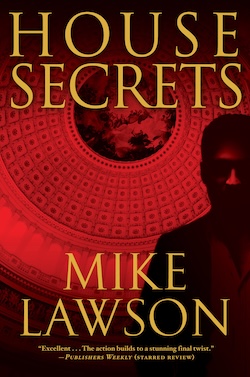
Quick Review: HOUSE SECRETS by Mike Lawson (Atlantic Monthly Press)

Joe DeMarco investigates the death of a reporter

It all begins with a simple request from the Speaker, Joe’s hard-drinking, glad-handing political boss from Boston, John Fitzpatrick Mahoney. One of Mahoney’s old colleagues has doubts about the supposed accidental death of his son, a middling newspaper reporter who had claimed, in the days before his death, that he had an incredibly hot story. But then again, he always said things like that, and nothing ever panned out. Mahoney just wants DeMarco to turn over some rocks around Washington and see what crawls out.

It turns out the reporter was on the trail of Senator Paul Morelli, the handsome and gifted rising star from New York, considered a shoo-in for his party’s presidential nomination. Some politicians are lucky, Morelli just happened to be luckier than most, but his opponents’ scandals and accidents had already been scrutinized and he looks clean. It seems like there’s nothing for DeMarco to do. But then some very dangerous things start to crawl out from under the rocks he’s turned over.

Dirty secrets, beltway politics, and divided loyalties threaten as DeMarco’s investigation spirals dangerously out of control, pulling in freelance operatives, intelligence figures, D.C. locals, a sinister chief of staff, and characters from his past in New York.

In House Secrets, a retired congressman, Richard Finley, has asked Speaker of the House John Mahoney to look into the death of Terry Finley, his son and a reporter who covered politics for the Washington Post. Mahoney sends his ever-reluctant bagman, Joe DeMarco, to investigate; more to do a favour for Finley, as Mahoney (and the cops, coroner, and to begin with DeMarco) believes Terry’s death was an accident. Continue reading

Quick Review: DEAD ON ARRIVAL by Mike Lawson (Harper Collins)

Political Thriller done right!

Joe DeMarco is back and the corridors of power have never felt so deadly…

First a bomb attack on the Baltimore Harbour tunnel is averted. Then a young American Muslim is shot down in a Cessna plane whilst trying to drive it into The Whitehouse.

What follows is chaos as a ruthless senator tries to pass a xenophobic law that will see non-citizen Muslims deported and extensive background checks on all Muslims living in the US carried out immediately.

Speaker of the house John Mahoney wants nothing to do with the bill being pushed through. He knows all to well what trouble a law like that could stir up, and what’s worse he knows the kid who tried to crash the plane into the White House.

Enter Joe DeMarco, a man with a shady past, a lawyer who has never practised law. He’s charged with investigating the attacks but there’s a twist to the attempted mass destruction, something the FBI didn’t even see, and suddenly at every turn DeMarco faces a new and terrifying danger…

Mike Lawson’s debut, The Inside Ring (2006) introduced us to Joe DeMarco, trouble-shooter for the Speaker of the US Congress, Mahoney. Called on to do all the jobs the Speaker doesn’t want publicised, DeMarco works in the dirty underbelly of US politics (not to mention having an office in the basement). In this, the third novel in the series (titled House Rules in North America) The novel is told primarily from the perspective of DeMarco and the Speaker (who’s actually an awesome character, so his increased presence here is definitely welcome), providing insight into both the public and private workings of the US government. Continue reading