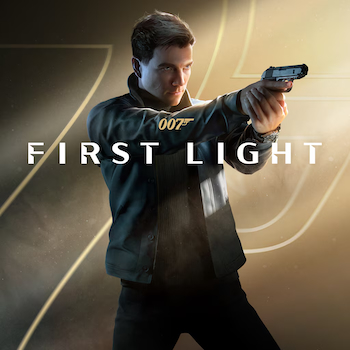
 007: First Light is the most recent video game to star Ian Fleming’s James Bond. As a long-time fan of the James Bond movies, I often wondered what a really good, modern game based on the character would be like. After the trailer and early images from 007: First Light dropped, I thought we’d all finally get our answer. The game quickly became one of the most highly-anticipated of the year; and clearly the game studio had high expectations for it, because it was widely promoted. If you followed any Playstation/video game online outlets or influencers, then you likely saw a lot of commentary about the game before its release, and it was pretty much inescapable. And most of that commentary was very positive. In addition to the strong visuals, the story also looked like a pitch-perfect take on Bond, in the form of (I suppose) a re-boot:
Follow James Bond as a young, resourceful and sometimes reckless recruit in MI6’s training programme.
After a heroic act, young Naval air crewman Bond is offered the opportunity to join the newly revived Double 0 programme.
But when a mission to stop a rogue agent ends in tragedy, he must join forces with his reluctant mentor Greenway to expose a deep conspiracy and stop a looming coup at the heart of the State.
The trailer and early buzz suggested an action-packed gameplay experience. Unfortunately, that is not quite what this game delivers.
007: First Light has a very strong story. Everything about it is quintessentially James Bond. The titular hero is rakish, prone to ignoring orders and going a little bit (and a lot) rogue; and Patrick Gibson’s performance is solid throughout. The game takes players on a globe-trotting journey to a variety of exotic locations and environments; from exclusive luxury hotels and swanky galas, to the bleak wilderness of Iceland and a pirate haven/kingdom in Africa. The supporting cast is varied, well-performed, and all add something interesting to the overall story. Even characters that Bond only fleetingly engages with or encounters are well-drawn and performed (though some of them make rather sudden exits, for various reasons). There are plenty of great little touches sprinkled throughout; in particular, snippets of overheard dialogue, and plenty of nods to the movies. The tech at the centre of the plot is ripped-from-the-headlines, but more exaggerated and futuristic. Of course, Q Branch provides Bond with some great gadgets to work with, as well as a few amusing background moments. (This is a game that does reward lingering in certain environments.) And, finally, there’s also a conspiracy at the heart of power! What more could one want from a James Bond story?
That’s a pretty long list of things to like. So, what’s the problem? It’s the gameplay. First, there’s not nearly as much of it as one might assume there should be. The balance of cut-scenes and cinematics to meaningful gameplay is completely off (especially in the first half of the game), which has probably distorted my sense of how much I actually did in the game. Sure, the cinematic moments are very nice, and do move the story forward — but sometimes it feels like they are the only thing that moves the story forward, and the player has basically no say/agency in that. Also, too often players will find themselves performing perfunctory actions with minimal thrills, just to move between cutscenes. It’s the video game equivalent of empty calories.
I want to avoid spoilers wherever I can, which does make it difficult to explain the level of imbalance. But here’s one instance that I feel is indicative of the problem early on: When confronting our first “mini-boss”, players cannot fight him head one, because apparently Bond is not skilled enough a combatant to take him head-on — you will be killed. So, players are forced to use their gadgets and smarts to take him down. “But that’s what Bond would do, and it’s cool!” you might respond. Well, yes, you’re right. But, after that short bit of gameplay (most solutions are kind of obvious), we are once again thrown into a cutscene in which Bond fights the antagonist and wins. Why wasn’t that something the player could do for themselves? Giving me a tough opponent to grapple with would have made me more invested in the outcome, and also allowed me to play the character.
The fact that the developers of the game thought players would be satisfied by so much of this kind of play feels a bit patronizing. Walking Bond down an alleyway between cut-scenes — no perils, no actions beyond walking, not even any collectibles — is neither engaging nor satisfying, and can barely be described as “playing”. (This happens multiple times.) Driving in a straight line, while Bond has a conversation, with a fellow passenger or on the phone, before another cutscene, is not satisfying gameplay. (This happens more than once.) Throwing in one task or easily-solved “challenge” (e.g., lower a bridge) between cutscenes isn’t particularly fun, and certainly not in a sustained way. It gives the game a frustrating start-stop feel, which definitely diminished my experience and enjoyment.
The training-montage-to-learn-the-controls in Malta was a solid idea, but should have been developed more and better. Alternating between scenes of the double-0 recruits being put through their paces was well-done and well-written, and giving players opportunities within that to learn controls and moves is a great idea. However, we need to use the controls more than once to really get them down. Have us do things a few times, rather than just once or twice. The sheer weight of cutscenes in the first half meant that, by the time the game lets players do more, I was not nearly as used to… well, doing anything meaningful than I should have been so many hours into playing. (It took about 15 hours to complete the main story.)
The mission stories are very good. As noted above, the writers have really got the feel of a Bond story down. (Seriously: all of my issues are with the gameplay, not the writing or overall story. There were only a few moments that felt off, which is perfectly acceptable in a video game.) The first big mission, set at a chess tournament at the ridiculously luxe Carpathian Hotel, was a very good real-world experience for the new 00s; and it’s also when I felt myself becoming more invested in the story/game. The mix of Hitman-like maneuvering through environments — picking up hints, tips, tools, tricking or distracting guards, etc. — to come up with creative solutions is very well done and also fun. Each mission has multiple solutions and approaches. I imagine this might be anxiety-inducing for players who like to get 100% on their games… You can’t really do everything in a single play-through.
This first mission actually really reminded me lot of the Hitman games (I’ve played most of them). IO Interactive also developed that franchise, so that’s perhaps not surprising; and it also probably explains why they were approached to develop this game. But, also like Hitman, the hand-to-hand combat feels clunky, and far less smooth than one should expect from a new, expensively-made game. (This has always been the weakness of the Hitman franchise, in my opinion — it never made sense that the world’s best assassin would be so inept when it came to punching someone or engaging in hand-to-hand combat.) Older and far-less-expensively made games have had smoother, better combat systems and gameplay. That this isn’t very well developed, in a James Bond game, is an odd choice. The use of the environment — throwing bottles, books, mugs, keyboards, etc.; crashing enemies into walls, shelves, furniture, etc. — is very well-done, and does add a fun element to the game.
I’ll concede that some of this frustration may very well be due to my own skills as a gamer. Fine. But there were many times when combat was just clunky. In hindsight, it feels as though they just mapped Hitman’s combat and movement systems onto this game, despite it being quite a different kind of game. It’s a shame, because a fully-formed combat system could have made this so much stronger. Similarly, sometimes general movement was weird; getting Bond to run (or just hustle, in some environments) was not always as smooth as it should have been. This, too, may have been a result of spending so much time not actually in control of what Bond does.
007: First Light had so much potential, and I wanted to love this. Unfortunately, it just doesn’t live up to its potential. The cut-scene-to-gameplay-ratio is completely off. Too often, while “playing” this game, I felt like a passive observer.
I couldn’t help but come away from this game thinking, “Why didn’t they just make this a movie, if they don’t really want me doing anything…?”
At the end of the game, we get a note on screen that Bond will return. I will certainly play a sequel. But I don’t think, at this point, it’ll be a must-play on day one.

