An Interview with M.L. BRENNAN

BrennanML-GV2-IronNight

I don’t read much Urban Fantasy. I don’t really know why. But, last week I read ML Brennan’s Generation V, which I found to be a lot of fun. Naturally, after liking the novel, my first inclination was to send the author some interview questions…

Let’s start with an introduction: Who is ML Brennan?

I’m an avid reader, a writer, and in my day job an adjunct professor. A lot of the time I wish there were many more hours in the day, since all three of those occupations have big time requirements!

I thought we’d start with your fiction: Your latest novel, Generation V, was recently published by Roc Books. How would you introduce the novel to a potential reader? Is it part of a series?

Generation V is the first in a series of books. Right now, I’m contracted for three books, but I’m hopeful that the series will do well, because I have ideas and plans for several more.

The elevator pitch of my book is that Fortitude Scott has a useless degree, a minimum-wage job, a cheating girlfriend, and a roommate who stiffs him on the rent. And he’s a vampire… mostly. But when a little girl is kidnapped, suddenly he’s the only one who is willing to try and do something about it, so he teams up with a wise-cracking shapeshifter and heads off for a rescue mission that will very likely kill him.

This is a book with a very non-typical hero – he isn’t the most powerful character, in fact he’s almost on human levels of weakness when the book begins. In order to beat someone, he has to outsmart them, or make friends and alliances that can help him. There’s no “End of the World” peril – instead, the peril at the heart of the book is one that Fortitude could very easily just ignore and it wouldn’t effect his life at all. His entire family urges him to just look the other way, but he doesn’t, and so it’s his own choices that lead to the life-threatening peril. There’s a lot of banter, a bit of dark humor. But at the core, it’s about a person who is afraid of himself and his heritage, who has to decide between the path of least resistance or something harder.

BrennanML-GenerationV

What inspired you to write the novel? And where do you draw your inspiration from in general?

Inspiration is a tricky thing for me – no one thing inspired me, rather it was a combination of a lot of ideas and topics that I found interesting. Over time I had a lot of scraps of ideas, and they eventually coalesced into the world that Fortitude inhabits.

But I was interested in the idea of family and heritage – Fortitude is a person who has very little in common with his family, and in fact is deathly afraid that he’ll eventually take on the kind of very selfish and harsh worldview that they possess and view as natural. This folds in really well with how I was interested in writing vampires – as dangerous predators, rather than some of their more benign depictions in recent movies. I am also a professor, and one of the things that those of us who teach have really been exposed to in recent years are films, lectures, and books about the idea of an extended adolescence. I also am very personally familiar (through my own experience and those of my friends) with what it can feel like to get a graduate degree and then enter a job market where the only jobs you seem able to find are ones that you could’ve done with a high school diploma. Those things really had a part in how I created Fortitude – he’s twenty-six, underemployed, stuck with a bad roommate and a bad relationship, but his biggest problem is his lack of self-confidence and ownership in his life. Over the course of the book, that starts changing, and it’s a theme that I’m looking forward to exploring in the sequels as well.

How were you introduced to genre fiction?

My brother is older than me by two years, so my first introduction to genre fiction came very much because I was the classic younger sibling: whatever my brother was doing was interesting to me, and whatever he was reading I wanted to read as well. I’m lucky that my brother was fairly tolerant, and he let me borrow all of his books. Thanks to him, I read Ender’s Game, the Death Gate Cycle, Star Trek novels (my favorites were the Peter David ones), and the Thrawn trilogy of Star Wars books. When I was a little older, our tastes and interests diverged, and I headed in the direction of David Eddings, Anne McCaffrey, and Margaret Weis’s Star of the Guardians series.

BrennanML-SFFIntro

How do you enjoy being a writer and working within the publishing industry? Do you have any specific working, writing, researching practices?

Very much. Traditional publishing was always my goal, and I worked very hard to achieve it. I spent almost a decade of very serious writing before I sold a book, and I have to say, starting a project feels different when you know for certain that you will be paid for it, and it is a very, very good feeling.

In terms of writing practices, I’m very much a planner. I don’t start writing a book until I have a very clear direction and an overall outline of the book very solidly hammered out. I know other writers who start writing and figure out that plot as they go, and while I respect their process, I know that I’m just too much of an anal-retentive control-freak to try that myself. Sometimes the outlining can take a few months (and sometimes even longer than writing the book itself takes), but it’s the method that works best for me. I like having already ironed out any timeline or motivation issues before I start working, and having an outline in front of me helps figure out if my plot or characters are somehow out of balance.

When did you realize you wanted to be an author, and what was your first foray into writing? Do you still look back on it fondly?

I’ve always enjoyed reading, and writing is something that I realized very young came pretty easily to me, but I didn’t have much desire to be an author when I was younger. Or, maybe a better way of putting it is that I didn’t want to be solely an author. I grew up in a single-parent household where my mother worked very, very long hours to provide for us, and so I was very leery at the thought of embarking on a career path that didn’t have a solid paycheck and reliability. So, while I did want to write, I always wanted it to be something on the side, with a regular paycheck always there just in case writing wasn’t enough to pay all the bills. I had that plan in mind all through college, in fact, and right up into my first month of law school.

And that first month of law school, unfortunately, is when I realized that I didn’t want the writing to be something that happened on the side – it was what I wanted to do all the time. I wasn’t happy about that realization at the time (as you can imagine, neither was my mother or my spouse), but there it was. I left law school and entered an MFA program, and writing has been the center of my professional life ever since. (In the interests of full disclosure – yes, the pay was every bit as low and unreliable as I’d feared when I was younger.)

What I view as my first serious foray into writing happened when I was an undergraduate in college: a short story that I’d written was published in a literary magazine. I do look back on it very fondly – I had no personal or professional connections to that literary magazine, and I mailed the story to them with just a standard cover letter. My story had already been rejected from easily two dozen other literary magazines, but I kept at it, and I was published. That experience really helped years later when I was trying to get a book published!

What’s your opinion of the genre today, and where do you see your work fitting into it?

I think the genre that I’m working in – urban fantasy – is really exciting. Dip into urban fantasy and you can find everything from hard-bitten, noir-ish police procedurals with monsters, to very sexually-charged paranormal romance. Urban fantasy is a big tent genre, which is why I have so much fun with it.

I think what can potentially be problematic about some urban fantasy is when authors start becoming formulaic in the hopes of getting an audience quickly. I made some decisions in my book that I felt helped make it be what I think urban fantasy should always try to be: something fun and new.

Your novel features vampires. What’s different about your vampires, and why do you think they (and other undead beasties) have been, and continue to be so popular with readers?

I think vampires rest in our cultural consciousness so well because they hit a lot of our buttons. Vampires look human, so they can pass among us unnoticed, and we can’t immediately identify them as a threat. Vampires are traditionally humans who have been changed and converted, so that hits on our fear of treachery, that the person who was an ally, friend, or loved one today might turn on us tomorrow. Vampires feed on human blood – this frightens us because it raises the horror we have of being prey, and of being consumed. Vampires typically have a level of sexualization – this also brings up that fear of not recognizing a threat, and of facing treachery later. I think all of those elements make vampires more popular (and sustain that popularity) over creatures that don’t play on those fears. For example, the Creature From The Black Lagoon: it poses no threat of infiltrating society, it can never betray you since everyone already hates it, while it does have a bit of subliminal sexual horror in that it sure seems to gravitate to pretty women in bathing suits, but it doesn’t seem to possess genitalia, and no one is going to be seduced by it, so no worries there, and finally it doesn’t really seem to eat us – mostly just squeeze us to death, if my memory of the movie is accurate.

So, vampires have a very long-standing appeal. In terms of the vampires in my book, I actually made a lot of changes to the traditional presentation. In the majority of vampire fiction, the vampire is a human who has been transformed into a vampire, and through that transformation process they are now ageless, immortal, and undead. I’ve always found this kind of idea a bit problematic. For one thing, a creature that reproduces just through a tiny blood donation? Talk about a population explosion! For another, a character that never gets older and will never die? That’s a fairly static character with very few outside pressures. I was never interested in writing about an immortal character.

The big change that I made for my vampires is to make them a separate species. These aren’t transformed humans – they have a lifecycle that includes growing up, old age, and ultimately death. They also have a reproductive cycle that is rather finicky and difficult, and it gives a good reason why vampires haven’t just overrun the planet – in fact, my vampires are a species in total crisis, and right on the edge of extinction.

BrennanML-GV2-IronNight

What other projects are you working on, and what do you have currently in the pipeline?

In the pipeline is Generation V’s sequel IRON NIGHT. It’s with the copyeditor right now, and I’m currently working on the third Fortitude Scott book, which has to be finished by the end of the summer, so that’s pretty much filling most of my days.

What are you reading at the moment (fiction, non-fiction)?

I’m a fairly wide reader, so if you asked me that week-to-week the answer would always be changing. Right now, I’m reading non-fiction, Carl Sagan’s The Demon-Haunted World: Science as a Candle in the Dark. It’s good – very challenging, extremely applicable to a lot of what is happening right now, but ultimately very optimistic. This has been on my stack for a while now. I haven’t read any Sagan before, though I did have a general working understanding of him.

SaganC-DemonHauntedWorldMy first encounter with Carl Sagan was actually thanks to The Far Side comics, which my brother and I used to read in the paper every day and puzzle over. There’s one comic that’s supposed to be Carl Sagan as a kid, and it’s two little kids looking up at the night sky, and one says to the other something like, “Look at all those stars, Susie! There must be hundreds and hundreds of them!” Which is funny, if you know about Sagan’s famous comment “billions and billions.” My mother explained that to us, which led to my brother reading one of Sagan’s books on outer space. I remember looking at the pictures but nothing else…

What’s something readers might be surprised to learn about you?

I guess it would depend on what readers’ expectations of me were. One expectation that I’ve actually encountered a few times (primarily, it must be said, from friends of my parents who don’t do much genre reading), is this idea that if I write about vampires, than I must be an active believer in vampires, ghosts, witches, UFOs, and just about everything else, or that I have some kind of obsession with one of those topics. That’s definitely not the case. While I have an interest, it’s similar to the interest I have when I read about mythology. Curiosity and enthusiasm for Norse myths doesn’t mean that I have an altar to Odin in my closet, or that I’ve decorated my house with runes.

What are you most looking forward to in the next twelve months?

Oh, lots of things! I’m going to my first convention as a writer in just a few weeks – ConnectiCon, and I actually will be on two panels, so I’m extremely excited about that. At the end of the summer I’ll be at WorldCon, which should be pretty amazing. And then Iron Night will be published in January, so I’ve got a lot of really great stuff to be looking forward to!

*

Be sure to check out Brennan’s website, Facebook and Twitter for more information about the Generation V series (sometimes called the “American Vampire” series, apparently), and more.

Quick Q&A with SUSAN CHOI

Choi-Header

I’ve been trying to expand the coverage of the blog, into other genres and sub-genres of fiction. To this end, today I bring you a Q&A with author Susan Choi, author of My Education, organised by Penguin USA…

Your previous novels deal with high stakes: the Unabomber, kidnapping, wars overseas, terrorism. Did you find writing My Education, a story that deals with more typical problems of passion, ambition, and love, to be a different experience?

I did, in a good way. For all three of my previous books I did tons of research into Twentieth Century history, and politics, and ideology, and loved immersing myself in abstruse and challenging material, and then after finishing A Person of Interest, I had another baby (my second) and the very thought of research just made me pass out. I realized I wanted to write a book about people being young and falling in love and behaving stupidly, and that I probably didn’t need to do research for that. Now my kids are older and I’m getting sleep again at night and I’m back to doing abstruse research!  But this book was a great change for me.

What was your inspiration for this novel?

Hollinghurst-LineOfBeautyApart from wanting to avoid research, I was actually inspired in a very specific way by a book that I love, Allan Hollinghurst’s novel The Line of Beauty.  I haven’t been more enthralled, and admiring, of a novel in I don’t know how long.  And something about the way that book opens, with Nick in a bookstore thinking about a much older, more powerful man that he knows, and being so full of youthful moxie and naïveté, brought an opening scene, fully realized, into my mind.  That’s happened to me a couple of times, and it’s thrilling:  you know there’s a novel, and that you’ve found the entrance, but you have no idea what it contains.

You currently teach at Princeton University and both My Education and your last novel, A Person of Interest, feature professors as their protagonists, so it’s safe to assume you are well-versed in the culture of academia. How does your experience in the world of academia play out in your fiction?

I think I’m less well-versed in the culture of academia than poorly-versed in anything else. Esoteric worlds are hard to resist in fiction, and academia can be pretty esoteric. If I had more experience with the esoteric world of the CIA operative, or the mafia don, I’d definitely write about that. But, I am a professor’s daughter, and I guess that’s bequeathed a certain compulsion on my part to keep poking around in that region.

Motherhood impacts the relationship between Regina and Martha over the entire course of the novel; in the end, it seems to be one of the primary means through which they absolve the past. How have your own children affected your writing and your perception of the world?

SusanChoiOnly totally. Parenthood has completely rewired me. Things that used to enthrall me now bore me, and things I never used to notice now obsess me, and that’s just one aspect of it. I think a lot, now, about children’s lives. Much of what happens to Regina in this book, to my mind, is that she realizes that children are people.

Being a love story, what kind of tropes of romance were you wary of? What did you hope to bring to the table with this novel?

I always saw this first as a story about being young. It is a love story, but the love story is a vehicle for exploring the youthful innocence, and selfishness, and unsustainable craziness of being a young person in love, and of being a young person in general. I think this novel is my way of coming to terms with my not being particularly young anymore.

For Regina, any contemplation of sexual identity seems to be on the backburner. Did you have any intentional reason for refraining from that sort of discussion?

Identity politics are very popular with Regina’s classmates, but they’re just not a part of her being. I’d be dragging the story into didactic territory, and maybe turning it into one of the dreary, insincere term papers Regina writes, if I had her sitting around contemplating her sexual identity, when everything about this situation is equally unfamiliar to her: Martha isn’t just a woman, she’s married, she’s a mother, she’s much older and more accomplished than Regina. For Regina the entire relationship is singular and unprecedented.  She doesn’t think, “Oh, I’m a lesbian,”  any more than she thinks, “Oh, I’m a home wrecker.”  She’s just insanely in love – a condition that makes it hard for her to do much clear thinking at all.

What are a few of your favorite love triangles (or rather quadrangles, to be most accurate to My Education) in literature, TV, or film?

I think we’re talking about a love square consisting of two equilateral triangles sharing one side. I actually had to draw a picture just now, to figure this out. I can’t think of other examples of this particular geometry although I’m sure there must be some. I do love the triangle, as who doesn’t. Two of my favorite books of all time, The Great Gatsby and The Age of Innocence, feature famous triangles. I also love the sad and quiet triangle at the center of J.L. Carr’s magnificent short novel, A Month in the Country. The ménage, a different arrangement altogether, can be very endearing. I loved April Ludgate and her gay boyfriend and his gay boyfriend, on Parks and Recreation. I was sad when she dumped them, but they certainly deserved it.

Choi-Reading

What do you think of Chaucer and the body of literature Nicholas teaches? Was this of particular interest to you when you were a student, or did you do the research for the sake of this novel?

As of this writing, I know less about Chaucer than Regina did when Nicholas hired her as his teaching assistant. I just wanted a subject matter that felt as far as possible from the groovy poststructuralist stuff that Regina was studying.

Do you have anything else in the works or projects on the horizon?

I am back in the throes of a research obsession, but I don’t know where it will lead me, if anywhere. Once I spent a year researching pirates, and then I wrote American Woman, which takes place completely on land. So I will have to wait and see.

*

My Education is published by Penguin US on July 3rd 2013, and Short Books in the UK on July 4th.

ChoiS-MyEducation

“The 5th Wave” by Rick Yancey (Penguin)

Yancey-5thWaveA Sinister new YA Dystopia Series

After the 1st wave, only darkness remains. After the 2nd, only the lucky escape. And after the 3rd, only the unlucky survive. After the 4th wave, only one rule applies: trust no one.

Now, it’s the dawn of the 5th wave, and on a lonely stretch of highway, Cassie runs from Them. The beings who only look human, who roam the countryside killing anyone they see. Who have scattered Earth’s last survivors. To stay alone is to stay alive, Cassie believes, until she meets Evan Walker. Beguiling and mysterious, Evan Walker may be Cassie’s only hope for rescuing her brother – or even saving herself. But Cassie must choose: between trust and despair, between defiance and surrender, between life and death. To give up or to get up.

There is a lot to like about this novel. The world-building is interesting, the characters are (for the most part) well-defined and well-written. The story is focused, giving it a quick-pace and addictive momentum. I really enjoyed reading this, despite one major niggle around the middle. Certainly, it’s easy to see why people have been talking about the series, and why Penguin think they are on to a winner. Among the better YA dystopia series, certainly.

The opening chapters offer one of the best introductions to a dystopian future I have read in a long while. We get a great sense of the environment in which Cassie, the first protagonist we follow, is operating and trying to survive. We also learn what the waves of alien attacks have done to the survivors, both physically (billions dead) and mentally (this is now paranoia city…).

“If you can’t trust anyone, then you can trust no one. Better to take the chance that Aunty Tilly is one of them than play the odds that you’ve stumbled across a fellow survivor. That’s friggin’ diabolical. It tears us apart. It makes us that much easier to hunt down and eradicate. The 4th Wave forces us into solitude, where there’s no strength in numbers, where we slowly go crazy from the isolation and fear and terrible anticipation of the inevitable… This is what the Others have done to us. You can’t band together to fight without trust. And without trust, there was no hope. How do you rid the Earth of humans? Rid the humans of their humanity.”

And so, survivors “put on a human face so no human face can be trusted. The only answer: Kill everyone or risk being killed by anyone.”

Most importantly, we get to know Cassie very quickly. Within about 5% of the novel (yes, read this on my Kindle), I felt I knew her pretty well, and certainly felt myself rooting for her. She is a bit true-to-type and is probably exactly what you expect from a YA heroine/hero, sure, but Yancey writes her well. She is a good guide, with an engaging, inviting voice. However, and this is my greatest issue with the book, this state of affairs did not last. I found Cassie’s character changed completely once she met Evan. She went from being hyper-self-sufficient to, effectively, totally-dependent (paranoid still, but dependent nonetheless). This weakened her. Though, she’s also not blind to the strangeness of her situation…

“Somehow the fact that I was rescued by a very good-looking guy with a lopsided grin and large, strong hands is the most unnerving thing that has happened to me since the Others arrived.”

Her interest in Evan, while sometimes a bit over-the-top, is also quite well done, reflecting the conflicted, bumbling, hormone-influenced confusion when it comes to people teenagers develop crushes on:

“What?” Smiling that damned lopsided, sexy grin, shoulders up, hands stuffed deep in his pockets with a sort of aw-shucks attitude, which I guess is meant to drive me the good kind of crazy. What is it about him that makes me want to slap him and kiss him, run from him and to him, throw my arms around him and knee him in the balls, all at the same time? I’d like to blame the Arrival for the effect he has on me, but something tells me guys have been doing this to us for a lot longer than a few months.

All of the other protagonists go through pretty realistic evolutions. The army has been collecting surviving teens and children, transporting them to the training facility, leaving adults behind for… clean-up. The militarisation of the young is troubling, certainly, but it is addressed through the eyes of some of those recruits. (A lot of YA novels seem to promote weapons-skills…) Our second main perspective is presented through Ben, who comes to be known as “Zombie” at the training camp. He develops into a more interesting character than Cassie, by the end of the book. All of his comrades are varied characters, and interesting to read about, too – certainly Ringer, who I enjoyed: she’s clearly a little mad, closed off (maybe edging towards sociopathic, actually). Sammy, whose call-sign is “Nugget”, was another good character, so very young and yet thrust into such horrific situations, brutal training, and a grueling environment.

Some of the early chapters with Evan felt a little muddled. As did some attempts to create uncertainty in the reader – there were at least two scenes that felt like attempts to make us question what we knew, when we’d already been doing that, and throwing these in ruined the tension and were obvious, and just a little artless. Minor niggles, I suppose, but they were clear. On the whole, though, Yancey’s prose is tight and well-crafted. It’s nothing spectacular, but he has a clear style, and one that pulls the reader on through the story.

Overall, though, Yancey has created a sinister, atmospheric and gripping alien-invasion-dystopia. The Waves are well-conceived, with the eponymous wave utterly devious.

The 5th Wave is flawed, but it’s gripping and well-executed. I definitely recommend it, and can’t wait for the next book in the series.

Book Trailer: “A Delicate Truth” by John le Carré (Viking)

I’ve never actually read a le Carre novel, much to my shame. I’ve always wanted to, but with an ever-growing TBR pile of ARCs and other novels, short stories, comics, etc., they always seem to get missed. (And they’ve been re-issued a few times, so I don’t have an excuse of them not being prominent…)

I’m hoping to get to this one some time soon. It’s out now. Here’s the synopsis…

A British civil servant is dispatched to Gibraltar where a top secret counter-terror operation (codename: Wildlife) is being mounted. He has been assigned by a Minister of Her Majesty’s Foreign Office to be his eyes and ears on the ground. The mission is so delicate that not even the Minister’s private secretary, Toby Bell, is admitted to the plan. The operation goes off without a hitch. Or does it?

Three years on, Sir Christopher “Kit” Probyn, a former British diplomat, is enjoying his well-earned retirement. Brought face to face with a living ghost from his past, he desperately appeals to Toby for enlightenment. With the surreptitious help of Kit’s daughter Emily, two men a generation apart, both loyal servants of the Crown, will separately discover whether Wildlife was the triumph it was made out to be, or a tragedy ruthlessly suppressed by the Foreign Office to which they owe their allegiance.

leCarre-ADelicateTruth

US / UK Covers

Upcoming: “A Matter Of Blood”, “Mayhem” & More by Sarah Pinborough (Ace/Gollancz/Jo Fletcher)

With a number of exciting releases on both sides of the Pond, it looks like 2013 is going to be a very good year for British author Sarah Pinborough.

Pinborough-FG1-AMatterOfBloodUSFirst up, and already out in the UK for ages (published by Gollancz in 2010), we have the author’s critically-acclaimed A Matter of Blood will now be hitting shelves in the US.

In a world steeped in darkness, a new breed of evil has fallen…

London’s ruined economy has pushed everyone to the breaking point, and even the police rely on bribes and deals with criminals to survive. Detective Inspector Cass Jones struggles to keep integrity in the police force, but now, two gory cases will test his mettle. A gang hit goes wrong, leaving two schoolboys dead, and a serial killer calling himself the Man of Flies leaves a message on his victims saying “nothing is sacred.”

Then Cass’ brother murders his own family before committing suicide. Cass doesn’t believe his gentle brother did it. Yet when evidence emerges suggesting someone killed all three of them, a prime suspect is found – Cass himself.

Common links emerge in all three cases, but while Cass is finding more questions than answers, the Man of Flies continues to kill…

This is the first novel in Pinborough’s Forgotten Gods series (which I shamefully have not yet read). In the UK, the series title was The Dog-Faced Gods. A Matter of Blood is followed by The Shadow of the Soul (August 2013) and The Chosen Seed (December 2013). As a bonus, here are the three UK covers for the series:

Pinborough-DFG-Trilogy

*

Pinborough-MayhemWhile North Americans will be able to finally get their hands on this trilogy in 2013, Brits will also be treated to Sarah’s latest novel, Mayhem (April 25th, published by Jo Fletcher Books)

When a rotting torso is discovered in the vault of New Scotland Yard, it doesn’t take Dr. Thomas Bond, Police Surgeon, long to realise that there is a second killer at work in the city where, only a few days before, Jack the Ripper brutally murdered two women in one night.

Though just as gruesome, this is the hand of a colder killer, one who lacks Jack’s emotion.

And, as more headless and limbless torsos find their way into the Thames, Dr. Bond becomes obsessed with finding the killer. As his investigations lead him into an unholy alliance, he starts to wonder: is it a man who has brought mayhem to the streets of London, or a monster?

This sounds really cool, so I’m going to try to get a review done A.S.A.P.

And finally, Pinborough also has three novellas – Poison (April 18th), Charm (July 18th) and Beauty (October 17th) – coming out this year in the UK, to be published by Gollancz. Here are the complete covers for the three, which have been described as “absolutely superb, fun, mischievous novellas”:

Pinborough-FairyTaleNovellas

Interview with DJANGO WEXLER

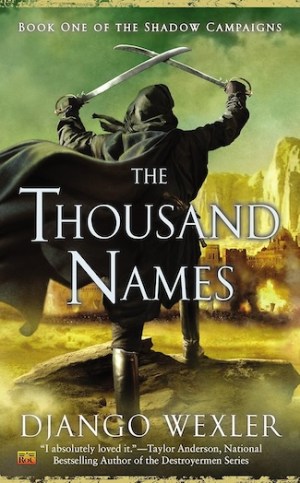
WexlerD-SC1-ThousandNamesUSI’ve been trying to remember how I first came across the name Django Wexler. It was probably via Twitter or a publisher’s catalogue. Since finding out about his next novel, The Thousand Names, I’ve had the chance to chat with Mr Wexler a good deal about fiction and more on the Twitters. With just a couple of months to go before the novel hits shelves (one of my most-anticipated novels of 2013), I thought it would be a perfect time to shoot him some questions. He agreed, so here are his responses…

Let’s start with an introduction: Who is Django Wexler?

That sounds kind of existential. Is the correct answer “I am!”?

Excellent, well done. You’ve passed the first test…

So: I’m Django Wexler, fantasy author. Until fairly recently I was Django Wexler, programmer/writer for Microsoft. I grew up in Westchester, NY and went to school at Carnegie Mellon, in Pittsburgh, where I managed to get degrees in Computer Science and Creative Writing. I moved out to Seattle about five years ago to be where the tech jobs are, which is starting to seem a little ironic now that I no longer work in tech. Continue reading

Upcoming: “Blood Song” by Anthony Ryan (Ace)

RyanA-RS1-BloodSong

Anthony Ryan’s Blood Song was originally self-published, but Penguin snapped it up in 2012. I know a few other reviewers have already read the novel, and general consensus seems to be that it’s one to watch.

An epic fantasy exploring themes of conflict, loyalty and religious faith.

We have fought battles that left more than a hundred corpses on the ground and not a word of it has ever been set down. The Order fights, but often it fights in shadow, without glory or reward. We have no banners.

Vaelin Al Sorna’s life changes forever the day his father abandons him at the gates of the Sixth Order, a secretive military arm of the Faith. Together with his fellow initiates, Vaelin undertakes a brutal training regime – where the price of failure is often death. Under the tutelage of the Order’s masters, he learns how to forge a blade, survive the wilds and kill a man quickly and quietly.

Now his new skills will be put to the test. War is coming. Vaelin is the Sixth Order’s deadliest weapon and the Realm’s only hope. He must draw upon the very essence of his strength and cunning if he is to survive the coming conflict. Yet as the world teeters on the edge of chaos, Vaelin will learn that the truth can cut deeper than any sword.

Blood Song, the first book in Ryan’s Raven’s Shadow series, will be published by Ace Books in July 2013 in the US.

UPDATE: Rather quietly, it was announced that Orbit has bought publishing rights for the UK. The novel will be released as an eBook in April, and a Hardcover later in July. The UK artwork has been added to the top of the post, on the right.