Upcoming: COVENANT’S END by Ari Marmell (Pyr)

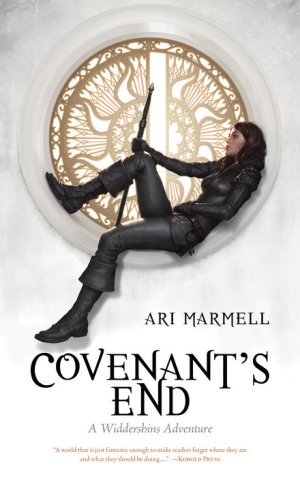
MarmellA-C4-CovenantsEndI’m a big fan of Ari Marmell’s writing. Covenant’s End is the fourth volume in the author’s YA fantasy series, Widdershins Adventures. I’ve only read the first two, but I really enjoyed them both (I haven’t managed to get around to Lost Covenant, yet). Here is the synopsis…

The thief Widdershins and her own “personal god,” Olgun, return to their home city of Davillon after almost a year away. While Shins expects only to face the difficulty of making up with her friends, what she actually finds is far, far worse. Her nemesis, Lisette, has returned, and she is not alone. Lisette has made a dark pact with supernatural powers that have granted her abilities far greater than anything Widdershins and Olgun can match.

Together, Widdershins and Olgun will face enemies on both sides of the law, for Lisette’s schemes have given her power in both Davillon’s government and its underworld. For even a slim chance, Shins must call on both old friends-some of whom haven’t yet forgiven her-and new allies.

Even with their help, Widdershins may be required to make the hardest sacrifice of her life, if she is to rid Davillon-and herself-of Lisette once and for all.

Covenant’s End is due to be published by Pyr Books in February 2015. So, that’s rather a long way away (damnit!), but it’s nice to be able to share the artwork.

Marmell’s latest novel is Hot Lead, Cold Iron – the first in his Mick Oberon urban fantasy series set in 1930s Chicago – published by Titan Books in the US (out now) and UK (out next week).

Also on CR: Interview with Ari Marmell, Guest Post (Triumph Over Tragedy), Reviews of The Thief’s Covenant, False Covenant, The Conqueror’s Shadow

Marmell-Widdershins1to3

International Giveaway: THE BARROW by Mark Smylie (Pyr)

SmylieM-TheBarrowToday, Pyr Books are offering two copies of Mark Smylie’s THE BARROW, with no geographical limitations at all! The novel has been racking up some impressive reviews since its release. In case you aren’t aware of the novel, however, here’s the synopsis…

Action, horror, politics, and sensuality combine in this stand-alone fantasy novel with series potential. Set in the world of the Eisner-nominated Artesia comic books.

To find the Sword, unearth the Barrow. To unearth the Barrow, follow the Map.

When a small crew of scoundrels, would-be heroes, deviants, and ruffians discover a map that they believe will lead them to a fabled sword buried in the barrow of a long-dead wizard, they think they’ve struck it rich. But their hopes are dashed when the map turns out to be cursed and then is destroyed in a magical ritual. The loss of the map leaves them dreaming of what might have been, until they rediscover the map in a most unusual and unexpected place.

Stjepan Black-Heart, suspected murderer and renegade royal cartographer; Erim, a young woman masquerading as a man; Gilgwyr, brothel owner extraordinaire; Leigh, an exiled magus under an ignominious cloud; Godewyn Red-Hand, mercenary and troublemaker; Arduin Orwain, scion of a noble family brought low by scandal; and Arduin’s sister Annwyn, the beautiful cause of that scandal: together they form a cross-section of the Middle Kingdoms of the Known World, brought together by accident and dark design, on a quest that will either get them all in the history books, or get them all killed.

I’m going to keep this simple – the first two people to leave a comment saying they’d like a copy of the book, get the books. Simples. I’ll keep checking back, so if you enter, please be sure to send me your details.

Also on CR: Interview with Mark Smylie

An Interview with STEPHEN HUNT

HuntStephen-AuthorPicLet’s start with an introduction: Who is Stephen Hunt?

Him? He’s me, he is! Professionally, I was usually found knocking around the publishing world (albeit with side-ventures into pharmaceuticals, banking and the computing industry at Apple). I set up one of the first websites for a magazine, Nature.com, back when nobody apart from scientists knew what the Web was. I worked for the Financial Times as an editor and publisher and ran a swathe of their online operations for a while. Now, I guess I’m just the geek with seven genre novels behind him.

Your next novel, In Dark Service, is due to be published by Gollancz in May 2014. It’s the first in a new series, no? How would you introduce the series to new readers?

The new series is called The Far-Called Sequence. The first novel, In Dark Service, has at its heart the tale of two families – the Carnehans and Landors – stuck in the nub-end of a backward, rural kingdom. Slavers attack the town they live in and carry away all the youngsters to sell. The town mounts a rescue expedition, hampered by the fact that the world, Pellas, is an amazingly large one, and their lost people could be anywhere in it. Those taken have to survive as slaves in a hellish environment. Those in the rescue expedition face their own kind of hell as they struggle to track down their missing loved ones.

HuntS-FCS1-InDarkServiceUK

What inspired you to write the series? And where do you draw your inspiration from in general?

I often take a comic-book series called the Trigan Empire (which I grew up with) as my starting point for inspiration. It has gorgeous illustrations – each panel like an oil painting in its own right – by Don Lawrence, and stories by Mike Butterworth. Every issue they would go off to some distant, exotic land, and the characters would have marvellous adventures that blew my young impressionable mind. If I can achieve even half of that feeling for my readers with the new Far-Called series, then it’s ‘job done’ as far as I’m concerned.

How does this novel (in terms of story and approach) differ from your previous series, The Jackelian Novels?

The main difference between the Jackelian series and the Far-Called sequence is that the Jackelian books were structured in a similar way to Sir Terry’s Discworld novels – all set in the same world, but each novel’s plot standing alone on its own, with a motley crew of characters who would dip in an out of the books. The Far-Called sequence is closer to Lord of the Rings or Game of Thrones – you’ll need to start with the first book, and move on through the books sequentially to get the most from it. Same characters and a single, coherent plot arc.

HuntS-JackelianSeries

How were you introduced to reading and genre fiction?

My father is a massive fantasy and science fiction reader, so I was very lucky in that I grew up with a library filled with all the post-war pulps and genre classics. Arthur C. Clarke, Clifford D. Simak, Heinlein, Isaac Asimov, E.E. Doc Smith, Fritz Leiber, Jack Williamson, Robert E. Howard, Tolkien, Harry Harrison. You name it, we had it, and I read it!

How do you enjoy being a writer and working within the publishing industry?

It’s better than working for a living!

What’s it like, being a professional author? Is it what you expected? Do you have any specific working, writing, researching practices?

Because I had twenty years of service in white collar open plan offices, I find I can write best somewhere like a museum or a coffee shop, where there are other people and a bit of a buzz to surround me as I write. The lack of human contact and interaction is the thing that gets to me the most, compared to my previous career(s). Of course, you have social networking, which you can kid yourself doubles as your ‘marketing’ – but the world of online distraction is a bit too disruptive to the task of writing a novel, so I try and resist being over-attached to the web, either by phone or laptop.

When did you realize you wanted to be an author, and what was your first foray into writing? Do you still look back on it fondly?

I actually started writing fiction in university, encouraged by actually being published in print in various eighties game magazines – computer and RPG, mainly. I thought: “Well, if they’ll pay for my articles, why not my fiction?” No training or academic background in the field. I just went out and did it.

What’s your opinion of the genre today, and where do you see your work fitting into it?

It’s interesting times, with the many changes brought about by online book-selling, the failing real-world retail, and the advent of e-books. As far as the genre goes, I’d be happy if my work’s just slotted into whatever corner is labelled, “Fantasy – not many Elves, Halflings or Dragons.”

What are you reading at the moment (fiction, non-fiction)?

I always have about ten books on the go at any one point. I’ve just finished How to Fail at Almost Everything and Still Win Big: Kind of the Story of My Life by Scott Adams, which was very amusing. I’ve nearly finished One Summer: America 1927 by Bill Bryson, and The Black Dahlia by James Ellroy, not to mention the thought-provoking Who Owns The Future? by Jaron Lanier.

HuntStephen-Reading

What’s something readers might be surprised to learn about you?

That I’m a failed comic-book illustrator who once studied part-time at Saint Martins but dropped out when I changed employer, and the new bunch wouldn’t allow me the time off to continue my studies.

What are you most looking forward to in the next twelve months?

Why, starting the next novel of course!

***

In Dark Service is published on May 15th 2014, by Gollancz. It is included as part of the Gollancz 2014 Debuts eBook promotion, and will be available for just £1.99 from now until the end of the first week of publication.

For more on Stephen Hunt’s writing, be sure to follow him on Twitter and check out his review website, SF Crowsnest.

Upcoming: THE BULLET-CATCHER’S DAUGHTER by Rod Duncan (Angry Robot Books)

PrintStumbled across this while looking for information and links for an upcoming interview on the blog. The cover caught my eye and the novel sounds pretty interesting, too. It is the first (of two) novels in the Fall of the Gaslit Empire series. Here’s the synopsis…

Elizabeth Barnabus lives a double life – as herself and as her brother, the private detective. She is trying to solve the mystery of a disappearing aristocrat and a hoard of arcane machines. In her way stand the rogues, freaks and self-proclaimed alchemists of a travelling circus.

But when she comes up against an agent of the all-powerful Patent Office, her life and the course of history will begin to change. And not necessarily for the better…

The Bullet-Catcher’s Daughter is due to be published by Angry Robot Books in September 2014, in the UK and US. Be sure to check out the author’s website and Twitter for more on his writing and novels.

“Half a King” by Joe Abercrombie (Del Rey / Voyager UK)

AbercrombieJ-HalfAKingStart of a new (YA) trilogy by the author of the First Law

“I swore an oath to avenge the death of my father. I may be half a man, but I swore a whole oath.”

Prince Yarvi has vowed to regain a throne he never wanted. But first he must survive cruelty, chains, and the bitter waters of the Shattered Sea. And he must do it all with only one good hand.

The deceived will become the deceiver.

Born a weakling in the eyes of his father, Yarvi is alone in a world where a strong arm and a cold heart rule. He cannot grip a shield or swing an axe, so he must sharpen his mind to a deadly edge.

The betrayed will become the betrayer.

Gathering a strange fellowship of the outcast and the lost, he finds they can do more to help him become the man he needs to be than any court of nobles could.

Will the usurped become the usurper?

But even with loyal friends at his side, Yarvi finds his path may end as it began – in twists, and traps, and tragedy.

I’ve only recently come to read Abercrombie’s novels, finally enjoying The First Law trilogy last year. What became quickly apparent with those novels is that Abercrombie can write. Not just in terms of plotting, but his prose, too, is superb. With Half A King, he has taken his first foray into the YA market, and everything we loved about his previous work is true here, too. This was a very enjoyable read, and I can’t wait for books two and three.

This novel is a pretty quick read. I blitzed through it in just two glorious days of fantasy entertainment. This is both a very good thing, and also brought to mind the one weakness (in my opinion) of the novel. Firstly, the pace never lets up, which means Yarvi’s journey and ordeal draws the reader inexorably on towards the excellent, unexpected denouement. The characters he meets along the way are varied, very well-drawn, and diverse. They all add to the story – none of them felt like props. They felt real – from the melodramatic captain of a slave ship; to Nothing, the mysterious deck-scrubber of said ship, with quite the secret… Yarvi’s handicap is handled delicately and naturally – that he must rely on his wits, as opposed to brawn, was a nice alternative to much fantasy today.

The society into which he is born is warlike and Viking-esque (it’s not fully explained or described, which I liked, as it leaves more for future novels), and he is naturally a disappointment to his father. His mother, a pioneering businesswoman, appears cold and somewhat indifferent to him, equally disappointed by his deformity and how it prohibits him from fulfilling the kingly promise of his father and ancestors. Over the course of his unwilling travels, he gathers a motley crew of companions, all of whom develop a loyalty to him and, somewhat inexplicably, agree to help him fulfill his oath for revenge.

Abercrombie-H1-HalfAKingUKSo how can any of this be a weakness? Well, after reading the novel, you realise that an awful lot happens to Yarvi and Co., in what is actually a pretty short timeframe. Generally speaking, there’s nothing wrong with this – just because it’s fantasy doesn’t mean it has to be drawn out for hundreds-upon-hundreds of pages, after all. It’s just that, this novel could be described as “A Serious of Unfortunate-Yet-Fortuitous Events”. A couple of developments felt a little too serendipitous. But still fun. If it had been just a bit longer, with a timeframe that lasted just a bit longer still, then I think this would have been a near-perfect fantasy adventure/revenge story.

Nevertheless, and despite this minor niggle, the novel is filled with great moments, scenes, encounters, and conversations. The characters, pacing, prose, and story are all engaging and addictive. The action scenes are well-composed and don’t dominate or bury the story. The first and last chapters have a nice symmetry, too – and, indeed, that was one of the best final chapters I’ve read in a while. Abercrombie avoids info-dumps and overt telling, and allows the story to fill out our picture of the world as it unfurls.

Overall, great storytelling for all fans of fantasy. I can’t wait for the next in the series, Half a World.

US/Canada Giveaway: SWORN IN STEEL by Doug Hulick (Ace)

Hulick-SwornInSteelUSOne of the most-anticipated follow-up fantasy novels of the year, Ace Books has provided three copies of Doug Hulick’s SWORN IN STEEL! All you have to do to enter the competition is leave a comment or email me (at the address at the bottom of the page), and I’ll randomly select three winners on Friday evening. Competition is open to US and Canadian residents only, I’m afraid.

In case you haven’t heard of the series (shame on you!), here is the synopsis for Sworn in Steel

It’s been three months since Drothe killed a legend, burned down a portion of the imperial capital, and unexpectedly elevated himself into the ranks of the criminal elite.

Now, as the newest Gray Prince in the underworld, he’s learning just how good he used to have it. With barely the beginnings of an organization to his name, Drothe is already being called out by other Gray Princes. And to make matters worse, when one dies, all signs point to Drothe as wielding the knife. As members of the Kin begin choosing sides – mostly against him – for what looks to be another impending war, Drothe is approached by a man who not only has the solution to Drothe’s most pressing problem, but an offer of redemption.

The only problem is the offer isn’t for him. Now Drothe finds himself on the way to the Despotate of Djan, the empire’s long-standing enemy, with an offer to make and a price on his head. And the grains of sand in the hour glass are running out, fast…

Both Among Thieves and Sworn in Steel are out now in the US, published by Ace Books (Penguin). The novels are published in the UK by Tor, and Sworn in Steel is out tomorrow! Among Thieves was published in 2011. You can find my review here, and an interview with the author here.

Cover Art: THE RITHMATIST by Brandon Sanderson (Tor UK)

Today, Tor UK unveiled this frankly gorgeous cover. It’s for the UK paperback edition of Brandon Sanderson’s YA fantasy, THE RITHMATIST. It’s an interesting take on, while still in keeping with, the overall aesthetic that Gollancz pioneered for Sanderson’s adult fantasy novels. And I think it may actually be my favourite of his UK covers…

Sanderson-TheRithmatist2014-TorUK

In case you haven’t been aware of this novel, here’s the synopsis:

In a school for the magically gifted, your talent could cost you your life…

Young student Joel is fascinated by the magic of Rithmatics, but few have the gift and he is not one of them. Undaunted, Joel persuades Professor Fitch to teach him about this geometric magic. For although Joel can’t infuse his protective lines and circles with power, or bring his chalk-drawn creatures to life, he can really understand how it works. However, a daunting test lies ahead, when someone starts kidnapping top Rithmatic students at his school, Armedius Academy.

Since he’s not a magic user, Joel appears to be safe and he’s desperate to investigate and prove himself. Then people start dying – but can Joel really stop a killer alone? He’ll need the help of Rithmatist apprentice Melody, as even more students disappear. Together, they must race to find clues before the killer notices them – and takes them out too.

The book features illustrations by Ben McSweeney, which depict the magical elements of the novel with great elegance and insight.

The Rithmatist will be available from May 22nd.

A Quick Comment on the Gemmell Award Shortlists, and One of the Nominees. Sort of…

This post is a bit of a break from the norm for me. I’m also not really sure what it’s meant to do. It’s a bit waffley, for which I apologise only slightly, and in not entirely a heartfelt manner. Fiction awards mean very little to me, being neither author, editor, publisher, nor agent. (At least, not yet…) This means I have never (to my recollection) written a post of any worth/note about shortlists or winners.

Brett-DaylightWarUKAward lists tend to pass me by without comment or thought. Invariably, this is because there aren’t any books featured that I’ve read – or, if there is, it is one that didn’t leave much of an impression one way or another. This year has been a bit different, however. For example, Kameron Hurley’s God’s War has been cropping up on a few shortlists, and it’s a book I rather enjoyed. So that made a nice change.

The shortlists for the Gemmell Awards were announced today at Eastercon. In a real break from the norm, the shortlist for the Legend Award (best fantasy) features not only five authors I have read, but also a book I feel particularly strongly about. So I thought I’d write a quick blog post about it. The book in question is Peter V. Brett’s The Daylight War, the third in his Demon Cycle series.

[Before I continue, let me just state that my focus on this book is not an indictment of the other authors nominated for the award. I just feel particularly strongly about this one. The other Legend nominees – Mark Lawrence, Scott Lynch, Adrian Tchaikovsky, and Brandon Sanderson – are great authors, too, whose works I have enjoyed very much. I just haven’t read their nominated novels.]

I’ve been experiencing a phase of fantasy disenchantment, lately. In fact, looking back over the past year or so, I’ve read far less (epic) fantasy than I would have expected. I have picked up and discarded more fantasy novels than I usually do, too. I just can’t get into anything, nor can I rustle up the enthusiasm to sit through hefty tomes.

Brett-DaylightWarUSThere is one clear exception to that, though, and that’s Brett’s series. Every time I think about reading a fantasy novel, I find myself wistfully wishing that the next novel in the Demon Cycle was already available. This is because there are very few authors who do it better. That’s not to say other fantasists writing today aren’t good, or are lacking in talent – far from it. But, really, I think the only epic fantasy series I would happily drop everything to read the next book in, is the Demon Cycle. Everything about the novels just works for me – the story, prose, characters… everything. I don’t think, across the three novels published so far, I’ve come across anything that gave me pause. I read the first, The Painted Man, in three sittings – the final sitting a 300-page marathon, which I finished at 4am. I read the second and third novels back-to-back (something I rarely do), eschewing everything else – true, I was unemployed at the time, and had little else to do; but nevertheless, all I wanted to do was read the books.

I haven’t experienced that level of Reading Insistence since I read Scott Lynch’s The Lies of Locke Lamora – the book that got me back into reading fantasy in the first place (as I think I’ve mentioned ad infinitum on the blog). In the case of Lynch’s series, I went straight out and bought Red Seas Under Red Skies when I was only two-thirds of the way through the first book – I even didn’t mind that it was the (frankly ghastly) shiny red-covered edition. Since then, and given the understandable delay before the third book came out, I have been almost afraid to go back and re-read the series to catch up.

Oh actually, that’s not entirely true – I was also incredibly impatient about getting hold of Brent Weeks’s Night Angel Trilogy. I must have pestered the Orbit publicist to the point of irritation, requesting the final two books… I was also really late to Abercrombie’s First Law trilogy, and I do consider Before They Are Hanged to be one of my favourite novels.

Regardless, the point I’m trying to make is that very few epic fantasy novels have really grabbed hold of my imagination and attention. And, I think, none more so than Brett’s Demon Cycle.

So, to bring this ramble back around to the topic at hand, I really hope The Daylight War wins the Legend Award.

***

The David Gemmell Awards ceremony will take place at London’s Magic Circle on June 13th, 2014.

***

Peter V. Brett’s The Daylight War is published in the UK by Voyager, and in the US by Del Rey. The first two volumes in the series – The Painted Man (UK)/The Warded Man (US) and The Desert Spear are published by the same publishers. Two novellas have also been collected into a single volume: The Great Bazaar and Brayan’s Gold. If you haven’t read them yet, and have any interest in fantasy, then I could not recommend them enough. You won’t regret reading them, I’m sure.

My reviews of the books: The Painted Man, The Desert Spear, The Daylight War and The Great Bazaar and Brayan’s Gold.

***

Regarding the Other Shortlists…

For the Morning Star category (best debut), I really enjoyed Brian McClellan’s Promise of Blood – it is also the only novel on the shortlist I’ve read.

In the Ravenheart category (best artwork), I actually like them all, and quite a lot. But I don’t understand why any of the covers for Elizabeth Bear’s Eternal Sky fantasy trilogy didn’t make it onto the final list… (I haven’t read any of the novels, but I want to, and those covers are frankly stunning.)

Interview with MARK SMYLIE

SmylieM-AuthorPicLet’s start with an introduction: Who is Mark Smylie?

Let’s see. I was born in Florida; my mother was Japanese, she had come to the States to study piano at Julliard, and my father is a Presbyterian minister who worked for the Church’s national body as their liaison to the United Nations (now long retired). I grew up in New Jersey and have lived there on and off for most of my adult life (with stints in New York and California). I’ve worked mostly in comics publishing, both as a writer/artist and as a publisher (I founded a company called Archaia that is now an imprint at BOOM! Studios).

Your debut novel, The Barrow, was published by Pyr Books last month in the US and this week in the UK. How would you introduce the novel to a new reader? Is it the first in a series?

The novel was written as a stand-alone but Pyr has agreed to publish two sequels so, yes, for better or for worse I’m afraid it’s yet another fantasy trilogy. The novel is part epic fantasy, part horror story, and I guess what could be termed part undercover detective story. At first glance it’s about a group of criminals and adventurers of few if any scruples that are following a map to find a fabled lost sword, but nothing is quite as it seems.

SmylieM-TheBarrow

The novel is, I believe, adapted from a comic series. What inspired you to write the novel, and what was it like adapting the world for fiction?

It might be more accurate to say that the novel is spun off from a comics series I (used to) write and draw, an epic military fantasy story called Artesia, but it’s actually an adaptation (and expansion) of a screenplay begun back in 2004 or so. I wrote the initial screenplay with my brother, John Smylie, and a friend of ours, Hidetoshi Oneda, who was a commercial director that worked mostly in Japan. We were working on the idea of creating a low-budget prequel to the comics series (which given its military content is something that would be very costly to try filming as is). The story was initially intended as a kind of metaphor for the search for weapons of mass destruction, as we were starting to get deep into the messy aftermath of the invasion of Iraq at the time. My brother and I had always talked about the idea of turning it into a novel at some point. In many ways the novel as a medium is much better suited for fantasy writing; you get more of a chance to fill in background and flesh out a world, I think, than you do in comics, where the format of panels and word balloons is much more restrictive.

Where do you draw your inspiration from in general?

LockStock&2SmokingBarrelsAll over the place. The setting is inspired by Greek, Roman, and Celtic mythology, late medieval and early Renaissance Europe, Marija Gimbutas’ writings on proto-European Goddess culture, Carlo Ginzurg’s work on shamanism and medieval witchcraft; there are bits and pieces of the poststructuralist analysis of mythology from writers like Vernant and Detienne, classic Joseph Campbell monomyth hero quests, years of roleplaying games and other fantasy novels. The underground scene of the main city in the story is modeled after some years spent living in New York City in the late ’80s and early ’90s when the city still felt a little dangerous, so there’s a kind of postpunk, transgender vibe going on as well which might seem odd for a fantasy setting to some readers (and the film script was originally conceived as Dungeons & Dragons meets Lock Stock & Two Smoking Barrels or The Usual Suspects). Horror films, military history, costume, cooking and cuisine; it all kind of gets thrown in a blender.

How were you introduced to reading and genre fiction?

My father used to read my brother and I stories when we were little kids; he read us the Chronicles of Narnia, and he was reading us Tolkien when my father realized we were finishing the pages faster than he was reading them aloud. So my brother and I went on to finish the Lord of the Rings on our own. I’ll read other genres and general fiction, but fantasy literature is where I come back again and again.

SmylieM-IntroToFantasy

How do you enjoy being a writer and working within the publishing industry?

I feel very, very lucky. I mean, it’s a difficult industry to work in with the rewards few and far between, but I’ve been very fortunate to do something that I love and to publish the works of a lot of writers and artists that I admire.

Do you have any specific working, writing, researching practices?

I’ve got a pretty large research library, it’s a reasonably specialized one built over 20+ years of book collecting, so a lot of the time I sort of wander over to my bookshelves with an idea in the back of my head – a remembered illustration, or a chart, or a line of text – and start flipping through pages. I’ll make notes to myself about something that I want to include in the story – a myth, a kind of pastry, a piece of costume – and use those notes to build the details of the world. I think a fantasy setting needs to feel real, like you can smell it, taste it. Though nowadays a lot of readers don’t seem to have much time for exposition; they just want to read dialogue, as though we’re now a nation of script readers. I try to have an outline that I’m constantly reworking as I write, so that I know how what I’m writing is going to tie into where I want to wind up. And then I reread and rewrite.

When did you realize you wanted to be an author, and what was your first foray into writing? Do you still look back on it fondly?

I don’t think I ever made a conscious decision to be an author. I took art classes in high school, drew comics, played a lot of roleplaying games; I took a creative writing class in college and found it kind of tough going, in part because I was always a genre guy and back then genre wasn’t something you were supposed to aspire to. I tried my first “official” comic book soon after college but couldn’t find a publisher for it; it wouldn’t be until my comic book Artesia came out, when I was thirty, that I would have my first published work as a writer/artist.

Artesia-01B

What’s your opinion of the genre today, and where do you see your work fitting into it?

We’re definitely living in a kind of geek Golden Age – whether it’s television, comics, film, novels, there’s an enormous variety in terms of the kind of material that’s out there and so much of it is being produced at a very high level of quality. I think that also makes it very competitive for those of us that are tying to get our work out in this kind of marketplace right now, which can be kind of tough. I’m not sure where my own work falls into it all; Artesia was sort of a pagan Joan of Arc military fantasy story, but The Barrow is more horror-oriented, very much grimdark, I suppose, though I didn’t discover that term until a few months ago.

What other projects are you working on, and what do you have currently in the pipeline?

Well, in terms of my personal work I’m currently working on the sequel to The Barrow, called Black Heart, along with a board game set in the world of the book and the comics, with an eye towards doing a second edition of an Artesia roleplaying game that I put out back in 2005. I’m still at Archaia as my day job, transitioning over to hopefully starting a games line for the company soon.

What are you reading at the moment (fiction, non-fiction)?

SmylieM-ReadingFiction

For fiction I’m juggling Steven Erikson’s Gardens of the Moon (I’d never read Erikson before but several reviewers have compared my work to his so I figured I’d better get familiar with it), Scott Lynch’s Republic of Thieves, and Kate Elliott’s Cold Magic. For non-fiction research I’ve been glancing through City of Sin, a history of the underbelly of London by Catharine Arnold, and Israel’s Beneficent Dead: Ancestor Cult and Necromancy in Ancient Israelite Religion and Tradition by Brian Schmidt.

SmylieM-ReadingNonFiction

What’s something readers might be surprised to learn about you?

Given the sex and violence in the book I suspect some readers might be surprised to learn that I have a daily yoga practice (hatha raja vinyasa mixed with ashtanga). Or that I have a lot of cats (not on purpose).

What are you most looking forward to in the next twelve months?

World peace and a cure for cancer?
Hinterkind, Vol.1 – “The Waking World” (Vertigo)

Hinterkind-01-ArtWriter: Ian Edginton | Artist: Francesco Trifogli

In a post-apocalyptic world where humans have been pushed to the edge of extinction by the creatures of fantasy and fables, THE HINTERKIND tells the story of one young woman’s quest to fulfill her destiny and put the world right again.

Fifty-seven years after an unspecified biological event has all but wiped out the human race, a green hand has moved over the face of the Earth. Leaf, root and shoot have steadfastly smothered the works of man, remorselessly grinding the concrete, glass and steel back into the minerals from whence they came. Mother Nature is reclaiming what’s rightfully hers but she’s not the only one…

The Hinterkind have returned. They come from hiding places in the lost corners of the world: Centaurs, Satyrs, Elves, Dwarves, Ogres, Trolls, Werewolves, Vampires…

They’re also known as “the Hidden,” “the Twilight People,” the “walkers-in-shadow,” collective names for the menagerie that mankind has hung its tales of myth and magic upon – but these aren’t fairy tale creatures. They are flesh, blood and passion, and they have a long simmering hatred of humanity.

They are a divergent species. Exotic evolutionary try-outs that couldn’t compete with the rapacious ape. Hunted to near extinction through fear and ignorance, they fled to the great forests and deserts, losing themselves in the shrinking wilderness of an ever-expanding world.

Now the wilderness is the world and mankind is in the minority.

Collects: HINTERKIND #1-6

This is a strange, promising, and yet somewhat flawed start to a new series.

The first issue presents a fantastic post-apocalyptic world – one in which human society has been near-destroyed, global populations brought to the brink of extinction. Our protagonists are based in Central Park, New York, and have built a working community: foraging for leftover items in the over-grown city around them, hunting the wildlife. It’s a stunning start, actually, and I was immediately drawn to the setting. The characters and writing were strong, and they were well-realised by the artwork.

Hinterkind-01-Interior6

Then things started to get a bit weird, and this is where (for me) the series stumbled: it became very busy, and the story grew expansive so quickly, that the mash-up of genres started to feel like it was trying too hard. I hesitated for a bit, deciding on how much detail this review should go in to, but I think it’s worth pointing some things out: there are army survivors similar to Buffy’s Initiative (only, weirder), the sidhe and other fairytale creatures have proliferated across the world, and the post-apocalyptic environment can cause mutations. All of this is revealed over this one book. I feel it may have been better to unveil the overall world more gradually, teasing us with possibilities, rather than dumping them all on in very quick succession.

Nevertheless, there’s a lot to enjoy in this book. The artwork is eye-catching; the writing is well-composed; and the characters are pretty interesting. I’m certainly looking forward to reading volume two, when it’s available.

Not the best start to a new Vertigo series, but still better than a lot of other publishers’ new books.

Hinterkind-Vol.1-Contents

Original Issue Covers #1-6, by Greg Tocchini