Interview with JAY POSEY

PoseyJ-AuthorPicLet’s start with an introduction: Who is Jay Posey?

I’m pretty much a professional typist. Sometimes I like to tell people I work with my hands, which I guess is technically true. I’m author of the Legends of the Duskwalker series from Angry Robot Books, and I’m also a Senior Narrative Designer at Ubisoft/Red Storm Entertainment. I’ve spent almost a decade contributing to Tom Clancy’s award-winning Ghost Recon franchise as a writer and game designer.

Your next novel, Morningside Fall, is due to be published by Angry Robot Books in April 2014. It is the sequel to Three. How would you introduce the series to a new reader, and what can fans of the first book expect here?

The Legends of the Duskwalker series is a mid-future post-apocalyptic sci-fi with cyberpunk elements and heavy Western influence. The first book, Three, tells the story of a lone gunslinger who reluctantly agrees to escort a woman and her young son across an urban wasteland to a distant oasis in hopes of finding the boy’s father.

Morningside Fall picks up about a year or so after the events of Three, and continues the story of two of the first book’s main characters. Fans of the first book will get to see more of what the world looks like from inside one of the few remaining great cities, several new characters, lots of action and suspense, a few big surprises, and more about who and what the Awakened are.

Posey-LotD1-Three

What inspired you to write the series? And where do you draw your inspiration from in general?

I’d had the basic idea of the story for Three for a while and had just never found quite the right setting for it. There were lots of elements I thought were cool and might be interesting to explore, but every time I started investigating one path, I kind of started to miss the other things I’d chosen to leave out. At some point I realized “Hey, I can do what I want if I just build a world where all these things can coexist.” Three, for me, was a small story in a big world. For that novel I was primarily interested in developing the relationship between the three main characters, and exploring ideas on heroism, sacrifice, and fatherhood. But the world I created let me play around with a lot of different ideas about technology and humanity.

I think my inspiration typically comes from a combination of my natural curiosity and my tendency to think a lot about human nature and why we do the things we do. I just like learning about things, so I read about a lot of different subjects, and then I can’t help but wonder what things mean for people in general. I ask a lot of what if questions, and that usually leads me into interesting places. Sometimes scary places.

PoseyJ-2-MorningsideFall2014

How were you introduced to reading and genre fiction?

Like a lot of writers, I grew up in a family of readers, and given my interest in science and my tendency to daydream a lot, I was just sort of naturally drawn into the world of science-fiction and fantasy. Piers Anthony and Margaret Weis and Tracy Hickman were some of my first forays into genre fiction. I never really thought about it as being “genre” fiction, of course. Back then, I just called them books.

How do you enjoy being a writer and working within the publishing industry?

When I’m not writing, I love being a writer. Sometimes when I’m in the process of it, I feel sad and broken and I wonder what I’m doing with my life. But for the most part, it’s really cool to have reached a point where I can share my daydreams with other people in a way that they finding exciting, or moving, or entertaining.

I’m also blessed to be working with Angry Robot Books; they’re a publisher that embraces author individuality, and it’s refreshing to work with people who want to help you succeed and achieve your own vision, rather than trying to dictate what your vision should be.

What’s it like, being an author? Is it what you expected? Do you have any specific working, writing, researching practices?

Well, I was assured that becoming a published author meant Instant Fame and Riches, so you can imagine my surprise when Three came out and there was no yacht waiting for me.

Other than that, I kind of go back and forth between being amazed that I reached this particular milestone (getting published) and trying to remember why I thought it was going to be such a big deal. I maybe thought that once I was a Published Author, I would suddenly find it so much easier to write books, but in fact it’s still very hard work, and I still have to wrestle with The Fear on a regular basis (as any creator does). Also, having become a part of that community, I have lots of friends who are published authors, so it doesn’t make me feel quite as special as I had thought it would.

But that being said, every once in a while I remember to step back and look at where I am now in my career, and I’m completely blown away by the fact that I wrote something that is out there on bookshelves in book stores and libraries, and people I’ve never met are reading it and sending me all sorts of very kind and generous emails about how much they love the work and how moved they’ve been by it.

As far as working, writing, and researching, it really depends on the project. I tend to do most of my writing at night, which is mostly a result of having a full-time job and a family. I don’t generally start writing until after I’ve put my kids to bed (after reading to them of course!), so that can make for long days. It’s also why I’m not as prolific as I probably could be, if I were a little more diligent. Research is sort of a full-time thing for me; I’m just interested in lots of different topics, so I tend to follow news and developments in a lot of different areas, and a lot of that ends up informing my writing.

When did you realize you wanted to be an author, and what was your first foray into writing? Do you still look back on it fondly?

I’ve loved writing since I was very young, but it wasn’t until I was in my mid-20s that I thought I might actually want to try to write at a professional level. I got my start as a screenwriter, which translated well into writing for video games, and then the novels grew out of a desire to create something that was truly my own rather than being creatively driven by someone else’s vision.

It’s funny because I occasionally find myself missing those very early days in elementary and middle school when I wrote with reckless abandon and had zero concept of character arcs or punchy dialogue or pacing. I’m sure those stories would be tedious and derivative to read, but back then writing felt a lot more like play than work so I certainly look back on that fondly.

What’s your opinion of the genre today, and where do you see your work fitting into it?

I think there’s a lot of great stuff going on in the genre today; a lot of different kinds of stories with a lot of different voices, and it’s an exciting thing to be a part of. I honestly don’t know how or where my work fits in, but I hope I’m doing my part to continue to advance and elevate the genre.

What other projects are you working on, and what do you have currently in the pipeline?

I’ve got the third and final book in the Duskwalker series going on, and then a few other concepts patiently waiting in line for me to get to them. A short story of mine will be showing up in an anthology called War Stories from Apex Publications, and I’ve got a military sci-fi project that I’m working up. I’d like to tackle a more Young Adult idea I’ve had for a while, but I’m not sure when I’ll have time to get to it.

What are you reading at the moment (fiction, non-fiction)?

I tend to read a few books at a time, depending on my mood, so in my current pile are: The Warded Man by Peter V. Brett, The Darwin Elevator by Jason M. Hough, Empire of the Summer Moon by S. C. Gwynne, Makers by Chris Anderson, and The Consequences of Ideas by R. C. Sproul.

PoseyJ-Reading

What’s something readers might be surprised to learn about you?

PatchAdams-MoviePosterI was an extra in the movie Patch Adams, starring Robin Williams, back in the late 90s. I played a generic medical school student and I’m actually fairly easy to spot if you know who you’re looking for. Of course I had a lot more hair back then.

What are you most looking forward to in the next twelve months?

I’m really looking forward to attending Phoenix Comicon this year and getting to hang out with fans and other creators. I’m also going to be especially happy when I wrap up work on the final Duskwalker book.

Thanks for letting me stop by!

*

Be sure to check out Jay Posey’s website and follow him on Twitter for news on his novels, writing, and more.

Hinterkind, Vol.1 – “The Waking World” (Vertigo)

Hinterkind-01-ArtWriter: Ian Edginton | Artist: Francesco Trifogli

In a post-apocalyptic world where humans have been pushed to the edge of extinction by the creatures of fantasy and fables, THE HINTERKIND tells the story of one young woman’s quest to fulfill her destiny and put the world right again.

Fifty-seven years after an unspecified biological event has all but wiped out the human race, a green hand has moved over the face of the Earth. Leaf, root and shoot have steadfastly smothered the works of man, remorselessly grinding the concrete, glass and steel back into the minerals from whence they came. Mother Nature is reclaiming what’s rightfully hers but she’s not the only one…

The Hinterkind have returned. They come from hiding places in the lost corners of the world: Centaurs, Satyrs, Elves, Dwarves, Ogres, Trolls, Werewolves, Vampires…

They’re also known as “the Hidden,” “the Twilight People,” the “walkers-in-shadow,” collective names for the menagerie that mankind has hung its tales of myth and magic upon – but these aren’t fairy tale creatures. They are flesh, blood and passion, and they have a long simmering hatred of humanity.

They are a divergent species. Exotic evolutionary try-outs that couldn’t compete with the rapacious ape. Hunted to near extinction through fear and ignorance, they fled to the great forests and deserts, losing themselves in the shrinking wilderness of an ever-expanding world.

Now the wilderness is the world and mankind is in the minority.

Collects: HINTERKIND #1-6

This is a strange, promising, and yet somewhat flawed start to a new series.

The first issue presents a fantastic post-apocalyptic world – one in which human society has been near-destroyed, global populations brought to the brink of extinction. Our protagonists are based in Central Park, New York, and have built a working community: foraging for leftover items in the over-grown city around them, hunting the wildlife. It’s a stunning start, actually, and I was immediately drawn to the setting. The characters and writing were strong, and they were well-realised by the artwork.

Hinterkind-01-Interior6

Then things started to get a bit weird, and this is where (for me) the series stumbled: it became very busy, and the story grew expansive so quickly, that the mash-up of genres started to feel like it was trying too hard. I hesitated for a bit, deciding on how much detail this review should go in to, but I think it’s worth pointing some things out: there are army survivors similar to Buffy’s Initiative (only, weirder), the sidhe and other fairytale creatures have proliferated across the world, and the post-apocalyptic environment can cause mutations. All of this is revealed over this one book. I feel it may have been better to unveil the overall world more gradually, teasing us with possibilities, rather than dumping them all on in very quick succession.

Nevertheless, there’s a lot to enjoy in this book. The artwork is eye-catching; the writing is well-composed; and the characters are pretty interesting. I’m certainly looking forward to reading volume two, when it’s available.

Not the best start to a new Vertigo series, but still better than a lot of other publishers’ new books.

Hinterkind-Vol.1-Contents

Original Issue Covers #1-6, by Greg Tocchini

Upcoming: “Extinction Game” by Gary Gibson (Tor)

GibsonG-ExtinctionGameAnother Science Fiction author whose work always sounds really interesting to me, but I have just never got around to reading. Not so long ago, Tor UK unveiled the artwork for Gary Gibson’s latest novel, Extinction Game (published in September). And it sounds pretty interesting, too. Here’s the synopsis…

Beche should be dead. But instead of dying alone, he’s been rescued from a desolated earth where he was the last man alive. He’s then trained for the toughest conditions imaginable and placed with a crack team of specialists.  Each one also a survivor, as each one survived the violent ending of their own versions of earth. And their specialism – to retrieve weapons and data in missions to other dying worlds. But who is the shadowy organization that rescued them?  How do they access other timelines and why do they need these instruments of death?

As Jerry struggles to obey his new masters, he starts distrusting his new companions. A strange bunch, their motivations are less than clear, and accidents start plaguing their missions. Jerry suspects that organisation is lying to them, and team members are spying on him.  As a dangerous situation spirals into fatal, who is an enemy and who can he really trust?

I’m rather looking forward to this, now.

Review: MITOSIS by Brandon Sanderson (Gollancz)

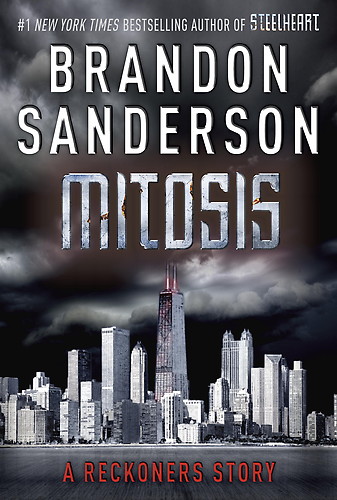
Sanderson-R-MitosisUSA good short story stop-gap between Steelheart and Firefight

Epics still plague Newcago, but David and the Reckoners have vowed to fight back.

Sanderson self-published this short story, set in the same world as his first super-hero novel, Steelheart. I rather enjoyed the novel (which was the first of the author’s that I’ve read), and when I stumbled across this I was very happy to be able to dive back into the world he’s created. I’m not going to include an official synopsis, as that will give away the ending of Steelheart.

Nevertheless, what you need to know (for both the novel and Mitosis) is that in this reality, super-heroes exist – something happened that bestowed upon a small percentage of the global population special powers. Unlike in the super-hero comic books of Marvel, DC, et al, the power has very much gone to most of these powered individuals’ heads, and they started using them for their own ends. In Chicago, Steelheart reigned supreme with a coterie of other powereds. Steelheart the novel was the story of a fight against this tyranny, spear-headed by an insurgent group known as the Reckoners and their new ‘recruit’, who is a bit of a geek, and has been cataloguing the powered dictators and criminals as a means to learn of their weaknesses.

Mitosis deals with a single powered individual: Mitosis. The story moves quickly, and there is a rather nifty homage (perhaps) to Agent Smith from second and third The Matrix movies. That is all I shall say on the specific plot of this story.

If you are familiar with Sanderson’s writing – be it The Way of Kings or his Mistborn series – then you are sure to know what to expect: brisk, engaging and professional storytelling. The man can certainly write, and I intend to get more of his novels read by the end of this year. [Famous last words, perhaps, but I managed to read three of the four authors I promised to last year…]

Short, but well-worth reading to hold you over until the release of Firefight.

***

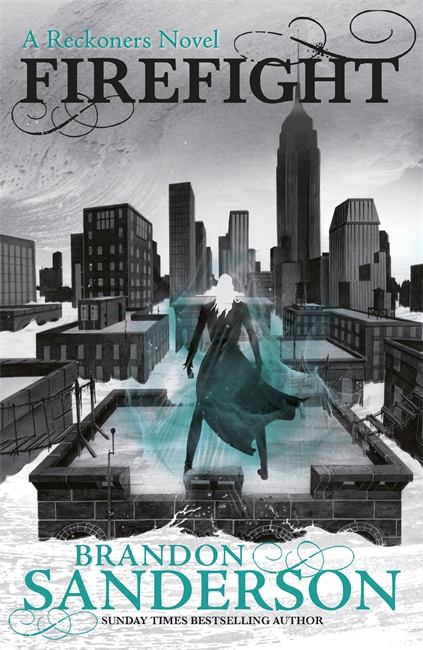
UPDATE: When I first wrote this, Gollancz had yet to announce the UK cover art, which I have now included below. The UK hardcover edition also includes an excerpt from Firefight and also some character sketches. It’s a really great little book. Perfect for any fan of Sanderson’s writing.

Sanderson-R2-FirefightUK

“Shovel Ready” by Adam Sternbergh (Headline)

SternberghA-ShovelReadyThe start to an interesting new dystopian series…

“I don’t want to know your reasons. I don’t care. Think of me as a bullet. Just point.”

Spademan used to be a garbage man. That was before the dirty bomb hit Times Square, before his wife was killed, before New York became a burnt-out shell. Now the wealthy spend their days tapped into virtual reality; the rest have to fend for themselves in the streets. Now there’s nothing but garbage.

So he became a hit man. He doesn’t ask questions, he works quickly, and he’s handy with a box-cutter.

When he’s hired to kill the daughter of a high-profile evangelist, Spademan’s life is upended. He will have to navigate two worlds – both the slick fantasy and the wasteland reality – to finish the job, clear his conscience, and make sure he’s not the one who winds up in the ground.

In the final few months of 2013, there was quite a bit of buzz around the genre sites related to this book. It has received a slew of great blurbs from respected and excellent authors. It was with great anticipation, therefore, that I dove into it when I received an ARC (quite a while ago, so I’ve been sitting on this review for some time). I enjoyed the novel, and Sternbergh offers up a rather convincing dystopian future, but one that at the same time felt slightly half-baked. The author has written a tightly-plotted novel that is certainly immediate and gripping. It left me wanting more, but not always in a good way.

Right off the bat, I should mention that this is another novel that dispenses with “proper” punctuation – specifically, there are no speech marks to indicate dialogue. This seems to be a style that is becoming popular again – before this, my latest read to take this path was Lavie Tidhar’s excellent The Violent Century. Unlike Tidhar’s latest offering, however, the lack of “normal” dialogue punctuation was confusing more often than I would like: the lack of differentiation between characters speaking would sometimes clash or merge less-than-seamlessly with Spademan’s internal monologue.

The main character, Spademan, is a “different kind of psycho”. He is quietly sociopathic, a product of an uncaring and dehumanizing New York city. Devastated by a dirty bomb, New Yorkers have either fled the city wholesale, barricaded themselves into their homes, or retreated to the outer boroughs. Wealthy and not alike have also retreated to a new, online reality – something akin to a steroidal, higher-tech Second Life – where ‘normal’ life can continue. This is where the bulk of international trade takes place, and the world of financial transactions in particular has retreated from the real world entirely, it seems. Interestingly, and related to the story contained herein, mega-churches have gleefully adopted the new technology as well. [That is all I shall say on that matter…]

The story moves at a breakneck pace, and we’re introduced to a number of interesting and varied, as well as believable, characters from a number of New York neighbourhoods and walks of life. His target and new job turns out to be not at all what he expected.

“Truth is, I have no idea what the next step should be. I’ve had jobs get out of hand, but not like this. I was hired to kill her, not adopt her.”

As someone who was having an extended moment of frustration with what felt like ever-increasingly-long Big Book Fantasies, its slim length was certainly welcome. I enjoyed the pace, but there was a sacrifice: world-building. Not only is the world beyond New York fleshed out at all, really (save the quotation, below), it also meant the world’s logic failed – I ended up not buying that so many people would remain in New York City. Suspending that frustration, though (and there were times when that was difficult), I did rather enjoy the novel.

“As for the rest of it, in in-between part, I hear it’s relatively clean and still open for business, like a plucky dollar store. No longer the land of milk and honey, maybe, but at least you can still get high-grade pharmaceuticals on every street corner on the cheap… Really, it’s just New York that got nuked, cordoned off, shut down, shunned. Capital of the world, cut loose to drift into the sea. The country’s soul, on a funeral pyre.”

The fact that New Yorkers stay in the city, despite the dirty bomb’s destruction and lingering radiation, and also the violence that rose in place of order, reminded me of the New York mentality Brian Wood showed in his masterful DMZ comic series. However, I think it worked much better in the graphic novel series – here, it felt that there wasn’t as much thought put into the world-building as there perhaps should have been. Bits and pieces felt forced, and to then not be fleshed out… Well, Sternbergh’s brevity was not always a boon (though, I repeat, it was refreshing amidst a sea of new, massive doorstoppers).

SternberghA-ShovelReadyUSAs the first book in a series, I’m hoping Sternbergh takes some of the time in his next (and future?) novels to flesh out this dystopian reality. As it stands, this is an engaging thriller, which happens to be set in a dilapidated New York City. Spademan is a good protagonist, and I’d like to read more, but this novel didn’t do enough to establish the world, and given the gaps, why people would remain in the city.

Recommended, therefore, but with the aforementioned caveats. An author to watch, certainly.

*   *   *

Shovel Ready is published by Headline in the UK (Jan.14/Jul.3 eBook/PB) and Crown in the US.

Guest Post: “The Delphi Room – Through the Looking-Glass” by Melia McClure

McClureM-DelphiRoomIn my novel, The Delphi Room, two people watch the past of the other unfold in a mirror. Trapped next door to one another in rooms they believe to be Hell, Velvet and Brinkley are captive audience to the disturbing “home movies” that play in a mirror that hangs in each of their prisons.

Mirrors are compelling symbols and have appeared in various art forms and spiritual texts throughout the ages. The Oracle of Apollo at Delphi, referenced in my book’s title, demanded of ancient Greeks “know thyself” – no small demand, and one which my characters grapple with mightily, in mightily eccentric fashion. Among other things, mirrors have historically symbolized self-knowledge and wisdom, and like the ancients who returned to Delphi again and again in search of answers to the riddles of life, countless numbers of people currently revisit a mirror as a daily reference point in the evolving construction of identity. The Delphic oracle answered seekers’ questions with riddles, and for mirror-gazers the riddles of the mind have a drastic impact on the perception of the confounding entity known as “self” that is reflected in the glass.

In the world of my novel, mirrors are also a means of two totally isolated people coming to understand the forces that have buffeted and shaped the other, and thus – as understanding creates connection – they give rise to Velvet and Brinkley’s growing bond. Mirrors can symbolize parallel universes or alternate realities, and both of my main characters are trapped in a hellish alternate reality while at the same time experiencing the universe of the other. And when, late in the book, Velvet and Brinkley jump into the past of the other through the mirror, rendering the past present, diverse realities are brought together, which alludes to the symbolism of an all-surfaced mirror: that all realities are one and seen and understood from all sides in the context of eternity.

But beyond the literal mirror-as-object, many of the characters themselves play some sort of mirroring role. Velvet’s psychosis, the Shadowman, reflects back to her multiple aspects of her selfhood: self-loathing, fear, creativity, ingenuity and rage. Brinkley’s psychosis, ’20s film starlet Clara Bow, references her tragic personal history – a history shared by the real-life Clara Bow – and in many ways it mirrors Brinkley’s crushingly sad upbringing: both had mentally ill mothers and, among other common experiences, Brinkley’s mother tried to kill him and as a teenager Clara awoke to find her mother holding a butcher knife to her throat. One could argue that Brinkley’s fractured mind chose to conjure that particular illusory movie star as an object of love because he found solace in the kinship of shared tragedy. Again, mirroring fosters connection: people seek their own humanity reflected back at them in the humanity of another – because, after all, humanity is about oneness.

The lives of Velvet and Brinkley mirror each other in many ways: their unstable mothers and absent fathers, along with their mutual obsession with cinema, furnish them with certain overlapping experiences and tendencies, though both characters are fiercely unique and individualistic. But clarity about the self can be harder to achieve than clarity about another, and the need for familial love can have an obfuscating effect, and thus it is through the mirror’s revelation of the past of the other that Velvet and Brinkley come to greater peace within themselves. As much as one’s reflection in a mirror begs the question “Who am I?”, we are all mirrors for each other, asking “Who are you?” and “Who am I to you?” The concept of identity is, of course, central to any conversation about mirrors, and the characters in The Delphi Room are fighting against crippling antagonism to define themselves on their own terms. What they see in the mirror is very different from how the world sees them, and it is in the chasm between those contrasting perceptions that the truth lies. When Brinkley gazes in a mirror, Clara Bow is there to alternately love and torment him; when Velvet gazes in a mirror, the Shadowman is often reflected as a sinister, albeit colourful, presence.

When we stand before a looking-glass, do we ever really know who is looking back at us?

***

Melia McClure’s The Delphi Room was published by ChiZine in September 2013. Be sure to follow the author on Twitter for more updates about her work, etc. You can read a sample of the novel on Tor.com. Here’s the synopsis:

Is it possible to find love after you’ve died and gone to Hell? For oddball misfits Velvet and Brinkley, the answer just might be yes. After Velvet hangs herself and winds up trapped in a bedroom she believes is Hell, she comes in contact with Brinkley, the man trapped next door.

Through mirrors that hang in each of their rooms, these disturbed cinemaphiles watch the past of the other unfold—the dark past that has led to their present circumstances. As their bond grows and they struggle to figure out the tragic puzzles of their lives and deaths, Velvet and Brinkley are in for more surprises. By turns quirky, harrowing, funny and surreal, The Delphi Room explores the nature of reality and the possibilities of love.

Upcoming: “Shovel Ready” by Adam Sternbergh (Headline)

SternberghA-ShovelReadyI first spotted a photo of a Shovel Ready ARC on Twitter (I forget exactly when it was, and who Tweeted the image), and I did some digging. Ever since, I have been rather looking forward to this novel. It’s still some time until it is published, but the new UK cover was unveiled today, and I rather liked it. So here it is, as well as the synopsis:

I don’t want to know your reasons.

I don’t care.

Think of me as a bullet.

Just point.

Spademan used to be a garbage man. That was before the dirty bomb hit Times Square, before his wife was killed, before New York became a burnt-out shell. Now the wealthy spend their days tapped into virtual reality; the rest have to fend for themselves in the streets. Now there’s nothing but garbage.

So he became a hit man.  He doesn’t ask questions, he works quickly, and he’s handy with a box-cutter.

When he’s hired to kill the daughter of a high-profile evangelist, Spademan’s life is upended. He will have to navigate two worlds – both the slick fantasy and the wasteland reality – to finish the job, clear his conscience, and make sure he’s not the one who winds up in the ground.

Shovel Ready is due to be published by Headline in January 2014.

Lazarus, Vol.1 – “Family” (Image)

Writer: Greg Rucka | Art: Michael Lark, w. Stefano Gaudiano & Brian Level | Colors: Santi Arcas

Forever Carlyle, the Lazarus of the Carlyle Family.

In a dystopian near-future, government is a quaint concept, resources are coveted, and possession is 100% of the law. A handful of Families rule, jealously guarding what they have and exploiting the Waste who struggle to survive in their domains.

Forever Carlyle defends her family’s holdings through deception and force as their protector, their Lazarus. Shot dead defending the family home, Forever’s day goes downhill from there…

Collects: Lazarus #1-4 & “Family: Prelude”

Prior to this, I was perhaps most familiar with Rucka’s first two, excellent Punisher volumes (must remember to finish off that series at some point). On the strength of just those books, I knew I wanted to read more of his work. That’s when I started to read and hear about Lazarus. As soon as this collection was available, I snapped it up and read it in one sitting. All I can say is that the hype is justified. While short, this is a very strong beginning.

The story opens with a pretty long, brutal scene that gives us an eye-popping, wince-inducing introduction to the nature of a Lazarus:

Lazarus-01-Interior1

Despite the above attempted-murder, Forever has plenty of… gumption left in her, and isn’t averse to doling out her blunt Family Justice:

Lazarus-01-Interior8

Over the course of these four issues, we learn about Forever’s psyche – she is unsure about the society in which she lives. She feels disconnected from her family, uncomfortable with her purpose, her nature. One gets the feeling that she’s headed for a break with the Family. It’s going to be an explosive journey, I’m sure.

The book offers a short, tantalizing taste of the Lazarus world, the dystopia controlled by a select few Mafia-on-steroids-like families. We’re not overburdened with world-building, but Rucka gives us just enough in the story to get situated, leaving breadcrumbs for us to follow and keep us guessing and get us hooked. This book is a perfect example of how comics can be used to show us new worlds and stories, without resorting to telling (which I still find strangely common for a visual medium). Forever is sent to parlay with a rival family, the Morrays. We learn through her mission that there is at least one other Lazarus, a member of the Morray family. They have met before, and share a deep affinity for each other’s situation and understanding of their lives – given their nature who else, really, could related? Meanwhile, Forever’s family members, her “brothers and sisters”, are plotting against her, each other, and their father. This does not bode well for the future.

Lazarus-01-Interior7

The pacing is fast but not rushed. It’s a dystopian world, the families appear in total control of the Americas, in a neo-feudal system that benefits the Families, while everyone else is categorised as either “Serfs” or “Waste”. It’s the argument against tyranny and the 1% writ large, exaggerated into a truly crushing social order.

Overall, this book is really quite excellent. I would have preferred a bit more world-building, sure, but I have a feeling this will be unrolled slowly and when necessary over the course of the series. The book is rather slim in length, which might leave people dissatisfied. I certainly would have liked more, but I see why the story was stopped here for the first volume. I can’t wait to read Volume 2. It’s not difficult to see why it has received so much praise. Very highly recommended, but if you need your comics more substantial in length, you may want to wait until the second collection is released/available before diving in them both together.

Lazarus-Vol.01-Interior1

You just might just like it…

Upcoming: “Day One” by Nate Kenyon (Thomas Dunne)

KenyonN-DayOneI stumbled across this today, and thought it sounded pretty interesting. In my way, that meant I decided to share it on here. [Ok, by “stumble”, I mean “found in the catalogue which I was reading”…]

I’m a sucker for post-apocalypse New York stories – Adam Baker’s Terminus being the most recent example. Here’s the synopsis – so there was little chance that I wouldn’t be interested in this:

Scandal­-plagued hacker journalist John Hawke is hot on the trail of the explosive story that might save his career. James Weller, the former CEO of giant technology company, Eclipse, has founded a new start­up, and he’s agreed to let Hawke do a profile on him. Hawke knows something very big is in the works at Eclipse – a major computing breakthrough – and he wants to use the profile as a foot in the door to find out more.

After he arrives in Weller’s office in New York City, a seemingly normal day quickly turns into a nightmare as anything with an Internet connection begins to malfunction. Hawke receives a phone call from his frantic wife, and just before the phone goes dead, she indicates that someone is trying to break down the apartment door. Soon, Hawke and a small band of survivors are struggling for their very lives as they find themselves thrust into the middle of a war zone – with no obvious enemy in sight.

The bridges and tunnels have been destroyed. New York City is under attack from a malevolent entity that can be anywhere and can occupy anything with a computer chip. It is deadly. It is brilliant. And it wants to eradicate the population of New York. Somehow, Hawke must find a way back to New Jersey and his pregnant wife and young son. Their lives depend upon it… and so does the rest of the human race.

Nate Kenyon’s Day One is due to be published by Thomas Dunne Books in October 2013. Kenyon is the author of Bloodstone and The Reach, both of which were Bram Stoker Award finalists. His other fiction includes The Bone Factory, Sparrow Rock, StarCraft: Ghost Spectres, and Diablo: The Order.

“Ex-Heroes” by Peter Clines (Del Rey UK/Broadway)

ClinesP-1-ExHeroesUKSuperheroes-vs.-Zombies Novel Fails to Impress

Stealth. Gorgon. Regenerator. Cerberus. Zzzap. The Mighty Dragon. They were heroes, using their superhuman abilities to make Los Angeles a better place.

Then the plague of living death spread around the globe. Billions died, civilization fell, and the city of angels was left a desolate zombie wasteland.

Now, a year later, the Mighty Dragon and his companions protect a last few thousand survivors in their film-studio-turned-fortress, the Mount. Scarred and traumatized by the horrors they’ve endured, the heroes fight the armies of ravenous ex-humans at their citadel’s gates, lead teams out to scavenge for supplies—and struggle to be the symbols of strength and hope the survivors so desperately need.

But the hungry ex-humans aren’t the only threats the heroes face. Former allies, their powers and psyches hideously twisted, lurk in the city’s ruins. And just a few miles away, another group is slowly amassing power… led by an enemy with the most terrifying ability of all.

I had high hopes for this novel – mixing superheroes and zombies seems like such an awesome, perhaps even common-sense mélange, yet it had not been done before. So, when the three books arrived on my doorstep, I was eager to get stuck in. While Ex-Heroes had some good bits – the action-scenes, in particular, are well-written – ultimately, I do not think this book was ready for publication. This was a big disappointment.

Ex-Heroes is very much rooted in the super-hero and zombie apocalypse genres. Clines does a fine job of painting the post-apocalyptic Los Angeles, and it was never difficult to get a sense of the place and atmosphere when he was writing about the city, it’s few surviving residents, and its shambling hordes.

The novel is also, disappointingly in my opinion, equally rooted in comic book aesthetic of, at a guess, 1990s Marvel – all of the women are super-hot, sexually available, adolescent fantasies. There’s even a “dominatrix-ninja” who doesn’t wear very much at all. This character is Stealth, and Clines overdid her introduction: it is filled with such cliché ideas of what makes someone a genius, for example, and also explanations of how much being stunningly beautiful was something that never mattered to her, and that she was endlessly frustrated that people will only ever see her worth in her looks. Fine, nothing wrong with the latter. But then why on Earth would she design an outfit that accentuates her underwear-super-model figure? And yes, she was an underwear-super-model. I think I get what the author was trying to comment on, but he didn’t do it too well at all. And I may be being charitable…

The novel is meant as pure entertainment, and I can certainly see what the author was trying to do. In many ways, he succeeds, but the end result remains not brilliant. It’s a good, even inspired blend of two popular genres – I’d say more rooted in superhero than zombie sub-genre, though, as it lacks the slow-build, sinister tension of the best zombie tales. It does a good job of tapping in to many wish fulfillment needs of super-hero fans everywhere.

Another major weakness, in my opinion, was the writing. I think it could have been much better written. The story lacked depth, but I can’t deny that I zipped through what I read pretty quickly. Sadly, the characters were unsurprising, some of the “psychology” seemed mixed up or garbled. The “relationships” were bland, relying on gorgeous, sexually aggressive women fawning over the menfolk. It lacked tension. Ultimately, I was rather bored. Which is why I stopped reading.

ClinesP-1-ExHeroesUSWhich is a pity, as I thought there were elements of the narrative and apocalypse-building that were innovative and interesting. For example, the nature of zombism idea is intriguing: the virus/pathogen is actually non-fatal, it just turns people/victims into walking petri dishes, as if they have been “injected with the CDC’s wish list” of the myriad diseases percolating in Los Angeles.

And the action scenes aren’t bad. But the overall momentum, and the level of my interest dwindled quickly, the more I read. Each time I picked it up, I’d easily get through a handful of chapters. But each time it took a bit more effort to pick it back up. I wonder, really, if the novel had been properly formulated before it was written – most of the ideas are there, but I would describe this as an early draft at best. It’s missing development. It lacks chops.

As I mentioned at the start, I was sent the first three novels in the series, which makes me feel a little awkward about disliking it as much as I have, truth be told. Will I read the others? Probably, yes. But I’m in no rush to get to them, so don’t hold your breath for reviews in the near future.

With Ex-Heroes, while Clines has managed to come up with an interesting, original spin (as far as I’m aware) on two very popular genres, the actual story, characters and quality of writing aren’t there. I really wanted to like this, but ultimately, after about 40% of the novel, I just couldn’t read any more. This, in my opinion, was not ready to go to market. A real shame.

***

Update: The original version of this review included an error. I stated that Ex-Heroes was previously self-published, when in fact it was published through a small-press: Permuted Press. Apologies for the error.

*

Ex-Heroes – and the sequels Ex-Patriots and Ex-Communication – are out now in the UK (Del Rey) and the US (Broadway).

ClinesP-2-ExPatriots

Book 2 – UK, US

ClinesP-3-ExCommunication

Book 3 – UK, US

The fourth book in the series, Ex-Purgatory, will be published in January 2014. Here are the covers (UK, US):

ClinesP-4-ExPurgatory