“NOS4R2”/“NOS4A2” by Joe Hill (Gollancz/William Morrow)

HillJ-NOS4R2A slow-burning suspense

Summer. Massachusetts.

An old Silver Wraith with a frightening history. A story about one serial killer and his lingering, unfinished business.

Anyone could be next.

We’re going to Christmasland…

I’m not a big reader of horror. I’m not really sure why, though, as I tend to be attracted to darker and more twisted tales. Nevertheless, I have enjoyed some of Hill’s previous writing, and after reading a little bit about NOS4R2, I eagerly awaited its arrival.

Despite that, and perhaps inevitably, I was not really in the mood for horror when I first started to read NOS4R2. Rather than letting this ruin it for me, I decided to put it aside and got back to it recently. I’m glad I did this, too: this is a pretty solid suspense/horror novel, sure to appeal to his existing fans and also new readers (with caveats). The novel is also, frustratingly, very difficult to review – and doubly so if I want to avoid any form of spoiler.

Once again, therefore, I find myself at a loss for how to review something by Joe Hill. Seriously. I’m completely stumped. His other work that I struggle to review is his Locke & Key comic series, a story that shares some similar sensibilities and aesthetics as NOS4R2. Both are heavily character-focused, with a slow-burning plot that allows for great tension and suspense to build brilliantly. It’s not action-packed (though there is some conflict), there are a fair few surprises, and some really creepy scenes.

I must admit that I did find the start a little slower than I would normally like, and this maybe influenced my decision to put it aside for a short while. Given how long the book is (the ARC is 700 pages, or there about), I think some people may not have the patience for Hill’s pacing. When I was about a third of the way through, even I couldn’t help but think, “When are things going to kick off?” However, when I allowed myself to just sit and read (recently, life has been very disruptive and stop-start), I found myself swept up by Hill’s prose and story, drawn on through the novel.

HillJ-NOS4A2The author manages to make the mundane fascinating – the little details of these characters’ lives, their thoughts and every-day concerns… In many authors’ hands, this attention to detail would be suffocating and perhaps tedious, giving the novel a bloated feel. Not so for Hill; when added to the creepy goings-on related to Christmasland and its master, Charles Manx, he spins a fascinating, engrossing, suspenseful tale.

I found his characters all too realistic, in a way. This is, in my opinion, Hill’s greatest talent: despite writing creepy, weird, oft-supernatural stories, his characters have a vividly real feel to them. Victoria McQueen, the protagonist, feels complete, fully realised and familiar, and in some ways we grow up with her over the course of the novel: first meeting her as a child, when she first gets her special bike and stumbles across her strange ability. Then time jumps ahead to her rebellious adolescence and onwards, as her childhood brush with information of the Silver Wraith and Manx, and her confrontations with him later.

As I said at the start, I have no real idea of how to review Hill’s work. Nothing I try seems to convey the atmosphere and feel of the author’s work appropriately.

Needless to say, if you have any interest in classic, literary horror fiction, then NOS4R2 is for you. Recommended.

Also by Joe Hill: Horns, Heart-Shaped Box, 20th Century Ghosts, Locke & Key Vols.1-5

Also Try: Benjamin Percy, Justin Cronin, Stephen King, Adam Neville

Marvel Events: “House of M” & “Secret Invasion”

HouseOfM-TPB1

Another dual-review, this time for two Marvel Events. I’m always wary of Marvel Events – they have a tendency to disappoint or prove a little pointless for those who are not devouring most/all of Marvel’s ever-expanding line of titles. The end of Avengers vs. X-Men at least had the benefit of shrinking their overall line, at least. It doesn’t appear that any of the big events that came before did. (I’d still like to read Siege, I think…)

Both of these two titles were included in a Marvel sale on ComiXology (which is pretty much the only way I buy Marvel titles, now, actually), so buying them and catching up with this Marvel backstory didn’t prove too costly. One of the titles was very good (much better than expected, certainly), and one just mediocre (and just a little bit of a struggle to keep reading)…

***

HOUSE OF M (2005)

HouseOfM-TPBWriter: Brian Michael Bendis | Artist: Olivier Coipel | Inks: Tim Townsend, Rick Magyar, Scott Hanna, John Dell | Colors: Frank D’Armata, Paul Mounts

The Avengers and the X-Men are faced with a common foe that becomes their greatest threat: Wanda Maximoff! The Scarlet Witch is out of control, and the fate of the entire world is in her hands. Will Magneto help his daughter or use her powers to his own benefit? Starring the Astonishing X-Men and the New Avengers! You know how sometimes you hear the phrase: and nothing will ever be the same again? Well, this time believe it, buster! Nothing will ever be the same again!

Collects: House of M #1-8

The book starts with Wanda Maximoff, also known as “The Scarlet Witch”, in a happy setting. Sadly, as Professor Xavier wheels in, we learn that it is not real – rather, a manifestation of Wanda’s power to bend and alter reality at will. What makes her power so deadly, though, is her mental instability. She’s clearly been spiraling into a much worse state, which forces the Avengers and X-Men to meet to discuss what is to be done about her. Some call for her termination, others call for restraint and understanding. A compromise is reached: they will go to the devastated land of Genosha to assess her state of mind, despite neither Prof X nor Dr. Strange able to help her retain (or, perhaps more accurately, attain) a grip on reality.

HouseOfM-01-Interior3

At the end of the first issue, Spidey walks off and wakes up… Only, nothing he sees is the same as it was… For one thing, there are a lot more apparent-mutants, too: they’re pretty much everywhere. They seem to be as numerous as humans, if not more so (later, it becomes clearer).

There are a number of funny moments in the book, too – not laugh-out-loud funny, but at least enough to make me chuckle. Here, for example, is Kitty Pryde, teaching a history class: “Who was the first mutant?” she asks her class. “And don’t say Moses or Jesus. I’m talking officially.”

Over the course the series, we are taken through this new reality for all the key players (too many to go through individually in a review, though). It’s pretty good, actually, and Bendis has chosen very well for most of the characters.

The spanner is thrown into the works, though, after Wolverine wakes up and knows something ain’t right… As Wolverine remembers his entire life in the “real” Marvel reality/timeline, he starts to seriously freak out. In a stroke of bonkers logic, he decides to launch himself off the Avengers’ Helicarrier… He flees from his former team-mates on the “Red Guard” (an elite S.H.I.E.L.D. unit), and gets scooped up and taken in front of the Human Resistance. And so begins his recruitment drive, collecting mutants and others to his side, as he realizes what Wanda’s done: given mutants what they always wanted, acceptance and a place in the world.

HouseOfM-04-Interior2

The chapters have a brief prose intro that is rather info-dumpy (I read this as individual issues, so I’m not sure if this is the case in the collected book). This is also probably because there were a lot of tie-in issues across Marvel’s titles at the time, all of which fed into and effected what happened in this book. I wasn’t prepared to buy and read them all, though (even with comiXology’s 99c sale).

In the sixth issue, we get this statement from Cyclops:

“I’ve – uh – I’ve been team leader of the X-Men since I was a teenager… And in that entire time, I’ve prided myself on my tactical restraint. Taking a moral high ground where violence is concerned.”

This from the mutant who will bring the world and community of mutants and super-heroes into a war so costly and devastating, that it will forever mess up the Marvel universe. What difference a couple of years make, huh?

At the end, we learn of what really happened, wrapping things up rather nicely. But then Wanda says those now-immortal words that forever changed the Marvel Universe…

HouseOfM-07-Interior4

After the pleasantly strong start, the book maintained its quality and pace. The artwork is also excellent throughout. Although, in an unusual twist: while the women are the comic-book ideal, it is the men who look deformed, as if their all suffering some steroidal gigantism. Sometimes, in the less-sharp or more-busy panels, it looks really wrong… On the whole, though, it was quite well realised on the page. Some of the pages were a touch too busy, which could make them unclear, and a handful of panels were sadly indecipherable. This didn’t have much of a negative impact on the book, however, as Bendis’s writing was strong and quite gripping.

This book was, therefore, much better than I had expected. I’m always wary of the Marvel Events, but this was well-written and fun. I would certainly recommend this to fans of any/all Marvel titles.

*

SECRET INVASION (2008)

SecretInvasion-TPBWriter: Brian Michael Bendis | Artist: Leinil Francis Yu | Inks: Miles Morales | Colors: Laura Martin

SECRET INVASION IS HERE The shape-shifting alien race known as the Skrulls has secretly infiltrated every super-powered organization on Earth with one goal – full-scale invasion In this collected edition, page-after-page unveils reveal-after-reveal and shocking moment-after-shocking-moment Brian Bendis and Leinil Francis Yu leap off the pages of mega-hit New Avengers and deliver a story that will change the Marvel Universe forever.

Collects: Secret Invasion #1-8

This ‘Event’ collection was a bit of a disappointment. I read it after House of M, and only because I rather enjoyed that book. Something about the rapid-fire dialogue made me wonder if Bendis had been watching a lot of The West Wing in the run-up to writing this. Sadly, though, the dialogue in here has nothing on Sorkin’s style, and instead just felt choppy and rushed.

The story in general felt simplistic, overloaded with telling-rather-than showing (which has been a frequent complaint of mine lately, I know). The book then becomes a riotous mess. I had a vague inkling of who the Skrull were, but had difficulty following what was going on and, as a result, never really came to care.

I would not recommend this to people who haven’t been following the overall, web-like Marvel chronology and story. There are a lot of hints and allusions to what has come before, but without knowing much of the back-story, I imagine I missed a lot. I include myself in that group. I was lost and, despite Yu’s excellent artwork, ultimately bored.

Trans-dimensional New 52 (DC Comics)

DCNew52-TransDimensionalSeries

There are three series in DC’s New 52 that feature inter-dimensional travel shenanigans, so I thought I’d compile a joint review of all three: Earth 2, Mister Terrific and World’s Finest.

Mister Terrific actually travels between these dimensions, too, so he has a way of anchoring the series together (although, he features more in later issues of World’s Finest, which are not reviewed here). I’m not sure if I’m reading too many New 52 titles, now – I seem to have a shorter fuse when it comes to quality, and am finding myself more inclined to drop series quicker. Or, equally possible/likely, I’m more of a traditionalist, and just prefer the ‘core’ characters that make up the Justice League and their solo-series. Certainly, I’m finding myself really liking Geoff Johns’ series (Justice League, Aquaman and Green Lantern).

Anyway, back to these three series… I had very mixed feelings about them all, and was quite disappointed with two of them. I’ll keep these reviews short, therefore, otherwise I’ll just feel like I’m flogging a dead horse. Also, as with most books I read and don’t connect with, there are some spoilers below.

***

MisterTerrific-Vol.1Mister Terrific Vol.1 – “Mind Games”

Writer:

Introducing the electrifying new villain Brainstorm, who is determined to bring Los Angeles to its knees – beginning with Michael Holt!

Collects: Mister Terrific #1-8

I picked up all eight issues of Mister Terrific during one of ComiXology’s sales. I read the first three. I’ve not read the rest of them, and each time I open up the fourth to start reading… I just give up before I turn a single page. This is my first DNF of the New 52 series collections (the panel, below, from issue #2 was just too apt to ignore and not include – it perfectly reflects my own feeling when reading this series). I’d be happy to put some of this down to a complete lack of familiarity with the character. But really, I just think this series wasn’t up to scratch.

MisterTerrific-02-Interior4

I’m always amazed when a comic book, a visual-dominated medium, has more telling than showing in it. It’s littered with pseudo-science, cliché terminology, and frankly sub-par writing. I can understand fully why it was cancelled. Even the revelation at the end of #3 felt forced, where it should have had a huge impact on the story and reader.

The artwork’s not bad, though, and I think the premise has (or, at least, had) a lot of potential. But from what I read in the first three issues, I just can’t generate the enthusiasm to finish it – even though there are only about 100 pages left of the entire series.

If someone can tell me that it got better before the ending, I’ll get back to it. Otherwise…

MisterTerrific-Vol.1-Content

*

Earth2-Vol.01Earth 2, Vol.1 – “The Gathering”

Writer: James Robinson | Artists: Nicola Scott, Trevor Scott & Eduardo Pansica | Colors: Ivan Reis & Joe Prado

Who are the heroes of Earth 2? When the Batman, Wonder Woman and Superman of Earth 2 fall in battle, it’s up to a new breed of heroes to come together to combat the returning evil of Apokolips!

Collects: Earth 2 #1-6

I read and rather enjoyed the first issue of this series, when it came out. As with so many series, I decided to hold off until the first collected volume/storyline was available, and on the strength of the debut issue had pretty high hopes. Sadly, these expectations were not met. The premise is interesting, certainly, and I like the idea of alternative versions of these heroes fighting their own battles, completely removed from the ‘normal’ DC Universe heroes and storylines.

However, despite the strong start, this series is riddled with irritating storytelling. For example, the Green Lantern of this world: before he is the Green Lantern, he’s some high-flying celebrity. He proposes to his partner, and we get a good idea of how devoted they are to each other. Then, a handful of pages later, there’s a train crash. His partner dies, and he… moves on rather quickly and easily. I’m not sure if this was an editorial decision, just a way of quickly providing the character with a motivational life-tragedy (in itself, rather cliché). Certainly, given that the character was trumpeted as the first(?) gay major DC character, the quick dispatch of the love interest (whose name I can’t remember) smacked of tokenism.

The storyline itself was just rather flat, and didn’t compare favourably with Robinson’s other stories and series that I’ve read. Given that he’s broken with DC under not the happiest of terms, I can’t help but wonder if this series suffered from overbearing editorial control. In many ways, it’s playing it safe – great, big bad-guy, terrorising Washington, killing everyone (he’s some kind of death creature, Grundy). Instead of getting a sense of any real peril, the threat posed by this big bad ends up forming the crux of a team-building exercise.

The artwork is rather good, I must say, which only makes the lackluster storyline all the more disappointing.

If I’d taken any notes while reading this, I probably could go on at greater length about the things that niggled, but I don’t really think there’s much point. Overall, this was disappointing, leaving me rather nonplused and uninvested in the characters. Will I try the next story-arc? Well… perhaps. A couple of other comic fans, whose tastes are often similar to my own, enjoy this series quite a bit. So… maybe. But not in the near future. And only if I can find Volume 2 or the individual issues on sale.

Earth2-Vol.01-Content

*

WorldsFinest-Vol.1Worlds’ Finest, Vol.1 – “Lost Daughters of Earth 2”

Writer: Paul Levitz | Artist: Kevin Maguire, Wes Craig (#0 & flashbacks), George Pérez | Inks: Scott Koblish | Colors: Rosemary Cheetham (#0 & flashbacks), Hi-Fi

Discover why these two heroes are stranded on our Earth – and what it means for the heroes of the DC Universe.

Collects: World’s Finest #0-5

The #0 issue (which originally came out mid-way through this story-arc) takes place two years before the events of Earth 2 #1. We’re introduced first to Helena of Earth 2. She is Bruce Wayne and Selina Kyle’s daughter. She is also the Robin of this universe. We meet her on the hunt, shadowed by her mother, and afterwards we learn that Bruce is not at all happy that she went out without him.

Then we meet Superman, who is trying to train Supergirl, while mourning the death of Lois Lane. It’s a much quicker introduction than Helena’s, but it gives us pretty much everything we need to know.

The rest of this chapter tells us of how they met, and the tragedy that brought them together (though Supergirl still wishes to keep her identity a secret).

WorldsFinest-01-InternalArt1

The first story-arc, then, takes place on the main DC world, is pretty good. The first chapter has a fun nod to Huntress’s past identities in the DCU (Bertinelli, the “mafia princess”, for example – above). I’d already read #1 before picking up the rest of the first issue volumes, and rather enjoyed it. The pair of heroines, who have very different approaches to their vigilantism are nevertheless fast-friends. They end up in Japan, and confront Hakkou, the irradiated man. Each issue also contains flashback sequences, which tells us of the first two years Helena and Supergirl-now-Power Girl spend in their new home. It’s a nice balance of action and a twist on a coming-of-age story (a “coming-to-terms” story, perhaps?).

WorldsFinest-02-Interior2

There are clear connections between this series, Earth 2 and Mister Terrific – both of which, as mentioned above, were not as good as I’d hoped they would be. This series is more fun, but it also feels like it’s not quite settled, and a bit thinner than it could have been. We’re still learning about the characters, their dynamic, and so forth, so at least Levitz gives the impression of not being in as much of a rush as Robinson to establish this new team’s dynamic. It is pretty good, and I like the characters, so I have no doubt I will read some more. Given the slight shakiness, though, I’m not wholly sold on this – it does bear more examination, though, and I hope things will take off better in the second story-arc.

In terms of the artwork, I really like the style for for the ‘present’, but the flashback art seems much more inconsistent, with characters sometimes deformed or distinctly different in appearance than they should ever be (faces change shape, rather than expression, for example). There were a few emotional moments that were robbed of their punch because the artwork/pencils looked cartoony (especially the tragedy at the end of #0). Both styles feature nice, bright and sharp colours, though.

WorldsFinest-Vol.1-Content

Guest Post: “On Worldbuilding” by Lenora Rose

RoseL-IllusionOfSteel-Crop

Lenora Rose is the author of The Illusion of Steel (Eggplant). A while back, I got in touch with her and asked if she might be interested in writing a little something for the blog, and she agreed. So, in advance of my review of the novel, here is Lenora on worldbuilding…

ON WORLDBUILDING

It seems that lately, worldbuilding has been coming up on the blogs of writers more than usual; possibly this is the case, or possibly it’s confirmation bias, since I’ve been trying to think how to put my own thoughts about worldbuilding into perspective.

Then Ursula Vernon posted this offering, memorably titled Worldbuilding and the Okapi’s Butt, in which she remarks:

The important thing is that the reader get a sense of vast, uncanny history and weird things happening just out of sight. You don’t want to drag the world in and put it on the dissecting table—that way lies Silmarillion-esque prologues—you just want them to catch a glimpse of it, like an okapi’s butt in the rainforest, and go “Whoa. There’s a really big animal over there, isn’t there?” while it glides away into the shadows. … And the truth, of course, is that for me (and I’d guess for many of us) there’s no okapi there at all, it’s basically a big striped butt on a stick that the writer is waving through the undergrowth. Possibly while making “Woooooooo!” noises because none of us actually know what an okapi sounds like.

And this… is true. Any speculative fiction writer, in attempting to present a fleshed out world, will probably several times need to reference something outside the actual story, some past kingdom or mythical animal, some hobby of the lower classes, some religious detail, or a line about, “That time when grandmother got into a drinking contest with a Giant Stoat…” Mostly, they sit in the corners, making the world a bit more solid.

The story where these things are lacking often feels unsatisfying, at least to me as a reader. If there’s nothing past the edges of the map in the frontispiece, if all the people come from the same racial type and same cultural background without a good reason, if the hero isn’t an orphan and yet seems to lack a family, if, to paraphrase Patricia C. Wrede, I can’t figure out who does the laundry (and yet the character’s clothes are always scrupulously clean), my chances of finishing the book decrease. It’s often essential to cultivate the sense that the world is large and has been around a while before the story starts, shifting and changing like the real world does.

RoseL-IllusionOfSteelBut how much worldbuilding, how much extraneous detail is enough? While some people write so as to have an excuse to world-build (Tolkien being the extreme and obvious example), others write so as to get through a story they love. We’re not all up to spending 40 years inventing our worlds; even more so for those working to deadline. It can be a rewarding game, but it can also exhaust the writer.

Even inventing, and remembering, all one’s Okapi butts can be wearing. They seem small, and they’re quicker and lighter than fully writing out the details of the Okapi in the forest (often for the reader as well as the writer), but they all need to be remembered, because when the writer least expects it, one turns into a key detail in the story. Your hero is surrounded by a tribe of giant stoats, and tentatively mentions his grandmother’s name… next thing you know, the stoat nation’s drunken-fu warriors are an essential part of his plan to defeat the enemy.

My usual workaround is to write mostly in the same world. Not the same country or culture, necessarily, not even the same time period, but a consistent world. This gives me some framework to add details that flesh the world out without exhausting myself inventing every single thing from scratch every time. I know what this character’s grandparents were doing, in that country across the sea. I know what animals are in the woods, at least well enough that when some strange thing moves through the trees, even if all I add in this moment is the flash in the trees, in another story, that animal was out in plain sight, being a big part of the plot. So I can produce the whole animal on demand without needing to invent it yet again.

Sherwood Smith uses much the same technique (with some of the overall worldbuilding that doesn’t fit into the stories appearing on her web site, for those interested enough after a few books).

It has its dangers. Not least, of course, is Tolkien syndrome, where most of his stories never got finished because their creator was refining his world yet again, and rewriting all but random pages rather than sitting down to write a piece start to end. The other is the possibility of too many subplots, too many things the reader needs to know to step into a story – as has happened with some of the multi-volume epics.

So for this, too, I developed a personal workaround.

I leave lacunae on purpose.

As I’ve already mentioned in a comment on this web site, when I read Robin Hobb’s Tawny Man trilogy, it often referred back to an earlier trilogy, the Farseer books, sketching out the youthful years of the main character, Fitz. Some of those early years had direct effects on the current story, so of course, the Tawny Man trilogy is filled with references to it, enough to keep new readers in the know but not so much a reader of the first story would feel bogged down by old information.

The main thing I took away from the Tawny Man trilogy, for all I enjoyed it very well, was that I never actually wanted to read the first trilogy. This was not, as it happens, any doubt that the story itself would be well written. I have read and admired numerous other works of Ms. Hobb’s (particularly those published as Megan Lindholm). However, in this one case, the details as they shone through the second trilogy seemed stronger to me as fleshed-out backstory than they would as a story in their own right. They made the world richer, deeper, and they satisfied any craving I had to learn more.

I don’t say this choice was right for others, but it was right for me.

There are places where I have an idea what happens to the characters. In some cases, these turned into essential backstory. In some cases, they’re foreshadowed in stories that already exist. But I do not intend to write these particular stories.

I can’t say that won’t change at some point. But while there are writers of whom I wish, deeply, that they had told more stories, finished works in their lifetime rather than leaving their heir to scramble through boxes and decades of revisions – or simply leaving things unwritten forever – there are other writers where I have noticed that they’re writing every last story they can, every last side quest or passing mention in their other books. And some of them just don’t interest me. I like the implied story, the story as it is in my mind, more than anything I suspect I would read that they wrote to fill that gap.

Story is, after all, something that happens between writer and reader. Fill in all the gaps, and you leave nothing for the reader to do.

***

You can read an excerpt of The Illusion of Steel here. And here’s the synopsis:

Not even a shape-shifter can hide from her past forever…

Abandoned by her mother as a child, never knowing her father, Kanna Mendrays understands how to hide. She has used her shapeshifting ability to mask who she is, what she is, even her gender. Now that she has come to Melidan Tower to heal, she finds her defenses crumbling.

Peace is scarce here. Biadei—the friend who saved her life and brought her to the Tower—goes mad at each full moon. The aged Lord Daemon—infamous for having killed the man who abused him—seems to know too much about her. Every room of the Tower presents Kanna with a mystery when all she wants is peace.

And now she has begun to hear a voice: the spirit of Lord Daemon’s victim, whispering to her through a sword named Desecrator. When Biadei is captured by werewolves, it promises, “Give me Daemon, and I will save your friend. Give me Daemon, and you will know the truth about your family…”

Congratulations to CHRIS BECKETT, Winner of the Arthur C. Clarke Award!

Yesterday I attended the Clarke Award ceremony at the Royal Society in London. The event opened with a panel discussion on science in five years (in 2,001 days… Geddit?) – I was pleased to learn that there are people currently working on World Ships. That was cool.

Anyway, the reason most of us were there was to learn who won the prize (and, ahem, the drinks afterwards…). And so, big congratulations to…

Beckett-DarkEden

CHRIS BECKETT, for his novel DARK EDEN (Corvus)

The runners-up, all equally interesting and high-quality science-fiction novels, were…

2013ClarkeAwards-RunnersUp

Adrian Barnes, Nod (Bluemoose)

Nick Harkaway, Angelmaker (William Heinemann)

Peter Heller, The Dog Stars (Headline)

Ken MacLeod, Intrusion (Orbit)

Kim Stanley Robinson, 2312 (Orbit)

After the event, I had the pleasure of meeting a great number of people who I have long respected and/or only known on the other end of an email conversation or through Twitter. It was wonderful to meet so many of you and chat about all things genre and much other things besides. A great evening.

Author Wisdom: Michael Chabon

This quotation was passed on to me by Alyssa, who found it on Sarah Rees Brennan’s blog, and which originated on a New York Review of Books piece Chabon wrote on Janury 31 2013 (the piece is about Wes Anderson’s movies):

“The world is so big, so complicated, so replete with marvels and surprises that it takes years for most people to begin to notice that it is, also, irretrievably broken. We call this period of research ‘childhood.’

“There follows a program of renewed inquiry, often involuntary, into the nature and effects of mortality, entropy, heartbreak, violence, failure, cowardice, duplicity, cruelty, and grief; the researcher learns their histories, and their bitter lessons, by heart. Along the way, he or she discovers that the world has been broken for as long as anyone can remember, and struggles to reconcile this fact with the ache of cosmic nostalgia that arises, from time to time, in the researcher’s heart: an intimation of vanished glory, of lost wholeness, a memory of the world unbroken. We call the moment at which this ache first arises ‘adolescence.’ The feeling haunts people all their lives.”

Joey Hi-Fi brings Tony Ballantyne’s “DREAM LONDON” to life… (Solaris)

Ballantyne-DreamLondon

Hot on the heels of Joey Hi-Fi’s two awesome covers for Charlie Human’s Apocalypse Now Now (Century), Solaris has unveiled the artist’s superb cover for Tony Ballantyne’s next novel, Dream London. The novel will be published in October 2013. In the meantime, here’s the synopsis:

Captain Jim Wedderburn has looks, style and courage by the bucketful. He’s adored by women, respected by men and feared by his enemies. He’s the man to find out who has twisted London into this strange new world, and he knows it.

But in Dream London the city changes a little every night and the people change a little every day. The towers are growing taller, the parks have hidden themselves away and the streets form themselves into strange new patterns. There are people sailing in from new lands down the river, new criminals emerging in the East End and a path spiraling down to another world.

Everyone is changing, no one is who they seem to be.

Fantastic Page from JUSTICE LEAGUE OF AMERICA #2 (DC)

I just caught this over on iFanboy’s “Best of the Week in Panels… 03/20”, and it made me laugh. So, naturally, I’m sharing it here:

JLAmerica-02-Interior5

The story is written by the great Geoff Johns, with artwork by David Finch, Sonia Oback, and Rob Leigh. It’s always nice to see that some writers haven’t lost their sense of fun. Justice League of America #2 is out now.

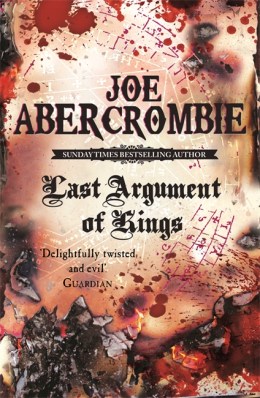
Review: LAST ARGUMENT OF KINGS by Joe Abercrombie (Gollancz)

AbercrombieJ-FL3-LastArgumentOfKingsUK1A strong finish to The First Law trilogy

The end is coming.

Logen Ninefingers might only have one more fight in him – but it’s going to be a big one. Battle rages across the North, the king of the Northmen still stands firm, and there’s only one man who can stop him. His oldest friend, and his oldest enemy: it’s time for the Bloody-Nine to come home.

With too many masters and too little time, Superior Glokta is fighting a different kind of war. A secret struggle in which no one is safe, and no one can be trusted. As his days with a sword are far behind him, it’s fortunate that he’s deadly with his remaining weapons: blackmail, threats, and torture.

Jezal dan Luthar has decided that winning glory is too painful an undertaking and turned his back on soldiering for a simple life with the woman he loves. But love can be painful too – and glory has a nasty habit of creeping up on a man when he least expects it.

The king of the Union lies on his deathbed, the peasants revolt, and the nobles scramble to steal his crown. No one believes that the shadow of war is about to fall across the heart of the Union. Only the First of the Magi can save the world, but there are risks. There is no risk more terrible, than to break the First Law…

It is always tricky to review the final book in a trilogy or series. So how to go about it, with a series and novel that I could talk about for hours? To avoid spoilers or over-analysis requires a very short review. But, “This is the culmination of a superb series” seems just too short… The Blade Itself started the series in fine form. Before They Are Hanged kicked things into a much higher gear. And Last Argument of Kings brings things to a brash, loud conclusion. Continue reading

Comic Cover Conformity…

While I understand that there are certain images that are iconic or eye-catching, I can’t help but raise an eyebrow at the similarities between the covers for Brooklyn Animal Control (a one-shot from IDW) and Garth Ennis’s new series, Red Team #2 (Dynamite):

CoverConformity-BrooklynAnimalControlRedTeam

I’ve read neither comic (though I’d like to give the series a try). But damn, those compositions are similar…