“The Last Man” by Vince Flynn (Simon & Schuster / Atria Books)

Flynn-LastManUKThe final Mitch Rapp novel

An invaluable CIA asset has gone missing, and with him, secrets that in the wrong hands could prove disastrous. The only question is: Can Mitch Rapp find him first?

Joe Rickman, head of CIA clandestine operations in Afghanistan, has been kidnapped and his four bodyguards executed in cold blood. But Mitch Rapp’s experience and nose for the truth make him wonder if something even more sinister isn’t afoot. Irene Kennedy, director of the CIA, has dispatched him to Afghanistan to find Rickman at all costs.

Rapp, however, isn’t the only one looking for Rickman. The FBI is too, and it quickly becomes apparent that they’re less concerned with finding Rickman than placing the blame on Rapp.

With CIA operations in crisis, Rapp must be as ruthless and deceitful as his enemies if he has any hope of finding Rickman and completing his mission. But with elements within his own government working against both him and American interests, will Rapp be stopped dead before he can succeed?

The Mitch Rapp series is in many ways the one that kick-started my passion for international and espionage thrillers. After reading Transfer of Power, the novel that introduced Rapp as the man who takes back the White House from terrorists, I quickly caught up with the rest of the series, and have read every one since. The Last Man is, sadly, the last novel. Flynn passed away last year, after a long battle with cancer. It’s an awkward ending, however. Thankfully, though, while the novel began shakily, it ended strongly. Long-time fans of the series and characters won’t be disappointed, as this is another fast-paced, gripping international thriller, featuring all of the key series characters.

One of the first things to jump out at me was just how aggressive Rapp is at the start of the novel. True, he’s a CIA assassin, who has had a decades-long career killing people all over the world, so how cuddly could he ever be, really? Nevertheless, he came across as far more aggressive and even downright mean when dealing with others. It felt like a real departure from how I remembered the character. The previous two novels Flynn wrote focused on Rapp’s early career, taking us to his first missions working for the CIA. This can, perhaps, account for the apparent shift in character – it’s been years since I read a novel when the ‘present day’ Rapp was at the centre of the story (a couple before the early ear novels focused more on one-time Rapp protégé Mike Nash). I’d accept, therefore, that I just forgot how the character was from before. At the same time (just to add yet more qualifiers), it definitely felt like he was just more aggressive and confrontational by default, rather than as a result of what’s going on around him. Maybe the novel’s naysayers have a point, that Rapp’s special status has made him more arrogant and given him a sense of invincibility (physical and political). He came across as though he was acting more macho and dick-swinging, rather than just being the Most Badass in Any Room.

Given just how much of an asshole he can be, this was one of the first times in the whole series when Flynn wasn’t able to always keep me on Rapp’s side, even when we know he’s pushing the envelope and bending rules just that little bit too far. Despite belabouring this impression, what I’ve come to consider the Rapp normalcy did reassert itself after I passed the 25% mark(ish).

Around this 25%-mark, Rapp is seriously injured, too. It allowed the author and character to take a look at Rapp’s life and SOP with a bit more depth. His memories are all screwed up, many of them missing, thanks to the head injury he sustains. We see him navigating the slow return of memories – both good and bad – and the way he processes them made him a more interesting and nuanced character. The presence of Louie Gould, too, added an extra level of tension (I won’t remind fans who he is, nor will I spoil it for new readers).

His injury is just one of a couple of factors that make Rapp more interesting as the novel progresses. True, he is still preternaturally gifted at his job, but he is kept grounded by mistakes and miscalculations (the cause of his injury, for example, is the result of a rash – though effective – last-minute tactical move). This humanising of Rapp, something that was not always as evident in the earlier novels, I thought was a welcome development – he’s not a super-human, faultless killing machine, anymore.

Flynn-LastManAs the novel continues, we learn of a larger conspiracy, which ended up being pretty well-told. There are the usual forces foreign and domestic working against Rapp, his comrades and CIA Director Irene Kennedy (who is always excellent). The final quarter of the novel is a fast-paced resolution that I could not put down, and I turned the final page at 2am. Flynn’s gift for constructing engaging, briskly-paced thrillers really was superb, and few authors writing in the same sub-genre could match him (David Baldacci and Kyle Mills are perhaps the only two I consider better).

There were a couple of moments when Flynn’s own politics and obvious affection and support for the clandestine and more force-oriented US governmental institutions shines through, coupled with less-than-positive portrayals of diplomatic actors. This doesn’t take up much of the novel, which also means he doesn’t offer the normal balance that I’ve always liked in his novels. The author was known for courting the conservative press in order to promote his novels – fair enough, as a conservative himself, why shouldn’t he? – but the fact that he didn’t lampoon liberals or Rapp’s opponents unnecessarily, always saved his novels from becoming ham-fisted anti-liberal screeds. Villains, foreign and domestic, were appropriately diabolical or (more likely) petty politicians, but were not limited to the Democratic Party. In The Last Man, however, it is far more about the investigation than the political forces at play behind the scenes – which is a pity, as Flynn really was very good at writing that part, too.

In all, then, a very good final novel, if not an excellent one. Nevertheless, I will seriously miss my annual fix of new fiction from Vince Flynn. The quality of his novels will allow them to persevere and, I’m sure, remain in print for many years to come. If you are a fan of international espionage thrillers, then I highly recommend Flynn’s work.

R.I.P. Vince Flynn, 1966-2013

Novel Chronology: American Assassin, Kill Shot, Term Limits,* Transfer of Power, The Third Option, Separation of Power, Executive Power, Memorial Day, Consent to Kill, Act of Treason, Protect and Defend, Extreme Measures, Pursuit of Honor, The Last Man

* This is not actually a Mitch Rapp novel, but a couple of the characters within feature throughout the main series. It’s an excellent novel, too.

“& Sons” by David Gilbert (Fourth Estate/Random House)

Royal.inddAn intriguing, engaging literary novel

The funeral of Charles Henry Topping on Manhattan’s Upper East Side would have been a minor affair (his two-hundred-word obit in The New York Times notwithstanding) but for the presence of one particular mourner: the notoriously reclusive author A.N. Dyer, whose novel Ampersand stands as a classic of American teenage angst. But as Andrew Newbold Dyer delivers the eulogy for his oldest friend, he suffers a breakdown over the life he’s led and the people he’s hurt and the novel that will forever endure as his legacy. He must gather his three sons for the first time in many years – before it’s too late.

So begins a wild, transformative, heartbreaking week, as witnessed by Philip Topping, who, like his late father, finds himself caught up in the swirl of the Dyer family. First there’s son Richard, a struggling screenwriter and father, returning from self-imposed exile in California. In the middle lingers Jamie, settled in Brooklyn after his twenty-year mission of making documentaries about human suffering. And last is Andy, the half-brother whose mysterious birth tore the Dyers apart seventeen years ago, now in New York on spring break, determined to lose his virginity before returning to the prestigious New England boarding school that inspired Ampersand.

But only when the real purpose of this reunion comes to light do these sons realize just how much is at stake, not only for their father but for themselves and three generations of their family.

& Sons is a very good novel. It’s a bit tricky to review, though. I was quickly drawn into the story, and the lives of the protagonists. It was by no means perfect, and sometimes downright weird, but Gilbert’s prose and characters were engaging throughout.

This is a peculiar novel, in many ways. Gilbert writes extremely well, but that didn’t stop the beginning from being a bit confusing – specifically, the narrative style wasn’t clear. I wasn’t sure who was narrating the tale. It is presented as if Philip Topping has written an account of the events, but bestowed upon himself omnipotence, able to write inside his subjects’ heads without really any way of knowing what was going on. A strange decision, but one that I quickly got used to and accepted.

It is the story of families, fathers and sons. Philip Topping, never particularly close with his father, was always enamoured of the Dyers – revering Andrew, idolising Richard and Jamie, glomming on to the family as an attempt to become a de facto member. For this desire, he has long been mocked and pranked by the elder two Dyer brothers. It was a strange and sometimes-creepy dynamic. Andrew Jr., the half-brother whose existence cratered A.N. Dyer’s marriage, is probably the best character in the novel, and I enjoyed seeing him navigate his world, and the strange dynamic he had with his father and brothers.

GilbertD-AndSonsLiterary fiction seems to require a peculiarity. I’m not sure why this trope has developed, but almost every literary fiction novel I’ve read contains a truly bizarre element or event, and this can often be the stumbling block that takes a great novel and almost ruins it. With & Sons, the peculiarity is the secret Andrew wishes to share with his sons. I’m not going to spoil it, but it kind of came out of nowhere, and we’re never sure if it’s real or a delusion of the fast-declining Andrew Dyer.

I’m not really sure what else to write about the book without spoiling the twists and turns, or delving too deeply or academically into its contents (which is not something CR has been doing in the past). Needless to say, I enjoyed reading & Sons. There’s a great deal of insight and shrewd observation about families – especially fathers and sons – presented in both remorseful and amusing ways. Despite the muddled narrative voice of the first couple of chapters, this grew to become a very strong novel and engaging read.

Recommended for fans of New York-based literary fiction – for example, Claire Messud’s The Emperor’s Children, Donna Tartt’s The Goldfinch – and also authors such as Michael Chabon, Philip Roth and Richard Russo.

*

David Gilbert’s & Sons is published by Fourth Estate in the UK and Random House in the US. It is out now.

Hinterkind, Vol.1 – “The Waking World” (Vertigo)

Hinterkind-01-ArtWriter: Ian Edginton | Artist: Francesco Trifogli

In a post-apocalyptic world where humans have been pushed to the edge of extinction by the creatures of fantasy and fables, THE HINTERKIND tells the story of one young woman’s quest to fulfill her destiny and put the world right again.

Fifty-seven years after an unspecified biological event has all but wiped out the human race, a green hand has moved over the face of the Earth. Leaf, root and shoot have steadfastly smothered the works of man, remorselessly grinding the concrete, glass and steel back into the minerals from whence they came. Mother Nature is reclaiming what’s rightfully hers but she’s not the only one…

The Hinterkind have returned. They come from hiding places in the lost corners of the world: Centaurs, Satyrs, Elves, Dwarves, Ogres, Trolls, Werewolves, Vampires…

They’re also known as “the Hidden,” “the Twilight People,” the “walkers-in-shadow,” collective names for the menagerie that mankind has hung its tales of myth and magic upon – but these aren’t fairy tale creatures. They are flesh, blood and passion, and they have a long simmering hatred of humanity.

They are a divergent species. Exotic evolutionary try-outs that couldn’t compete with the rapacious ape. Hunted to near extinction through fear and ignorance, they fled to the great forests and deserts, losing themselves in the shrinking wilderness of an ever-expanding world.

Now the wilderness is the world and mankind is in the minority.

Collects: HINTERKIND #1-6

This is a strange, promising, and yet somewhat flawed start to a new series.

The first issue presents a fantastic post-apocalyptic world – one in which human society has been near-destroyed, global populations brought to the brink of extinction. Our protagonists are based in Central Park, New York, and have built a working community: foraging for leftover items in the over-grown city around them, hunting the wildlife. It’s a stunning start, actually, and I was immediately drawn to the setting. The characters and writing were strong, and they were well-realised by the artwork.

Hinterkind-01-Interior6

Then things started to get a bit weird, and this is where (for me) the series stumbled: it became very busy, and the story grew expansive so quickly, that the mash-up of genres started to feel like it was trying too hard. I hesitated for a bit, deciding on how much detail this review should go in to, but I think it’s worth pointing some things out: there are army survivors similar to Buffy’s Initiative (only, weirder), the sidhe and other fairytale creatures have proliferated across the world, and the post-apocalyptic environment can cause mutations. All of this is revealed over this one book. I feel it may have been better to unveil the overall world more gradually, teasing us with possibilities, rather than dumping them all on in very quick succession.

Nevertheless, there’s a lot to enjoy in this book. The artwork is eye-catching; the writing is well-composed; and the characters are pretty interesting. I’m certainly looking forward to reading volume two, when it’s available.

Not the best start to a new Vertigo series, but still better than a lot of other publishers’ new books.

Hinterkind-Vol.1-Contents

Original Issue Covers #1-6, by Greg Tocchini

“Galveston” by Nic Pizzolatto (Sphere)

PizzolattoN-GalvestonUKAn interesting, if flawed debut thriller

Roy Cady is by his own admission “a bad man”. With a snow flurry of cancer in his lungs and no one to live for, he’s a walking time-bomb of violence. Following a fling with his boss’s lover, he’s sent on a routine assignment he knows is a death trap. Yet after a smoking spasm of violence, Roy’s would-be killers are mostly dead and he is mostly alive.

Before Roy makes his getaway, he finds a beaten-up woman in the apartment, and sees something in her frightened, defiant eyes that causes a crucial decision. He takes her with him on the run from New Orleans to Galveston, Texas, permanently entwining their fate along a highway of seedy bars and fleabag hotels, a world of treacherous drifters, pick-up trucks, and ashed-out hopes, with death just a car-length behind.

Only after finishing this novel, did I learn that Pizzolatto is the creator of HBO’s critically-acclaimed True Detective series (starring Woody Harrelson and Matthew McConnaughey). I can certainly see it, now, though. This is a good thriller: very well-written and fast-paced. However, it also left me slightly dissatisfied at the end.

The story is told from the perspective of Roy, a bagman for a crook in New Orleans. After the set-up (mentioned in the synopsis, above), he escapes bruised and brutalised, taking with him Rocky (Raquel), the partner of a prostitute who was turning a trick at the home of the trap. Roy soon finds that, despite a desire to ditch Rocky (and her toddler ‘sister’, Tiffany, who they pick up on the way to Texas), he can’t seem to follow through. Ruminating on his life and his pending death-by-cancer, he develops a wary connection with Rocky and Tiffany. Definitely attracted to Rocky, he is unwilling to allow himself to accept any of her advances – at first, somewhat business-like, but later perhaps genuine. Instead, he plays a role of protector and, in some ways, rehabilitator – a somewhat ironic role, given his own past actions (not to mention present/future actions that he commits over the course of the story).

Pizzolatto writes incredibly well: his prose is stripped back, fluid and sparse. There isn’t a redundant phrase or extraneous word in sight. This has the positive effect of making this a very quick read (I read the first 10% on a Saturday night, after finishing another novel, and blitzed through the rest on Sunday). However, it does also mean certain things aren’t developed too much. There is a fever-like quality to Roy’s recollection and narrative – he is, after all, a practicing alcoholic who necks one hell of a lot of bourbon in these pages…

By the end of the novel, I felt pretty invested in these characters’ fates. But, given the very brisk pacing, by the brutal end, the dénouement was robbed of some impact, while remaining tragic. It was a peculiar feeling, really. Slightly disconnected.

Nevertheless, Galveston is still well-worth checking out. Pizzolatto has a great style, and can only get better. I am definitely looking forward to reading his next novel, and also watching True Detective.

Mini-Review: “The Owl Who Liked Sitting on Caesar” by Martin Windrow (Bantam Press)

WindrowM-OwlWhoLikedSittingOnCaesarAn endearing memoir of one man and his owl

When author Martin Windrow met the tawny owlet that he christened Mumble, it was love at first sight. Raising her from a fledgling, through adolescence and into her prime years, Windrow recorded every detail of their time living together (secretly) in a south London tower block, and later in a Sussex village. This is the touching, intriguing and eccentric story of their 15-year relationship, complete with photographs and illustrations of the beautiful Mumble. Along the way, we are given fascinating insight into the ornithology of owls – from their evolution and biology to their breeding habits and hunting tactics. The Owl Who Liked Sitting on Caesar is a witty, quirky and utterly charming account of the companionship between one man and his owl.

This is a book that doesn’t require much of a review. It is an endearing, amusing, and also moving account of an editor’s life and experiences as the owner of an owl. An interesting, short book.

“Perched on the back of a sunlit chair was something about 9 inches tall and shaped rather like a plump toy penguin with a nose-job. It appeared to be wearing a one-piece knitted jumpsuit of pale grey fluff with brown stitching, complete with an attached balaclava helmet. From the face-hole of the fuzzy balaclava, two big, shiny black eyes gazed up at me trustfully. Kweep, it said quietly.”

Windrow recounts his various experiences with Mumble (and the short tenure of his first owl), and there are so many moments that bring a smile or even laugh, as he recounts the rather cat-like affections and mannerisms of his pet owl. (Indeed, Windrow says owls are basically cats with wings). To avoid cute-overload, the author alternates some chapters of his experiences with more informational chapters – for example, one on the biology of owls, one (really interesting) chapter on their place in folklore and mythology, and so forth.

A quick read, that will make you smile and also tug on your heartstrings, The Owl Who Liked Sitting on Caesar is an enjoyable book. It perhaps could have done with being a bit shorter: the anecdotes have a slightly repetitive quality about them, without ever losing the obvious sense of affection Windrow felt for his pet and companion. A different book to what I normally read, it was nevertheless a quick and endearing diversion.

Mini-Review: “Mr. Penumbra’s 24-Hour Bookstore” by Robin Sloan (Atlantic Books)

SloanR-MrPenumbras24HourBookstoreAn endearing novel about bibliophilia and the advance of technology

Recession has shuffled Clay Jannon out of his life as a Web-design drone and serendipity coupled with sheer curiosity has landed him a new job working the night shift at Mr. Penumbra’s 24-Hour Bookstore. And it doesn’t take long for Clay to realize that the quiet, dusty book emporium is even more curious than the name suggests. There are only a few fanatically committed customers, but they never seem to actually buy anything, instead they simply borrow impossibly obscure volumes perched on dangerously high shelves, all according to some elaborate arrangement with the eccentric proprietor.

The store must be a front for something larger, Clay concludes, and soon he has plugged in his laptop, roped in his friends (and a cute girl who works for Google) and embarked on a high-tech analysis of the customers’ behaviour. What they discover is an ancient secret that can only be solved by modern means, and a global-conspiracy guarded by Mr. Penumbra himself… who has mysteriously disappeared.

This is a very quick, endearing read. The synopsis really tells you all you need to know. This novel is, in many ways, a love-letter to both bookstores and books, and also modern technology and all it allows us to do. Clay’s background in the tech industry collides with his new job, after discovering the strange goings-on at Mr. Penumbra’s store. With the help of some friends, and eventually the strange, fanatical repeat-customers/borrowers, he uncovers a peculiar society with a peculiar belief.

Written with obvious love for both the new and old, Sloan weaves and engrossing, endearing and gripping story. The novel is filled with the author’s observations about the slowly disappearing (though still highly important) book and publishing industries, and the near-hyperactive growth of the tech and internet sectors. The protagonist’s geekiness is well-done, if ever-so-slightly cliché (a couple of things raised a disappointed eyebrow, but these are minor elements to the story, and easily dismissed).

If you enjoy gentle tales surrounding a love for books, reading, and technology, then Mr. Penumbra’s 24-Hour Bookstore is a must-read. If you are after just a fun, quick read, then this is a must-read. Highly recommended.

Review: HALF BAD by Sally Green (Penguin)

GreenS-HalfBadPBThe most frustrating novel I still couldn’t stop reading

You can’t read, can’t write, but you heal fast, even for a witch.

You get sick if you stay indoors after dark.

You hate White Witches but love Annalise, who is one.

You’ve been kept in a cage since you were fourteen.

All you’ve got to do is escape and find Mercury, the Black Witch who eats boys. And do that before your seventeenth birthday.

Easy.

I have very, very mixed feelings about Half Bad. On the one hand, Green writes very well – there isn’t a bad sentence or garbled phrase in sight. The pacing is excellent. But, the story was in many ways deeply troubling, not to mention buried by certain choices the author made to make the novel more “gritty” (as she admits in the author’s acknowledgments at the end). Usually, I drop novels I don’t like very quickly, but with this one I kept reading. Partly because I was intrigued, but eventually because I was hopeful that the story-proper would begin at some point. Sadly, the novel did not properly deliver. Continue reading

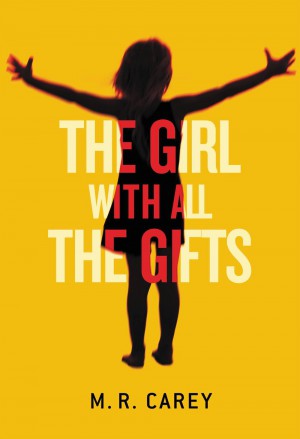
Review: THE GIRL WITH ALL THE GIFTS by M.R. Carey (Orbit)

CareyMR-GirlWithAllTheGiftsA superb novel, one of my favourite so far this year

Melanie is a very special girl. Dr. Caldwell calls her “our little genius”. Every morning, Melanie waits in her cell to be collected for class. When they come for her, Sergeant keeps his gun pointing at her while two of his people strap her into the wheelchair. She thinks they don’t like her. She jokes that she won’t bite, but they don’t laugh. Melanie loves school. She loves learning about spelling and sums and the world outside the classroom and the children’s cells. She tells her favourite teacher all the things she’ll do when she grows up. Melanie doesn’t know why this makes Miss Justineau look sad.

I have long been familiar with Carey’s comics work – mainly the amazing Lucifer and The Unwritten, both of which I am addicted to. It took me a long time to get around to reading this novel, though, for reasons I cannot quite figure out. Long-time readers of the blog will know I’m a fan of certain types of post-apocalyptic-zombie novels. The Girl With All the Gifts is absolutely brilliant, and one of this year’s Must Reads. I loved it. Continue reading

Rat Queens, Vol.1 – “Sass & Sorcery” (Image Comics)

Writer: Kurtis J. Wiebe | Artist: Roc Upchurch

Who are the Rat Queens?

A pack of booze-guzzling, death-dealing battle maidens-for-hire, and they’re in the business of killing all god’s creatures for profit.

It’s also a darkly comedic sass-and-sorcery series starring Hannah the Rockabilly Elven Mage, Violet the Hipster Dwarven Fighter, Dee the Atheist Human Cleric and Betty the Hippy Smidgen Thief. This modern spin on an old school genre is a violent monster-killing epic that is like Buffy meets Tank Girl in a Lord of the Rings world on crack!

Collects: Rat Queens #1-5

In the tradition of Skullkickers (also published by Image) and Princeless, Rat Queens is a tongue-in-cheeky, funny take on traditional sword-and-sorcery tropes. We have the classic fantasy band of adventurers, with an amusing dynamic. That they happen to all be women is a nice touch, too, and Wiebe clearly shows (without any type of preaching) that there’s no reason why only big, hulking male barbarians or wizened, white-bearded sages have to be at the centre of fantasy adventures. Someone in the Rat Queen’s home town is setting up the local mercenary bands – engineering deadly assignments intended to eradicate them entirely. Unfortunately for the conspiracists, the Rat Queens won’t go down without a fight, a lot of killing and plenty of raucous fun.

RatQueens-01-Prev2

As the first volume, we’re still only just getting to know the characters by the end, but I am very eager to read more of their adventures. There is a perfect balance between action, story, and just plain fun in this first volume. At the same time, Wiebe does not ignore the importance of character development, and we start to see them develop a good deal over the course of this collection – there’s still plenty of scope for expansion, which I have no doubt the creative team will firmly exploit in the future.

RatQueens-01-Prev1

There were so many great touches throughout that just made me like the characters more – the unusual, perhaps conflicting character traits and mannerisms they have round them out wonderfully (one, for example, has extreme social anxiety, despite being able to throw down with a troll – below), and even after this short introduction to them, we start to see them as fully-rounded, three-dimensional characters. The dialogue and interaction between the cast is sharp and funny. There are a fair few background gags and asides that a quick read might miss (poor, put upon Dave, for example).

RatQueens-02-Prev2

The artwork is clear, if slightly cartoony. This does not detract from the story, rather it enhances and complements it perfectly – Upchurch realises the action and visual gags extremely well. Like my other favourite artists, Upchurch has a gift for drawing and presenting facial expressions, and conveying so much with a simply smirk, raised eyebrow, or knowing glance. It really adds an excellent, bonus nuance to how the characters interact with each other.

A must-read for fantasy and comics fans. Long live the Rat Queens! Can’t wait to read book two.

RatQueens-Vol.1-Content

“Iron Night” by M.L. Brennan (Roc)

BrennanML-GV2-IronNightA second, fine mess Fortitude Scott has got himself into…

Underachieving film theory graduate and vampire Fortitude Scott may be waiting tables at a snooty restaurant run by a tyrannical chef who hates him, but the other parts of his life finally seem to be stabilizing. He’s learning how to rule the Scott family territory, hanging out more with his shapeshifting friend Suzume Hollis, and has actually found a decent roommate for once.

Until he finds his roommate’s dead body.

The Scott family cover-up machine swings into gear, but Fort is the only person trying to figure out who (or what) actually killed his friend. His hunt for a murderer leads to a creature that scares even his sociopathic family, and puts them all in deadly peril.

Keeping secrets, killing monsters, and still having to make it to work on time? Sometimes being a vampire really sucks.

The sequel to Generation V, in Iron Night, we get more of the same – which is by no means a bad thing. We get to see Fort embracing his vampire heritage a little more. Since he started going through his physical changes, he appears to have accepted that he can’t escape what he is, and as a result has stopped rebelling as much as he used to. Iron Night is a solid follow-up, complete with great character development. Continue reading