An Interview with ANNA KASHINA

AnnaKashina-AuthorPicLet’s start with an introduction: Who is Anna Kashina?

I am a biomedical scientist and a writer, not necessarily in that order. My day job is being a professor at a major US university. Writing is reserved for the rest of my time. More recently, I am also a mother of two, which taps seriously into all the other occupations.

Your novel, Blades of the Old Empire, is due to be published in February by Angry Robot Books. How would you introduce the novel to a new reader? Is it part of a series?

I hope readers would see it as an adventure fantasy in the best traditions of the genre, which also includes some elements of romance. It does not push the boundaries or create new concepts, it is intended as a fun, fast-paced read. It is book one of the Majat Code series, with book two, Guild of Assassins, coming out this August. I do have plans for other books in the series and hope to see them forthcoming later on.

KashinaA-MC1-BladesOfTheOldEmpire

What inspired you to write the novel? And where do you draw your inspiration from in general?

As it turns out, these are two separate questions. Generally, my inspiration for writing comes from a desire to get some unresolved emotions out on paper. I can only do it in the form of fantasy, ideally set in a world that does not exist in real life. But a lot of ideas for these stories also come from my dreams. In a big sense, it almost seems as if these worlds do exist somewhere and find their way out into my books.

With Blades of the Old Empire, it was somewhat different. I wanted to write a traditional fantasy. And then, as I sat down to write it, the story just emerged. Once it got going, all I had to do was write it down. So, in this sense, I had an even stronger feeling that not only the world, but this particular story existed somewhere, and just found its way out through me. The feeling was very special, one I still miss.

How were you introduced to reading and genre fiction?

Tolkien-LOTR-1-TheFellowshipOfTheRingI grew up in the former Soviet Union. Back then, reading was pretty much the only form of entertainment available (we had no TV, and people did not go out much). I was reading ever since I can remember; everything I could lay my hands on, but my favorites were always fairy tales and myths, and this probably started my early interest in fantasy. The first true fantasy I read was The Lord of the Rings, and after that I was hooked on the genre.

How do you enjoy being a writer and working within the publishing industry? Do you have any specific working, writing, researching practices?

Now that I have a publisher, I love it. It means I can focus only on my writing and somebody else will do the rest. Of course, I used to see it differently before I found a publisher and an agent.

I write for enjoyment, and I do have a demanding day job; so, unlike many authors, I don’t have a routine in which I must sit down and write something every day. If I need to write something, I just sit down and write it, whenever I can. But the most rewarding times are when I feel inspired, and then keeping from writing becomes a torture and I literally use every available moment to write. This yields some of my best work.

I usually do research as I write, on an “as-needed” basis. If I feel very inspired, I leave blanks for the parts that need researching, sometimes with a note of what needs to be in there, and then fill these blanks later.

When did you realize you wanted to be an author, and what was your first foray into writing? Do you still look back on it fondly?

My first was a self-illustrated “novel” written when I was six years old, which ended with the words “and they sailed to the east, where the sun sets.” When my father politely pointed out to me that the sun actually sets in the west, I was so ashamed that I destroyed that “book”. I am sure it was for the best.

AnnaKashina&VladimirKeilisBorok-NovelMy first novel that I look back fondly on was written when I was in high school, co-authored with my grandfather, Vladimir Keilis-Borok. It is a historical novel about the pirates and Queen Elizabeth of England, written in Russian under pen names. I still think it is very good (probably for young adults) and maybe some day I will translate it into English.

What’s your opinion of the genre today, and where do you see your work fitting into it?

This is difficult to tell. Personally, I really enjoy traditional fantasy that explores the familiar concepts well. I believe there are not enough such books out there – partly because the professionals in the industry, who have literally seen it all, tend to be attracted to new things they have not seen before. As a reader, I still like the old, and I hope we get more books published in the “good old” style. I hope my book would appeal to readers like myself, those who like to have fun with a book and don’t care about anything else.

My books also tend to have lots of romance (which is even more true about the upcoming Guild of Assassins), and I don’t think there are enough books out there that blend fantasy with elements of romance (usually these two genres are somewhat separate). I hope my books will appeal to the readers who are not straight romance fans, but enjoy good romance elements in their adventure story.

What other projects are you working on, and what do you have currently in the pipeline?

The Guild of Assassins is the next in the pipeline. It is a sequel to Blades of the Old Empire, even though each of these books can be read as a stand-alone. I am working on book three in the series.

RabyA-H&T1-AssassinsGambitWhat are you reading at the moment (fiction, non-fiction)?

At the moment I am reading Amy Raby’s Hearts and Thrones series: a great example of traditional adventure fantasy with elements of romance. I am enjoying it very much. I mostly read non-fiction at work, so even though I do have several historical reference books on my shelf, they are on hold for the moment.

What’s something readers might be surprised to learn about you?

I hope, that English is not my first language…? (Unless, of course, my name already gave it away.)

I grew up in Russia and came to America as an adult, so for the first few years I was really conscious about my limitations in the English language. At that time, I felt that if I could make one wish, it would be to know English as well as I know Russian. I feel that in the past decade I have achieved that state, and possibly switched to English as the dominant one.

What are you most looking forward to in the next twelve months?

Well, I am both anticipating and dreading the release of my books. I hope readers will like them, and sitting around and waiting is just so unnerving. I am sure many authors can relate to this feeling, of pouring out your soul, defeating impossible odds, putting your work out there, and waiting for the reaction it would cause… All in all, fingers crossed!

***

Blades of the Old Empire is published by Angry Robot Books in the UK on March 6th and in the US and eBook format today.

An Interview with MATTEO STRUKUL

Italian author Matteo Strukul stops by to talk about his first novel in English, The Ballad of Mila, his broad and varied influences, his inspirational home country, why Chuck Wendig is a “badass wizard”, and much more…

MatteoStrukul-AuthorPicLet’s start with an introduction: Who is Matteo Strukul?

First of all, thank you so much Stefan for this opportunity to talk about my work. Well, about myself… I’m a man who loves life and rock ’n’ roll music (The Black Crowes, Rival Sons, Buckcherry and all the old stuff like Led Zep or Skynyrd). I adore American pulp-crime fiction authors (Jim Thompson, James Crumley, Joe R. Lansdale, among others), but at the same time I read so many European authors and literature (Friedrich Schiller, Wolfgang Goethe, Robert Louis Stevenson, Emilio Salgari), I love Italian red wine like Raboso or Grinton and I love my land that is Veneto in the Northeast of Italy. I’m so lucky to grow up in this area in towns like Padova, Venezia, Verona – so full of arts and beauty, I must confess that it’s an amazing place and for that reason I love to write about my land in my novels.

Your novel, The Ballad of Mila, is due to be published in March by Exhibit A. How would you introduce the novel to a new reader? Is it part of a series?

Yes it is, it’s the first novel in an on-going series, Exhibit A has already bought English rights of the second one, and I’m writing the third exactly NOW. Well, The Ballad of Mila is a kind of “Revenge Movie”: it’s a story about vengeance and blood and you have this amazing woman with long red dreadlocks who is able to face and defeat every kind of man because she was a victim, and now she is a predator and a merciless one. But you have also the Chinese mafia, the Venetian territory, you have non-stop action and torment and rage and hatred and, in the middle of a battle between two different gangs – like in Sergio Leone’s For a Fistful of Dollars – you have Mila, a woman who is also damaged goods and who can’t accept herself for what she became. So Mila is a killer, but at the same time she is broken, in some way she’s a kind of mixture between Luc Besson’s La Femme Nikita and Garth Ennis’s Punisher

MatteoStrukul-BalladOfMilaInfluences.jpg

What inspired you to write the novel? And where do you draw your inspiration from in general?

From stories that I read during the years penned by authors like Victor Gischler, Allan Guthrie, Tim Willocks, Jason Starr, Adrian McKinty, Christa Faust, Duane Swierczynski, Massimo Carlotto, Giancarlo De Cataldo, Don Winslow, Anthony Neil Smith, David Peace, Charlie Huston, Dan Simmons, David Wellington, James Ellroy, Derek Raymond, Cathy Unsworth, Stuart O’nan, Kem Nunn, Cormac McCarthy, Henry Crews. Then, of course, I must mention TV shows like Sons of Anarchy, movie directors like Sam Peckimpah, Sergio Leone, Quentin Tarantino, Robert Rodriguez, Guy Ritchie, Joe Carnahan, among others, and I don’t wanna forget Videogames (Bloodrayne) and Comic books screenwriters like Alan Moore, Warren Ellis, Mark Millar, Garth Ennis, Jason Aaron, and Brian Azzarello.

How were you introduced to reading and genre fiction?

Well, since I was five years old I started reading, and now here we are. I remember that my Mom used to read to me epic poems like Homer’s Iliad and Odyssey. I loved those stories, about heroes and battles and fighting, so this was how everything started.

StrukulM-1-TheBalladOfMila

How do you enjoy being a writer and working within the publishing industry? Do you have any specific working, writing, researching practices?

Well I worked for some years as press agent for an Italian independent publisher: Meridiano Zero. I organized press campaigns for authors like David Peace, James Lee Burke, Derek Raymond and I met Victor Gischler in 2008 in Courmayeur at the Noir Festival, I was his press agent because Meridiano Zero published in that year Gun Monkeys in Italy. It was great and we had so much fun. So, of course this fact doesn’t mean that I was an author in those years but means, without any doubt, that I had a strong background.

Then I founded Sugarpulp, a literary movement focused on pulp-crime fiction and was and am line editor for a crime fiction imprint called Revolver that published authors like Allan Guthrie, Ray Banks, Brian McGilloway, Derek Nikitas among others. At the same time I work as author, my new book will be published by Mondadori in Italy next April and will be a Gaslight Mistery set in Padova and Venezia in 1888 AD. It’s a story about an alienist and a serial killer strongly influenced by Caleb Carr, ALan Moore and Dan Simmons stuff. About writing what can I say? I love my life as writer and editor and comic book screenwriter, you know, I’m free and do what I want. Like Jagger said, “Ha, Ha so I’m a lucky guy, probably the luckiest one in the entire world.” For my last book – The Gaslight Mistery that I mentioned before – well I researched so much because I needed to study the Venetian area of the 19th Century. It was a great challenge. For Mila’s novels, I don’t research so much, but I watch so many movies and TV shows, and I mixed all those things and sequences and feelings, and after that I have a new story. I don’t know how it works, but it’s impossible for me to do a synopsis and those kind of stuff, you know, especially because Mila needs to decide everything and I just have to listen to her and write. Ha Ha.

When did you realize you wanted to be an author, and what was your first foray into writing? Do you still look back on it fondly?

I realized that I wanted to be an author when I was a child. I remember that I wanted to be a rockstar or a pulp-crime writer. It was cool, I remember that I formed a rock ’n’ roll band with my brother. We played rock ’n’ roll stuff, gigs in coffee-bars or small clubs. But it was hard to earn money and fame, so I decided to write my own stories. I started with nonfiction and penned two nonfiction books about two Italian songwriters and I wrote for years as a rock ’n’ roll journalist. I interviewed cool guys like Black Crowes guitarist Marc Ford, Jethro Tull’s Ian Anderson, Zucchero, Dave Matthews, Ryan Bingham, Joss Stone, among others. But, if I must be honest the best interview that I ever done was with Willy De Ville. We spoke together for one hour, he was so cool and generous and he was an amazing and great person and a so talented artist and I remember that after some months or something like that he died. It was shocking and brutal, I remember I wrote a six-page article for a very important Italian rock magazine. It was sad and bitter, but at the end I was so happy to have done something for him, nothing so important but a kind of way to testify all my love for his music and art. In my opinion he was probably the most talented and wonderful singer of the last 30 years.

What’s your opinion of the genre today, and where do you see your work fitting into it?

Well, I love crime and pulp fiction and I think that a pulp-crime author would be able to be popular if will be able to offer amusement and amazing but low-cost stories. And literature, in my opinion, is real literature, if it could be popular and mass market distributed. Professors and Academics and Intellectuals are so boring and selfish and in fact they use literature like a weapon to divide and create differences between high culture and low culture, between upper and middle class and common people. Fuck them all! Man, it’s a shame. I want to be a honest pulp writer and create good and strong characters.

Wendig-MB3-CormorantFor example, recently I read Chuck Wendig’s Miriam Black’s three books series: Blackbirds, Mockingbirds and The Cormorant… well it was a real roller-coaster, I loved that series. Chuck is a wonderful author, and is able to mix pulp, horror, urban fantasy, crime fiction… He is a badass wizard. At the same time, I think that I wanna try to write some historical novel, especially a big story that I have in my mind about The Northern Crusades with kings, knights, witches, female warriors, wild tribes, castles, snow and tortures, I think could be a very interesting setting.

What other projects are you working on, and what do you have currently in the pipeline?

WillcocksT-TwelveChildrenOfParisAs I said, my new Gaslamp Mistery novel for Mondadori, I’m writing also the third Mila Zago novel and a double book story about Teutonic Knights, and I’m writing a graphic novel, drawn by an amazing Italian artist, Filippo Vanzo. I’m also writing the second ebook novella together with Marco Piva Dittrich for my on-going series about Skuld, a she-werewolf who’s fighting the Nazis during the WWII and I’m editing Tim Willocks’s The Twelve Children of Paris for an Italian publisher. I have many other projects in the pipeline, including comic-books and… movies… but I must keep my mouth closed and, much important, keep my fingers crossed.

What are you reading at the moment (fiction, non-fiction)?

WellingtonD-W1-FrostbiteI just finished reading David Wellington’s Frostbite, a werewolf tale: an amazing novel.

What’s something readers might be surprised to learn about you?

Probably that I love Ice Hockey, I’m a big fan of Asiago Hockey 1935, my favorite Italian team. Ice Hockey is quite popular in the North East of Italy. Maybe the reason why I love so much this sport is because when I was a child, I lived for two years in Canada: Vancouver, British Columbia. I remember when I watched Vancouver Canucks on TV with my father, so maybe that’s the reason why I love ice hockey so much. I am also a big Philadelphia Flyers and Montreal Canadiens fan. Ice hockey has an important role in Mila’s novels, ha ha. I’m not kidding…

What are you most looking forward to in the next twelve months?

Well, I’m very curious to see if Mila could break English and American readers’ hearts. I hope they would be so generous and kind to give Mila a chance. So thank you so much, Stefan, for what you have already done for her… and me.

*

Be sure to follow Matteo Strukul on Twitter, and check out his website for more information on his writing and projects. The Ballad of Mila is published by Exhibit A in March 2014 (UK & US). Here’s the synopsis:

Imagine Elmore Leonard behind the wheel of a car in Grand Theft Auto, as one Italian woman sets out to cut the mafia down to size – one limb at a time…

Two perfectly matched gangs are fighting for control of the north-east Italian region of Venetia. But a formidable young woman with vengeance on her mind has plans to upset the balance. Abandoned by her mother and violated by a gang of criminals just after they slaughtered her father, Mila Zago is a cold-blooded killer, a deadly assassin. Brought up by her grandfather on the Sette Comuni plateau under a rigid martial code, she returns home to seek her revenge, conspiring to create a spectacular showdown reminiscent of A Fistful of Dollars.

The Ballad of Mila is the first novel in an ongoing series focused on the formidable female Italian bounty hunter Mila Zago, a.k.a. Red Dread.

An Interview with SEBASTIEN DE CASTELL

deCastell-AuthorPicBack in November, I stumbled across some information about Sebastien de Castell’s Traitor’s Blade on Jo Fletcher Books’ website. Naturally, I was very intrigued. Then, in January, an ARC of the book appeared, and I dove right in. To put it bluntly, I loved it: a perfect blend of action, intrigue, humour, and all-round great storytelling. This novel is going to cause a splash, as well it damn well should. Read on for an interview with de Castell…

Let’s start with an introduction: Who is Sebastien de Castell?

I guess you could say that I’m a professional wanderer. I love to take on challenges in new fields and learn everything I can. These days I write fantasy and mystery novels but in the past I’ve been a full-time musician, an interaction designer, teacher, project manager, fight choreographer, actor, and, well, lots of other things. (At least one of which I’m keeping secret until my deathbed!)

Your debut novel, Traitor’s Blade, is due to be published in March by Jo Fletcher Books. How would you introduce the novel to a new reader?

The Three Musketeers meets A Game of Thrones. It’s a swashbuckling mystery set in a country that is being torn apart by corruption and intrigue. Continue reading

An Interview with SUSIE MOLONEY

MoloneySusie-AuthorPic(Richard-Wagner-2010)Let’s start with an introduction: Who is Susie Moloney?

I’m a writer of horror fiction, and I live in Canada and the US, spending half my time in New York City with my playwright husband, Vern Thiessen. I’m a mom to two sons and a blind dog, and I love them all equally, no favourites.

I’ve been writing stories since I could hold a pencil, although when I first started writing, I used to illustrate them as well, and color the pictures. Somewhere there’s a pretty epic illustrated story about a black water beetle (“Blackie’s Story”) who isn’t black, but green. No black crayon.

To date, I’ve written four novels, Bastion Falls, A Dry Spell, The Dwelling and The Thirteen. My claim to fame is that A Dry Spell received the largest advance ever, in Canada. That may have changed by now, but it was a big deal back in the day. I’ve been on the cover of two national magazines. The week my cover on Chatelaine came out, was the week that Princess Diana died. True story: I walked into an airport bookstore to pick up something to read on the plane, and there was my cover, right next to the People Magazine Princess Diana cover. I turned around and ran out. It was too overwhelming, my face right next to hers. I read the in-flight magazine that trip.

Things Withered, Stories is my very first collection. I’m no longer a collection virgin.

MoloneyS-ThingsWithered

What inspired you to write these particular stories? And where do you draw your inspiration from in general?

All my inspiration comes from really mundane, prosaic sources. I know everyone says that. But I’ll tell you, regular, ordinary everyday people terrify me. You know why? Because everyone has something special about them. Everyone. We were raised on that tenet. So if some regular Joe is standing in front of you, and you can’t quite tell what’s special about him — I just naturally assume his special quality must be that he’s a serial killer. Or what if he’s a vampire (if it’s at night), or a warlock hell-bent on collecting enough souls to pay a debt to Satan? What if there’s a suburban mom, slowly letting her oppression and anger drive her into madness and as a means of releasing that horrible pressure cooker of rage, she poisons cookies and brings them over? What if the cookies are super-good and you eat like, ten of them (not saying I’ve ever eaten ten cookies at once)?

I’m pretty sure regular, ordinary, everyday folk are seriously dangerous.

How were you introduced to genre fiction?

Blatty-TheExorcistThe first genre book I ever read, if you can call it a genre book, was The Exorcist. I’m pretty sure I wasn’t supposed to read it, I was only a little kid. I certainly knew enough to read it with a flashlight in the cubby hole at my grandparent’s house. It was sufficiently terrifying that I went on to read Jaws I think that same summer. By the time I was a teenager, people were passing around Salem’s Lot by Stephen King and I alternated between horror and those bodice rippers that were all the rage in the ’80s (an entirely different kind of horror).

Up until then I was writing stories about my dog and the odd love story. Often someone died in what I wrote. After I finished reading Cujo, also by King, I just wanted to write something in the tone and mood of that book — and so was born Bastion Falls, my first novel.

MoloneySusie-FirstStephenKing

How do you enjoy being a writer and working within the publishing industry? Do you have any specific working, writing, researching practices?

Publishing has changed so much since my early days! In a lot of ways it’s much better. We do seem to be in some kind of a transition phase and I’m curious to know where it ends up. This is the most literate epoch in human history — we’re constantly communicating. Email, Facebook posts, Twitter (literate in 140 characters!). Everyone is clever and interesting and sharing. I love/hate it. Being a writer is no longer a special career! On the other hand, there has never been so much access to such an incredible variety of experiences and perspective, that a seeker of the human experience is the beneficiary of an embarrassment of riches, the likes of which have never been seen.

MoloneyS-TheThirteenAs for writing practices, the only thing I consistently do is burn a candle while I write. Makes me feel like I’m in a dark garret in the middle of Paris (never been, I hear they have garrets).

When did you realize you wanted to be an author, and what was your first foray into writing? Do you still look back on it fondly?

Aside from the aforementioned “Blackie’s Story,” the first substantial piece I ever wrote was about a single-mother vampire by the name of Aria. This was long before the Twilight days, long before vampires were ever even a thing — how about that, right? I invented vampires (maybe not — should probably Google-check that). The story came out of my experience of being a single mom back in the days when that was a bad thing. I felt like a monster much of the time, and I suppose that was my way of dealing with it. In the story the little boy is not a vampire and the mom — Aria — does her best to raise him even as she tries to adapt to her new form. There’s a version of it in Things Withered at the very end of the book, a short film script I wrote to adapt the story in some way.

MoloneyS-TheDwellingWhat’s your opinion of the genre today, and where do you see your work fitting into it?

I love how many women are writing genre now, and how that’s changing the face of genre. I have my favourites, like Gemma Files, Kaaron Warren, Barbara Roden — her book Northwest Passages is absolute not-miss — Tananarive Due, these are all great writers who are writing genre.

I never quite feel like what I’m writing fits exactly into the genre category. It’s not a perfect fit like some of the women I’ve listed. I feel like I’m writing about very dark subject matter, with some supernatural elements.

What other projects are you working on, and what do you have currently in the pipeline?

I’ve started a new novel, but it’s always slow going in the beginning. I always think of the first four-five months of a new novel to be the “mistake-making” time. I change my mind about the direction a character is taking and have to rewrite, or I decide one character is more important than the one I felt was the protagonist and have to rewrite, or I have an existential crisis and decide to spend a week drinking too much, doubting the value of my existence and the value of words in general, and have to spend some time drying out. I’m nearly through this part. Also, there’s still lots of crying.

This new (currently untitled, or more accurately, over-titled) is the first time I’ve written “in period.” It takes place in the very early ’70s. It requires more research than you’d think. Who remembers? You know what’s fun about it? Listening to the music of the time and remembering that most young girls listened to AM radio. Wow that was some really bad music (“Go Away Little Girl”, Donny Osmond), and some really exceptional stuff (“Ain’t No Sunshine”, Bill Withers).

What are you reading at the moment (fiction, non-fiction)?

EndicottM-TheLittleShadowsRight this very moment I’m reading The Little Shadows by Marina Endicott, a stunningly written story about a mother and her daughters on the Vaudeville circuit around the time of the first world war. I’m also reading Manson by John Gilmore. I’m a Gilmore fan, love his gritty edge, his no bullshit style.

What’s something readers might be surprised to learn about you?

I’m totally obsessed with Bonnie & Clyde. I have about twenty books on the subject and I’m sure I know everything there is to know about the deadly couple. I once started a screenplay, told from Bonnie’s POV and I called it “Dirt.” Never got very far with it, but I think about picking it up again about every six months. I also have a more minor obsession with Tudor history and the reformation. I like to think that gives me Nerd status on the street. I got juice, man.

What are you most looking forward to in the next twelve months?

I have a couple of projects that I’ll see the end of. It’s always nice to finish things. And I have the new novel… I’m hoping that my schedule will clear up enough so that all I’ll be working on is the new book. There’s something so extraordinarily wonderful about waking up in the morning and knowing that the only thing you have to do is toss yourself into the world you are creating and not come up for air until it’s dark.

I do love the dark.

***

Things Withered is out now, published by ChiZine Publications.

An Interview with SIMON BECKETT

BeckettS-StoneBruises

Simon Beckett’s Stone Bruises is one of my most-anticipated thriller novels of 2014. I was very happy, therefore, to get the chance to interview the author. Read on, fair reader, for Beckett’s thoughts on writing, his latest novel, and more.

Let’s start with an introduction: Who is Simon Beckett?

BeckettS-TheChemistryOfDeathI’m the author of four crime thrillers featuring David Hunter, a British forensic anthropologist. I’ve worked as a freelance journalist for most national newspapers and colour supplements, and the idea for the Hunter series came after I was commissioned to write a piece on the Body Farm in Tennessee, where real human cadavers are used to research decomposition. It was a gruesome but fascinating experience, and provided the basis for the first David Hunter novel, The Chemistry of Death. My aim was to draw on some of the forensic techniques I’d seen used in the US but with a British main character and a British setting. And to make it scary, as well.

I thought we’d start with your fiction: Your latest novel, Stone Bruises, will be published by Transworld in January 2013. How would you introduce the novel to a potential reader? Is it part of a series?

Stone Bruises is a standalone novel rather than part of a series. It’s a psychological thriller that opens with a young British man, Sean, abandoning a bloodstained car in rural France. He’s obviously traumatised and on the run, although we don’t know what he’s trying to escape from. When he’s badly injured in what might be described as “suspicious circumstances”, he regains consciousness to find he’s being cared for by two young women on a dilapidated farm. He’s not sure if he’s a patient or a prisoner, but despite falling foul of the women’s violent father, he begins to regard the farm as a perfect hiding place. Except that he’s not the only one with secrets, and as his own story emerges we come to realise this might not be the idyllic retreat that Sean imagines.

What inspired you to write the novel? And where do you draw your inspiration from in general?

I don’t think I could say anything inspired me, as my ideas tend to come from a variety of different sources. But when I was younger I hitchhiked in France myself, so I know how remote some parts are – and how difficult it can be to hitch a lift. So I came up with what I thought was a strong opening scene, and then built the story and character from there.

BeckettS-StoneBruises

How were you introduced to genre fiction?

I read a lot of horror and science fiction as a kid, and then started reading crime after someone recommended Raymond Chandler. That was quite an eye-opener, as until then I’d thought crime was all fusty, murder-in-the-drawing room-type-stories. It made me realise that what’s loosely categorised as “crime fiction” can cover a huge range of different styles and stories.

How do you enjoy being a writer and working within the publishing industry? Do you have any specific working, writing, researching practices?

I’m lucky being able to make a living doing this, although it isn’t something I take for granted. I always try to make each book better than the last, which can make life difficult sometimes but stops you becoming complacent. I try to work more or less office hours, but that often goes out of the window. The main thing is to be disciplined, and keep going.

SimonBeckett-AuthorPicWhen did you realize you wanted to be an author, and what was your first foray into writing? Do you still look back on it fondly?

I’ve always enjoyed writing, and took an English degree that had a creative writing element. But after I graduated I found I’d nothing to write about and stopped altogether for a few years. I wound up doing various jobs, from playing in bands to property repairs, but at the back of my mind I still had an urge to write. Then I got a job teaching English as a foreign language in Spain, and since I only worked evenings I had a lot of free time. So I started writing again, but even then it still took me several years to actually get anything published. 

What’s your opinion of the genre today, and where do you see your work fitting into it?

I think crime fiction seems very healthy at the moment. It’s hugely popular and I think maybe there’s less literary snobbery towards it now than there used to be. Which is only right: some crime fiction is good and some isn’t, just like anything else. As for where I fit in, I don’t really think of it in those terms: I just write the best stories I can, and try to make them as believable and unpredictable as possible.

What other projects are you working on, and what do you have currently in the pipeline?

At the moment I’m working on the next David Hunter novel.

BoydW-007-SoloWhat are you reading at the moment (fiction, non-fiction)?

I’m reading Solo, the new James Bond thriller by William Boyd. I’m a long-time fan of Ian Fleming’s original Bond novels and Boyd is a very good writer, so I have high hopes.

What’s something readers might be surprised to learn about you?

Hard to say. I play percussion – congas and bongos – though not as much as I used to. I suppose that might surprise a few people.

What are you most looking forward to in the next twelve months?

I try not to think too far ahead. But I’m looking forward to Stone Bruises being published in January.

***

Stone Bruises is published tomorrow in the UK, by Bantam/Transworld Books.

An Interview with TAYLOR STEVENS

StevensT-TheInformationist

Taylor Stevens is the author of the new thriller THE INFORMATIONIST. It has an interesting premise and a pretty unique-seeming protagonist. Naturally, I wanted to learn more after the book arrived in the mail, and so Stevens’s UK publicist (Arrow) kindly set up this interview…

Let’s start with an introduction: Who is Taylor Stevens?

I’ve been asked many, many questions but this is the first I’ve been presented with this one, so let’s see: Officially, Taylor Stevens is an award-winning, New York Times bestselling author, whose books have received critical acclaim, are published in over twenty languages, and whose first title, The Informationist, has been optioned for film by James Cameron’s production company. Unofficially, Taylor Stevens is a harried, fulltime working mom, who juggles after-school activities and all the crazy that goes into running a household, with making up stories to pay the bills.

Your latest novel, The Informationist, was published by Arrow in December. How would you introduce the novel to a potential reader? Is it part of a series?

The Informationist is the beginning of tragic, intense, victorious, globe-trotting, rollercoaster-ride of a kick-butt series, though I had no idea that would be the case when I wrote it. As readers, we tend to categorize books because this allows us to explain in quick brushstrokes how they fit into the reading experience. For that reason, these stories are labeled thrillers, although there is more to them than that. They are in the vein of Jason Bourne, or James Bond, or Jack Reacher—albeit with a woman in the lead who could go toe-to-toe with any one of the men.

What inspired you to write the novel? And where do you draw your inspiration from in general?

Well, the impetus and inspiration winds so far back that we would take pages to get to the root of it, but in its most concise version: I had lived in Equatorial Guinea, a tiny island off the coast of Central Africa, for a little over two years. When I made the decision to start writing, it was because I wanted to bring this country to life for readers who might never have the chance to visit. Without a doubt, the first two books are drawn heavily from things I lived and experienced, but we’re heading into the fifth book now and, as I often joke to my readers, “I only have so much life trauma to pull from and I’d really like to keep it that way.” World news and current events work quite well as alternative source material.

StevensT-TheInformationist

The Informationist UK Cover

How were you introduced to thrillers/crime fiction?

Somewhat by accident, I think. When I first began writing fiction, I had no concept of genre. I had been born and raised in a very strict, isolated, and controlled religious environment in which my education stopped completely when I was 12 years old. We weren’t allowed to watch TV, or listen to music from the outside, and were also forbidden from reading fiction. When finally I was free of that and able to make my own choices, not only did I have no reference as to what authors to read, I was too poor to go to bookstores to buy books. Everything I read came to me second hand, and as it was, most of the novels were suspense and thrillers. So I came to fiction with the understanding that stories were meant to be “exciting,” and that was what I emulated when I began to tell stories of my own — which actually worked out quite nicely given that writing suspense is what I’m good at.

How do you enjoy being a writer and working within the publishing industry? Do you have any specific working, writing, researching practices?

I cannot even imagine what life would have been like had this whole “writing thing” not worked out. I’m overwhelmed by the goodness that has come through the publication experience, ever grateful for each day that passes wherein I’m able to pay the bills while still being available for my children. That said, I do not really consider myself a “creative” or even a “writer” so much as a storyteller who happens to use the written word as the medium for communication. My personality is more inclined toward spread-sheets and paperwork, so imagining the stories to life is what’s most difficult about the process. Once the stories are built, the bean-counter in me gets to have fun with the editing and tightening, which is handy I suppose, because revision is where the craft lies. As far as writing and researching practices, these have changed often throughout the years, but the one thing that has been consistent is “butt in chair.” That’s the only way to get a book written.

StevensT-InformationistUS

The Informationist US Cover

When did you realize you wanted to be an author, and what was your first foray into writing? Do you still look back on it fondly?

You see, this is a very difficult question to answer. Growing up, I had no concept that “being an author” was even an option. Thoughts of becoming a doctor or lawyer, bartender or chef were as foreign as those of becoming a handyman within one of the communes — which, in our culture, was strictly a male job. As a girl, the best I could hope for was to become a personal assistant to one of those higher up the cult food-chain, and in my early twenties I did wind up in that unpaid position for a few years. As children we were essentially child labor, and as we had no mental stimulation and we were so bored, I would make up stories for entertainment. When I was fourteen, I started writing them down, but this turned out very badly. When my notebooks were discovered, I was isolated from my peers and the “demons” “exorcised” and my writing was confiscated and burned. I was told never to write fiction again, or else. I was in my thirties, at home with two babies, when I realized that I wanted to give storytelling another try. But I didn’t start writing with the idea of “becoming an author.” I wrote just so I could say I had finished a book, and to give a finger to the people who had controlled me in the past. There was no way I could have possibly predicted or even imagined what would follow from the determination to see that one decision through.

Taylor Stevens (credit must be used Alyssa Skyes)

Taylor Stevens (Credit: Alyssa Sykes)

What’s your opinion of the genre today, and where do you see your work fitting into it?

To be honest, I have no idea. I’m still sorely under-read and rather painfully oblivious to current trends. I know that there is so much available for readers to explore and that my books are just a drop in a vast ocean of goodness. I’m completely honored to be part of that ocean, though, and treasure every one of my fans and readers — they’re the ones who’ve kept me in business and I owe them a huge debt of gratitude.

What other projects are you working on, and what do you have currently in the pipeline?

The next in the series, THE INNOCENT, takes readers inside the cult of my childhood. It is as close to real life as I could get in a genre-specific, word-count based, fictional format. For that reason, it is more psychological and has less blood and violence than the first — but the realism is uncomfortably accurate. The high octane continues with THE DOLL, and in the United States we are now getting ready to publish the fourth in the series, THE CATCH. I’m excited because with each new title I hear from more readers, and I do love to interact with my readers. For those who are interested, I email regularly via my website.

What are you reading at the moment (fiction, non-fiction)?

SmithHW-PowerOfPerceptionI’m a firm believer in the need for continual self-growth. I feel that the more I am able to shed bad habits and wrong ways of thinking, the happier and more balanced my life will be — and there is always room for improvement. I have just finished Power of Perception by Hyrum W. Smith. It’s a tiny book, basically the direct transcript of a speech that he gives, but the principles, simple as they are, are life-changing. Based on how much I appreciated the speech, I purchased two of his older books, 10 Natural Laws of Successful Time and Life Management and What Matters Most: The Power of Living Your Values, and plan to start them shortly.

What’s something readers might be surprised to learn about you?

Considering the characters that I write and the life background I’ve risen from, readers are often surprised—perhaps disappointed—to discover that I’m very sweet, happy, empathetic, content, and polite in real life. I also cry when I see or experience something beautiful, or when something makes me happy (which is often).  And I hate suspense and blood and gore, which I find hilarious, seeing as that’s exactly what I write. I suppose it’s different with my own work because I get to control the story and I know how it ends. I love spoilers. Sometimes that’s the only thing that will get me to watch a particularly suspenseful movie. With suspenseful books, I have to read the last chapter first.

What are you most looking forward to in the next twelve months?

Over the past few years, during quiet spells, or while waiting to receive material back from my publisher, I’ve worked on side project geared more toward a younger audience. Oblivious as I am, I couldn’t say what genre the book is, only that it’s not a thriller. I finally finished the writing just last month and the response from test readers has been quite enthusiastic. The manuscript is in the hands of my agent now, and I’m nervous because it’s unlike anything I’ve done before. If I could have a wish granted over these next twelve months, it would be to see something wonderful happen with that story. I’m also quite excited to begin on the fifth book in the Vanessa Michael Munroe series.

*

Be sure to visit the author’s website, and follow her on Twitter and Facebook, for more information and news. The Informationist by Taylor Stevens is available now (Arrow Books in the UK, Crown in the US).

An Interview with DAVE HUTCHINSON

Let’s start with an introduction: Who is Dave Hutchinson?

Dave Hutchinson is a 53-year-old journalist and writer, born in Sheffield and living in London. He likes cats and hates mushrooms. He is obsessed with Twitter to a disturbing degree.

HutchinsonD-EuropeInAutumnYour latest novel, Europe In Autumn, is published by Solaris. How would you introduce the novel to a new reader?

Europe In Autumn is, for want of a better term, a near-future espionage thriller. It’s set in a Europe where the EU has begun to fracture for various reasons, and new nations are springing up all over the place. Rudi, the central character, is a chef who becomes involved with a group of couriers and people smugglers, and finds himself mixed up in what may be a very large conspiracy. It wasn’t originally planned as part of a series, but while I was writing it I had an idea for a companion novel, and since I finished it I’ve started to see a possible sequel. We’ll see how things go.

What inspired you to write the novel? And where do you draw your inspiration from in general?

Inspirations… that’s a tough one. Alan Furst’s novels were a big influence on the feel and structure of the book, and Anthony Bourdain’s Kitchen Confidential inspired me to make Rudi a chef. Further back, Len Deighton’s definitely an influence, as is Keith Roberts. More widely, ideas come from anywhere. You can be reading the paper and a phrase will jump out at you and set off a chain of association that will wind up with you writing a story. Other times a bit of dialogue will pop into your head, or you’ll see something, and a few months later you’ll see something else and sort of subconsciously bolt them together, and that keeps happening until all the bits reach critical mass and you find yourself sitting down and starting to write. It’s just a matter of keeping your eyes open. That’s the easy bit; it’s the writing that’s hard.

How were you introduced to reading and genre fiction?

WellsHG-FirstMenInTheMoonI’ve been a fan of science fiction ever since junior school, when I read First Men In The Moon. It was really the only thing that seemed interesting to me, and I spent years working my way through Asimov, Heinlein, Niven, E.E.  ‘Doc’ Smith and so on. Then I read Funeral In Berlin and really got into spy fiction. Then I read Farewell, My Lovely and really got into crime fiction.

How do you enjoy being a writer and working within the publishing industry? Do you have any specific working, writing, researching practices?

I find writing very, very difficult. I’m an enormously lazy writer – I was picking around at Europe In Autumn for at least ten years, probably longer – but I love doing it. I love the act of imagining something and describing it, and seeing that turn into a book, an object you can actually hold, is a continual delight to me. It’s a very different discipline to journalism, which – at least in the journalism I did – doesn’t allow great scope for creativity. It does, however, knock any prima donna tendencies out of you; I once wrote a double-page feature on the Reagan-Dukakis Presidential election and saw it subbed down to four column inches.

When did you realize you wanted to be an author, and what was your first foray into writing? Do you still look back on it fondly?

I wanted to be a writer very early on – I was scribbling little stories in notebooks when I was about thirteen or fourteen. My first novel was a rip-off of the Lensman books. It was awful beyond belief, and the world is far better off without it. When I was sixteen my mother bought me a typewriter, and that’s really where I date my writing “career” from. And since then it’s just been a long slog of stories, some better than others.

What’s your opinion of the genre today, and where do you see your work fitting into it?

One of the things I like about science fiction is the way it’s constantly examining itself, asking itself questions. I’m not sure other genres do that. Sometimes, I think science fiction puts itself to the question a little too harshly, but it keeps everyone on their toes, keeps things moving forward, and that’s healthy. I think I’ve been seeing articles about how science fiction is dead, or at least stagnant, for the best part of forty years, but it always keeps going, there’s always new blood coming through, new points of view, new questions to face. If my stuff does fit into it at all, it’s in a small, quiet, English kind of way.

What other projects are you working on, and what do you have currently in the pipeline?

At the moment I’m working on the companion to Europe In Autumn, which is a kind of parallel view of some of the events in the first book. I’m also working on a novel called Gunpowder Square, which is a detective story involving gnomes and the nature of Reality. There will also be a book of previously-uncollected short stories at some point either this year or next from NewCon Press.

What are you reading at the moment (fiction, non-fiction)?

Right now I’m re-reading Alexandra Richie’s fabulous biography of Berlin, Faust’s Metropolis, which is an utterly terrific book, I really can’t recommend it highly enough. I’m also reading Dracula for the first time, and I’m finding it a bit of a surprise. Which is always good.

HutchinsonDave-Reading

What’s something readers might be surprised to learn about you?

What would readers be most surprised to learn about me? I’m not sure anything would surprise people who know me. I was once quite athletic – I was Sheffield City discus champion, back in the day. But then I discovered the joys of sloth and I haven’t looked back since.

What are you most looking forward to in the next twelve months?

I have a feeling the next twelve months are going to be a period of great change for me. Some of it for good, some of it maybe not so much. I’m really looking forward to Europe In Autumn coming out, though. It’s amazing to me to think that this thing, which began over a decade ago as a bunch of notes and bits of dialogue, is now a physical object which other people are reading, and whatever happens I’ll always be grateful to Solaris for taking a chance with it. A lot of writers aren’t so lucky.

An Interview with JOHN MEANEY

MeaneyJ-R3-Resonance

John Meaney is the author of the now-complete Ragnarok science fiction trilogy and more. His latest novel, Resonance, was published in December 2013, and I thought this would be a perfect time to get in touch and ask him about his work, the trilogy, and more…

Let’s start with an introduction: Who is John Meaney?

Just some weird bloke, you know?

A little grey-haired geezer who might surprise you by dropping into box splits at fifty-six years of age. Runs up mountains and lifts big, rusty weights. Pounds the crap out of heavy punch bags. Survived over forty years of martial arts training, despite or because of starting out as a podgy, asthmatic couch potato. Didn’t feel he’d accomplished anything until twenty-five years after starting, when he left the elite shotokan dojo of the late Enoeda sensei (as the least of the students) and realised what he’d been through.

As a young guy he dropped out of his original physics degree in his final year, due entirely to a philosophical crisis, and wrote unpublished fiction before getting his head together. He passed up the chance of finishing the degree and took a programming course instead, leading to his first computing job. At the same time, he studied all the higher-level physics and computer science modules that the Open University offered and gained his degree with the OU. Recognised as a physics graduate by the Institute of Physics, he later gained an MSc (with distinction) in Software Engineering at Oxford University. Despite being a working-class boy raised in Slough, he thinks that Oxford rocks.

He worked for three IT departments in the South East during the 1980s, was a senior consultant for a Very Large Software House during the 90s, and worked for an IT training company before becoming a freelance trainer and consultant, so that he could manage his time for writing books. Bizarrely, his most interesting computing assignments came after selling his first novel, and involved frequent travel to the US and Europe, and a couple of trips to Asia.

He lives in Wales, laughs a lot, and hardly ever takes himself seriously.

MeaneyJ-R3-Resonance

I thought we’d start with your fiction: Your latest novel, Resonance, was recently published by Gollancz. It’s the third in your Ragnarok series – what can fans of the series expect from this final book? How would you convince a new reader to check out the series?

In the first book’s prologue, you meet resurrected humans in crystal bodies, waking up on the Moon and staring up at space. One of the stars in Orion’s belt has changed colour, which means that a million years have passed since the humans lived their original lives. And the mysterious Kenna, their leader, makes it clear that the final battle, Ragnarok, is imminent.

After the first two books, readers know that a darkness has subtly influenced selected individuals across millennia of human history, starting in what we now call the Viking Age, and significantly during the twentieth and twenty-seventh centuries. And they’ll know that the darkness commenced its voyage from the far side of a cosmic void that’s one hundred and fifty million lightyears across, and has been heading for our galactic centre for at least that number of years.

MeaneyJ-Ragnarok1&2

They’ll also have been following the intricate links between the various timelines, both overt and covert, obvious and subtle. If the readers are astute, they’ll have paid particular attention to surnames, since a passing character in one timeline may be the ancestor or descendant of someone they know from another century.

What I’ve promised is Ragnarok, or Ragnaroekkr, as a galaxy-spanning battle that follows on from the previous machinations. And with luck I’ve delivered, with billions of resurrected humans following the nine leaders whom you may (or may not) expect. (One of the subtleties is that everything comes in threes and nines, primarily nines, matching Old Norse memes, including their cosmology.)

To the new reader, the good news is that you don’t have to wait for the ending! Try the books if you like multiple-timeline stories: there’s a 27th century timeline that forms the spine, comprising every second chapter, set in the Pilots future that features in four of my other novels. Cities where quickglass buildings alter their shape, including room furnishings, at will. A city-world in the golden fractal continuum that underlies this universe. Political intrigue within and across the universes.

The 20th century timeline features a Jewish physicist whom you first meet as a student in 1920s Zurich, before she escapes Europe to work in Bletchley Park and later for its intelligence-community descendant, one of the few who can perceive the darkness. Her conflicted Russian counterpart is an agent of that same darkness.

Among the Norse, a young warrior originally called Ulfr will also face the darkness, and in many ways become the enemy, while his actual enemy Stigr, the one-eyed poet, is his darkness-controlled nemesis. In total there are five important timelines running through the trilogy, with some others added painlessly as we go along .

And everything links together. I made it happen.

To the long-term reader, here’s something which appears to make folk smile: the Ragnarok trilogy spans a far greater period than my Nulapeiron trilogy, whose mere 1400-year duration is buried deep within the Ragnarok timeframe. In Resonance, the final Ragnarok book, some of the key chapters take place on Nulapeiron…

I haven’t just linked a tangle of timelines together in one trilogy. I’ve linked every single short story and novel that I’ve ever written in the Pilots universe, that’s twenty years of my life, all coming together in Resonance. And in a way that also works, so I’m told, for someone who’s not read any of that other stuff.

Spacetime is big. We are thin ghosts in a universe whose greatest density of stuff consists of something whose properties we don’t know and which we cannot see, hence dark matter and dark energy. For dark read invisible. And this is the universe we really, really live in.

My goal has been to write an exciting story that hints at the cosmic context which is all around us, all the time.

MeaneyJ-NulapeironTrilogy

What inspired you to write this series? And where do you draw your inspiration from in general?

The general mental process involves a foreground/background duality. Fragmented visual images of particular scenes come to me, and set up a tension against a more abstract visualisation of – typically – weird but real physics.

For the latter, I mean concepts like the absence of timeflow, of past-present-future, from any of the equations that are considered fundamental. Time appears as a geometric dimension, not something with flow. And photons can travel a billion lightyears in a vacuum, can be created and destroyed with a lifetime that is literally zero in duration. Or they can be slowed down passing through a medium, and begin (after perhaps a billion lightyear journey that was instantaneous) to experience time.

This is John’s brain on physics…

More normally, one of the particular human images that came to me was Ulfr, a young Viking, walking into a village to see one of his friends tied to a post while the other villagers throw axes at him. I know where that came from.

ColumP-NordicGods&HeroesWhen young, I read poet Padraic Colum’s Norse tales for children. A decade later, I read more deeply, and was struck by a particular paradox: gay Vikings (not a term you meet every day: stereotypes are insidious) were often punished in exactly that manner – tied to a post and used as a target for axes – while Loki and Odin were themselves practitioners of dark magic, called seithr, being shape-shifters and gender-changers. The Trickster and the All-Father both belonged to the dark side, at least partly, unlike Thor and his mates.

I use different spellings for the mythological names in the books, incidentally, partly because I got all geeky about Old Norse, partly to distinguish what I was writing from, let’s face it, the Marvel universe. (I’m not knocking Marvel. When I turned my beard into a goatee a few years back, I went round saying: “The truth is… I am Iron Man.” My extended family know I’m strange.)

Likewise, scenes from Gavriela Wolf’s student life in 1920s Zurich just popped into my head, but I can work out where they came from. Once, on one of several week-long business trips to Zurich, I wandered around inside the ETH, the university where Einstein studied and taught, at night when everything was deserted. (Because I could.) And in that mental landscape appeared distorted images of things that happened during my own student days in Birmingham.

Then of course there are the images with no obvious roots: humans of living crystal awakening on biers; Pilots flying through a golden universe with physically fractal dimensions; the glorious image of Labyrinth, the infinitely complex city-world I can scarcely imagine: depicting my mental image in detail would have been impossible, but it was mind-blowing.

Welcome to John’s brain on physics and fiction…

The trick is to be able to place all of reality subtly out of focus, any place, any time.

If you want to be weird, that is.

How were you introduced to genre fiction?

When I was five and eligible to join the local library (in north-west London), my mum took me to sign up and take home my first books, including the story of a young boy who hid behind some wooden crates before sneaking on board a rocket to the moon.

And hats off to television… It’s a huge time waster for adults with unfulfilled dreams, but Supercar and Fireball XL5 and Torchy the Battery Boy laid down some of the basic circuits in my brain. I was six when Dr. Who first aired, and boy do I remember it. I read my first Marvel comics at the same time: for me, the Golden Age of Comics is, well, six.

Two years later I was reading Robert Heinlein and Andre Norton, and my fate was sealed.

MeaneyJ-IntroToGenre

How do you enjoy being a writer and working within the publishing industry? Do you have any specific working, writing, researching practices?

Let me put it this way. I would never encourage anyone to become a writer. But if someone absolutely has to become a writer, then – provided they’re polite and honourable – I’ll do whatever I can to help. (Although, let’s face it, the best help is simply an instruction to knuckle down, write every day, read as much as you can, and live your life.)

As a profession, writing sucks. In fact it barely passes the definition of a profession, not when the average annual earnings for writing come to four thousand quid. Why do writers even bother to produce books for publishers? Oh, only because we have to. There’s a devil riding our backs, didn’t you know?

I could have earned an awful lot more by making different career choices at many stages, starting long before I got published, and staying full-time within the computer industry. One of many examples: when I received news of my first ever book deal, in 1996, it was via fax to my hotel room at Worldcon in Los Angeles. During that same trip, a computer industry contact offered me a job in San Francisco. But I had a book to finish…

On the other hand, consider the pop-psychological advice on how to spend money on yourself. Given a choice of a material item (which you’ll soon take for granted) or an experience, always choose the experience. It stays with you forever, and the joy can be fresh every time you remember.

No computing job could compare with the triumph of selling my first book.

As for working practices, I realised a long time ago that I needed to be able to trigger the right mental state at will. I wrote my first two novels on a busy commuter train, working long days for Europe’s largest software house, and training at one of the toughest dojos in the world. Cue music…

I write to movie soundtracks, particularly Hans Zimmer’s work, just as Anne McCaffrey used to. It was a strategy that worked for her, and when I tried it, it turned out to be perfect for me as well.

I also use a colour scheme (normally on a dedicated machine) that looks radically different from anything you’d see if I were performing any other task on a computer. My dedicated writing machine is permanently disconnected from all networks.

By preference, I write first thing in the morning, before any other major tasks.

Research-wise, I don’t do anything radical. For deep background on the next book, I read a dozen or fifteen books in one field I didn’t know, a couple of years ago while still in the middle of the Ragnarok trilogy. But that interest spins partly from a foreign trip made decades ago: hands-on stuff. When it comes to cities on Earth in anything like the present day, I use locations I know, at least in passing. Travel is a wonderful thing.

For Ragnarok, I did no directed research in advance. Rather, it came from my existing long term interests, from the Norse mythology to the Bletchley Park codebreaking and the dark-matter physics. While the trilogy was in progress though, I did have to dive in deeply, reading dozens of books, many obscure, as the bibliographies at the end of the books indicate.

It’s hard work. It’s supposed to be.

When did you realize you wanted to be an author, and what was your first foray into writing? Do you still look back on it fondly?

OLYMPUS DIGITAL CAMERA         Aged eleven, and for three years afterwards, I found that my English teachers would accept short stories in lieu of essays for homework assignments, and I can remember some of them still. One featured a meditation on infinite reflections in a barber-shop mirror, foreshadowing my interest in recursion, meta statements and paradoxes. Another, supposed to be an essay entitled “The Salad Bowl”, turned into an assassination thriller set in a botanical garden. They were the beginning.

The year after that, a different English teacher poured scorn on the idea of submitting science fiction instead of essays. Her discouragement might have been as important as the earlier encouragement. Sod her, in other words.

The realisation that I wanted to write professionally occurred while I was a physics undergraduate. That was painful, because when you write for publication it begins with rejection. Fifteen years later, of course, that becomes sheer joy, when publication happens.

In my case that was a short story called “Spring Rain”, published in 1992 in Interzone, then edited by David Pringle. That man started the career of a huge percentage of British writers. And we are very, very grateful.

What’s your opinion of the genre today, and where do you see your work fitting into it?

The genre… Ask most people whether they like science fiction, and their answer will be based on Dr. Who or Star Trek, or a movie based on a game. Elements of written SF bleed out into the greater cultural awareness, but the process is subliminal. From the outside, the genre is misunderstood, as it always has been.

I don’t think this matters. When John le Carré was asked about the changes made to his story for the Tinker, Tailor movie, he pointed out that most people don’t read. Insisting on some kind of purity is irrelevant.

As for judging the state of the genre as We True Readers perceive it… I’m too aware of the books I haven’t read, the authors whose works I’m unfamiliar with, to form a judgement or want to. I will say that it’s a mature genre, which offers different challenges to writers compared to something new.

By that I mean, once there were the Three Big Names in our field. Now, no one could occupy a similar position. No space opera will ever have the impact of Foundation. Not unless someone breaks new ground to the extent that the genre itself is reborn.

As for my own work, that is seriously for other people to judge. I know that I’ve written each book to the best of my ability at that time. That’s all I can do. And of course, reading a book is a deeply personal experience, just like the writing.

Meaning and significance are decided subjectively and individually.

What other projects are you working on, and what do you have currently in the pipeline?

All I can say about the next book is that there will be one.

For most writers, and probably most people engaged on projects of great personal significance, public discussion of goals is the wrong way to go, while the optimum approach is to keep everything locked up in a mental pressure cooker. Keep pressurised until done.

That’s only a generalisation: Charlie Stross can discuss details of a new project in detail with his friends (it’s an honour to hear them), and people who know Larry Niven say that he’s the same. It works for them, clearly.

If I were writing more science fiction, which is going pretty well for me, I’d feel no need to be mysterious or guarded… but in fact I’m jumping to a totally new genre.

I’ve nailed the first draft of something very new, having previously thrown away a 65,000-word prototype. I’m taking it seriously.

Really seriously.

For a sedentary occupation, writing can feel a lot like a white-knuckle ride.

What are you reading at the moment (fiction, non-fiction)?

I’ve just finished reading the latest George Pelecanos thriller, immediately preceded by the latest C.J. Box. In the past month I’ve ripped through a lot of fiction, including Somerset Maugham’s Ashenden, two Harlan Cobens, an early Robert B. Parker for the umpteenth time, and Stephen King’s Doctor Sleep. At other times my fiction reading drops right off, but not for long.

MeaneyJ-ReadingFiction

Non-fiction-wise, I’m currently reading Brian Clegg’s Dice World, Alfred Ayers’s Language, Truth and Logic, and Nick Lane’s excellent Life Ascending. Plus some heavy-duty computer science stuff, because I can.

MeaneyJ-ReadingNonFic

What’s something readers might be surprised to learn about you?

I was Stephen King.

More precisely, I once spent several hours being Stephen King.

To add some extra precision: when I was learning advanced hypnosis from Paul McKenna, I used a technique called Deep Trance Identification… with trusted hypnotists around me. It’s method acting taken to its extreme, because it involves deep, deep trance, to the extent that your facial features and voice alter totally, as you become convinced you’re someone else.

The purpose is to gain insight into an individual’s talent. It’s also a controlled form of deliberate, temporary psychosis. I went so deep, I think I freaked out one of Paul’s assistants. But it was very interesting…

Afterwards, I had to leave the course venue and sit in a lonely graveyard for two hours to recover my own identity. If I ever did.

I should add that I’m a clean-living, teetotal vegetarian – the most mind-altering substance I would ever imbibe is coffee. I’m one hundred percent a rationalist (and hypnosis is a straightforward neurological phenomenon – a trance state is obvious when measured with even the crudest EEG – and mainstream medicine, used every month by the NHS for surgical patients who are allergic to anaesthesia).

But shhh… Don’t tell Mr. King. He’s got a phobia of therapists and hypnotists, though I can’t imagine why. What’s the worst that could happen? It’s not as if someone could, like, enter a strange trance and steal his soul. Surely he couldn’t believe that?

Ha, ha, ha…

What are you most looking forward to in the next twelve months?

Wouldn’t it be nice if “world peace” were a realistic answer?

Within SF fandom, I’m enormously honoured to be Guest of Honour at two conventions: Confetti in Gothenburg, Sweden – having been a guest at Fantastika in wonderful Stockholm last year – and the British national convention (Eastercon) in Glasgow, both happening in April.

In my fifth decade of martial arts training, I have fitness goals that are important to achieve this year, but the real joy is simply the continuing hard work of running, lifting weights, bodyweight exercises, bag work, solo drills and sparring with my equally mad mates. I look forward to every single training session, six a week at least.

In computer science, I’m looking forward to teaching another in an annual series of graduate training programmes that I enjoy immensely. A total blast.

And, oh man, the writing… Finishing the new book and finding out what happens next.

I can’t wait.

*

Resonance is out now, published in the UK by Gollancz.

An Interview with ALMA KATSU

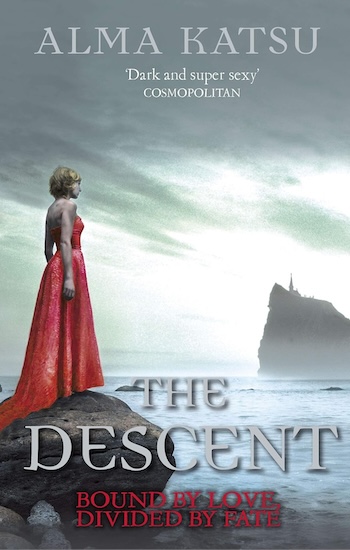
KatsuA-I3-DescentUKA few days ago, a copy of Alma Katsu’s third novel, The Descent dropped through the mailbox. It is the third novel in the author’s The Immortal trilogy, but I didn’t (at the time) know too much about the series or the author, so I took the opportunity to send her some questions.

Who is Alma Katsu?

As a girl, I wanted to have a magical, fantastical life but the outlook was kind of narrow and grim, and I think that’s why I turned to creating my own worlds in fiction. Then, funnily enough, I ended up having a life that was the stuff of fantasy: working in intelligence, traveling, doing all this technical, math-y stuff that I never would’ve thought possible for a little storyteller. Lesson: you never know where life will take you. Continue reading

An Interview with PAT CADIGAN

CadiganP-Chalk

A few days ago, I got an email from an editor at This Is Horror, a UK indie publisher. I haven’t been the biggest of horror readers, but the email was about Pat Cadigan’s latest chapbook, Chalk. I was intrigued, and will hopefully have it read and reviewed in the near future. I’ve been aware of the multi-award-winning Cadigan for years, though, and so I took this opportunity to interview the author. So, here we chat about her work, the chapbook, writing, and more…

Let’s start with an introduction: Who is Pat Cadigan?

CadiganP-SynnersI’m a recovering American and the mother of a grown son. I’ve lived in North London for almost eighteen years. Most people would know me as a science-fiction writer. All my novels are hard science-fiction (meaning they’re based on things that are possible now). I’ve won the Arthur C. Clarke Award twice, once in 1992 for Synners and again in 1995 for Fools. I’ve won the Locus Award three times: once for my short story, “Angel,” once for my collection Patterns, and most recently for my novelette, “The Girl-Thing Who Went Out For Sushi,” which also received the Hugo Award in 2013. In between, I had cancer but it’s gone now. I keep busy.

I thought we’d start with your fiction: Your latest novellette (or chapbook, if you will), Chalk, was recently published by This Is Horror. How would you introduce it to a potential reader? Is it part of a series?

It’s not part of a formal series, but it is one of several pieces of short fiction set in the neighbourhood where I grew up in Massachusetts. They’re generally set in the early 1960s and while they contain autobiographical elements, they are not the story of my life. I just borrowed a few things to riff on. Or riff off.

What inspired you to write this particular story? And where do you draw your inspiration from in general?

Michael Wilson asked me if I’d be interested in doing a chapbook and I said yes. I’d never done a chapbook before and I’m always up for a new experience. I read the previous ones from This Is Horror and found them all satisfyingly variegated (and quite good). So I prayed to the Story Fairy (Dept. of Horror) and this is what I got.

CadiganP-Chalk

I know how that must sound. My creative process is a black-box operation and I’ve been at this long enough (34 years professionally) to know what works best for me: tell brain to think, consider the elements involved – genre, length, my personal taste; allow the associations to marinate overnight in REM sleep; return to task the next day, try writing a paragraph, see what happens. The first paragraph written isn’t always the first paragraph of the story and it usually undergoes editing if not outright retro-fitting, depending on what I discover in the course of writing the story.

Paragraphs that don’t work end up in my fragment box for recycling.

How were you introduced to genre fiction?

We met in the dark. We’d already been making out for some time before I said, “Say honey, what’s your name?”

I had a library card for longer than I can remember. My mother would take me to the library with her and find books to read to me. Eventually, I learned to read myself and discovered that all the cool stuff was in the science fiction section. In those days – when dinosaurs roamed the net, before the discovery of flame – the genre wasn’t as stratified as it is now. Everything was science fiction – Heinlein, Bradbury, Clarke, Tolkien, Mervyn Peake’s Gormenghast books, Richard Matheson, Jack Finney – anything with a fantastic element was science fiction. Judith Merrill used to edit a best-of-the-year anthology that was the same way – pure-quill hard SF by Mack Reynolds and Walter M. Miller, Jr., sat cheek-by-jowl with oddities from Bernard Malamud, John Cheever, and Tuli Kupferberg. My ambition was to be good enough to get into one of those anthologies. I still want to be that good.

PatCadigan-IntroToGenre

How do you enjoy being a writer and working within the publishing industry? Do you have any specific working, writing, researching practices?

I love being a writer and I wouldn’t do anything else. For most of my life, I’ve had additional responsibilities – school, an outside job, motherhood, looking after my aged parent – so I learned to write as and when: late at night, early in the morning, lunch hour, weekends, sometimes reaching around the baby napping in my front-carrier to the keyboard, in hospital waiting rooms, on the train. If you really want to do something, you figure it out.

When did you realise you wanted to be an author, and what was your first foray into writing? Do you still look back on it fondly?

I don’t remember a time when I didn’t want to be a writer. As soon as I knew books and stories were written by people, I knew I was one of those people. My mother gave me her old Underwood typewriter – it was a monster. It must have weighed about five hundred pounds. You had to really bang on the keys and all the capital letters were half a line up from the rest of the word. I started out at 3 or 4, always typing “Chapter One” first. Finally my mother suggested that I should maybe try writing a short story first to get the hang of storytelling. But I preferred trying to write novels. Eventually, I hand-wrote several novels that were my cracked version of a mystery series. It was a kind of a cross between Nancy Drew and Trixie Belden, with occasional supernatural flourishes. I was very disciplined. Every chapter had to run both sides of the page, no less, no more.

UnderwoodTypewriter

This is an Underwood. It looks heavy as all get-out…

Later I had a sort of Doc Savage in space thing going for a while – by then, my Aunt Loretta had given me her portable typewriter, which was a lot easier on the fingers than the Underwood. Then sometimes, when my mother worked weekends, I’d go with her. She worked in the admitting office of a hospital and I wasn’t supposed to be there but as long as I sat in the back office and kept quiet, nobody minded. There I met my first IBM Selectric; I couldn’t imagine a machine more advanced, more futuristic. Selectrics were so expensive back then, only businesses had them.

IBMSelectricII

Somewhere in there, I read the Isaac Asimov issue of F&SF in which he talked about his early attempts at writing, including something he called The Greenville Chums At College. I was delighted; I could relate. I’d just left the Greenville Chums stage of my own development and I knew I would persevere.

What’s your opinion of the genre today, and where do you see your work fitting into it?

PatCadiganI love genre and I read for pleasure as much as I can. But I don’t think of my work as “fitting into it.” I write genre fiction because I love genre fiction. I don’t write critical essays and I don’t do reviews, so you’ll have to forgive me for not answering that question.

People love genre fiction, in every medium – print (including e-print), TV shows, movies, and of course games (when was the last time you heard about a game that was all real, all the time?). If you want to see writers treated like rock stars, go to the American Library Association convention and watch how they react to children’s and YA authors. YA authors who work in genre get the most attention and adulation, because they keep kids reading.

Fine art is fine art and I have drawn inspiration from it in many forms. But to be brutally honest, the things people internalise most come from popular culture, particularly the genre portion. Everything I Ever Needed To Know I Learned In Kindergarten was soon followed by Everything I Ever Needed To Know I Learned From Star Trek. Some people might scoff but people tend to take their cues from things they enjoy, that give them pleasure, more often than from things they’ve been told are good for them.

So if people turn to entertainment, I try to provide good entertainment.

What other projects are you working on, and what do you have currently in the pipeline?

Right now I’ve just crawled out of Deadline Hell into Deadline Purgatory. I said yes to a lot of short fiction requests and they all came due around the same time. I have to plan better in the future so I can go back to work on the novel based on “The Girl-Thing Who Went Out For Sushi.”

KingS-DoctorSleepUKWhat are you reading at the moment (fiction, non-fiction)?

I’m reading a lot of science and books about the solar system. I had to take a few days away from everything so I could read Doctor Sleep, and I’ll probably re-read some other Stephen King books. When it comes to writing about the human condition, nobody does it better. Even if the books themselves aren’t completely successful – which doesn’t often happen – they still contain brilliant passages of superb writing and characters that are as real as anything.

And like everyone else, I’m waiting for the next Game of Thrones book from George R.R. Martin. At last, epic fantasy with a dirty face, dirtier clothes, permanent scars, and body odour. And occasional dragons.

LindaLovelaceForPresidentI read a lot of crime fiction and thrillers, too. I like Nicci French and Minette Walters, among others.

What’s something readers might be surprised to learn about you?

I was an uncredited (and fully-clothed) extra in Linda Lovelace For President.

What are you most looking forward to in the next twelve months?

The London Worldcon. That’s going to be great!

***

Be sure to follow Pat Cadigan on Twitter and Live Journal; and also This Is Horror on Twitter on Facebook. Chalk is available to buy in print and eBook formats.