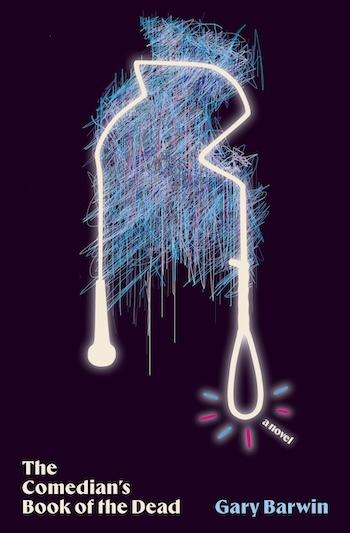
 Tomorrow, Book*hug Press are due to publish The Comedian’s Book of the Dead by Gary Barwin. An imaginative “underworld quest”, it’s the latest amusing page-turner from the acclaimed Canadian storyteller. To mark the occasion, the publisher has provided an excerpt to share with our readers. First, here’s the synopsis:
Death is a comedian and devoted family man, but everything falls apart when the Fates choose him to guide departed souls to the Beneath. Having to perform this new role erodes his humanity and causes him to do some perhaps unforgivable things, and when his only son dies by suicide, Death realizes he’s likely the one to blame.
Attempting the impossible, Death goes into the Beneath to beg the Fates to allow him to bring back his son. Naturally, things are not what they seem, and Death is forced to reevaluate everything he knows― everything except the deep love he has for his child. Blending Barwin’s celebrated wit with deeply moving scenes of empathy and compassion, The Comedian’s Book of the Dead is a heartbreaking and humorous journey into the joy and pain of parenthood, and a thoughtful exploration of choice and agency, sacrifice and love.
*
Before he was chosen to be Death, Death was a comedian. And a family man. Betty, his wife, Grigory, his young son.
I had a gig at Chortle’s, a comedy club in the suburbs. Betty had taken Grigory for a picnic in the park. We’d once discovered a large gravestone behind a hedge, in an out-of-the-way part of the park. It was for a horse, much loved a hundred years ago. Two by three feet of granite loved, in fact. Grigory was fascinated and always wanted to visit. He’d run his little fingers through the carved-out letters of the horse’s name. Martin. It was almost mystical for Grigory. Martin the Horse. Grigory imagined Martin as an almost-ghost, horsehair over a cloud.
Martin would be outside our front door during breakfast. “Listen,” Grigory would say. “There’s Martin. Eating grass.” Sometimes Martin would visit Grigory at night. “I like to talk to him,” Grigory said. “About fields and hay and galloping. And we tell jokes.” And then Grigory would snort like Martin. Occasionally, Grigory would dream that he went riding with Martin, but since Martin wasn’t alive, they’d gallop into the earth where, Grigory said, it was cool and dark and you could only see the moon.
But I wasn’t going Beneath, by myself or with Grigory. I pulled into the parking lot in the strip mall where Chortle’s administered comedy to its patrons, a rare free spot in front of Flat Jack’s Flapjacks, open 24/7. Perhaps it was its own kind of not being alive.
I’d had a new set to try out, one that had lots of jokes about sports because the Olympics were on. As if I knew anything about sports.
What’s the difference between death and gymnastics?
What were the last words of the Russian goalie after he let in the winning goal?
Why isn’t javelin catch an Olympic sport?
I greeted the beefy bouncer/front-door guy and went through the club, nodding to Cindy at the bar and then to a few couples having early dinner. The green room was actually green—painted a shade I associated with mould, and perhaps mould was actually used. There were two nearly beaten-to-death couches slumped against the walls, a mini-fridge, and some ancient magazines from a time before sanitation. I dropped myself into one of the couches, giving up hope of ever rising again. I was early but I wanted time to review my set. Also to have a chance to speak to the other performers and the host, whose most characteristic features were bad puns, inuendo, and hair that had been slicked back by desperation and something sebaceous a decade or so before. It was harm reduction.
Eventually it was time for me to go on. Through the one-way mirror, I saw there was a small but not entirely pathetic audience gathered around the tables and at the bar. Before performing I liked to look at the audience, trying to housebreak through the windows of their eyes into their deepest regions, read what punchlines the darkest places of their souls most desired. Comedy can be a delicate, nuanced poetry of philosophy, hope, despair, and almost spiritual glee. What did my audience want? Boob jokes and risqué shtick about dating. I had my bits about bobsleds, basketball, and salchows. Also mortality, meaninglessness, and love. I’d adapt like I always did.
The emcee called me onto the stage, setting me up with some exorable jokes based on a mispronunciation of my name. The audience didn’t laugh so much as endure. I walked on, not thinking about my set but about Betty and Grigory’s picnic near Martin’s grave.
How did it go? Tittering. Restrained snickering. That particular hesitant low laughter that is more about worried anticipation than enjoyment. And then quite a few real guffaws. Sometimes there’s a point when the audience breaks and they let go. They trust the comedian and even laugh at the set-ups. That didn’t happen, but a kind of amiable, pleasant relation was formed between the audience and me. A discreet understanding. I’d take it. I’d had anger, resistance, incomprehension. This agreeable if not enthusiastic audience was better than that. As I did my set, I had the clear sense of what I wanted to change, how I would reshape it, twist around some of the jokes. I would start with a lump of clay and then roll it, bash it against the table, claw at it, slather it with dirty water, and remake the lopsided bust I’d been working on. I always had this sensation. A set wasn’t so much an unchangeable solid but rather a soft and malleable possibility. And now I received the soft and malleable possibility of applause when I was done my set and the audience returned to their Canadian Club whiskies, Coors Lights, and rum and Cokes. Their chatter and their hardly realized hopes.
I was happy with this life. I’d have preferred better stages, more receptive audiences, festivals, and knowledgeable comedy enthusiasts, but this felt real. A kind of authentic semi-connection that was exactly the precise and required expression of the times.
I’d have been happy to have had this life forever, or at least until I became old, surrounded by my wife-of-my-whole-life, Betty, and my then middle-aged son.
To only know Death when he came for me.
© 2026 by Gary Barwin. Used with permission of Book*hug Press.
*
Gary Barwin’s The Comedian’s Book of the Dead is due to be published by Book*hug Press on September 22nd.

