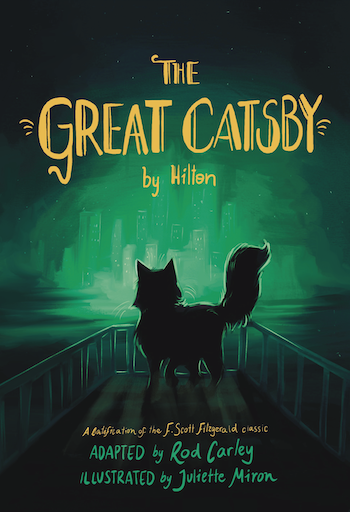
 The Great Catsby by Hilton, the latest book by award-winning and acclaimed author Rod Carley will be published shortly by Smart House Books. Illustrated by Juliette Miron, it is a “catification” of F. Scott Fitzgerald’s classic novel, “a playful parody poking fun at love foiled and ambitions foisted” within an uncertain 1920s world of cats. Here’s the synopsis:
Jay Catsby, the feral son of impoverished barn cats, has built his kibble fortune selling illegal catnip. When Nick Cattaway moves in next cat-door, Catsby’s only a whisker away from winning back his beloved Daisy, the beautiful Persian he lost to the arrogant Tom Cat Burmese two lives earlier.
Fitzgerald wrote The Great Gatsby as an indictment of the reckless wealth of post-World War I America. The selfish and careless fat cats of The Great Catsby by Hilton similarly ring true.
Part of the charm of the book is that Hilton, a seven-year-old rescue tabby adopted by Rod, “writes” it. He is the voice of Nick Cattaway, the first-person narrator. Reimagining the story through the eyes of a domestic housecat has allowed Hilton to be frisky with the text. Hilton also writes the Preface.
The Great Catsby by Hilton also features twenty full-page colour illustrations in addition to an assortment of black and white drawings.
The Great Catsby by Hilton adds some much-needed whimsy to the world. In these uncertain times, we could all use a few more cats and a little more catnip in our nine lives.
*
I followed behind Tom Cat on top of a low-whitewashed railroad fence for a hundred yards. The only building in sight was a small block of yellow brick sitting on the edge of the wasteland. One of the three shops it contained was for rent and another was an all-night Burmese fried mice restaurant approached by a trail of clay litter ashes: the third was a garage — GEORGE B. WHISKER. AUTOMOBILE REPAIRS. SCRATCHING POSTS BOUGHT AND SOLD — and I followed Tom Cat inside.
The interior was unprosperous and bare; the only scratching post visible was a dust-covered, twisted wreck that leaned against the wall in a dim corner. The proprietor himself appeared in the cat-door of an office, wiping his mangy paws on a piece of waste. He was a dirty grey, spiritless moggy, anemic, and faintly handsome. Missing one eye and patches of fur, Whisker looked like what the proverbial cat might drag in. When he saw us, a damp gleam of hope sprang into his light blueish-green eye.
“Hello, Whisker,” mewed Tomcat, cuffing him jovially on the shoulder. “How’s business?”
“I can’t complain,” answered Whisker unconvincingly. “When are you going to sell me that post?”
“Next week; I’ve got my dog working on it now.”
“Works pretty slow, don’t he?”
“No, he doesn’t,” said Tom Cat coldly. “And if you feel that way about it, maybe I’d better sell it somewhere else after all.”
“I don’t mean that,” explained Whisker quickly. “I just meant —“
His meow faded off and Tom Cat glanced impatiently around the garage. Then I heard a thud on the stairs and in a moment, the thickish figure of a molly blocked out the light from the office door. She was in her middle life, and faintly stout, but she carried her surplus orange fur sensuously as some mollies can. It was as if the nerves in her body were continually smouldering. She smiled slowly and walking through her husband as if he were an Egyptian ghost touched noses with Tom Cat, looking him flush in the eye. Then she wet her whiskers and without turning around spoke to her husband in a soft, coarse whine:
“Get some baskets, why don’t you, so somebody can sit down.
“Oh, sure,” agreed Whisker hurriedly and went toward the office as his wife moved close to Tom Cat.
“I want to see you,” purred Tom Cat intently. “Get on the next train.”
“All right.”
“I’ll meet you by the mews-stand on the lower level.”
She nodded and moved away from him just as George Whisker emerged with two baskets from his office doorway.
We waited for her down the road and out of sight. It was a few days before the Fourth of July, and a scrawny, grey feral cat was beheading a mouse along the railroad track.
“Terrible place, isn’t it?” spat Tom Cat.
“Clawful.”
“It does her good to get away.”
“Doesn’t her husband object?”
“Whisker? He thinks she goes to see her sister in Mew York. He’s so dumb he doesn’t know he’s alive.”
So Tom Cat and his molly and I went up together to Mew York — or not quite together, for Mrs. Whisker sat discreetly in another car. Tom Cat deferred that much to the sensibilities of those East Pawsians on the train.
At the mews-stand, she bought a copy of Tabby Town Tattle. Upstairs, in the solemn echoing drive she let four taxicabs drive away before she selected a new one, lavender-coloured with grey unscratched upholstery and in this we slid out from the mass of the station into the glowing sunshine. Immediately she scratched the seat cushion then turned sharply from the window, leaning forward to claw the front glass.
“I want to get one of those dogs,” she mewed earnestly. “I want to get one for the apartment. They’re nice to have – a dog.”
We backed up to an old alley cat in a hat who bore an absurd resemblance to John D. Rockefeline. In a basket, beside him, cowered a dozen very recent puppies of an indeterminate breed.
“What kind are they?” asked Mrs. Whisker eagerly as he came to the taxi-window.
“All kinds. What kind do you want, lady?”
“I’d like to get one of those police dogs; I don’t suppose you got that kind?”
The cat peered doubtfully into the basket, plunged in his teeth and drew one up, wriggling, by the back of the neck.
“That’s no police dog,” said Tom Cat.
“No, it’s not exactly a police dog,” said the cat with disappointment in his meow. “It’s more of an Airedale.” He passed his paw over the brown wash-rag of a back. “Look at that coat. Some coat. That’s a dog that’ll never bother you with catching cold.”
“I think it’s cute,” purred Mrs. Whisker enthusiastically. “How much is it?”
“That dog?” He looked at it admiringly. “That dog will cost you ten kibble.”
The Airedale — undoubtedly there was an Airedale concerned in it somewhere though its feet were a startlingly white — changed paws. Mrs. Whisker fondled its weather-proof coat with rapture.
“Is it a boy or a girl?” she asked delicately.
“That dog? That dog’s a boy.”
“It’s a bitch,” said Tom Cat decisively. “Here’s your kibble. Go and buy ten more dogs with it.”
We drove over to Fifth Avenue, so warm and soft, almost pastoral, on the summer Sunday afternoon that I wouldn’t have been surprised to see a great clowder of white Persians turn the corner.
“Hold on,” I said, “I have to leave you here.”
“No, you don’t,” interposed Tom Cat quickly. “Myrtle’ll be hurt if you don’t come up to the apartment. Won’t you, Myrtle?”
“Come on,” she urged. “I’ll telephone my sister Catherine. She’s said to be very beautiful by fat cats who ought to know.”
“Well, I’d like to, but —“
We went on, cutting back again over the Park toward the West Hundreds. At 158th Street, the cab stopped at one slice in a long brown, mouse paté of apartment houses. Throwing a regal homecoming glance around the neighborhood, Mrs. Whisker gathered up her puppy and her other purchase and went haughtily in.
*
Rod Carley & Juliette Miron’s The Great Catsby by Hilton is due to be published by Smart House Books, in Fall 2026.
Follow the Author: Website, Goodreads, Instagram, BlueSky
Follow the Illustrator: Website, Goodreads, Instagram

