
Like many people who saw and enjoyed Christopher Nolan’s take on The Odyssey this summer, my long-standing interest in mythology has been given a bit of a boost. Unconnected to the upcoming Nolan movie, I had started reading Stephen Fry’s Mythos series last year, with Mythos and Heroes. After seeing the movie, I decided to finally finish Fry’s series, which I did over the past couple of months or so. Afterwards, I found myself casting about for something else to try, craving a bit more mythology. (It’s just so much more interesting than what’s going on in the real world, to be honest, that I’ve found myths to be a rather pleasant escape.) That’s when I noticed Natalie Haynes’s Divine Might (2024) and Pandora’s Jar (2022).
In addition to writing multiple novels and these two mythology books, Haynes is a comedian and the host of BBC’s Natalie Haynes Stands Up for the Classics series (which I have added to be listening queue). The author’s novels reimagine various Greek myths from the perspectives of different characters (mainly the oft-overlooked or neglected female characters), many of which were bestsellers, and all of which are now on my ever-growing TBR mountain.
After finishing the Mythos series, I was more in the mood for some “non-fiction” mythology, though, so I started with Divine Might. I got the audiobook, which is brilliantly read by the author. It’s an engaging, well-written, and lively account of the Greek goddesses and their stories, accompanied by some excellent commentary and examination of the lasting impact of these tales. Here’s the synopsis:
Few writers today have reshaped our view of the ancient Greek myths more than revered bestselling author Natalie Haynes. Divine Might is a female-centered look at Olympus and the Furies, focusing on the goddesses whose prowess, passions, jealousies, and desires rival those of their male kin, including:
-
- Athene, who sprang fully formed from her father’s brow (giving Zeus a killer headache in the process), the goddess of war and provider of wise counsel.
- Aphrodite, born of the foam (and sperm released from a Titan’s castrated testicles), the most beautiful of all the Olympian goddesses, the epitome of love who dispenses desire and inspires longing—yet harbors a fearsome vengeful side, doling out brutal punishments to those who displease her.
- Hera, Zeus’s long-suffering wife, whose jealousy born of his repeated dalliances with mortals, nymphs, and other goddesses, leads her to wreak elaborate and often painful revenge on those she believes have wronged her. (Well, wouldn’t you?)
- Demeter, goddess of the harvest and mother of Persephone; Artemis, the hunter and goddess of wild spaces; the Muses, the nine daughters of Zeus and Mnemosyne, the goddess of memory; and Hestia, goddess of domesticity and sacrificial fire.
Haynes’s experience as a broadcaster and comedian really come through in her narration, so I would definitely recommend giving the audiobooks a try. (I will also buy the paperback editions too.)
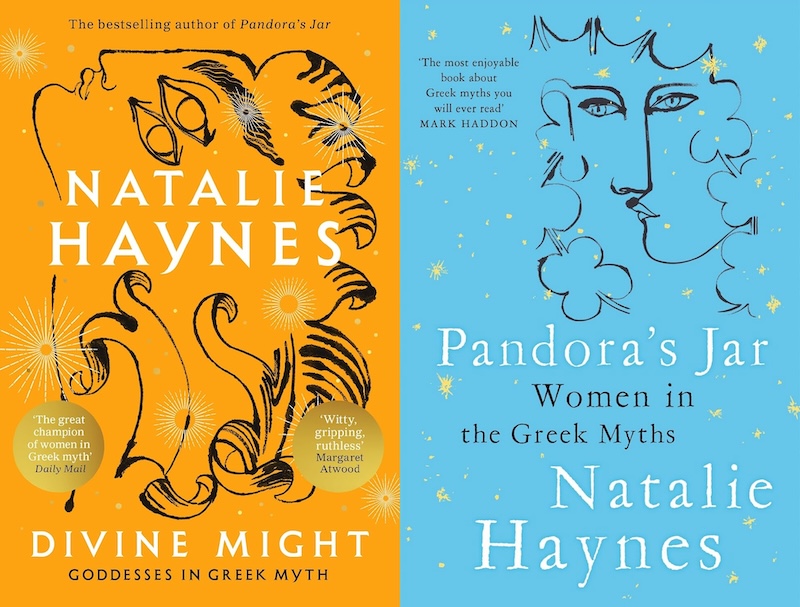
I started listening to the audiobook edition of Pandora’s Jar, Haynes’s first book of Greek Myths, as soon as I finished Divine Might. It is as good as Divine Might, and featured everything I enjoyed about the first book: excellent retellings and examinations of the stories covered, engaging and witty commentary, and also a look at the ways in which the stories continue to inspire and influence newer forms of mythology and storytelling. Here’s the synopsis:
A fascinating, eye-opening take on the remarkable women at the heart of classical stories Greek mythology from Helen of Troy to Pandora and the Amazons to Medea.
In the world of ancient Greece, the tellers of myths—historically men—have routinely sidelined the female characters. When they do take a larger role, women are often portrayed as monstrous, vengeful or just plain evil—like Pandora, the woman of eternal scorn and damnation whose curiosity is tasked with causing all the world’s suffering and wickedness when she opened that forbidden box. But, as Natalie Haynes reveals, in ancient Greek myths there was no box. It was a jar . . . which is far more likely to tip over.
In Pandora’s Jar, the broadcaster, writer, stand-up comedian, and passionate classicist turns the tables on classical mythology, putting the women of the Greek myths on an equal footing with the men. With wit, humor, and savvy, Haynes revolutionizes our understanding of epic poems, stories, and plays in this engaging feminist retelling, resurrecting them from a woman’s perspective and tracing the origins of their mythic female characters. She looks at women such as Jocasta, Oedipus’ mother-turned-lover-and-wife (turned Freudian sticking point), at once the cleverest person in the story and yet often unnoticed. She considers Helen of Troy, whose marriage to Paris “caused” the Trojan war—a somewhat uneven response to her decision to leave her husband for another man. She demonstrates how the vilified Medea was like an ancient Beyonce—getting her revenge on the man who hurt and betrayed her, if by extreme measures. And she turns her eye to Medusa, the original monstered woman, whose stare turned men to stone, but who wasn’t always a monster, and had her hair turned to snakes as punishment for being raped.
Pandora’s Jar brings nuance and care to the millennia-old myths and legends and asks the question: Why are we so quick to villainize these women of Greek myth in the first place—and so eager to accept the stories we’ve been told?
-
- Mythology Retold: Discover why Pandora didn’t have a box but a jar (far more likely to tip over), and how that simple mistranslation changed our view of the world’s first woman.
- Feminist History: Explore how the stories of powerful figures were reshaped by the men who told them, turning characters like the monstrous Medusa into victims punished for being assaulted.
- Unique Angles on Classic Tales: See the women of myth in a new light, from the vilified Medea—reimagined as an ancient Beyoncé getting revenge—to Helen of Troy, whose choice of husband resulted in a somewhat uneven response.
- Accessible Classical Studies: Join a passionate classicist and comedian as she reveals the cleverness of Jocasta, the nuance of Clytemnestra, and the truth behind the formidable women we thought we knew.
Both of these books are, in my opinion, excellent. If you like audiobooks, too, then these are great in that format. Highly recommended. I’ll hopefully get around to the author’s novels very soon.
Natalie Haynes’s Divine Might and Pandora’s Jar are published in North America by Harper Perennial, and in the UK by Picador.
 Civilian Reader
I
LikeLike