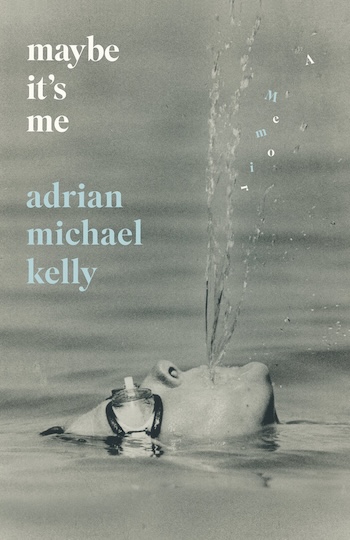
 Today, ECW Press publishes Maybe It’s Me, the new memoir by Adrian Michael Kelly; who is also the author of the story collection Ambassador Of What. It the raw story of someone navigating in a world marked by frustration, unrealized dreams, of getting in one’s own way, and finding a way through.
Here’s the synopsis:
A raw and riveting memoir of collapse, recovery, and reinvention
For most of his adult life, Adrian Michael Kelly specialized in failure — serial, sometimes comic, but also epic failure. Born to a gambling-addicted, compulsively spending mother who left when he was five, and raised by his dad, a haunted and often violent hard-drinking Scot, Kelly learned failure early and learned it remarkably well: how to be small, how to be safe, how to be self-defeating. By the age of 30, he was larking around abroad, trying (and failing) to write like his literary heroes while mired in bad relationships and dead-end work.
On a gray October morning in 1999, thunderously hungover and sick to death of himself, he boarded a train in Zurich bound for Bergamo and entered the initial, terrifying stages of a months-long collapse, less a psychological than a spiritual emergency — full-bore and loud.
Maybe It’s Me recounts what led up to that emergency as well as its aftermath, when Kelly came back to Canada to try to rebuild his life. For a while he did just that, but at the very summit of his hard-won achievements, life and his own folly brought him low again. Chronically unemployed, crippled by hideous back pain, and driven to despair by the mother of all writer’s block, he was divorced and nearly homeless at age 47. But along with how to fail, Kelly knew how not to quit, and he set about the process — long and difficult — of creating a consequential, good-enough life.
Free of self-pity and beautifully told, Maybe It’s Me is for everyone who gets in their own way — and can still have a laugh about it.
*
4
A Season in Hell
Newly arrived in a city such as Bergamo, another couple might have enjoyed a long, bawdy romp followed by an alfresco meal in magnificent città alta. Lisa and I sat at our rickety kitchen table masticating a take-away prosciutto e funghi pizza. Then we had our first look at Italian TV. In a preposterous game show, a doughy, balding man in a mafioso suit put five or six contestants, all of them beautiful women, through a series of tests and trials, such as catching ping-pong balls in the crotch of their bikini. On another channel, meanwhile, the young Mia Farrow, short-haired and gamine, staggered through a field shouting “Help me!” dubbed in Italian — “Aiutami! Aiuto!” — but no one answered and no one came, except for her pursuer, a man filmed from the knees down in tall leather boots.
I remember all of that, but nothing of what was spoken between me and Lisa. Maybe we didn’t speak at all. There was certainly no excitement, no anticipation. In bed we lay flat on our backs, three feet of space between us. Silently I raged at the endless buzzing of Vespas and endless tooting of horns beneath our bedroom window, but even when traffic subsided, my head was a restless hive, my body hot and prickly. While Lisa slept or pretended to, I dressed and left the flat, with nothing in my pockets but a set of apartment keys.
Walking north a short way on Via San Bernardino, I turned right on Venti Settembre, where shops, cafés, and restaurants stood dark and empty behind metal gates and shutters, and no one but I was about, easy prey for thieves and thugs if thieves and thugs there were. Continuing more or less east, I passed through a shadowy, vaulted colonnade and came to a crossroads at the heart of città bassa. Somewhere nearby a fountain plashed, but the streets, empty of traffic, were quiet as catacombs. Standing in the middle of wide Viale Roma, I gazed for some time at splendid città alta, up there on its hill. Floodlights swathed its duomo, its turrets, and its towers in dramatic chiaroscuro. Never in my travels had I seen anything quite so beautiful. Returning now to the flat and scooching back into bed, I curled into Lisa and could nearly believe that this was right, that I hadn’t done something stupid, something terribly wrong, something I would pay for in an as yet non-discernible but deep and lasting way.
Aiutami! Aiuto!
It was the first Italian phrase that stuck with me for good.
Traffic resumed early, but there were also church bells, and voices in the street.
Buon giorno, signora. Come va? Bene, bene, tu?
Lisa was still asleep or still pretending to be. I threw on shorts and a T-shirt and stretched in the living room, my back stiff as a plank. Then I went down to the street in search of a café or small groceteria. Shop clerks were hosing down and sweeping each their entranceways, their particular stretch of sidewalk. Two and three stories above, patterned area rugs had been hung out open windows, where Italian faces smoked and watched the waking day.
Only a few yards up Via San Bernardino, I was stopped in my tracks by a distinct whiff of incense — indeed, the same blend of frangipani and sandalwood that I had first smelled in an Edmonton natural foods store. A little further ahead, I saw smoky tendrils wafting into the street through an open doorway, and on the door itself, a sticker: I♥MEDITATION. Statuettes of faeries and various CDs — Zen flute, didgeridoo, Tibetan Buddhist chants — stood in the shopfront window along with the Bhagavad Gita and books by Thomas Merton. Elegant sten-cilling on the glass said La Libreria Stregata. I didn’t know what stregata meant, and right now it didn’t matter.
The biggest dog I had ever seen, a glossy-black Great Dane, was lying on its side in front of the cash counter. Behind it stood a man about my age, with dark, floppy curls and close-set eyes. When he looked at me, I felt as though I had known him for many, many years.
“Buon giorno,” I said.
“Hello,” he said.
“Ah, you speak English.”
“Mmm, only little.”
I mimed petting his dog.
He shrugged. “She is diffident.”
“Your English is more than a ‘little.’”
“In Italian, diffidente. I cut the e.”
“My name is Adrian. I cut the o.”
“I am Ettore,” he said, and the two of us shook hands. “Please, I show you my shop.”
Salt rock lamps, dreamcatchers, Meister Eckhart, Alan Watts: your standard “metaphysical” merch, but nothing was overdone. In back there was a roomy meditation hall, along with the kind of table I was only too happy to see.
“You also do massage?”
“My friend, Nic. Profondo.”
“Profondo is what I need.”
I scheduled an appointment and wanted to talk some more, but Lisa would be up by now and wondering where I was.
“Good to have met you, Ettore.” We shook hands again.
“You are always welcome here in my little shop.”
No one could have predicted a more serendipitous meeting. Over the weeks and months, Ettobecame a friend, and his book-store a haven. You’ll pardon me if I ruin any lingering suspense, but life with Lisa in Bergamo was no less bleak and wearisome than life with Lisa in Edmonton.Depression is a mouth. It eats everything, swallows all the light. Beauty was all around us, but asPeter Schjeldahl says, depression means no beauty ever. Always the Helper, the cheerleader andnurse, I coaxed and encouraged Lisa, at times cajoled and goaded her, as though her real, her nat-ural self, luminous and strong, obscured for years beneath layers of dust and verdigris, would finallyemerge. This only exhausted me, and repulsed and flummoxed her. She began escaping to Rome, where she took Italian courses and befriended an American gal in whose flat she stayed, nearPiazza Navona. When she came back to Bergamo, the two of us still played house, but ourrelationship was entering end-of-life care.
Meanwhile, I went through the motions, the daily dog-
and-pony show, of teaching ESL. The Wall Street Institute of Foreign Languages (Wally World to me) was the same as private English schools all over Europe and Asia: five or six small and sullen-looking classrooms with tired, rheumatoid furniture and grimywhiteboards. An overworked Xerox bulked in a corner of the claustrophobic teachers’ room, where cheap shelving bowed beneathwrinkled, dog-eared copies of Headway and other text-books. Most of my students were businesspeople who needed English fornothing more than brief exchanges on the phone or via fax and email. They slouched in late and tired after a day of meetings and paperwork, at which point I prodded them through the role-plays and other drills designed to reinforce their shaky comprehension of modal auxiliary verbs or the present progressive tense. It wasn’t entirely make-believe, but if I could state the obvious, my studentswere Italian. They didn’t want business English. They wanted human contact: Who was I, where was I from, why had I come to Bergamo, and what did I think of it? More often than not I was happy to drop the teacherly mask and let the conversation find its level and tenor; in the process, my students not only enjoyed themselves, they actually learned something, even if their grammar remained a little off.
Between lessons here and there, I hid in an empty classroom and scratched out another scene or two of my putative novel in progress. Like their anemic cousins, these scenes had no velocity, no texture, and no weight. Neither were they unified by that thing we call story.
Weekends I walked the streets up in città alta, and now and then managed an escapade to Venice, Siena, or Florence. These wondrous, shimmering cities may as well have been pasteboard, for I was living a lie, an insubstantial life, devoid of meaningful work, meaningful companionship, authentic and realizable artistic goals and aims — a half-life, ghost-life, death-within-life. Of course I pretended otherwise, but my back knew the difference. Every day I got out of bed a stiff and sore old man and stretched for up to an hour simply in order to move — to reach for a cup of coffee or bend for dropped keys — without fear of spasm and electrical storms of pain.
Ettore happily served as an Italian-English translator when I met his friend, Nic, the massage therapist, prior to the first in our series of appointments. A small, wiry man with longish dark curls and crackling blue eyes, Nic had almost unnerving intensity and presence. Your back, he explained to me, isn’t the problem, Adrian. Your back is only the symptom. He went on to speakof blockages, energy blockages, in my vital organs. Clearing them, he said, required more than digging his hands or elbows into muscle meat. Nodding like an idiot, Isaid, “Assolutamente,” and signed the consent form. Given my pain, I would gladly have parted with forty thousand lira (half a day’s pay at Wally World) had Nic promised to paint me green and summon Pan himself.
Three times over three weeks, I entered the meditation hall at La Libreria Stregata and lay in loose-fitting clothes atop the massage table. Nic dimmed the lights and burned some Japanese incense. We began with deep breathing. Then he went to work, and nothing I had experienced was even remotely like it.
While stretching one of my arms or legs, Nic also applied pressure to various points on mytrunk — solar plexus, stomach, large intestine, liver. Way down within me, big beasts of feeling awoke. One of the first Italian phrases I ever spoke unbidden was “Ho paura,” or “I’m afraid.”“Senza parole,” Nic said. “Solo respira, Adrian, respira profondamente.” Now and then he encouraged me to make sound on the exhale, a long and vibrating nnnn-nnn. Deep blue sadnesses washed through my body, but so did a fiery rage for life. Following one treatment, I was lying face down on the table, and my dangling right arm made involun-tary circles, counterclockwise. Back on my feet, I felt tall and clean and open, hugely energetic. Striding up San Bernardino to Sant’Alessandro, an extremely steep uphill, I broke into a run and was still going hard when an astonished Nic passed me on his Vespa. “Moltissimo!” he said, whichtranslates literally as “very, very much.” What he really meant was more like “fuckin’ eh!”
The progress that I was making, this wonderful sense of lightness, release, and possibility, culminated on a night toward the end of September. Lisa and I were taking a walk and happened upon astaircase, a long stone staircase, the Via del Paradiso, which wound all the way from città bassa to the great white marble gate, SanGiacomo, in città alta. We saw no one else during our climb and paused now and then to gawp: ochre and cinnamon villas withterracotta roofs; cypress trees and hedgerows and flowering bushes and shrubs; a blood-orange sun setting over the distant Lombardy hills; and the air now turning a deep lavender blue. Not Constable or Turner could have painted such a scene.
With San Giacomo now in sight, our cellular phone rang. It was Lisa’s mum, calling from Edmonton. While the two of them spoke, I backtracked several steps and lay down on top of a low wall, gazing at the sky.
Double the feelings of peace and ease following a stupendous fuck with the all-time love of your life, and you might begin approaching the immensity of bliss and undiluted sweetness that was now breathing into me. The more my chest opened, the more this munificence gave of itself, until I thought I could take no more and would simply die of it — which is what happened, in a way. My small, my carapaced self, with its history, its hoard of hurts, released its little hold on things and became a large, buoyant porousness.It lasted only minutes, but minutes such as these last a long time. Now they subsided gently, and up there was the sky again, with its palette of purples and blues. Small birds were twittering, and Lisa was saying goodbye to her mum. We finished our climb and found a wonderful restaurant with panoramic views. Awaiting our polenta, our casoncelli with butter and sage, I felt large and magnanimous, enormously optimistic. Lisa sneered at me. “Why,” she wanted to know, “are you acting like an asshole?”
In mid-to-late October, Lisa and I visited a couple I knew in Zurich, Chris and Emma Domeisen. Most of the weekend is blank to me; there was outlandish drinking, especially on the Saturday, when the four of us had dinner at a Spanish restaurant and capped things off back at the flat. When all was said and done, pints of German weissbier, a bottle or two of Sauvignon blanc, and several amarettos were soaking through a mattress of paella in my stomach. Both Lisa and I had early-morning trains to catch. She was on her way to Rome, I back to Bergamo and life at Wally World.
Gracious to the last, Chris and Emma walked with us to Zurich Hauptbahnhof. I did what I could to keep up an air of bonhomie and mirth, but low, leaden skies and near-freezing temps did nothing to ameliorate my nausea and fatigue. All the booze aside, leave-takings in those days tended to sadden and sicken me. The most routine of goodbyes was a small desolation, especially those that left me on my own afterward. As soon as Chris and Emma turned and walked away, I bent and retched up danglers of something white and viscous.
Memory dispenses with Lisa at this point. Only for the briefest, most dreamlike of moments do I see her standing there, that otherwise beautiful face all but void of affect, her pressed-together lips forming a thin black line. Surely we said goodbye in one form or another, but all I remember next is hunkering alone in the backwards-facing half of a four-seat compartment on the mostly empty train. At least I think it was mostly empty. It felt that way, feels that way. Whatever the case, I leaned my greasy forehead against the window and its coolness, which began to weep with rain when we had left the city limits.
Few if any of the several hundred hangovers I had by then endured could compare to this Gormenghast of gloom upon gloom. In its multiplying depths, all the neglected truths of my unaccomplished life gathered and became a vast, engulfing hopelessness. For maybe two hours Isat there, numb and dully gaping.
What happened next is hard to describe. The train had entered the Alps, where wraith-like clouds clung to wet, black crag, and sudden, slamming chasms opened beneath a bridge. Iremember thinking that only a landscape such as this could have shaped Carl Jung and his myth-laden theories of the unconscious. Some minutes later, a neuro-physiological tumult spread throughout me. My blood began to scream, every corpuscle a mouth, an enraged and gaping mouth. Something long within me had escaped its dark confinement, and following the scream, found words for what it wanted.
Take your life, it said.
Take your life.
At first the voice was moderate, as though taking my life was only a logical next step, but then it became louder, like the voice of a schoolyard bully, pursuing me as I walked away, shoving me in the back.
Take your life.
Take your life.
Next it adopted the voice of Dad in his worst, most hateful moments, roaring at me.
Take your LIFE. Take your LIFE.
Finally, the voice became that of a boy, seven or eight years old, screaming in blind fury.
Take your life, take your life, take your life, take your life!
With effort, I achieved a little distance between the voice and me. I could watch it like amadman howling in the street — unnerving, but not an immediate threat. It receded even further when the snack cart came by. I asked for a bottle of water from the man in his crisp blue uniform simply in order to prove that I could transact common business. Collecting my change, Isaid, “Merci” and bestowed a generous tip. The man said, “Je vous en pris,” as he would to anyone else, betraying no sign at all of concern or alarm. I sat and sipped my water and felt moreor less OK — as long as I maintained my inner watchfulness. When and if I let it relax, the voice redoubled its fury, alternating in tone between my father and the boy.
Take your LIFE. Take your LIFE.
Take your life, take your life, take your life, take your life!
On and on in an endless loop, it simply wouldn’t stop. Surely if this kept up, my heart would split with terror.
*
Adrian Michael Kelly’s Maybe It’s Me is out now, published by ECW Press.

