 As you may have noticed, Civilian Reader recently celebrated its 20th anniversary — a milestone that is still quite amazing to me. In addition to sharing the first review and interview I posted, I wanted to publish some other “CR20” content. One of the ideas I keep coming back to, recently, is some kind of “CR20 Favourites” series of posts: what are the books, interviews, and other things over the past 20 years that have stood out to me.
I thought I’d kick off this series of posts by revisiting, and re-recommending, Ian Tregillis‘s superb, not-as-widely-read-as-it-deserves Milkweed Triptych!
The Milkweed Triptych is made up of Bitter Seeds, The Coldest War, and Necessary Evil, published by Tor Books in North America and Orbit Books in the UK.
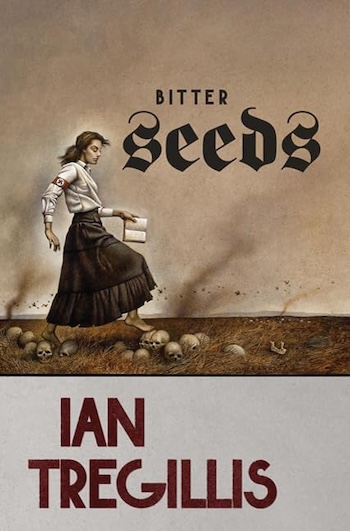
The series has a bit of a difficult publishing history. Bitter Seeds was first published by Tor Books in North America, in April 2010 (cover above). There then followed a bit of a gap before The Coldest War appeared, on January 2012. The series was picked up by Orbit Books for the UK, and the first two novels were published in July 2012 and February 2013. Necessary Evil was published in both in April 2013.
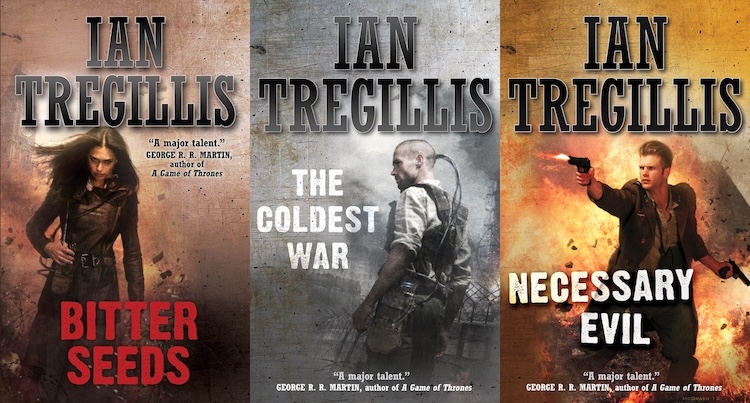
I started reading the series with a UK review copy of Bitter Seeds, during the month between finishing my PhD and starting an internship. I was blown away: Tregillis’s inventiveness, plotting, and prose was also superb, and I called it “one of the best novels I’ve read this year” — sure, it was only July, but that opinion held up for the remainder of 2012, and the series has remained one of my favourites (I am long-overdue a re-read, I think). Here’s the official synopsis for Bitter Seeds:
It’s 1939. The Nazis have supermen, the British have demons, and one perfectly normal man gets caught in between Raybould Marsh is a British secret agent in the early days of the Second World War, haunted by something strange he saw on a mission during the Spanish Civil War: a German woman with wires going into her head who looked at him as if she knew him.
When the Nazis start running missions with people who have unnatural abilities—a woman who can turn invisible, a man who can walk through walls, and the woman Marsh saw in Spain who can use her knowledge of the future to twist the present—Marsh is the man who has to face them. He rallies the secret warlocks of Britain to hold the impending invasion at bay. But magic always exacts a price. Eventually, the sacrifice necessary to defeat the enemy will be as terrible as outright loss would be.
Here’s how I described the situation in my review:
“In this world, the Nazis have been secretly developing a group of supernaturally-gifted, alchemically and physically engineered soldiers. These men and women are able to draw on their ‘Willenskrafte’ – the power of their own wills, effectively, which – when combined with powerful electric currents – manifest as different super-powers/abilities, such as pyromancy, telekinesis, psionics, and so forth. When members of the British special operations division discover evidence of this, they at first don’t know what they’ve stumbled across. As they learn more, they must scramble to find a response in kind. At the same time, the Allies are getting a kicking from the Germans on almost all fronts.”
Nazis interested and dabbling in the supernatural is a classic trope (see, for example, Hellboy), but Tregillis’s series approaches the concept with plenty of fresh and original ideas, and a gripping story — the global backdrop of the World Wars and, later, the Cold War, all are altered brilliantly. Tregillis was kind enough to write a guest post about how he developed the “Götterelektron” that are central to the Germans’ creation of their superhumans.
The author kept the story focused on the characters, though, and the challenges they are facing — personal and dramatic. We see them grow and change over the years covered in the novel and series as a whole. Many of them go through some pretty harrowing, brutal situations (not always related to the plot’s focus), and each of them is changed by their experiences. Add to this the fantastical elements of the story — the German superheroes and the British occult magic involving Eidolons — and you have all the ingredients for an epic, dark, and gripping re-telling of the mid-20th Century. Marsh is a particularly strong character, as is Gretel (one of the best characters in SFF, in my humble opinion).

After reading the first novel in the UK, I then moved for a short while to New York, and was able to convince Tor Books to send me review copies of The Coldest War and, later, Necessary Evil — for which I will be eternally grateful. The second and third novels built on the foundations of the first brilliantly, expanding readers’ understanding of this dark version of reality. The story also jumps ahead, with The Coldest War picking up 20 years after Bitter Seeds: the Cold War is under way, and the USSR has access to the Nazi’s superhuman tech and have used it to expand. The stakes — personal and global — are raised, the main characters (assuming they survive) continue to grow and develop, and it’s impossible not to become invested in their fates. Tregillis puts many of our favourite characters through the wringer, and this is not a “light” read in many respects. The third novel also introduces some time-travel elements which expertly alters some of what readers will have already learned. All three novels contain plenty of twists and surprises, and kept me guessing as to where it was all going. The conclusion to the series is extremely satisfying and earned, but also heart-wrenching. All of the mysteries seeded over the course of the trilogy are addressed, and loose ends are tied up nicely.
All three Milkweed novels kept me up well into the night as I had to keep reading, eager to find out what was going to happen to Marsh et al. Even all these years later, I can’t recommend the Milkweed Triptych often enough. I’ve bought Bitter Seeds for at least a couple friends, and have recommended to countless others. If you are interested in SFF, then I think you will find a lot to like (maybe even love) in this series.
*
Also on CR: Reviews of Bitter Seeds, The Coldest War, and Necessary Evil; Guest Post on “The Origin of the Götterelektron”
Tregillis is also the author of the acclaimed Alchemy Wars Trilogy — The Mechanical, The Rising, and The Liberation (published by Orbit Books in North America and UK); and Something More Than Night.
 Civilian Reader
Congratulations on your 20th anniversary! I have been keeping a low profile (ha – did you see what I did there?) but still check in from time to time. 🙂
LikeLiked by 1 person