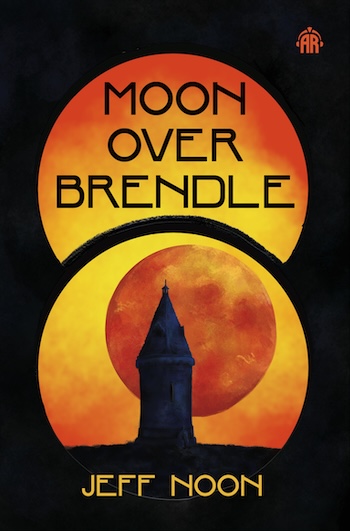
 A couple of weeks ago, Angry Robot Books published the latest magical contemporary fantasy novel from Jeff Noon: Moon Over Brendle. Already very well-received, the publisher has provided CR with an excerpt to share with our readers (in case you need any more convincing to give it a read). Before we get to that, though, here’s the synopsis:
The Dust tells the story…
1968, Lancashire: It is Joe Sutter’s last summer before going to secondary school. His world is like ours but beyond and beside what we know is Greot; a vast swirling rainbow of many-coloured dust. It settles on the dead, it swathes cities and fields. Joe is one of the few who have the gift of always being able to see it. But no one knows what Greot is. Is it the trillion-eyed god? The history of everything told grain-by-grain? Prophecy? The magic of creativity?
Joe can’t know; all he wants to do is draw comics and listen to music. Then one day, after climbing up to the ancient tower on Brendle hill, he meets an old writer of pulp SF books who is determined to pass on the power and joy of telling stories. And everything changes.
Decades later Joe is a successful SF novelist, and the time has come to tell his story, not only of how he became a writer but also how the secrets of the dust were revealed to him, one grain at a time.
And now, on with the excerpt…
*
2
I got home late for supper, after all the excitement. Chloe was upstairs in her bedroom, listening to records. Most probably
“Do You Know the Way to San Jose” by Dionne Warwick, her favourite single of that year. She would play the same song over and over again, driving me nuts. Our mother worked hard at the factory, and most evenings she would just plonk herself down in front of the television, occupying herself with cigarettes and chocolates. She called out to me.
“Do you have to bang the door every time?”
“Sorry, Mum.”
“The whole street can hear.”
She often said this, and I never responded.
“Where have you been? Your supper’s in the oven.”
“Thanks, Mum.”
“Sausages and mash. It’ll be dried out by now.”
I went to the living room doorway, lingering there. “I was out with Denny Portman.”
“That layabout.”
“We found a dead body.”
“What?” Her eyes were fixed on the TV.
“It was Mr Halfpenny. The man who sings on the green.”
“A dead body, you say?”
“The coppers are out there now. We had to show them where he was and everything.”
“What did he die of?”
“I don’t know. Probably old age or something.” I didn’t want to explain that we couldn’t see any wounds or anything like that on the body. And I certainly said nothing of the dust covering him head to foot. That fact was for Slew Hill club members only, Denny had insisted. We had a growing number of secrets, and it made me excited to think of them all.
“He was getting on a bit, I suppose,” my mother said.
“Someone said it was a heart attack.”
She looked over from the television screen for the first time. “Oh, that Dennis Portman, I always said he’d lead you astray.”
“We both found him.”
It seemed important to explain such a thing, a joint venture. But she tutted and told me off for being such a dirty wreck. It was true; I had grass stains on my shorts and scrapes on both knees, cuts on my hands, burrs stuck in my hair, smears of dirt on my face. She shooed me away and returned to It’s a Knockout! and her box of Milk Tray. I was heading towards the kitchen when I noticed the handwritten “do not disturb” sign hanging on the door of the parlour. This could only mean one thing, that Grandma Sykes was conducting one of her viewing sessions. I crept along and nudged open the door, peering through a gap. The back parlour was a place all of its own, with its own mood, its own smell, a mix of furniture polish and talcum powder. Grandma had taken the room over. There was a single bed in the corner draped with a flowery eiderdown. Her clothes hung on a portable metal rail, of the kind she had once used on her haberdashery stall on the market. Pushing the door a little further open, I could see the table where Grandma was sitting with her visitor, someone I recognised, even though her back was to me. Her long straight blonde hair gave her away. It was May Harper from the next street along. May worked as a shop assistant in a boutique, and wore miniskirts, coloured tights, strings of beads around her neck, and jingle-jangle bangles on her wrists. She was a hippy. I knew this from looking at the photographs in the News of the World every Sunday. Hippies are happening! Wild music, mind-expanding drugs, and orgies. We expose the outrageous lifestyle of the young. I looked up the word orgy in the Family Dictionary but there was no entry for it. Denny told me it was “like a party, where people roll around on the floor and Koag lands on their bodies, tickling them all over.”
“Really? Do they have any clothes on?”
“No, nothing at all. Totally starkers.”
Denny knew everything. He learnt it all from his older brother, Michael. The hippy girls in the photographs all dressed and looked like May Harper did. She fascinated my young mind for reasons I could not work out.
Two women, one old, one young. A darkened room.
And myself, the peeper at the doorway.
Taken by a sudden boldness, I stepped into the room. Usually Grandma kept her consultations private, but this time she did not mind me. Perhaps she knew that something strange had happened that day. She had a knack of reading people’s thoughts, one of her many gifts.
The earliest records say that all can see the dust. This is no longer the case. Nowadays, only a few of us can view Koag, or Greot, or whatever name you like to use, perhaps five percent of the populace. We are known as witnesses. I have that ability. Sometimes I can feel it on my skin, or I can move it with my breath. But mostly I just look at it, like watching dust motes in a sunbeam. My mother could not see the dust, nor could my father. But my grandma could see it. Such a talent can sometimes run in families, skipping generations. Growing up I knew of a few others in the towns of Lancashire who had the gift; they were featured in the local newspapers now and then. And of course there was Yvette Bishop on the BBC, the country’s most popular witness. She spoke every evening after the weather forecast of the day’s sightings, the local colours, the shapes and patterns of dust across the nation. My grandma was even more special than Mrs Bishop, however. Not only could she view Greot, she could also see through the eyes of Greot, and then share that vision. She was more than a witness, she was a beholder. Some likened beholders to mediums, or else to witches and wizards. Or to charlatans. Some refused to believe, while others wanted desperately to believe. And it was to those believers that Grandma directed her talents. So the back parlour of our house was now a “Chamber of Living Eyes”. She advertised her wares on a card placed in the window of Cooper’s corner shop: With great foresight and wisdom, Mrs Dorothy Sykes (widow) will reveal your innermost secrets and desires. Visit the Chamber of Living Eyes today. Below this was our address and a drawing (my own work) of a huge staring eye with magical energy rays coming out of it in wavy lines.
The curtains were closed, as was always the case when the Chamber was in session, day or night. Grandma’s hair was fiery red. Her cheeks were shiny with rouge. She kept a stuffed animal under a glass dome; I could never tell what species it was, something her brother, Uncle Jud, had picked up on his travels as a merchant seaman. The creature’s glass eyes would stare at me. Of course, I thought of Dotty Sykes as being incredibly old at the time, but in reality she would be in her late fifties, younger than I am now. She had only moved in with us recently, about a year ago. It made sense, as she was alone in life now, and Mum was thankful for the extra money, now that Dad had left home. Her customers came from all the nearby towns, from Ashtonunder-Lyne, Oldham, Stalybridge, Droylsden, and even from Manchester, the nearest city. Dotty was famous. Bowls of Greot were lined up on a shelf, separated into their colour schemes. Coco the budgerigar was busy in his cage, pecking at his own reflection in a mirror. That was the only noise in the room. I held my breath. One of the glass bowls stood on the table. Dotty asked, “Are you sure now, dearest, this is your choice?” She always let the visitors choose the bowl they liked best, even though Greot was invisible to them. May Harper nodded. Grandma took up a handful of dust and poured it from her closed fist in a controlled sweep across the polished tabletop. The dust was air-force blue, a very common colour, mixed with the rarer mint green, the two strands separate from each other. Slowly, dramatically, Dotty moved her hands back and forth like a magician at work on a television show. She started to moan, to shiver and shake. Her chair rocked back and forth as the passion took her over. Her head reared back, revealing the tendons of her neck. The dust on the tabletop was animated by her jittery movements and started to rise up towards the hands which passed over, left to right and back again. The dust glowed with light. I never knew how she managed to control Greot in this way; it was something I could never do. But it responded to her as always, and quickly settled into a small cloud trembling in the air between the two women.
Dotty calmed herself. Her face took on a serene look. Her hands stirred the dust gently in the air, shaping it. Coco pecked at his bell. That sound, I hear it in my dreams. Any bright tiny tinkling noise like that always brings me back immediately to those days, the back parlour and its attendant smells and my grandmother going into her spiel. Her voice lowered. “To see not the world, but something beyond the world, that is our purpose.” I suppose such words were never meant to be spoken in a thick Lancashire accent – T’see not t’world, but summat beyond t’world – but she had perfected the speech over the years, taking bits and pieces from various cheaply-printed pamphlets received through the post: Dust to Dust; The All-Seeing Eye; The Watchers; and so on. She was a member of the International Society of Beholders, whose international headquarters were contained within a back bedroom (I imagined) of number 12, Leatherhill Drive, Kirby Bridge, Birkenhead, the address printed in their magazine. Dotty went on with her patter: “Something beyond this petty world. Something that cannot be seen otherwise, only with the help of Greot. To see into the darkness that surrounds our pitiful ring of senses, the darkness encircling.” She spoke with urgency. “Open your eyes, wider, wider!” May Harper did so, as wide as possible. Then Dotty puffed out her cheeks and blew upon the dust cloud, sending it towards May’s face, into her stretched eyes.
“BEHOLD!”
Dotty’s shouted instruction had its desired effect. May looked startled. Then she blinked a few times, and started to gently weep.
“Do you see?”
May nodded. “I see, I do see.”
But what did she see, this eager young hippy woman? The basic idea was that Greot travelled everywhere, and saw everything, and so therefore knew all things, and a beholder could in some way transfer this vision into people’s eyes. Grandma never allowed me to join her in this work, no matter how many times I asked. I was not old enough. You’re not ready, Joe. Not nearly enough. And then sometimes, and even worse: Who knows, perhaps it will never happen. She would laugh, saying this. It maddened me. But still I loved to watch her ply her trade. And right now May Harper looked to be in ecstasy. Her hands reached out to grasp at some invisible object.
But then Dotty’s voice changed again, becoming a rasp. I
had never heard it reach such a tone before. The sound made
me nervous, and I stepped closer to the table.
“In the dust, in the dark.”
I caught my breath. Viewings didn’t go like this. Usually the visitor reported what they saw, things like “a bird”, or “a clock face”, or “a stranger dressed in black”. Grandma then interpreted these images, rather like other old ladies on the housing estate would read the future in tea leaves. But this time Grandma was seeing the vision. Her eyes were fixed and staring as she spoke: “In the dark of the dust, she is waiting.” The words came from deep inside, a horrible thing to hear. “Little girl, poor little girl! Come to me.” Grandma stood up, her body rocking to and fro over the table. “Come to me, my child.”
May had broken out of her trance. She pressed back in her chair, unable to move. I was the same, frozen to the spot. “Grandma? Grandma, are you…” I could not finish the question. She was most certainly not all right. I watched in fright as a sudden stream of dust darted towards her open mouth. The vision of Tom Halfpenny’s body came to me, with its shroud of many colours. I cried out. But then Dotty coughed, and came to her senses, falling back to her seat, but not quite making it and landing on the floor. I went to her. Her eyes were flinty green, sparkling. This time she whispered to me, not to May, that same phrase.
“In the dust, in the dark.”
Mum and Chloe hurried into the parlour, roused by the commotion. May Harper slipped past them on her way to the front door; she had seen enough, more than enough. Mum knelt down at Grandma’s side, rubbing her shoulder and asking what the trouble was. Then she glared at me, as though I were to blame. What could I say? That little bell rang on and on, needling at my head, my ears. It marks the day when my life started to change.
*
Jeff Noon’s Moon Over Brendle is out now, published by Angry Robot Books in North America and in the UK.

