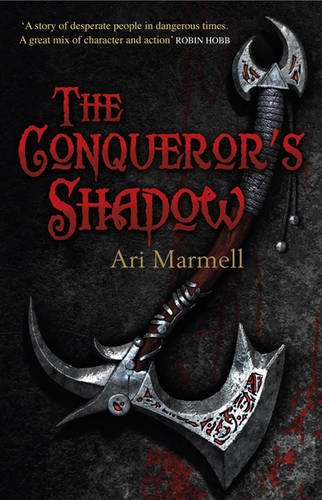
 For a long time, I only posted reviews on Civilian Reader. For some reason, I resisted branching out into other types of content. Partly, it was an issue of how much time I had (postgraduate degrees take up a lot of time), and how much I wanted to commit to the website. As I started to become more interesting in publishing and writing in general, though, the website took up more of my attention and energy, and I started to think about other types of content I could publish.
In December 2010, while taking a train back to university in the UK, my partner convinced me to try some interviews. I’ve always loved the long, feature-length interviews in magazines like Rolling Stone, but I didn’t feel like I had the journalistic chops to pull off anything remotely as in-depth or interesting. (I’m also not entirely sure that there are many authors who offer the chance for this type of interview; rock and movie stars just live the kind of lives that do.)
I’d just read, and very much enjoyed, Ari Marmell’s The Conqueror’s Shadow, so decided to reach out to him, and he agreed to answer some questions. I published that Q&A on December 31st, and it began a long run of interviews on CR — at the time of writing, there are 390 published interviews on the site. (I only did the math today.) The interview is recreated, below, entirely as it was published on the original, Blogspot version of CR, except for some typos. (I’ve also added the now-normal “Follow the Author” stuff, and updated some links to mentioned titles.)
After the interview, I’ve included a few general thoughts on interviewing, and why they became less-common on Civilian Reader.
*
Six Questions for Ari Marmell
1. How did you come up with the idea for Conqueror’s Shadow? Who would you say is the biggest influence on your work?
The very earliest kernel of the idea was just one of those random thoughts that strikes out of nowhere: I was having lunch with my wife, and I just sort of came out with “Hey, wouldn’t it be cool to have a fantasy novel where the ‘hero’ is a retired evil warlord who has to come back to stop someone even worse?”
Really, the genesis was just that basic. Obviously, the concepts of the novel grew and evolved well beyond that – for instance, my decision to take the opportunity to take many classic fantasy tropes and twist them throughout the book came later, and was much more deliberate – but the core just sort of dawned on me.
As for my biggest influence? While there are several, if I had to pick one, I’d say probably Steven Brust. Specifically, his Vlad Taltos novels.
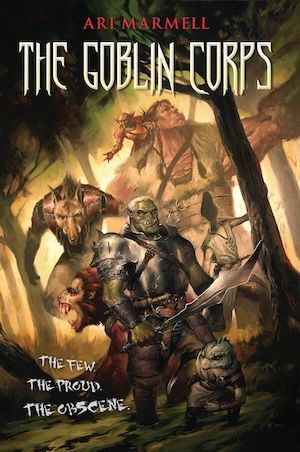 2. You’ve been writing and developing fantasy products for a long time, from Dungeons & Dragons to White Wolf’s Vampire: The Masquerade; what made you decide to finally create your own fantasy world, and how did you find that process?
The truth is, while I’ve been publishing mostly role-playing game materials for most of my career, my actual writing happened the other way around. I wrote five full-length original novels before I ever wrote a single word for the games (though I’d been playing the games for years). The first three of those novels were, to put it kindly, a learning experience, and are utterly unsalvageable. The other two, after massive rewriting, became The Conqueror’s Shadow and The Goblin Corps.
But at the time, I wasn’t having any luck getting my fiction published (in part, I’ll admit, because I wasn’t good enough yet). So when the opportunity came to write for RPGs, which were also a passion of mine, I jumped on it. As I said, though, the original stuff actually came first.
As to what made me decide to start shifting focus once more from RPGs to fiction? Simply the fact that I’m finally having some success with the latter. It’s always been my ultimate goal. (I don’t see myself abandoning the RPG stuff any time soon, though. It just won’t be as much of a focus as the fiction.)
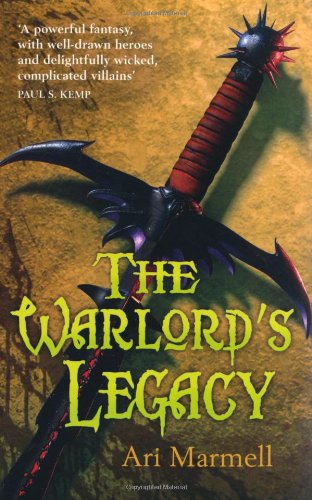 3. What can we expect from your upcoming novels, The Warlord’s Legacy (the sequel to Conqueror’s Shadow) and The Goblin Corps?
The Warlord’s Legacy picks up six years after TCS, with things having not even remotely gone the way one might expect from the ending of the first book. I think it’s a more mature novel; not necessarily a better book, but better written. (At least, it feels that way to me, and I hope it is.) While there are some far-reaching ramifications of what’s happening, it is, in a way, a somewhat more personal story for the protagonists than TCS. (This despite the fact that it’s a threat to his family that brings Corvis Rebaine out of retirement in the first book.) I can’t really say more than that without spoilers, but I’ll admit that I’m very much looking forward to seeing how fans of the first book react to the second.
I did, incidentally, do my best to make TWL stand alone. It’s better if you’ve also read TCS – you’ll have a more emotional connection to the characters – but I’ve had several people read TWL first and tell me they didn’t feel like they were at all confused or missing important details.
The Goblin Corps is something of a different beast. It’s completely unrelated to my other novels – different setting, different tone – and it’s rather more exaggerated. What I mean by that is, anyone who’s read any of my prior novels knows that I enjoy the juxtaposition of sarcastic humor and bloody violence. TGC takes both of those to an extreme. It’s both funnier and gorier than TCS, and while TCS focused on a very dark anti-hero, TGC actually focuses on the villains. They’re not “dark good guys”, they’re not looking for redemption; they’re the bad guys, and unapologetic about it.
Basically, take your typical almost Tolkien-esque epic fantasy. Then turn it around, so you’re telling a tale about what’s happening to the villains during these events, rather than the heroes. Then flavor the resulting story with a dollop of Quentin Tarantino and a tiny sprinkling of Sam Raimi.
4. How do you enjoy being a writer and working within the publishing industry? Frustrations, pleasant surprises, different processes depending on genre, etc.?
Well, I really enjoy working from home, for one thing. The dress code is pretty relaxed, and the hours are flexible.
Honestly? It has its ups and downs. Income is far from steady, there are no benefits, and a huge amount of my time is spent waiting and hoping. I don’t have access to nearly as much information as I’d like – in terms of sales, marketing, audience, etc. – and I wouldn’t know what to do with it if I did. There’s a lot of frustration, a lot of waiting, a lot of worrying.
But I’ve also gotten to meet and work with some truly fantastic people, including several who I now count among my very close friends. More importantly, I love what I do, and I truly can’t imagine doing anything else.
So far, there’s not a huge difference in terms of genre. Obviously, when I work on tie-in materials, there’s more creative control from above, but since I developed my career doing freelance work, I usually find that pretty easy to work with. And while it’s important for any given book to have only one hand actually at the rudder, I’ve found that the collaborative process can actually produce some pretty cool results.
5. What else do you have in the pipeline?
Well, I can’t go into too much detail, but I can say this much. In addition to The Goblin Corps, I’ll be publishing another novel through Pyr Books. It’s currently untitled, but it’s a fantasy set in a culture somewhat reminiscent of Renaissance France. It’s actually my first young adult novel, but it should prove perfectly accessible to my older fans as well.
My agent is currently shopping my first urban fantasy novel. (That is, modern or near-modern fantasy. Near-modern, in my case.) I obviously can’t talk about it until it sells, but I have really high hopes for it. I feel it’s one of my best books to date, if not the best.
And I’ll be doing some more tie-in novels in the future as well, though again, I can’t yet talk about what or for whom, I’m afraid.
Beyond those? Dunno. I have a whole heap of ideas, but which one(s) I go with really depends on how everything else turns out. (I wouldn’t mind going back to the setting/characters of The Conqueror’s Shadow and The Warlord’s Legacy, if the opportunity arises. But to be perfectly blunt, that’s all a question of sales, now, whether it happens or not.)
6. Who are you reading at the moment (fiction and/or non-fiction), and which books of 2011 are you most looking forward to?
I’m right in the midst of James Lovegrove’s Age of Zeus at the moment. I recently read Gary Corby’s The Pericles Commission and Peter Brett’s The Warded Man. Next on my list (in no particular order) are The Desert Spear (Brett again), The Wolf Age (James Enge), Shadow’s Son (Jon Sprunk), and, well, a whole mess of novels from Pyr Books.
Books I’m looking forward to? Man, there’s a lot; I’m sure I’m going to forget a bunch (and if any of my friends are on that list, I humbly apologize). Some are actually already out, but I haven’t gotten them yet. In any case, they include another heap of Pyr novels (far too many to list here), new instalments in Simon Green’s Nightside series and Drood series, Echo (Jack McDevitt), Unsympathetic Magic (Laura Resnick), Iorich (Steven Brust), Servant of the Underworld (Aliette de Bodard), the start of the Iron Druid series (Kevin Hearne)…
Man. At this rate, I’m not going to have time to write anything…
*
Ari Marmell’s The Conqueror’s Shadow and The Warlord’s Legacy are out now, published by Gollancz in the UK and JABberwocky in North America.
Also on CR: Guest Post “Triumph Over Tragedy”
Follow the Author: Website, Goodreads, BlueSky
***
On Interviews
Not bad for a first attempt, I think. Initially, I figured something simple like “Six Questions With…” would be a good approach: simple, contained, and not too time-consuming for the authors I asked. Over the years, I added a few other questions, but have basically stuck with the same format since the beginning. Maybe not the most imaginative approach to interviewing, but the questions are what I’d like to learn about. So, that’s ultimately all that matters.
What has been interesting is seeing the different approaches that authors have taken to this same set of questions. Some authors have offered long, thoughtful, and thought-provoking responses. A minority have offered not very much. (One in particular was a real dud: an author whose books I’ve read for years, but whose answers to the questions were dull and dashed off.) One set of responses was not published — they were so phoned-in and seemed so impatient with the interview that I still don’t understand why the author agreed to do it. For the main, though, I’ve really enjoyed getting to ask authors about their approaches to writing, and how they were introduced to their genre(s).
I think I benefited from starting CR early in the boomlet of book blogging, when so many authors were open to Q&As, and especially debut authors who made up the bulk of my interviews. At one point, though, and I forget exactly when it was, I started to see on social media a lot of push-back and snark directed at new bloggers and the questions they were asking. I remember one specific and disappointing Twitter conversation between some pretty prominent SFF authors (including one of my favourites at the time) about basic questions (inspiration, influences, and so forth), the kind of conversation where it was obvious it was about a specific person, even without them being named, that I thought this was obnoxious and unkind.
I understand the frustrations that many authors, actors, musicians, and other celebrities feel about interviews. (Intellectually, at least: I’ve only been interviewed twice.) Today, I’m sure everyone who follows entertainment news has seen complaints about answering the same questions, over and over, on press junkets. I imagine that it is very frustrating, not to mention boring, to trot out the same answers to one interviewer after another. If you are a fan of Hot Ones, as I am, you may even be familiar with how many guests tell Sean Evans that they love his questions because they’re so original. (The amusing irony that they all compliment his original questions in the same way…) Indeed, it is one of the reasons I love that show.
However, this complaint, about answering the same questions, has always rubbed me the wrong way. The onus is greater on professional journalists, of course, and they should be held to a higher standard than the bloggers, fans, and other content creators who use their free time to highlight the authors, genres, and books they’re excited about. But, given that most people won’t be hunting down everything an entertainer says, answering some questions about what you are currently promoting seems to be a good thing? For example, if you’ve just published a new novel, of course an interviewer is going to ask you about it. Maybe it won’t take up the whole interview, but it will feature. If you agree to do 20 interviews… yeah, that’ll probably be 20 questions about the new book.
A couple of years ago, quite a while after seeing that Twitter conversation unfold, I started to think that CR was becoming a bit stale. I felt like I was running out of things to say about the novels and non-fiction books I was reading. In part, this was due to burnout and doing a lot of writing for some of my freelance jobs, which meant the website no longer felt like a break from work, nor as fulfilling. That led to a drop in reviews, and then also interviews and guest posts. Excerpts, in a way, took the place of the latter two.
Earlier this week, I posted the first interview in three years. In 2023, I only published one. The last year I published a number of interviews was 2022 (eight, to be exact). I think I’d like to start publishing them again. (At least ten more: 400 would be a nice milestone to hit.) The changes in the (social) media landscape, though, makes me think it’ll not be as easy. Interviews never did the kind of numbers that other posts have. There are a couple of exceptions — my interviews with Brian McClellan (2013) and Christopher Ruocchio (2018) remain extremely popular. (How popular? At the time of writing, McClellan’s is the most popular post on the site this week.)
The current social media landscape has really changed things: where publicists used to organize blog tours of interviews and guest posts, much more of that energy is now devoted to other platforms. (Shout out to the publicists and publishers who still reach out to me about featuring their authors and books on CR: you’re awesome.) Authors’ ability to just post their own content to their own accounts, as and when they want, probably also makes interviews a little less appealing.
I wonder if anyone thinks blogs or review websites are worth much time anymore. (Are there many left?) All I can say is that reviews of “older” titles remain extremely popular, and especially reviews of crime/mystery novels.
 Civilian Reader