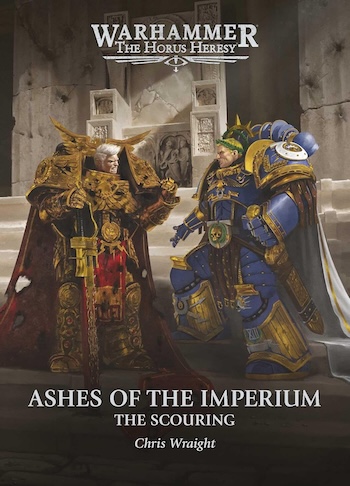
 Horus is dead. It’s time to pick up the pieces…
As the Siege of Terra ends, there are many loose ends – Traitors trying desperately to escape, a monumental vacuum of power to fill, and a crumbling galactic government to see to. Those who hold on to power must decide how to wield it, and a new structure must be put in place, all while desires to exact vengeance run high.
Horus is dead. Terra lies in ruins. The Emperor is silent. Amid the rubble of the Palace, shell-shocked survivors emerge into the light of an uncertain dawn. New powers are present now, ones that have travelled the length of the galaxy to bring salvation to the Imperium, though they are as readily cast as usurpers as redeemers. The survivors of the Traitors’ Grand Armada, now scattered and desperate to escape vengeance, are riven with doubt and dissension, and their gods too are silent. Amid all the grief and confusion, some hopeful souls believe the war to be over and an era of renewal just ahead. But wiser heads know that this war can never end, and that the only question remaining is who shall rise to power within the perilous new age, and who shall fall.
The Horus Heresy is over, but at terrible cost. The time period between the rebellion and the “present” day of Warhammer 40,000 has, thus far, not been much-covered in the fiction and lore sections of the various games WH40k-based books. I think the most I read about the period was included in the rulebook for Games Workshop’s short-lived, but very good, Inquisitor game (which introduced us to Eisenhorn). Even here, though, not much attention was paid to the aftermath of the Horus Heresy and Horus’s death. It was with great interest, therefore, that I started Chris Wraight’s latest Black Library novel. What I found was one of the best books BL has published in some time.
Your reaction to Ashes of the Imperium will very much depend on your preferences when it comes to Black Library fiction. If all you’re after is wall-to-wall action, then you will probably be disappointed. If, like me, you like novels that explore the setting and its inhabitants in “quieter” moments, then you should find plenty to enjoy. It’s probably best if you have at least read some of the Horus Heresy series, particularly the Siege of Terra books — there are many returning characters who you’ll recognize if you have. Discovering what these characters did after the Siege was, indeed, one of the main draws of this novel.
The novel is told from a variety of perspectives: mostly, a surviving member of Malcador’s chosen, Rogal Dorn and one of his Imperial Fist champions, a surviving Iron Warrior (who is one of the best characters, by the end of the novel), a Word Bearer survivor, and a traitor soldier. Each of these characters offers very different perspectives of the time, providing a nicely varied story and portrait of the time.
Wraight does a great job evoking the mass confusion of the days, weeks, and months following the end of the war. Insecurity is rife: nobody seems to know what will happen to them. The world is in ruins, polluted by lethal-levels of toxins. There has been no word from, nor glimpse of the Emperor. Meanwhile, traitor forces unable to flee Terra are still engaged in pockets of conflict, trying to figure out why they lost and eke out an existence as they decide what to do. Wraight has a particular gift for evoking the grim future of Terra, and the nightmarish experience of the non-elite masses who live there — something he also does very well in his Vaults of Terra and Watchers of the Throne series.
Among Terran leadership, tension and fractures are beginning to form. There is growing distrust between the surviving Primarchs. There is particular frustration with Guilliman, who is attempting to exert some measure of control over the situation, much to the chagrin of his brothers, and others, who were actually present for the invasion. (To be fair to Roboute, he was genetically created to do this… But still: read the room.) This is a repeated frustration and complaint from the defenders, directed at the latecomers. Most interesting: without the guiding, all-powerful hand of the Emperor, supported by the Sigillite, politics has re-emerged as the place of the Primarchs and the Legions is questioned and challenged. Indeed, we start to see a growing, general distrust of the Legiones Astartes. At the same time, Terran leadership struggles with what to do with the Emperor’s incapacity and absence.
‘The Legions are running things now,’ said Xanthus. ‘One of them, anyway.’
‘And that is the problem,’ said Hassan. ‘They were created for a purpose, and that purpose has gone. Allow them to rule, and we’ll never see an end to the crisis.’
As a long-time reader of the Horus Heresy series, I have become particularly interested in the dynamics between the Primarchs, and this novel offers a good amount of new material to chew over, as we see how the war has changed them. Vulkan’s first scene in the novel was particularly good, giving the reader insight into his changed mental (and, maybe, physical) state. He has developed a bitterness towards his brothers, based on how he has always been expected to serve, but never listened to, and how they have taken his special “condition” for granted. We see Rogal Dorn’s character shift, slightly, from measured to more proactive and bloodthirsty. Guilliman, interestingly, kind of stays… well, very Guilliman.
They had banished the nightmares, those Ultramarines, preserved the home of the species, kept us all alive, and all people did was wish that, somehow, for some reason, someone else had done it.
The time we spend with the Traitor forces is equally interesting. The fleeing Traitors are also confused, insecure, directionless. They are in near-total disarray. While never as cohesive in their alliance as the loyalists, the fractures between the various surviving Traitor forces also grow and become more severe. The author does a very good job of portraying the palpable distrust, disgust, and even hatred different Traitor factions have for each other. For example, the Iron Warriors mocking the Word Bearers, disdainful of Lorgar’s Legion’s “cheating”, relying on the daemonic and supernatural to get around doing any manual work.
I could probably write a lot more about this novel, and the seeds it has planted for how the setting will develop into the “present” WH40k setting, but I’ll stick with just three more observations.
The withdrawal of the aether is interesting. Given how much the Traitors relied on the Warp for their strategies, selves, and more, its removal has a considerable impact on them — mentally, but also physically in many instances.
Wraight uses the epigraphs to each chapter very effectively. They well-written and give readers hints of what is to come; not too much in the way of specifics, but still adding depth to what we’re reading. Presented as accounts of the war and aftermath that are far more honest and self-reflective than anything that the Imperium would allow in the WH40k present. (No doubt, they’ve all been censored or proscribed…)
There are a couple of scenes that address the Emperor’s fate and his internment in the Golden Throne, caught now in a Perpetual state of agony. Details are thin, and there’s a disconnected and distant feel to these scenes, but they nevertheless pack a punch. Wraight’s novel strongly suggests that this is exactly not what He wanted, and adds to the overall tragedy that is the WH40k setting.
Ashes of the Imperium is on the longer side, perhaps, but it never felt sluggish or slow. In fact, despite the lack of battlefield action, I read this pretty quickly — if for not other reason than I picked it up at every opportunity I could, and read well into the night on two occasions. Wraight’s prose is excellent, as expected, and he does a fantastic job of bringing his characters and the setting to grim life on the page. This is one of the most character-focused novels from BL in some time.
I think Wraight has done for this time period what Abnett did for the Horus Heresy: set the terms perfectly, and set in motion some very intriguing storylines. I’m really looking forward to seeing how the series develops. Hopefully we won’t have to wait to long for the next book…
Definitely recommended, and a must-read for fans of the Horus Heresy series.
*
Chris Wraight’s Ashes of the Imperium is out now, published by Black Library in North America and in the UK.
Also on CR: Reviews of Brotherhood of the Storm, The Path of Heaven, Valdor, Warhawk, and The Emperor’s Legion; Interview with Chris Wraight (2011)
 Civilian Reader