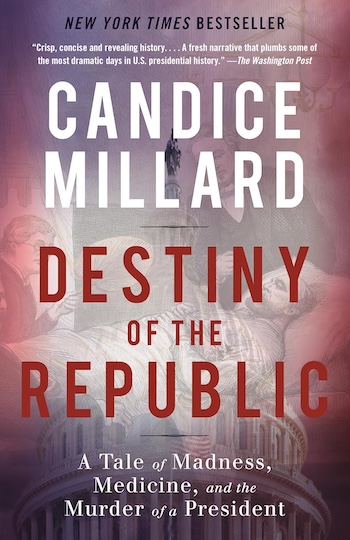
 An engaging, highly-readable history of Garfield’s rise to the presidency and death.
James Abram Garfield was one of the most extraordinary men ever elected president. Born into abject poverty, he rose to become a wunderkind scholar, a Civil War hero, a renowned congressman, and a reluctant presidential candidate who took on the nation’s corrupt political establishment.
But four months after Garfield’s inauguration in 1881, he was shot in the back by a deranged office-seeker named Charles Guiteau. Garfield survived the attack, but became the object of bitter, behind-the-scenes struggles for power — over his administration, over the nation’s future, and, hauntingly, over his medical care.
Meticulously researched, epic in scope, and pulsating with an intimate human focus and high-velocity narrative drive, The Destiny of the Republic brings alive a forgotten chapter of U.S. history.
Candice Millard’s Destiny of the Republic has been on my radar for a very long time; it was first published in 2011, when I was still in college and reading through as many biographies of the US presidents as I could (for my studies, but also because I was generally interested). I never got around to reading it while at university, but with the recent Netflix adaptation — Death by Lightning — my interest in reading it was revived. So, I popped to Book City in Toronto (highly recommend this local chain), bought the book, and started reading it that same day.
Destiny of the Republic is only the second book I’ve read about Garfield, who is one of the lesser-known presidents from a period of American history that featured a number of less-well-known (if at all) presidents; most of whom kind of looked the same (it’s probably the facial hair they sported). The first biography was Ira Rutkow’s contribution to the excellent American Presidents Series, which focuses a lot on the medical-side of the history.
Millard’s book is excellent. Well-written, well-paced, and very well-researched, the author brings in plenty of Garfield’s own writing, as well as many of his contemporaries, family members, and even enemies. The author paints a compelling portrait of the man, providing readers with a detailed picture of Garfield’s professional and personal lives. He seems, by many counts, to perhaps have been one of the only men who actually “deserved” to become president: decent to all, highly-educated, dedicated to helping others, raised in poverty to overcome incredible odds, and a passionate abolitionist his entire life. He also didn’t want to be president, and spent much of the nominating convention effectively telling those who supported his candidacy to (politely) shut up and sit down.
 Millard’s portrait of Charles Guiteau is one of a deeply deluded man. It’s hard not to see him as insane and narcissistic. The lengths to which he went to con his way into an appointment were classic grifter: he just lied about everything, attempted to insert himself into situations he had no business in, and providing plenty of unsolicited (and dismissed) “advice”.
The account of Garfield’s long, drawn out decline and death is harrowing to read, at times — the details of his suffering and injuries, mostly caused by his doctors, are vividly explained. The tragedy of his death is also clear: his wound, while serious, was absolutely survivable. And, indeed, following the Civil War there were many other Americans with more serious gunshot wounds who survived and perhaps even thrived. The arrogance of his doctors, their resistance to evidence-based new medical science (antisepsis), ultimately killed him. Millard also includes some discussion of Joseph Lister’s work with sterilization, and how he tried to bring that knowledge to the United States, only to be dismissed by the “top” surgeons of the time.
After reading Destiny of the Republic, one can’t help but wonder what an uninterrupted Garfield presidency, whether one or two terms, might have accomplished. His successor, Chester A. Arthur kept Garfield’s agenda (such as it was) central to its policies, and defied all expectations. His story is also worth reading; it’s a real example of someone rising to the moment, and that of the office (dramatically) changing its holder for the better.
To sum up: Destiny of the Republic is an excellent and highly recommended read. Anyone with an interest in history, especially US history, should find this a rewarding and engaging read. After I was only a few chapters into this book, I went out and bought Millard’s The River of Doubt, which I’ll be reading very soon as well.
*
Candice Millard’s Destiny of the Republic is out now, published by Vintage in North America.
Follow the Author: Website, Goodreads, Instagram
 Civilian Reader