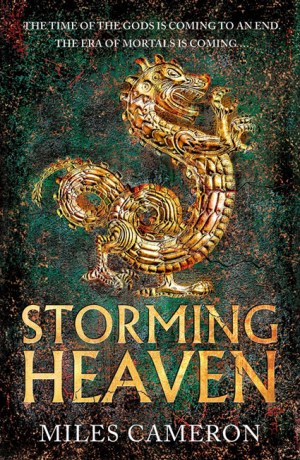
 To celebrate the release of Storming Heaven, the second novel in Miles Cameron‘s Age of Bronze series, Mobius Books has provided us with an excerpt to share with you all! The excerpt is comprised of the prologue and some other information to help readers get situated, and hopefully whet your appetite to read the rest of the novel. First, though, here’s the synopsis…
Before iron helmets and steel swords, when dragons roamed the world, was an age of bronze and stone, when the Gods walked the earth, and people lived in terror.
A scribe, a warlord, a dancer, a mute insect and a child should have no chance against the might of the bickering gods and their cruel games. But the gods themselves are old, addicted to their own games of power, and now their fates may lie in the hands of mere mortals . . .
By divine plan a plague of cannibals has been unleashed across the world, forming an armada which preys on all who cross their path. Meanwhile the people who allied against the gods have been divided, each taking their own path to attack the heavens — if they can survive the tide of war which has been sent against them.
All they need is the right distraction, and the right opportunity, to deal a blow against the gods themselves . . .
An original, visceral epic weaving together the mythologies of a dozen pantheons of gods and heroes to create something new and magical, this tale of the revolt against the tyranny which began in Against All Gods is a must read from a master of the fantasy genre.
Now, on with Storming Heaven…
*
Some Notes on the World
Characters in Against All Gods and Storming Heaven express distance in paransangs and stadia (singular stadion).
The parasang is approximately five kilometres, or the distance a fit man can walk in an hour of hard walking. It’s not an exact measurement. This is, after all, the Bronze Age.
The stadion is approximately six hundred feet (roughly two hundred metres, give or take).The foot is the measure of a man’s foot – not standardised. There are thirty stadia in a parasang in Noa and Dardania; fewer in the Hundred Cities, more in Narmer. But don’t be fooled; there are no standardised systems of measure. Every city measures everything from weights to distance, from grain to volume, in a different way. I have chosen to use the archaic Greek/Persian stadion and parasang (and the ‘foot’) to keep it relatively simple.
There is no money. This is a barter economy, and the relative value of gold, silver, grain or any other commodity varies from place to place and from transaction to transaction. Precious stones, like emeralds, rubies and lapis, are all useful for trade, but again, have no standard value.
There are no maps or charts, although Narmer and Ma’rib have ‘world pictures’ that begin to approach maps. People tend to express travel as a set of waypoints: ‘I went to A, then B, then C.’ Written down, these itineraries are the way pilgrims and merchants learn their routes.
Most people cannot read; the ability to read is almost a magic power. Scribes hold that power, and a good scribe can read most of the languages, ‘modern’ and ‘ancient’, of the world. There is no paper. Everything must be written on either papyrus (mostly in Narmer) or inscribed on clay tablets. Book-keeping and accounting, like reading, are near-magical powers.
Finally, the most durable metal is bronze. Iron is almost un- known, and its ownership is illegal and taboo. It is worth noting that a good work-hardened bronze blade is the equal or superior of much ironwork; only steel would exceed bronze, and bronze can be worked much more easily. This is an age of bronze, extended and enforced by the gods.

The Outer Darkness
Temis, the Dark Huntress, spun through the endless, featureless darkness of the void. She couldn’t breathe but then, as a god- dess, she didn’t really need to breathe. The cold was a limitless, terrifying thing, but where a mortal body might have frozen, or exploded, she merely endured. The cold – even the absolute cold of the void – was not going to kill her.
She withdrew into herself, thinking her dark thoughts, most of which were about how her sister, the Blue Goddess, had set her up for a fall and walked away unscathed. And she spent an unfathomable aeon trying to imagine how Enkul-Anu could think she was in league with the Jekers when Temis herself had warned him of the whole plot.
That had provided her with some entertainment.
And then she began to imagine the revenge she’d wreak when she returned, but that led, with a kind of awesome finality, to the thought she was trying to avoid …
There was no return from the Outer Darkness, not unless you were released or rescued. Enkul-Anu had loved Arrina, and he’d banished her into the Outer Darkness, and the poor goddess of the Sun had never returned.
And Enkul-Anu had been obsessed with Arrina, whereas he flat-out hated the Dark Huntress.
She cursed, trying to see where it had all gone wrong.
It had seemed like any other petty crisis among the gods: Enkul-Anu had ordered the death of an over-mighty mortal, Gamash of Weshwesh. The Huntress had made use of Gamash herself; he was just the sort of ambitious fool that the gods loved.
But one of the insane godlings had got his orders mixed up, and killed Gamash’s daughter Irene instead. Why had that mattered so much? Temis spun in the dark, remembering.
Tyka, the Blue Goddess, had promised the man revenge, and the two sisters had found star-stone out on the edge of reality near the Outer Darkness, and thrown it to earth. It was an old ploy – something they did to annoy the other gods. Mortals would make weapons which could harm the gods, and the gods would react with war, terror and repression. Enkul-Anu didn’t know any other way. And the repression fostered further revolt, the ripples spreading …
Temis might have shrugged – the story was so familiar – if she hadn’t been so utterly cold.
And there’d been one other mistake: the same godling, sent to support one mortal kingdom against another, had managed to destroy the kingdom he’d been sent to support – and had been wounded by a mortal.
Oh, how I savoured that.
In response, her blue ‘sister’, Tyka, had rescued the mortal along with some others. She’d had her share in the choices; all expendable mortal tools. A craftsman, a bureaucrat, a dancer, a washed-up warrior. Not the heroes they usually used.
And then Tyka had put them aboard a ship full of pacifist Hakrans. Another very strange choice. As sheexamined the steps that had led to her expulsion into the Outer Darkness, the Huntress realised how much of the action had been driven by Tyka. How many of the choices her silent ‘sister’ had made.
She winced.
I thought I was in charge.
Then Nisroch had plotted against his father, Enkul-Anu. And the foolish godlings, Nerkalush and Resheph, had plot-
ted against Nisroch.
And the puny human ship had washed up on the beaches of the dead island, Dekhu, seat of the old gods. Her former friends and allies who she thought of as dead. And everything went straight to hell. Someone had killed the godlings; someone had released the ancient World Serpent, which pre-dated the realms of the gods.
All of the gods.
The island had exploded; the resulting cataclysm had probably hurried the environmental collapse, and it had certainly thinned the human population. The tidal wave alone would have killed so many …
Even floating alone and abandoned in the void, the Dark Huntress found tears frozen to her eyes.
Who released the fucking World Serpent?
She spun in endless, perfect darkness, alone, considering it all, as time passed.
She revisited all her own decisions, and those of others.
She repented her errors, but not her rebellion. She imagined revenge.
She longed to return. And more time passed. Revisit.
Repent.
Revenge.
Return.
‘How long until I go mad?’ she wondered after six or nine- teen cycles of repeating her own thoughts.
Not that long.
And then, with malign satisfaction: Without me, the wheels will fall off. Even now, the whole environment iscollapsing, and the Jekers are an accelerant, and the Dry Ones are creeping in from the desert edge. A couple of centuries more, and …
That’s all I can hope for? A complete revolution, with the winner inviting me back. Nisroch? Not really up to it, and maybe dead, anyway. My sister Tyka? A plotter withoutpower. Clever, though.
Sypa?
For the first time in forty cycles of self-recrimination and desire for revenge, the Dark Huntress had a new thought. About Enkul-Anu’s affair with Arrina and the former sun goddess’s spectacular fall from grace. She had secretly been leading an insurrection among mortals and trying to give them the secret of the resinthat fed the gods.
What, five hundred years ago?
I always believed that story, the Dark Huntress thought, spin- ning silently in the dark. But with nothing to do but think …
Look at the aftermath: Arrina was banished to the Outer Darkness …
Arrina, who was a threat to … Sypa.
And Sypa’s son Telipinu takes over the resin works. Fuck, how did I fail to see this?
Regret.
Revisit.
Repent.
Revenge.
Return.
How long until I go mad?
*
Mile Cameron’s Storming Heaven is out now, published by Mobius Books in North America and Gollancz in the UK. The first book in the series, Against All Gods, is also published by Mobius Books in North America and Gollancz in the UK.
 Civilian Reader