Upcoming: “Fortune’s Blight” by Evie Manieri (Jo Fletcher Books)

ManieriE-SK2-FortunesBlightLast year, Evie Manieri’s Blood’s Pride was one of the pleasant surprises of the speculative genres. The first in the author’s Shattered Kingdoms series, it arrived unannounced one day in the mail. I had known nothing about it, I dove in and enjoyed what I read. Today, I spotted some information about the anticipated sequel, Fortune’s Blight

Victory for the Shadari rebels has come at a terrible price. Hardship, superstition and a murderous cabal poison King Daryan’s young regime, but help is nowhere to be found: the mercenary who led their rebellion has vanished, their Nomas allies have troubles of their own, and the Norlanders who returned home to plead – or fight – for the Shadari’s independence have found themselves embroiled in the court politics of an empire about to implode.

As the foundations of the two far-flung countries begin to crack, an enigmatic figure watches from a tower room in Ravindal Castle. She is old, and a prisoner, but her reach is long, and her patience is about to be rewarded…

Fortune’s Blight is due to be published in February 2015, by Jo Fletcher Books. So, it’s quite a way off, still, but that means there’s plenty of time for you to hunt down Blood’s Pride in time. (It is also currently for sale in the UK Amazon Kindle store.) Manieri’s series is published in the US by Tor Books.

Also on CR: Interview with Evie Manieri, Guest Post (“Why I Write Fantasy”)

Marvel Graphic Novel Catch-Up: Fearless Defenders, Avengers, and Thor

GraphicNovelsRead-201311-1

Three new Marvel NOW collections that I’ve read and enjoyed recently. I had my doubts about the new re-launch/re-boot, but I have actually rather enjoyed the stories themselves (despite, sometimes, only have movie knowledge to get me situated…).

Reviewed: Avengers, Fearless Defenders, Thor: God of Thunder

FEARLESS DEFENDERS, Vol.1 – “Doom Maidens”

FearlessDefenders-Vol.01Writer: Cullen Bunn | Artist: Will Sliney | Colors: Veronica Gandini

New team! New villains! New creators!Valkyrie and Misty Knight are the Fearless Defenders, and not since Power Man and Iron Fist has an unlikely duo kicked this much – well, you know.

Collects: Fearless Defenders #1-6

Cullen Bunn offers up  an all-female team of super-heroines, with a distinctly mythological slant. The story is fun and quirky, with Bunn’s signature, gentle humour often on display – witty asides, amusing narrative moments, and pretty great characterisation. I wasn’t wholly gripped, as I have been with some of his other work (The Sixth Gun remains one of my favourite series of all time). The artwork is good, sometimes a little exaggerated (think Marvel in the 1990s, perhaps). There’s some darkness in the story, too, which offered a nice balance to the levity, although I think I would have preferred to see that a little more developed. By the end, I thought I knew the characters rather well, but that the story had been a bit thin.

It was recently announced, I think, that this is being cancelled. That’s a pity, as I think this could have grown into something pretty cool, if given time. I’ll certainly be reading the remaining issues, though.

*

AVENGERS, Vol.1 – “Avengers World”

Avengers-Vol.01Writer: Jonathan Hickman | Artist: Jerome Opeña (#1-3), Adam Kubert (#4-6) | Colors: Dean White, Justin Ponsor, Morry Hollowell, Frank Martin, Richard Isanove (#1-3), Frank D’Armata (#4), Frank Martin (#5-6)

The greatest heroes in comics together on one unbeatable team! The Avengers “go large”, expanding their roster and their sphere of influence to a global and even interplanetary level. When Captain America puts out his call – who will answer? Big threats, big ideas, big idealism – these are the Avengers NOW!

Collects: Avengers #1-6

Captain America and Iron Man are rebuilding the Avengers. They’re using a more sophisticated organisational model, this time (it’s not as dull to read about as that sounds…). Meanwhile, Ex Nihilo, Abyss and Aleph have been terra-forming Mars and lobbing “evolution bombs” at Earth, re-writing Evolution. As you do. And, collaterally, killing whole bunches of people all over the world. Naturally, this irks the Avengers. After the core Avengers team confronted them at the start, Iron Man, Hulk, Black Widow, Thor and Hawkeye are held captive by these new baddies. Ex Nihilo likes to monologue. Cap is sent back to Earth to “bring everyone”. And then… We get one of the most anti-climactic conclusions in issue/chapter 3. It’s a total deus-ex-machina, couldn’t-be-bothered moment. Sadly fails to deliver, and I felt rather disappointed.

Avengers-Vol.01-Interior4

Recruiting, Avengers-Style

The second story in the book looks at the clean-up after the evolution bombs, from different perspectives, coupled with the backgrounds of some newer Avengers recruits (new for me, at any rate). First, Hyperion (a rather emo-God-type from another dimension, who seems to miss his former station on his world). Second, Smasher (a female “guardian”, or “subguardian” – basically, a Green Lantern with cool tech, a mask instead of a ring, and attached to the Shi’ar Empire, rather than the, uh, Guardians…). And third, Captain Universe (who appears to be a god… or perhaps the origin of all things… It’s not entirely clear…).

Avengers-Vol.01-Interior9

Three Moments of Levity: Bruce Banner explains himself (top), Thor confuses Tony (bottom, left),
and Thor is unimpressed by puny human’s idea of “Godlike”…

Overall, though, this isn’t a bad start to the new Avengers series. There’s a lot of rather cryptic information. Certainly, the Avengers are going Bigger. Hopefully it won’t become too silly in the future, but I am looking forward to reading Vol.2, “The White Event”. The artwork is pretty fantastic, too. Lots of great detail, rich colors, and it really pops throughout.

*

ThorGodOfThunder-Vol.01Thor: God of Thunder, Vol.1 – “The God Butcher”

Writer: Jason Aaron | Artist: Esad Ribic | Colors: Dean White (#1), Ive Svorcina (#2-5)

Throughout the ages, gods have been vanishing, their mortal worshippers left in chaos. Now, Thor follows a trail of blood that threatens to consume his past, present and future. The only hope for these ravaged worlds is for Thor to unravel the gruesome mystery of the God Butcher!

In the distant past, Thor follows the bloody wake of murdered gods across the depths of space. In the present, the Thunder God discovers a forgotten cave that echoes with the cries of tortured gods… and is shocked to find himself among them! And thousands of years from now, the last god-king of a ruined Asgard makes his final stand against the God Butcher’s beserker legions. As three Thors from three eras race to stop the God Butcher, the full extent of his vicious scheme takes terrifying shape!

Collects: Thor – God of Thunder #1-5

Another great start to a new Marvel NOW series. This is the first Thor solo series I’ve ever read, and I think Aaron does a great job of offering a starting point – given that the story hops between three times (past, present, and very far future), there’s no need to be greatly versed in the Thor mythology (Norse or Marvel’s). We see the character develop a bit, and a millennia-long struggle against the God Butcher, who – true to his name – has been working his way through the various pantheons of the universe, culling the numbers of deities. Thor, the only one to give him much of a challenge, has been chosen as the Last, in order that he sees his fellow gods killed, one-by-one.

It’s a solid story, and I’m certainly going to try to stick with the series for a little while. The writing is great, the story and artwork complement each other brilliantly, too. Definitely recommend this one to anyone who either likes the character already, or wants somewhere to jump on.

ThorGodOfThunder-Vol.01-Interior1

“The Crystal Cave” by Mary Stewart (Hodder)

StewartM-M1-CrystalCaveOne of the best-loved interpretations of the Merlin Myth

Fifth century Britain is a country of chaos and division after the Roman withdrawal. This is the world of young Merlin, the illegitimate child of a South Wales princess who will not reveal to her son his father’s true identity. Yet Merlin is an extraordinary child, aware at the earliest age that he possesses a great natural gift – the Sight.

Against a background of invasion and imprisonment, wars and conquest, Merlin emerges into manhood, and accepts his dramatic role in the New Beginning – the coming of King Arthur.

Hm. How to review a book that is well-written, well-conceived, but didn’t fire one’s imagination? In brief, I suppose, is the best answer. I received this as part of the Hodderscape Review Project, which has been a great way to try out some classics of genre fiction. True, only one has truly wormed its way into my mind (Stephen King’s The Shining), but I am very happy that I’ve had the opportunity to read these books (this is the third so far). I’m especially looking forward to the next title in the project (by none other than Ursula le Guin…). The Crystal Cave, however, must also be put on the Shelf of Classics That Disappointed.

Despite this, there is a fair bit to like in this novel. Stewart’s prose is well-crafted and fluid – it reminded me of Robin Hobb’s Assassin’s Apprentice, actually, in style. The characters are interestingly portrayed and well-drawn. Despite these things, the story itself just didn’t grab me enough to make me love it. This is one of the first novels that, after I told friends and family that I was going to read it, was universally met with comments along the line of, “It’s great!” and “It’s fantastic!” Sadly, I just didn’t get swept up by it. The story took too long to get going. I did, however, enjoy how Stewart brought in Merlin’s gift of Sight into the story, and developed it over the course of this first book – he first comes across as incredibly observant, and then we start to see his knowledge of things he couldn’t possible know.

As far as Merlin/Arthur interpretations go, I can certainly see why this has been so popular, and how that popularity endures today. Of the many other versions of this story that I have read (most recently, I think, DC Comics’ Demon Knights and Maurice Broaddus’s Knights of the Breton Court), this is probably the best conceived and in-depth.

It is perhaps the long-game approach that Stewart took that makes the novel not really work for me. It suffers from being too obviously the first part of a series – the characters, ideas and so forth aren’t developed enough, and I didn’t think the plot moved forward enough. Sadly, this means I haven’t got the bug to seek out the rest of the series. At least, I am not in any hurry. As someone who will happily sit through thousands of pages of epic fantasy trilogies (most recently, Joe Abercrombie and Peter V. Brett – both authors for whom I had some catching up to do), it is perhaps strange to say this book didn’t work for me.

That’s quite possibly the most carefully-written, sitting-on-the-fence review I’ve ever written. I’m not proud of it. I just couldn’t rustle up much verve to dig deeper. Which is never a good sign when it comes to a novel. I’m sure, in the future, I’ll give this another try. As it stands, though, it didn’t work for me, and I don’t want to belabour the point.

Jonathan Franzen on Writers and Social Media

JonathanFranzen-AuthorPicIn the October 6th issue of the Atlantic Weekly, author Jonathan Franzen had an article called, “Why Novelists Should Stay Off Facebook”. [Before I continue, I must say I’ve been enjoying the Atlantic Weekly a great deal – it’s a brilliant read for anyone who can’t wait the month between each issue of the main magazine – and I’ve particularly enjoyed the articles on books and literature.]

The author is no shrinking violet when it comes to his opinions on technology, and especially any advancements that have an impact on publishing. He is not, for example, a big fan of eBooks, and has warned that they are “corroding values” and “damaging [to] society”. Anyway, the article was interesting, so I thought I’d offer some comments here, and see what other people think. The article carries a pretty restrictive prescription, especially in this day and age, but if you stand back and take a look at it, there may be some truth in what he writes (subjective and individual truth, of course, as there is no One Way to Write a Novel).

Let’s begin with this comment:

“… the internet in general – and social media in particular – fosters the notion that everything should be shared, everything should be communal. Where that becomes especially dangerous, I think, is in the realm of cultural production – and particularly literary production. Good novels aren’t written by committee. Good novels are produced by people who voluntarily isolate themselves, go deep, and report from the depths on what they find. The result is communally accessible, but not the process itself.”

Do you agree? I sometimes wonder about this. I think there is undeniable value that can be found in utilising social media to reach out to fans, potential fans, and the ever-growing horde of bloggers and reviewers (almost all of whom, I’m sure, use at least Twitter). To be able to reach out and engage with fans of your genre (critically or from their own position as fans), must have value. I can think of a few authors who, early in their careers, have reached out to bloggers to help get the word out about their upcoming debuts. Established authors can also marshall their considerable followings to help promote their own work and causes, or those of others they deem worthy.

I think the most important part of Franzen’s point, though, lies in the “Good novels aren’t written by committee” comment. To that end, he continues:

“What makes a good novel, apart from the skill of the writer, is how true it is to individual subjectivity. People talk about ‘finding you voice.’ Well, that’s what it is. You’re finding your own individual voice, not a group voice.”

I agree with him. There are times when, in my precocious and pseudo-intellectual moments, I get the feeling that an author’s voice has been trampled by the requirements and tastes of their editors and/or agents. Certainly, there are plenty of examples of stunning debuts followed by lacklustre sophomore efforts that bear little resemblance to the style and panache of what came before.

JonathanFranzen-TIMEI wonder if, while he makes no explicit mention of them, Franzen is also passing judgment on the new-and-proliferating online writing forums and communities? Perhaps so, but then I wonder what his opinion would be on writing groups that are “old school” and in-person? Surely the online forums bring the potential for wider and more varied input? If you’re only able to meet and discuss projects with like-minded people from similar backgrounds (geographical and/or socio-economic), then you might miss a trick, or end up regurgitating time-worn cliches and tropes. But what if someone from across the world was able to offer comments and advice? Surely that would help keep things fresh, or spark a wholly original idea? (Gasp! Yes, they must still exist…)

As for his comment about novels not being created by committee… Well, as anyone even remotely interested in the publishing industry and process probably knows, no novel is written in a vacuum, and that there is a committee, of sorts, that will likely put their fingerprints on a novel that is to be published. One novel that was recently sold by my boss, for example, went through a number of drafts, before it was sent to me for a reader’s report, before then being sent to the editor, before being sent to another editor. That’s quite the committee. I don’t think anyone involved suggested anything that would take away or adversely suppress the author’s voice (one which I thought was superb, atmospheric, and at times immersive). But I do wonder if online forums might? If your audience or committee (just to keep using Franzen’s term) has no vested, professional interest in the final product, might that change their prescriptions? There is an online writers group/platform that at least one publisher keeps an eye on. I know of one novel that was picked up based on how much attention it received from users of that platform. To me, it wasn’ that interesting or particularly well-written. The novel equivalent of a camel? (Please tell me I don’t have to explain that metaphor?) That probably sounds like elitist claptrap to many people who read this, or something Franzen (professional Grumpus and naysayer that he is)* might pronounce. But I do think there is at least a kernel of truth in Franzen’s belief that for an author to develop his or her own Voice, one does have to step back from the cacophony of voices and opinions and inputs online.

Franzen-FreedomUKI do, however, think Franzen also doesn’t really understand the ways in which many authors (certainly many in the SFF genres) use social media and the internet. I don’t know of many who reach out blindly or incautiously for input from online communities. Most, at least in my experience, do so for publicity reasons. And for many it seems to work rather well, at least from a critical (if not commercial) standpoint.

Near the end of the article, Franzen expounds on some wisdom that Don DeLillo once shared with him, on the subject of authorial isolation:

“… if we ever stop having fiction writers, it will mean we’ve given up on the concept of the individual person. We will only be a crowd. And so it seems to me that the writer’s responsibility nowadays is to very basic: to continue to be a person, not merely a member of a crowd. This is a primary assignment for anyone setting up to be and remain a writer.”

In other words, writers and would-be writers should Be Aloof? What do you think? Is Franzen wrong? Completely, partly?

Jonathan Franzen is the author of, among others, Freedom and The Corrections.

* That being said, he still seems to have nothing on Brett Easton Ellis on that front…

I Have Never Read… Graham Joyce. (But I’d really like to.)

JoyceG-SomeKindOfFairyTaleUKAuthor Graham Joyce’s latest novel, Some Kind of Fairy Tale won the British Fantasy Award for best novel this past weekend (announced during the World Fantasy Convention in Brighton). This is the sixth time Joyce has won the Best Fantasy Novel Award. Here is the synopsis:

Some Kind of Fairy Tale is a very English story. A story of woods and clearings, a story of folk tales and family histories. It is as if Neil Gaiman and Joanne Harris had written a Fairy Tale together.

It is Christmas afternoon and Peter Martin gets an unexpected phone-call from his parents, asking him to come round. It pulls him away from his wife and children and into a bewildering mystery.

He arrives at his parents house and discovers that they have a visitor. His sister Tara. Not so unusual you might think, this is Christmas after all, a time when families get together. But twenty years ago Tara took a walk into the woods and never came back and as the years have gone by with no word from her the family have, unspoken, assumed that she was dead. Now she’s back, tired, dirty, disheveled, but happy and full of stories about twenty years spent travelling the world, an epic odyssey taken on a whim.

But her stories don’t quite hang together and once she has cleaned herself up and got some sleep it becomes apparent that the intervening years have been very kind to Tara. She really does look no different from the young women who walked out the door twenty years ago. Peter’s parents are just delighted to have their little girl back, but Peter and his best friend Richie, Tara’s one time boyfriend, are not so sure. Tara seems happy enough but there is something about her. A haunted, otherworldly quality. Some would say it’s as if she’s off with the fairies. And as the months go by Peter begins to suspect that the woods around their homes are not finished with Tara and his family…

Joyce’s other winning novels were: Dark Sister (1993), Requiem (1996), The Tooth Fairy (1997), Indigo (2000), Memoirs of a Master Forger (2009). In addition to these six wins, perhaps more impressive is the fact that he’s been nominated a total fourteen times.

Earlier this year, Joyce was diagnosed with aggressive lymphoma cancer.  The awards ceremony was his first public appearance since his diagnosis – indeed, six months ago, his condition was extremely precarious. Accepting the award, the author stated, “Just being able to stand here today is a wonderful award, thanks to the doctors and nurses of the NHS.”

Graham Joyce’s novels have always somehow managed to escape my attention. True, in this case, the synopsis doesn’t appear to be entirely to my taste. However, given just how many people rave about his work (and irrespective of the number of awards he’s won), I am intrigued. Especially as I start forcing myself to read more outside my ‘comfort zone’, and as my general Reader’s Block continues (‘standard’ fantasy novels have started to blur into one…).

I thought I’d also pick up on something from the biography I received today from his publicist:

“In 1989 Joyce quit his job as a youth worker and went to live and write in a beachside shack on the Greek island of Lesbos. He sold his first novel after a year in Greece. Since then he has written twenty novels and numerous short stories. His novels have attracted admirers including Isabel Allende, Iain Banks, A.S. Byatt and Stephen King.”

I wish I had the courage (not to mention the talent) to do this… Too often, I feel like my life has been dictated by “safe” choices. True, I’d like to retire to a cabin in North America, but there are rather strict visa concerns to take into account…

Reader’s Block…

… is apparently a thing. Which I am experiencing at the moment. I haven’t liked about 3/4 of the books I’ve tried to read over the past two weeks. I’m still reading, and have managed to get through a couple (reviews pending), but I’m finding I have zero patience for a lot of things. I’ve even tried to go with safe bets, comfort reads (Star Wars, something published by Black Library, or by authors I know I’ve really enjoyed in the past). But… nothing is hitting the mark.

This may be a case of genre-overload (I have to read this stuff for work, now, too), which could explain why I’ve been reading more real-world novels (thrillers, literary fiction, etc.). For this reason, I think we’ll be seeing a temporary shift, and I’ll be focusing more on non-SFF novels for just a little while, as I clear my brain. Then, after that, we’ll be seeing far more genre breadth on the blog – in terms or reviews, news, and hopefully interviews. I haven’t stopped liking SFF or anything of the sort. I think I just need a bit of a break. They’re starting to blur into one mass, right now…

“Wonder Boys” by Michael Chabon (Harper Collins / Random House / Open Road)

Chabon-WonderBoysA University Professor’s Crippling Writer’s Block and Drug-Fuelled Self-Destruction

Grady Tripp is a pot-smoking middle aged novelist who has stalled on a 2611-page opus titled Wonder Boys. His student James Leer is a troubled young writer obsessed by Hollywood suicides and at work on his own first novel. Grady’s bizarre editor Terry Crabtree and another student, Hannah Green, come together in his wildly comic, moving, and finally profound search for an ending to his book and a purpose to his life.

This is the second of Michael Chabon’s novels that I’ve read – and in a very short time, too. I still have no idea how to review The Amazing Adventures of Kavalier & Clay, which may rank as one of my all-time favourite novels. (Needless to say, it’s not difficult for me to see why it won the Pulitzer Prize.) Wonder Boys, the novel Chabon wrote before Kavalier & Clay, is a rather different novel. It’s nowhere near as long, for one thing – and yet, strangely, it feels far more rambling and unfocused. I enjoyed it a great deal, and zipped through it in just a couple of days. Chabon has a wonderful way with words that can make even the mundane a pleasure to read about.

The main character is almost archetypical, struggling author with writer’s block. Wonder Boys is basically the story of his long-time spiral of self-destruction coming to a head. Over the course of a single weekend, his wife leaves him, his affair takes a shocking turn, lots of people realise that he’s a nightmare and kind of feckless. He also has to attempt to keep his rather predatory editor away from one of his potentially-suicidal students. Along the way, there is a dead dog, one of Marilyn Monroe’s jackets, a shoot-out in an alley, and also a massive dead snake. And some Korean Jews. And a heavy amount of drug consumption.

Chabon-WonderBoysORI haven’t read much literary fiction (or whatever genre this is meant to be in), but there are some tropes that are popping up. They seem to be predictable in their unpredictability. Strange things happen. People do really weird things (see, for example, the bacchanal in The Secret History). They react in slightly melodramatic ways. And yet… there is a way that Chabon writes these little weirdnesses that feels very natural. Realistic, and not actually forced or jarring.

Without walking through the whole plot, it’s tricky to know what to write for this review. I am not aiming for a review in the style of the New Yorker, The New Republic, or Harper’s, so I’m not going to attempt to deconstruct this in any intellectual or academic manner. That’s not what the blog is for. What I will say, though, is that if you’re after a slightly strange, well-written novel about a writing professor at a small Ohio University going crazy, then this is for you. It’s witty, engaging, rather addictive, and very quirky.

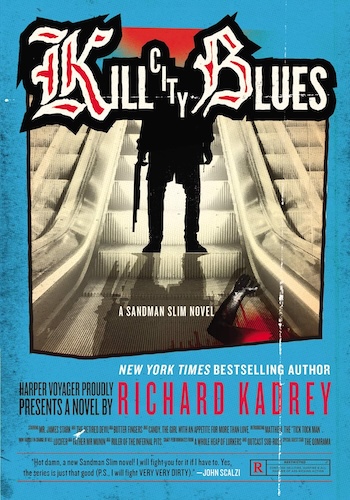
Review: KILL CITY BLUES by Richard Kadrey (Voyager)

Sandman Slim is back on Earth, Averting Apocalypse & causing mischief…

James Stark, aka Sandman Slim, has managed to get out of Hell, renounce his title as the new Lucifer, and settle back into life in LA. But he’s not out of trouble yet. Somewhere along the way he misplaced the Qomrama Om Ya, a weapon from the banished older gods who are also searching for their lost power.

The hunt leads Stark to an abandoned shopping mall – a multi-story copy of LA – infested with Lurkers and wretched bottom-feeding Sub Rosa families, squatters who have formed tight tribes to guard their tiny patches of this fake LA. Somewhere in the kill zone of the former mall is a dead man with the answers Stark needs. All Stark has to do is find the dead man, get back out alive, and outrun some angry old gods-and a few killers-on his tail.

In the fifth Sandman Slim novel, we get more of the same. In both a good and less-good way. Kadrey serves up another dose of gritty, sometimes gnarly, often amusing supernatural urban fantasy. All the hallmarks of the Sandman Slim series are on display – the interesting and inspired twists on classic urban fantasy and horror denizens and creatures. His characters are quippy and interesting, not to mention developing rather nicely. The action is well-written, and doesn’t take over from the plot (of the novel or series’ meta-plot). I still love Kadrey’s version of Hell, God, Lucifer and Samael (former Lucifer). All the characters feel very real, now, even if they are outlandish (Kasabian, for example). Continue reading

Author-Of-Many-Genres: Jeff Somers

I was spending some time on Goodreads, recently (as you do), and I noticed that Jeff Somers wrote in a number of genres. On the face of things, that is not at all a groundbreaking discovery. But, given the publishing industry’s preference for author branding, I thought it was interesting that Somers wrote under the same pen-name for all of the genres. Again, not exactly an earth-shattering discovery, but it gives me the opportunity to feature his work on the blog, before I get around to reading any of it. So, without further ado…

Author Bio: “Born in Jersey City, N.J., Jeff Somers has managed to migrate just five minutes away to nearby Hoboken, land of overpriced condominiums and a tavern on every corner. Between weekly drunks, Jeff manages to scrawl enough prose onto cocktail napkins and toilet paper to keep up a respectable fiction career.”

Genres: Avery Cates (Cyberpunk), Ustari Cycle (Urban Fantasy), Lifers, and Chum (fiction)

PrintAvery Cates – THE ELECTRIC CHURCH (debut), THE DIGITAL PLAGUE, THE ETERNAL PRISON, THE TERMINAL STATE, THE FINAL EVOLUTION

In the near future, the only thing growing faster than the criminal population is the Electric Church, a new religion founded by a mysterious man named Dennis Squalor. The Church preaches that life is too brief to contemplate the mysteries of the universe: eternity is required. In order to achieve this, the converted become Monks – cyborgs with human brains, enhanced robotic bodies, and virtually unlimited life spans.

Enter Avery Cates, a dangerous criminal known as the best killer-for-hire around. The authorities have a special mission in mind for Cates: assassinate Dennis Squalor. But for Cates, the assignment will be the most dangerous job he’s ever undertaken – and it may well be his last.

*

SomersJ-UC1-TricksterUstari Cycle – TRICKSTER

Magic uses blood — a lot of it. The more that’s used, the more powerful the effect, so mages find “volunteers” to fuel their spells. Lem, however, is different. Long ago he set up a rule that lets him sleep at night: never use anyone’s blood but your own. He’s grifting through life as a Trickster, performing only small Glamours like turning one-dollar bills into twenties. He and his sidekick, Mags, aren’t doing well, but they’re getting by.

That is, until they find young Claire Mannice — bound and gagged, imprisoned in a car’s trunk, and covered with invisible rune tattoos. Lem turns to his estranged mentor for help, but what they’ve uncovered is more terrifying than anybody could have imagined. Mika Renar, the most dangerous Archmage in the world, is preparing to use an ocean of blood to cast her dreams into reality — and Lem just got in her way.

*

SomersJ-ChumCHUM

Mary and Bickerman are the center of their circle of friends – but these friends are strangers as well as family to them. In the course of year, under the influence of a stressful wedding and a whole lot of alcohol, relationships and nerves are twisted and broken as the dynamics of the cozy-seeming group shift. Secrets are kept, emotions withheld, and it doesn’t look like it’s going to end well for anyone.

Told always in first person, but not the same person, and unfolding in double-helix chronology that provides a “Rashomon”-like narration, “Chum” is the story of love, liquor, and death.

*

SomersJ-LifersLIFERS

Three twenty-something guys, who transitioned from collegiate underachieving to corporate bottom feeding sketch out a plan to make a grab for some dignity. They will rob the publishing house that employs their only stable member and results him on a daily basis. Being the bright, perceptive fellows they are, they all quickly realize it’s about the money.

For Phil “Dub” Dublen, it’s a pissed off statement against a dull, meaningless job. For self-styled poet Trim, it’s a chance to actually be outrageous and anarchic as he needs to be. For Trim’s roommate Dan, it seems to be something he does for the same reason he does everything: to vent some anger, having nothing better to do. By the time their master plan is all said and done, nothing has been solved, nothing is better, and nothing, really, has changed. And, in the slightly fractured wisdom of the larcenous trio, this surprises none of them.

Who’s read any of these? I’ve picked up TRICKSTER and LIFERS, and intend to read them ASAP. Any other multi-genre authors you like? Or any you would like me to feature on the blog in either a post like this, or as reviews?