Guest Post: “On Worldbuilding” by Lenora Rose

RoseL-IllusionOfSteel-Crop

Lenora Rose is the author of The Illusion of Steel (Eggplant). A while back, I got in touch with her and asked if she might be interested in writing a little something for the blog, and she agreed. So, in advance of my review of the novel, here is Lenora on worldbuilding…

ON WORLDBUILDING

It seems that lately, worldbuilding has been coming up on the blogs of writers more than usual; possibly this is the case, or possibly it’s confirmation bias, since I’ve been trying to think how to put my own thoughts about worldbuilding into perspective.

Then Ursula Vernon posted this offering, memorably titled Worldbuilding and the Okapi’s Butt, in which she remarks:

The important thing is that the reader get a sense of vast, uncanny history and weird things happening just out of sight. You don’t want to drag the world in and put it on the dissecting table—that way lies Silmarillion-esque prologues—you just want them to catch a glimpse of it, like an okapi’s butt in the rainforest, and go “Whoa. There’s a really big animal over there, isn’t there?” while it glides away into the shadows. … And the truth, of course, is that for me (and I’d guess for many of us) there’s no okapi there at all, it’s basically a big striped butt on a stick that the writer is waving through the undergrowth. Possibly while making “Woooooooo!” noises because none of us actually know what an okapi sounds like.

And this… is true. Any speculative fiction writer, in attempting to present a fleshed out world, will probably several times need to reference something outside the actual story, some past kingdom or mythical animal, some hobby of the lower classes, some religious detail, or a line about, “That time when grandmother got into a drinking contest with a Giant Stoat…” Mostly, they sit in the corners, making the world a bit more solid.

The story where these things are lacking often feels unsatisfying, at least to me as a reader. If there’s nothing past the edges of the map in the frontispiece, if all the people come from the same racial type and same cultural background without a good reason, if the hero isn’t an orphan and yet seems to lack a family, if, to paraphrase Patricia C. Wrede, I can’t figure out who does the laundry (and yet the character’s clothes are always scrupulously clean), my chances of finishing the book decrease. It’s often essential to cultivate the sense that the world is large and has been around a while before the story starts, shifting and changing like the real world does.

RoseL-IllusionOfSteelBut how much worldbuilding, how much extraneous detail is enough? While some people write so as to have an excuse to world-build (Tolkien being the extreme and obvious example), others write so as to get through a story they love. We’re not all up to spending 40 years inventing our worlds; even more so for those working to deadline. It can be a rewarding game, but it can also exhaust the writer.

Even inventing, and remembering, all one’s Okapi butts can be wearing. They seem small, and they’re quicker and lighter than fully writing out the details of the Okapi in the forest (often for the reader as well as the writer), but they all need to be remembered, because when the writer least expects it, one turns into a key detail in the story. Your hero is surrounded by a tribe of giant stoats, and tentatively mentions his grandmother’s name… next thing you know, the stoat nation’s drunken-fu warriors are an essential part of his plan to defeat the enemy.

My usual workaround is to write mostly in the same world. Not the same country or culture, necessarily, not even the same time period, but a consistent world. This gives me some framework to add details that flesh the world out without exhausting myself inventing every single thing from scratch every time. I know what this character’s grandparents were doing, in that country across the sea. I know what animals are in the woods, at least well enough that when some strange thing moves through the trees, even if all I add in this moment is the flash in the trees, in another story, that animal was out in plain sight, being a big part of the plot. So I can produce the whole animal on demand without needing to invent it yet again.

Sherwood Smith uses much the same technique (with some of the overall worldbuilding that doesn’t fit into the stories appearing on her web site, for those interested enough after a few books).

It has its dangers. Not least, of course, is Tolkien syndrome, where most of his stories never got finished because their creator was refining his world yet again, and rewriting all but random pages rather than sitting down to write a piece start to end. The other is the possibility of too many subplots, too many things the reader needs to know to step into a story – as has happened with some of the multi-volume epics.

So for this, too, I developed a personal workaround.

I leave lacunae on purpose.

As I’ve already mentioned in a comment on this web site, when I read Robin Hobb’s Tawny Man trilogy, it often referred back to an earlier trilogy, the Farseer books, sketching out the youthful years of the main character, Fitz. Some of those early years had direct effects on the current story, so of course, the Tawny Man trilogy is filled with references to it, enough to keep new readers in the know but not so much a reader of the first story would feel bogged down by old information.

The main thing I took away from the Tawny Man trilogy, for all I enjoyed it very well, was that I never actually wanted to read the first trilogy. This was not, as it happens, any doubt that the story itself would be well written. I have read and admired numerous other works of Ms. Hobb’s (particularly those published as Megan Lindholm). However, in this one case, the details as they shone through the second trilogy seemed stronger to me as fleshed-out backstory than they would as a story in their own right. They made the world richer, deeper, and they satisfied any craving I had to learn more.

I don’t say this choice was right for others, but it was right for me.

There are places where I have an idea what happens to the characters. In some cases, these turned into essential backstory. In some cases, they’re foreshadowed in stories that already exist. But I do not intend to write these particular stories.

I can’t say that won’t change at some point. But while there are writers of whom I wish, deeply, that they had told more stories, finished works in their lifetime rather than leaving their heir to scramble through boxes and decades of revisions – or simply leaving things unwritten forever – there are other writers where I have noticed that they’re writing every last story they can, every last side quest or passing mention in their other books. And some of them just don’t interest me. I like the implied story, the story as it is in my mind, more than anything I suspect I would read that they wrote to fill that gap.

Story is, after all, something that happens between writer and reader. Fill in all the gaps, and you leave nothing for the reader to do.

***

You can read an excerpt of The Illusion of Steel here. And here’s the synopsis:

Not even a shape-shifter can hide from her past forever…

Abandoned by her mother as a child, never knowing her father, Kanna Mendrays understands how to hide. She has used her shapeshifting ability to mask who she is, what she is, even her gender. Now that she has come to Melidan Tower to heal, she finds her defenses crumbling.

Peace is scarce here. Biadei—the friend who saved her life and brought her to the Tower—goes mad at each full moon. The aged Lord Daemon—infamous for having killed the man who abused him—seems to know too much about her. Every room of the Tower presents Kanna with a mystery when all she wants is peace.

And now she has begun to hear a voice: the spirit of Lord Daemon’s victim, whispering to her through a sword named Desecrator. When Biadei is captured by werewolves, it promises, “Give me Daemon, and I will save your friend. Give me Daemon, and you will know the truth about your family…”

Congratulations to CHRIS BECKETT, Winner of the Arthur C. Clarke Award!

Yesterday I attended the Clarke Award ceremony at the Royal Society in London. The event opened with a panel discussion on science in five years (in 2,001 days… Geddit?) – I was pleased to learn that there are people currently working on World Ships. That was cool.

Anyway, the reason most of us were there was to learn who won the prize (and, ahem, the drinks afterwards…). And so, big congratulations to…

Beckett-DarkEden

CHRIS BECKETT, for his novel DARK EDEN (Corvus)

The runners-up, all equally interesting and high-quality science-fiction novels, were…

2013ClarkeAwards-RunnersUp

Adrian Barnes, Nod (Bluemoose)

Nick Harkaway, Angelmaker (William Heinemann)

Peter Heller, The Dog Stars (Headline)

Ken MacLeod, Intrusion (Orbit)

Kim Stanley Robinson, 2312 (Orbit)

After the event, I had the pleasure of meeting a great number of people who I have long respected and/or only known on the other end of an email conversation or through Twitter. It was wonderful to meet so many of you and chat about all things genre and much other things besides. A great evening.

Author Wisdom: Michael Chabon

This quotation was passed on to me by Alyssa, who found it on Sarah Rees Brennan’s blog, and which originated on a New York Review of Books piece Chabon wrote on Janury 31 2013 (the piece is about Wes Anderson’s movies):

“The world is so big, so complicated, so replete with marvels and surprises that it takes years for most people to begin to notice that it is, also, irretrievably broken. We call this period of research ‘childhood.’

“There follows a program of renewed inquiry, often involuntary, into the nature and effects of mortality, entropy, heartbreak, violence, failure, cowardice, duplicity, cruelty, and grief; the researcher learns their histories, and their bitter lessons, by heart. Along the way, he or she discovers that the world has been broken for as long as anyone can remember, and struggles to reconcile this fact with the ache of cosmic nostalgia that arises, from time to time, in the researcher’s heart: an intimation of vanished glory, of lost wholeness, a memory of the world unbroken. We call the moment at which this ache first arises ‘adolescence.’ The feeling haunts people all their lives.”

Joey Hi-Fi brings Tony Ballantyne’s “DREAM LONDON” to life… (Solaris)

Ballantyne-DreamLondon

Hot on the heels of Joey Hi-Fi’s two awesome covers for Charlie Human’s Apocalypse Now Now (Century), Solaris has unveiled the artist’s superb cover for Tony Ballantyne’s next novel, Dream London. The novel will be published in October 2013. In the meantime, here’s the synopsis:

Captain Jim Wedderburn has looks, style and courage by the bucketful. He’s adored by women, respected by men and feared by his enemies. He’s the man to find out who has twisted London into this strange new world, and he knows it.

But in Dream London the city changes a little every night and the people change a little every day. The towers are growing taller, the parks have hidden themselves away and the streets form themselves into strange new patterns. There are people sailing in from new lands down the river, new criminals emerging in the East End and a path spiraling down to another world.

Everyone is changing, no one is who they seem to be.

Fantastic Page from JUSTICE LEAGUE OF AMERICA #2 (DC)

I just caught this over on iFanboy’s “Best of the Week in Panels… 03/20”, and it made me laugh. So, naturally, I’m sharing it here:

JLAmerica-02-Interior5

The story is written by the great Geoff Johns, with artwork by David Finch, Sonia Oback, and Rob Leigh. It’s always nice to see that some writers haven’t lost their sense of fun. Justice League of America #2 is out now.

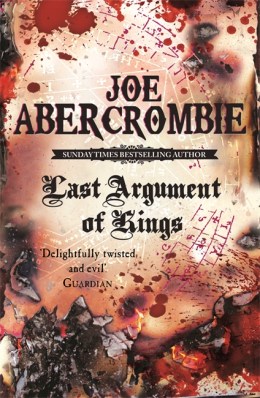
Review: LAST ARGUMENT OF KINGS by Joe Abercrombie (Gollancz)

AbercrombieJ-FL3-LastArgumentOfKingsUK1A strong finish to The First Law trilogy

The end is coming.

Logen Ninefingers might only have one more fight in him – but it’s going to be a big one. Battle rages across the North, the king of the Northmen still stands firm, and there’s only one man who can stop him. His oldest friend, and his oldest enemy: it’s time for the Bloody-Nine to come home.

With too many masters and too little time, Superior Glokta is fighting a different kind of war. A secret struggle in which no one is safe, and no one can be trusted. As his days with a sword are far behind him, it’s fortunate that he’s deadly with his remaining weapons: blackmail, threats, and torture.

Jezal dan Luthar has decided that winning glory is too painful an undertaking and turned his back on soldiering for a simple life with the woman he loves. But love can be painful too – and glory has a nasty habit of creeping up on a man when he least expects it.

The king of the Union lies on his deathbed, the peasants revolt, and the nobles scramble to steal his crown. No one believes that the shadow of war is about to fall across the heart of the Union. Only the First of the Magi can save the world, but there are risks. There is no risk more terrible, than to break the First Law…

It is always tricky to review the final book in a trilogy or series. So how to go about it, with a series and novel that I could talk about for hours? To avoid spoilers or over-analysis requires a very short review. But, “This is the culmination of a superb series” seems just too short… The Blade Itself started the series in fine form. Before They Are Hanged kicked things into a much higher gear. And Last Argument of Kings brings things to a brash, loud conclusion. Continue reading

Comic Cover Conformity…

While I understand that there are certain images that are iconic or eye-catching, I can’t help but raise an eyebrow at the similarities between the covers for Brooklyn Animal Control (a one-shot from IDW) and Garth Ennis’s new series, Red Team #2 (Dynamite):

CoverConformity-BrooklynAnimalControlRedTeam

I’ve read neither comic (though I’d like to give the series a try). But damn, those compositions are similar…

Upcoming: “Apocalypse Now Now” by Charlie Human (Century)

Feast your eyes on this twisted, visual delight…

Human-ApocalypseNowNow-UK

This is, as I’m sure you can gather, the cover for South African author Charlie Human’s debut novel, Apocalypse Now Now. The cover was first unveiled on the always awesome Pornokitsch (whose post also has an interview with Charlie Joey Hi-Fi – go check it out).

I’ve been hearing about this book a lot recently (from one person in particular…), and he has done a sufficiently excellent job of making me ridiculously excited to get my grubby mitts on a copy.

Baxter Zevcenko is your average sixteen-year-old-boy — if by average you mean kingpin of a schoolyard porn syndicate and possible serial killer who suffers from surreal  nightmares. Which may very well be what counts as average these days. Baxter is the first to admit that he’s not a nice guy. After all, if the guy below you falls, dragging you down into an icy abyss you have to cut him loose — even in high school. That is until his girlfriend, Esmé, is kidnapped and Baxter is forced to confront a disturbing fact about himself — that he has a heart, and the damn thing is forcing him to abandon high-school politics and set out on a quest to find her. The clues point to supernatural forces at work and Baxter is must admit that he can’t do it alone. Enter Jackie Ronin, supernatural bounty hunter, Border War veteran, and all-round lunatic, who takes him on a chaotic tour of Cape Town’s sweaty, occult underbelly.

What do glowing men, transsexual African valkyries, and zombie-creating arachnids have to do with Esmé’s disappearance? That’s what Baxter really, really needs to find out.

The cover at the top, by Joey Hi-Fi, is the UK edition (to be published by Century in August 2013), but Apocalypse Now Now will also be graced with an equally sinister and moody cover (also by Joey Hi-Fi) in the author’s native South Africa:

Human-ApocalypseNowNow-SA

Batman: Dark Knight, Vol.2 – “Cycle of Violence” (DC)

BatmanDarkKnight-Vol.02Writer: Gregg Hurwitz | Artist: David Finch | Inks: Richard Friend (#10) | Colors: Sonia Oback

The Scarecrow has returned to Gotham City, but he’s no longer the meek punching bag Batman is used to. The villainous genius has always preyed on the worst fears of his victims, but has refined his legendary fear toxin to even greater effectiveness and deadlier consequences. As the Scarecrow’s origin is unfurled, Batman must find out not only how to conquer this dangerous psychopath, but how to beat his own worst fear.

Collects: Batman: Dark Knight #10-15

This story arc, the first from New York Times bestselling thriller author Gregg Hurwitz, is simply brilliant. It covers some familiar Batman-Scarecrow ground (and also back story), but with a more contemporary, sinister edge. Hurwitz has taken a very psychological approach to the story (there’s not as much action as many comic authors inject into Dark Knight tales), and he really pulls it off, delving into the mind and past of both the Scarecrow and Batman. I was hooked from the first page, and blitzed through this in one quick, satisfying sitting.

BatmanDarkKnight-12-Internal4

Finch’s artwork, Oback’s colors and Friend’s inks are absolutely superb. Everything works together to enhance the story in every way: from the wonderful, clever use of shadows, shading and especially the facial expressions, to the effectively silent pages. For example, these two, from the first chapter, which were particularly powerful and moving:

BatmanDarkKnight-10-Internal7

Overall, then (and excuse the short review – I don’t want to spoil the story), this is very, very good indeed. Hurwitz’s story is just all-round, dark brilliance: the writing, artwork, everything comes together perfectly. This is, without doubt, one of the best Batman stories I’ve read. The series is a keeper once again.

BatmanDarkKnight-Vol.02-Content

Original Series Covers

For the review, I read the digital editions of the single issues, bought from ComiXology.

Guest Post: “The Monster Within” by Richard Thomas

ThomasR-StaringIntoTheAbyss

Richard Thomas is the author of STARING INTO THE ABYSS (Kraken Press – awesome cover, above), and while I do some catching up on my ever-growing TBR Mountain, I thought it would be a great idea to invite him over to CR to write a little something. He kindly took the time to put together a post (despite my hectic, less-than-speedy correspondence). Check it out…

***

“The Monster Within” by Richard Thomas

When we look at classic horror stories, and the need to update them, the way that so many authors today are trying to build on the beasts we all grew up with – werewolves, vampires, demons – I often take a step back, away from these creatures and ask myself what we’re really writing about. Is it a matter of graphic violence, the gore, do we just want to see a creature transform under the full moon, limbs stretching, bones popping, nails pushing through fingertips? Or the evidence of their feeding – necks ripped out, blood drained from pale flesh, muscle and sinew scattered across the forest floor, painting an abstract vision of the grotesque?

What fascinates me more is not a new version of the beast, the boogeyman, the creatures that hide in the shadows, swim in our waters, and hide beneath the earth. What I find the most terrifying, is the monster within us all.

Let me tell you a little story. It’s a true story, at least up to the endings I’m going to give you. When I lived in Wicker Park, a hip neighborhood on the near north side of Chicago, I used to grill out on a little barbeque pit I bought at Home Depot. Maybe $200 total for the gas range, easier to light in a hurry. I make these chicken wings every year for the Super Bowl, a mixture of hot wings, with the standard spices and hot sauces, but with an Asian flair—a bit of teriyaki, soy, ginger and Sriracha. I baste a ten-pound bag of wings overnight, stirring it, sucking the liquid up with a baster, and then squirting it back over the wings. It’s a labor of love.

Well, one year I was standing out in the cold cooking up the wings, after a night of marinating them, off to a party – not the Super Bowl, I know that much, because it was hot out – I kept running back upstairs to grab a cold can of Budweiser. Across the street from us was a block of Section 8 Housing – government property for those that were struggling to get by. I lived with my girlfriend at the time, Lisa, who is now my wife, and the mother of my children. These guys across the street, they were mostly black, a few Hispanics, nobody white. They would stand on the porch, smoke cigarettes, and at night the cars would stop, buy their drugs, and move on. They had kids of course – they were people you know, not monsters. I would nod to them when I walked past – I didn’t bother them, and they didn’t bother me. But I knew they had guns, I knew about the drugs of course – there would be fights, screaming, glass breaking, and the police would show up now and then.

RichardThomas-AuthorPicI was about halfway done with the wings, when I ran back up to get a beer. I was only gone about twenty seconds, but in that time the boys across the street had run over, grabbed the giant metal bowl of cooked wings, and disappeared. I stood at the barbeque, a slow rage building. I looked across the street, and they were all gone, not a single person in sight. I’d even given a few of the wings to some kids that had wandered over, not fifteen minutes early, as they’d walked by, saying, “Man, those wings smell GOOD.” I had paused – should I share with them, I had a lot of wings. “Here you go, have one,” I said, holding out the bowl. They each took one and walked away – happy, I thought. I guess not. One was not enough. They took them all.

As I started to walk across the street to go get my wings, I stopped. I asked myself, “What the hell are you doing?” The guns, the violence I’d seen, black eyes and bloody lips, kids crying, police cars. I turned around and went back to the grill, and cooked the other half of my wings. The bastards even kept the metal bowl.

Why did I stop? Because I knew violence, and I knew that it would escalate, that in the end, I might be the one to suffer, my girl. I’d been in fistfights where the only end to the beating is when one person didn’t get back up. I’d seen faces stomped into the curb. I knew that the monster that lived in me would be happy to get into it, to start something – baseball bat in hand, bricks through windows, slashed tires in the dead of night. I looked at my car parked right in front of the house. How long would it last? Not long, I imagined. The ending I imagined, the one I’m making up here, that didn’t happen (but could have) involved terror – looking out the window, waiting for my girl to get home, standing outside smoking a cigarette, and then a gun is pushed in my temple, and what then? I’d be lucky with a beating.

A few weeks later, a woman was raped in the gangway between our apartment building and the one next door. This is not fiction – this is true. A man beat her, tore off her clothes, and shoved his hard cock in her most private and delicate area and fucked her until she bled, leaving her crying on the concrete. Above, merely feet away, my girlfriend and I slept soundly, the air conditioner blasting, never hearing a thing. The only evidence on the concrete sidewalk was a dark stain that would never quite fade away, some broken glass, and the idea that violence knows no rules, no laws – random chaos that can descend at any moment, and come home to roost.

This is what scares me – not werewolves, vampires or demons. (Okay, maybe demons a little bit, but that also comes back to religion and some sort of factual evidence.) These are the stories that fascinate me, the Dexters and Hannibals, or even the unnamed evil that lurks in the heart of all men, all women – the desire to hurt another human being, the need for vengeance, to be right at any cost. So quite often, in my stories, it’s not that yeti, the chupacabra, or a zombie. No, it’s the guy next door, drunk, running over a child in the street. It’s a moment of selfishness that results in the death of a wife, and the magic and voodoo that any man would trade to get her back, the love of his life. It’s the feeling of loss, of disintegrating, losing yourself in the madness of a moment in time, that tipping point, something you can never get back. It’s the monster within us all, flawed as we are – that’s what scares me.

*

ThomasR-StaringIntoTheAbyssFor more, Richard Thomas can be found on Twitter and his website. Here’s the cover (again) and synopsis for Staring Into The Abyss:

As Friedrich Nietzsche said, “Battle not with monsters lest ye become a monster; and if you gaze into the abyss the abyss gazes into you.” In this collection of short stories Richard Thomas shows us in dark, layered prose the human condition in all of its beauty and dysfunction. A man sits in a high tower making tiny, mechanical birds, longing for the day when he might see the sky again. A couple spends an evening in an underground sex club where jealousy and possession are the means of barter. A woman is victimized as a child, and turns that rage and vengeance into a lifelong mission, only to self-destruct, and become exactly what she battled against. A couple hears the echo of the many reasons they’ve stayed together, and the one reason the finally have to part. And a boy deals with a beast that visits him on a nightly basis, not so much a shadow, as a fixture in his home. These 20 stories will take you into the darkness, and sometimes bring you back. But now and then there is no getting out, the lights have faded, the pitch black wrapping around you like a festering blanket of lies. What will you do now? It’s eat or be eaten – so bring a strong stomach and a hearty appetite.