“Shovel Ready” by Adam Sternbergh (Headline)

SternberghA-ShovelReadyThe start to an interesting new dystopian series…

“I don’t want to know your reasons. I don’t care. Think of me as a bullet. Just point.”

Spademan used to be a garbage man. That was before the dirty bomb hit Times Square, before his wife was killed, before New York became a burnt-out shell. Now the wealthy spend their days tapped into virtual reality; the rest have to fend for themselves in the streets. Now there’s nothing but garbage.

So he became a hit man. He doesn’t ask questions, he works quickly, and he’s handy with a box-cutter.

When he’s hired to kill the daughter of a high-profile evangelist, Spademan’s life is upended. He will have to navigate two worlds – both the slick fantasy and the wasteland reality – to finish the job, clear his conscience, and make sure he’s not the one who winds up in the ground.

In the final few months of 2013, there was quite a bit of buzz around the genre sites related to this book. It has received a slew of great blurbs from respected and excellent authors. It was with great anticipation, therefore, that I dove into it when I received an ARC (quite a while ago, so I’ve been sitting on this review for some time). I enjoyed the novel, and Sternbergh offers up a rather convincing dystopian future, but one that at the same time felt slightly half-baked. The author has written a tightly-plotted novel that is certainly immediate and gripping. It left me wanting more, but not always in a good way.

Right off the bat, I should mention that this is another novel that dispenses with “proper” punctuation – specifically, there are no speech marks to indicate dialogue. This seems to be a style that is becoming popular again – before this, my latest read to take this path was Lavie Tidhar’s excellent The Violent Century. Unlike Tidhar’s latest offering, however, the lack of “normal” dialogue punctuation was confusing more often than I would like: the lack of differentiation between characters speaking would sometimes clash or merge less-than-seamlessly with Spademan’s internal monologue.

The main character, Spademan, is a “different kind of psycho”. He is quietly sociopathic, a product of an uncaring and dehumanizing New York city. Devastated by a dirty bomb, New Yorkers have either fled the city wholesale, barricaded themselves into their homes, or retreated to the outer boroughs. Wealthy and not alike have also retreated to a new, online reality – something akin to a steroidal, higher-tech Second Life – where ‘normal’ life can continue. This is where the bulk of international trade takes place, and the world of financial transactions in particular has retreated from the real world entirely, it seems. Interestingly, and related to the story contained herein, mega-churches have gleefully adopted the new technology as well. [That is all I shall say on that matter…]

The story moves at a breakneck pace, and we’re introduced to a number of interesting and varied, as well as believable, characters from a number of New York neighbourhoods and walks of life. His target and new job turns out to be not at all what he expected.

“Truth is, I have no idea what the next step should be. I’ve had jobs get out of hand, but not like this. I was hired to kill her, not adopt her.”

As someone who was having an extended moment of frustration with what felt like ever-increasingly-long Big Book Fantasies, its slim length was certainly welcome. I enjoyed the pace, but there was a sacrifice: world-building. Not only is the world beyond New York fleshed out at all, really (save the quotation, below), it also meant the world’s logic failed – I ended up not buying that so many people would remain in New York City. Suspending that frustration, though (and there were times when that was difficult), I did rather enjoy the novel.

“As for the rest of it, in in-between part, I hear it’s relatively clean and still open for business, like a plucky dollar store. No longer the land of milk and honey, maybe, but at least you can still get high-grade pharmaceuticals on every street corner on the cheap… Really, it’s just New York that got nuked, cordoned off, shut down, shunned. Capital of the world, cut loose to drift into the sea. The country’s soul, on a funeral pyre.”

The fact that New Yorkers stay in the city, despite the dirty bomb’s destruction and lingering radiation, and also the violence that rose in place of order, reminded me of the New York mentality Brian Wood showed in his masterful DMZ comic series. However, I think it worked much better in the graphic novel series – here, it felt that there wasn’t as much thought put into the world-building as there perhaps should have been. Bits and pieces felt forced, and to then not be fleshed out… Well, Sternbergh’s brevity was not always a boon (though, I repeat, it was refreshing amidst a sea of new, massive doorstoppers).

SternberghA-ShovelReadyUSAs the first book in a series, I’m hoping Sternbergh takes some of the time in his next (and future?) novels to flesh out this dystopian reality. As it stands, this is an engaging thriller, which happens to be set in a dilapidated New York City. Spademan is a good protagonist, and I’d like to read more, but this novel didn’t do enough to establish the world, and given the gaps, why people would remain in the city.

Recommended, therefore, but with the aforementioned caveats. An author to watch, certainly.

*   *   *

Shovel Ready is published by Headline in the UK (Jan.14/Jul.3 eBook/PB) and Crown in the US.

An Interview with PAT CADIGAN

CadiganP-Chalk

A few days ago, I got an email from an editor at This Is Horror, a UK indie publisher. I haven’t been the biggest of horror readers, but the email was about Pat Cadigan’s latest chapbook, Chalk. I was intrigued, and will hopefully have it read and reviewed in the near future. I’ve been aware of the multi-award-winning Cadigan for years, though, and so I took this opportunity to interview the author. So, here we chat about her work, the chapbook, writing, and more…

Let’s start with an introduction: Who is Pat Cadigan?

CadiganP-SynnersI’m a recovering American and the mother of a grown son. I’ve lived in North London for almost eighteen years. Most people would know me as a science-fiction writer. All my novels are hard science-fiction (meaning they’re based on things that are possible now). I’ve won the Arthur C. Clarke Award twice, once in 1992 for Synners and again in 1995 for Fools. I’ve won the Locus Award three times: once for my short story, “Angel,” once for my collection Patterns, and most recently for my novelette, “The Girl-Thing Who Went Out For Sushi,” which also received the Hugo Award in 2013. In between, I had cancer but it’s gone now. I keep busy.

I thought we’d start with your fiction: Your latest novellette (or chapbook, if you will), Chalk, was recently published by This Is Horror. How would you introduce it to a potential reader? Is it part of a series?

It’s not part of a formal series, but it is one of several pieces of short fiction set in the neighbourhood where I grew up in Massachusetts. They’re generally set in the early 1960s and while they contain autobiographical elements, they are not the story of my life. I just borrowed a few things to riff on. Or riff off.

What inspired you to write this particular story? And where do you draw your inspiration from in general?

Michael Wilson asked me if I’d be interested in doing a chapbook and I said yes. I’d never done a chapbook before and I’m always up for a new experience. I read the previous ones from This Is Horror and found them all satisfyingly variegated (and quite good). So I prayed to the Story Fairy (Dept. of Horror) and this is what I got.

CadiganP-Chalk

I know how that must sound. My creative process is a black-box operation and I’ve been at this long enough (34 years professionally) to know what works best for me: tell brain to think, consider the elements involved – genre, length, my personal taste; allow the associations to marinate overnight in REM sleep; return to task the next day, try writing a paragraph, see what happens. The first paragraph written isn’t always the first paragraph of the story and it usually undergoes editing if not outright retro-fitting, depending on what I discover in the course of writing the story.

Paragraphs that don’t work end up in my fragment box for recycling.

How were you introduced to genre fiction?

We met in the dark. We’d already been making out for some time before I said, “Say honey, what’s your name?”

I had a library card for longer than I can remember. My mother would take me to the library with her and find books to read to me. Eventually, I learned to read myself and discovered that all the cool stuff was in the science fiction section. In those days – when dinosaurs roamed the net, before the discovery of flame – the genre wasn’t as stratified as it is now. Everything was science fiction – Heinlein, Bradbury, Clarke, Tolkien, Mervyn Peake’s Gormenghast books, Richard Matheson, Jack Finney – anything with a fantastic element was science fiction. Judith Merrill used to edit a best-of-the-year anthology that was the same way – pure-quill hard SF by Mack Reynolds and Walter M. Miller, Jr., sat cheek-by-jowl with oddities from Bernard Malamud, John Cheever, and Tuli Kupferberg. My ambition was to be good enough to get into one of those anthologies. I still want to be that good.

PatCadigan-IntroToGenre

How do you enjoy being a writer and working within the publishing industry? Do you have any specific working, writing, researching practices?

I love being a writer and I wouldn’t do anything else. For most of my life, I’ve had additional responsibilities – school, an outside job, motherhood, looking after my aged parent – so I learned to write as and when: late at night, early in the morning, lunch hour, weekends, sometimes reaching around the baby napping in my front-carrier to the keyboard, in hospital waiting rooms, on the train. If you really want to do something, you figure it out.

When did you realise you wanted to be an author, and what was your first foray into writing? Do you still look back on it fondly?

I don’t remember a time when I didn’t want to be a writer. As soon as I knew books and stories were written by people, I knew I was one of those people. My mother gave me her old Underwood typewriter – it was a monster. It must have weighed about five hundred pounds. You had to really bang on the keys and all the capital letters were half a line up from the rest of the word. I started out at 3 or 4, always typing “Chapter One” first. Finally my mother suggested that I should maybe try writing a short story first to get the hang of storytelling. But I preferred trying to write novels. Eventually, I hand-wrote several novels that were my cracked version of a mystery series. It was a kind of a cross between Nancy Drew and Trixie Belden, with occasional supernatural flourishes. I was very disciplined. Every chapter had to run both sides of the page, no less, no more.

UnderwoodTypewriter

This is an Underwood. It looks heavy as all get-out…

Later I had a sort of Doc Savage in space thing going for a while – by then, my Aunt Loretta had given me her portable typewriter, which was a lot easier on the fingers than the Underwood. Then sometimes, when my mother worked weekends, I’d go with her. She worked in the admitting office of a hospital and I wasn’t supposed to be there but as long as I sat in the back office and kept quiet, nobody minded. There I met my first IBM Selectric; I couldn’t imagine a machine more advanced, more futuristic. Selectrics were so expensive back then, only businesses had them.

IBMSelectricII

Somewhere in there, I read the Isaac Asimov issue of F&SF in which he talked about his early attempts at writing, including something he called The Greenville Chums At College. I was delighted; I could relate. I’d just left the Greenville Chums stage of my own development and I knew I would persevere.

What’s your opinion of the genre today, and where do you see your work fitting into it?

PatCadiganI love genre and I read for pleasure as much as I can. But I don’t think of my work as “fitting into it.” I write genre fiction because I love genre fiction. I don’t write critical essays and I don’t do reviews, so you’ll have to forgive me for not answering that question.

People love genre fiction, in every medium – print (including e-print), TV shows, movies, and of course games (when was the last time you heard about a game that was all real, all the time?). If you want to see writers treated like rock stars, go to the American Library Association convention and watch how they react to children’s and YA authors. YA authors who work in genre get the most attention and adulation, because they keep kids reading.

Fine art is fine art and I have drawn inspiration from it in many forms. But to be brutally honest, the things people internalise most come from popular culture, particularly the genre portion. Everything I Ever Needed To Know I Learned In Kindergarten was soon followed by Everything I Ever Needed To Know I Learned From Star Trek. Some people might scoff but people tend to take their cues from things they enjoy, that give them pleasure, more often than from things they’ve been told are good for them.

So if people turn to entertainment, I try to provide good entertainment.

What other projects are you working on, and what do you have currently in the pipeline?

Right now I’ve just crawled out of Deadline Hell into Deadline Purgatory. I said yes to a lot of short fiction requests and they all came due around the same time. I have to plan better in the future so I can go back to work on the novel based on “The Girl-Thing Who Went Out For Sushi.”

KingS-DoctorSleepUKWhat are you reading at the moment (fiction, non-fiction)?

I’m reading a lot of science and books about the solar system. I had to take a few days away from everything so I could read Doctor Sleep, and I’ll probably re-read some other Stephen King books. When it comes to writing about the human condition, nobody does it better. Even if the books themselves aren’t completely successful – which doesn’t often happen – they still contain brilliant passages of superb writing and characters that are as real as anything.

And like everyone else, I’m waiting for the next Game of Thrones book from George R.R. Martin. At last, epic fantasy with a dirty face, dirtier clothes, permanent scars, and body odour. And occasional dragons.

LindaLovelaceForPresidentI read a lot of crime fiction and thrillers, too. I like Nicci French and Minette Walters, among others.

What’s something readers might be surprised to learn about you?

I was an uncredited (and fully-clothed) extra in Linda Lovelace For President.

What are you most looking forward to in the next twelve months?

The London Worldcon. That’s going to be great!

***

Be sure to follow Pat Cadigan on Twitter and Live Journal; and also This Is Horror on Twitter on Facebook. Chalk is available to buy in print and eBook formats.

Short Story Reviews: RIVEN and HAND OF DUST by John French (Black Library)

Two short stories by one of Black Library’s up-and-comers

FrenchJ-Riven(HH)RIVEN (Horus Heresy)

As one of the vaunted Crusader Host, Brother Crius stood as the representative of the X Legion upon the soil of Holy Terra, but when he learns of the death of his beloved primarch Ferrus Manus at the hands of the traitors, his stoic, mechanical grief imbues him with the strength and resolve to undertake a special mission on behalf of Rogal Dorn himself. Striking out into the stars, he searches for any signs of his lost Iron Hands brethren, hoping to bring them back to Terra to aid in the final defence of the Palace. The question remains – just who has survived the slaughter on Isstvan V, and what yet remains of them?

I’m always happy when a new piece of Horus Heresy fiction is released, and this one is by an author I have not read much by, before. The story follows Brother Crius, a member of the Iron Hands, struggling with the loss of his Primarch, Ferrus Manus. He is tasked by Sigismund, the First Captain of the Imperial Fists to seek out any other survivors of the Isstvan V massacre, and bring them back to Terra to bolster the defence against the eventual attack by Horus’s forces. Heading out, with the support of an Imperial Fists captain, what Crius and his companions discover is not at all what they were expecting – nor, actually, what I was expecting.

I like what French has done with this story. While I wasn’t entirely clear as to why Crius was incarcerated at the start of the story, the author nevertheless has written a pretty great story. We see a little bit more of what makes the Iron Hands tick, and also a little bit of the psychological damage that the death of Ferrus has caused. True, it’s still a relatively short story, so there isn’t too much of this, but I would certainly like to read more about the Legion pre- and post-Ferrus’s death. The final battle is pretty intense, and not over-described (which was certainly welcome to me). Overall, this is a recommended addition to the growing Heresy story.

*

French-AhrimanHandOfDustAHRIMAN: HAND OF DUST

On Prospero, a solitary living soul walks across the shattered world. Beneath the ruined spires, Ahriman, exiled son of Magnus the Red and destroyer of his Legion, contemplates what once was, what is, and what may yet be. And amidst the dust of the long-lost paradise world, the sorcerer faces his mistakes and decides his destiny.

This (very) short story is part of Black Library’s Advent Calendar series of eBooks. It is also the second by French featuring the Thousand Sons (All is Dust, another micro-story, was released early last year). Hand of Dust follows one of the greatest sorcerers of the Thousand Sons traitor legion – Ahriam, the architect of the Rubric that ‘froze’ his fellow legionaries, in an attempt to rescue them from the fate that has plagued the sons of Magnus for centuries.

Hand of Dust is perhaps too short to really have much to write about it. The premise is interesting, and I think it could (and, perhaps, should) have been extended. It’s like a teaser for French’s writing and also his Ahriman fiction. It’s a good one, too. As with Riven, above, French’s writing is pretty solid and well-crafted. It is perhaps not as streamlined and fluid as some of the other, more-established Black Library authors, but it’s still very good. It will certainly be interesting to see how he develops over time.

French also wrote the first Ahriman novel, Ahriman: Exile (cover below), which is out now, and has now been bumped up my tottering TBR mountain. Ahriman also features in Rob Sanders’s Atlas Infernal and Graham McNeill’s superb A Thousand Sons (and a handful of other Horus Heresy novels). French will also be writing a follow-up to Exile, Sorcerer, which is due for publication in 2014.

French-AhrimanExile

“Scars”, Ep.X-XII by Chris Wraight (Black Library)

Wraight-Scars(HH)The final serial episodes of this Horus Heresy novel

Of all the Legiones Astartes, the White Scars of Jaghatai Khan remain the most enigmatic and elusive. Born of a civilisation that prizes honour, speed and fearsome loyalty, their allegiance has yet remained unclear even as the galaxy is torn apart by Horus’s treachery, and both sides have apparently counted them among their potential allies in the war to come. But when the Alpha Legion launch an unexplained and simultaneous attack against the White Scars and Space Wolves, the Khan must decide once and for all whether he will stand with the Emperor or the Warmaster… or neither.

I’m going to keep this very brief, as this review covers the final quarter of a novel. Why ruin it for everyone? The synopsis above is that for the novel as a whole. I must say it is possibly Wraight’s best so far. Everything I’ve reported on from the first nine episodes is just as evident and well-written as in the chapters that have come before. We learn more about the White Scars, and their strange place alongside the other Legiones Astartes, and the Imperium at large. Wraight sets up a lasting conflict and antagonism that (I assume) continues into the “present” Warhammer 40,000 timeline. Two Primarchs face off against each other, and the result of that exchange dictates the fate of the White Scars going forward. These three episodes pack in a lot of action, and the battle-scenes are very well-written (better, even, than Wraight’s Battle of the Fang). I particularly liked the attention paid to the Scars’ as a Legion split in two – mainly because it’s not been particularly well-addressed in other novels. Wraight’s writing is excellent throughout – clear, crisply composed, and briskly paced.

To be honest, a good amount of the story’s impact was lost as a result of the serialisation – hitting cliffhanger moments works for TV series, but not so much for a Horus Heresy novel. Even though I read them in chunks or multiple episodes, I’m used to read a novel in no more than five days (when they’re really long) and as little as one or two days. Stretching one out over a couple of months just didn’t work for me. An interesting experiment, though.

Nevertheless, with the whole novel now available, I would certainly recommend this as a must-read for all fans of the Heresy series. Wraight’s first full-length foray into the era is a triumph of military sci-fi. I certainly look forward to his next offering.

The Horus Heresy: Horus Rising, False Gods, Galaxy in Flames, Flight of the Eisenstein, Fulgrim, Descent of Angels, Legion, Battle for the Abyss, Mechanicum, Tales of Heresy, Fallen Angels, A Thousand Sons, Nemesis, The First Heretic, Prospero Burns, Age of Darkness, The Outcast Dead, Deliverance Lost, Know No Fear, The Primarchs, Fear to Tread, Shadows of Treachery, Angel Exterminatus, Betrayer, Mark of Calth, Promethean Sun, Scorched Earth, Vulkan Lives, Scars (I-III, IV-IX), The Unremembered Empire

[I’m going to work at filling in those review-blanks – some I’ve already read, but there are a couple of oversights that need addressing. As I am always thirsty for more Heresy fiction, I think I may have to catch up pretty soon. Starting with Graham McNeill’s Mechanicum. Fallen Angels is the only other I’ve never read.]

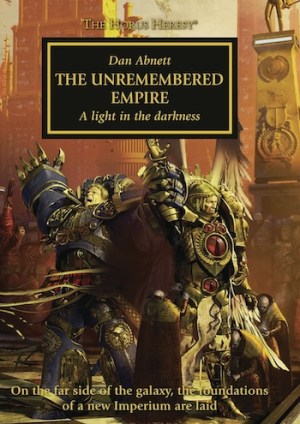
Review: THE UNREMEMBERED EMPIRE by Dan Abnett (Black Library)

AbnettD-HH27-UnrememberedEmpireIsolation, Confusion and Consolidation during the Horus Heresy

Far out on the Eastern Fringe, the realm of Ultramar stands alone. Having weathered the Word Bearers’ attack on Calth and the subsequent Shadow Crusade against the Five Hundred Worlds, the Ultramarines primarch Roboute Guilliman now draws all loyalist forces to Macragge as he contemplates a new future for mankind. With the arrival of more and more fugitives from the war that has engulfed the rest of the galaxy, all distinction between friend and foe is lost – isolated from Terra by fearsome warp storms, is Guilliman making a bid for power to rival even the renegade Warmaster Horus?

In The Unremembered Empire, Dan Abnett is firing on all creative cylinders. It’s an epic novel, in many respects – action-packed, momentous, a type of bridging point in the overall Horus Heresy series. I blitzed through this, and was left desperately wanting more at the end. A very good addition to the series. Absolutely addictive. Continue reading

Review: FORTUNE’S PAWN by Rachel Bach (Orbit)

Bach-P1-FortunesPawnThe start of a fun SF series from the author of the Eli Monpress novels

Devi Morris isn’t your average mercenary. She has plans. Big ones. And a ton of ambition. It’s a combination that’s going to get her killed one day – but not just yet.

That is, until she just gets a job on a tiny trade ship with a nasty reputation for surprises. The Glorious Fool isn’t misnamed: it likes to get into trouble, so much so that one year of security work under its captain is equal to five years everywhere else. With odds like that, Devi knows she’s found the perfect way to get the jump on the next part of her Plan. But the Fool doesn’t give up its secrets without a fight, and one year on this ship might be more than even Devi can handle.

I only heard about this series a few weeks ago. About the same time, I learned that Rachel Bach was a pseudonym for Rachel Aaron, the author of the amusing Eli Monpress fantasy series (also published by Orbit). Knowing that, I had a good idea of what I might find in Fortune’s Pawn, and my interest rose as a result. On the whole, this met my expectations, and while flawed, I think it’s a fun, breezy start to a new sci-fi series that will please a great many readers. Continue reading

Lazarus, Vol.1 – “Family” (Image)

Writer: Greg Rucka | Art: Michael Lark, w. Stefano Gaudiano & Brian Level | Colors: Santi Arcas

Forever Carlyle, the Lazarus of the Carlyle Family.

In a dystopian near-future, government is a quaint concept, resources are coveted, and possession is 100% of the law. A handful of Families rule, jealously guarding what they have and exploiting the Waste who struggle to survive in their domains.

Forever Carlyle defends her family’s holdings through deception and force as their protector, their Lazarus. Shot dead defending the family home, Forever’s day goes downhill from there…

Collects: Lazarus #1-4 & “Family: Prelude”

Prior to this, I was perhaps most familiar with Rucka’s first two, excellent Punisher volumes (must remember to finish off that series at some point). On the strength of just those books, I knew I wanted to read more of his work. That’s when I started to read and hear about Lazarus. As soon as this collection was available, I snapped it up and read it in one sitting. All I can say is that the hype is justified. While short, this is a very strong beginning.

The story opens with a pretty long, brutal scene that gives us an eye-popping, wince-inducing introduction to the nature of a Lazarus:

Lazarus-01-Interior1

Despite the above attempted-murder, Forever has plenty of… gumption left in her, and isn’t averse to doling out her blunt Family Justice:

Lazarus-01-Interior8

Over the course of these four issues, we learn about Forever’s psyche – she is unsure about the society in which she lives. She feels disconnected from her family, uncomfortable with her purpose, her nature. One gets the feeling that she’s headed for a break with the Family. It’s going to be an explosive journey, I’m sure.

The book offers a short, tantalizing taste of the Lazarus world, the dystopia controlled by a select few Mafia-on-steroids-like families. We’re not overburdened with world-building, but Rucka gives us just enough in the story to get situated, leaving breadcrumbs for us to follow and keep us guessing and get us hooked. This book is a perfect example of how comics can be used to show us new worlds and stories, without resorting to telling (which I still find strangely common for a visual medium). Forever is sent to parlay with a rival family, the Morrays. We learn through her mission that there is at least one other Lazarus, a member of the Morray family. They have met before, and share a deep affinity for each other’s situation and understanding of their lives – given their nature who else, really, could related? Meanwhile, Forever’s family members, her “brothers and sisters”, are plotting against her, each other, and their father. This does not bode well for the future.

Lazarus-01-Interior7

The pacing is fast but not rushed. It’s a dystopian world, the families appear in total control of the Americas, in a neo-feudal system that benefits the Families, while everyone else is categorised as either “Serfs” or “Waste”. It’s the argument against tyranny and the 1% writ large, exaggerated into a truly crushing social order.

Overall, this book is really quite excellent. I would have preferred a bit more world-building, sure, but I have a feeling this will be unrolled slowly and when necessary over the course of the series. The book is rather slim in length, which might leave people dissatisfied. I certainly would have liked more, but I see why the story was stopped here for the first volume. I can’t wait to read Volume 2. It’s not difficult to see why it has received so much praise. Very highly recommended, but if you need your comics more substantial in length, you may want to wait until the second collection is released/available before diving in them both together.

Lazarus-Vol.01-Interior1

You just might just like it…

TANYA HUFF Finally Coming to the UK! (Titan Books)

I’ve been aware of Tanya Huff’s writing for a long time – her novels have been mentioned on so many of the US-based book blogs that I read. I also consider he agent a friend. And, of course, I know of the TV show, Blood Ties, that was inspired by her Urban Fantasy series of the same name (sometimes called the Victoria Nelson Series, after the protagonist). I have, however, never read a single one of her novels… This year, Titan Books will be publishing two of her novels, which should help me remedy this oversight – and very soon. Here are the details…

HuffT-TheSilveredTHE SILVERED

The Empire has declared war on the small, were-ruled kingdom of Aydori, capturing five women of the Mage-Pack, including the wife of the were Pack-leader. With the Pack off defending the border, it falls to Mirian Maylin and Tomas Hagen — she a low-level mage, he younger brother to the Pack-leader — to save them. Together the two set out on the kidnappers’ trail, racing into the heart of enemy territory. But with every step the odds against their survival, let alone their success, grow steeper…

This sounds like a pretty interesting fantasy novel. Maybe a little steampunk-y, given the US cover? Regardless, I’m certainly intrigued. The Silvered is already available in the US, published by DAW Books.

*

HuffT-C1-ValoursChoiceVALOUR’S CHOICE

In the distant future, humans and several alien races have been granted membership in the Confederation — at a price. They must serve and protect the far more civilized species who have long since turned away from war. When her transport ship is shot down, a routine diplomatic mission across the galaxy becomes anything but, and Staff Sergeant Torin Kerr must fight to keep her platoon alive.

This is the first novel in Huff’s Confederation series. I believe Titan will be re-issuing all of the books in this series, although I’m not sure of the timetable. The rest of the series: The Better Part of Valour, The Heart of Valour, Valour’s Trial, and The Truth of Valour. [In the British spelling, of course…] The Confederation series is also published in the US by DAW Books (first published in 2000).

*

Neither of these UK editions have a Goodreads listing, yet, but I’m sure that’ll be fixed in the near future. I’m really looking forward to both of them. Be sure to follow the author on Twitter, for more up-to-date news and all the usual stuff one finds on Twitter.

“Scars” Eps.IV-IX by Chris Wraight (Black Library)

Wraight-Scars(HH)-pt4The next six parts of the serialised Horus Heresy novel

Of all the Legiones Astartes, the White Scars of Jaghatai Khan remain the most enigmatic and elusive. Born of a civilisation that prizes honour, speed and fearsome loyalty, their allegiance has yet remained unclear even as the galaxy is torn apart by Horus’s treachery, and both sides have apparently counted them among their potential allies in the war to come. But when the Alpha Legion launch an unexplained and simultaneous attack against the White Scars and Space Wolves, the Khan must decide once and for all whether he will stand with the Emperor or the Warmaster… or neither.

Originally, I was going to read this serialised novel in chunks of three ‘episodes’. However, after leaving things for a little longer than intended, I ended up blitzing though the middle six parts in one go. While I’m still not entirely sold on the serialisation-aspect of this project, I do believe Scars will shape up to be Wraight’s best Black Library work to date. This is a very good novel (so far).

I’m still not entirely sure how best to approach reviewing these episodes. As with the previous review, it’s a little difficult to decide on what is a spoiler, what isn’t, whether it should be approached as if these were a single, complete book? I’m going to try to walk a middle-ground, and just highlight some of the things I really liked about Scars so far, and some more general observations. The synopsis, above, does a good job of situating the reader, and I think only needs a little bit more for the purposes of the review.

Two of the best things about the novel are, first the plethora of Legions represented (eight with ‘proper’ characters, but another on the sidelines, referred to quite frequently), and second, the continued examination of what the new revolt and civil war has done to the Astartes – collectively and individually. Many of the characters are still struggling with the idea of open warfare between the Legions, how peculiar and abhorrent fighting their own kind, their cousins, is.

Fighting another Legion was an unsettling experience: they thought like he did, were as quick as he was and almost as familiar with the layout of his vessel. It was like fighting a mirror.

The Thousand Sons had been different. They’d already been half beaten once the Space Wolves had made planetfall, and their defence had been desperate and messily, confusedly defiant. The Alpha Legion had no such disadvantages: they were in better shape than the Wolves, better resourced and with the advantage of the initiative. They had come looking for this fight, for reasons that even Russ hadn’t fathomed with any precision.

In addition to the confusion borne of the rebellion, the machinations of the Word Bearers and their allies in the Warp has only increased the problems facing the loyalists. Communications are effectively down – messages through the Astonomican are either delayed, garbled, contradictory, or nonexistent. At one point, the White Scars Primarch’s frustrations bubble over:

“I have the strength of the Legion arrayed before me, ready to strike. The ordu has assembled, and yet none can tell me who the enemy is. Tell them if they cannot interpret correctly then I shall come up to their spires and hammer their dreams into order for them.”

And later, he reflects on the situation:

The Khan almost felt like laughing. Nothing made sense. After years insulated from the rest of the galaxy, locked in a campaign that had promised little glory and much routine hard work, every certainty seemed to have been twisted into a comical level of incongruity.

True, these have become central themes of the Horus Heresy series as a whole, but the fact that it remains interesting after so many novels, from so many authors, is a testament to the skills of the writers involved, but also the strength of the overall project. It’s no mean feat to juggle all these novels, short stories, and audio dramas and maintain the quality (in fact, as I’ve mentioned before on the blog, from Graham McNeill’s A Thousand Sons onwards, the quality has been improving).

Wraight-Scars(HH)These episodes are littered with examples that explain the White Scars’ rarefied position among the Legions. They are set very much apart from their fellows. Sure, the Alpha Legion are mysterious, but they are known. They are infamously opaque and mysterious, and yet known because of that. The White Scars have simply been… absent. Off persecuting their own part of the Crusade, away from their brother Legions, without much support. This makes them very difficult to judge. When orders do arrive for the White Scars, however, and the Emperor and Dorn order the Khan’s Legion to return to Terra, to reinforce the throneworld’s defences, the Khan does not react well:

“I will not take direction from anyone, not even the Throneworld that only now, now that its Legions are tearing one another to pieces, deigns to remember that it has eighteen warrior-sons at its service… You are nobody’s slaves… We take orders from no one. We take no one’s word. We are on our own, just as we have always been, and if there is truth to be found in this, then we will find it for ourselves.”

Jagatai Khan is a pretty interesting Primarch. He’s enigmatic, even after reading this much of the novel. But this is, really, the root of his charm and why he remains a popular figure in Warhammer 40,000 mythology. There’s a great scene in which four Primarchs are gathered, shortly after Horus’s investiture as Warmaster (at Ullanor), and we get some interesting insight into his character. For example, this shrewd observation about his brothers:

Fulgrim and the Angel looked similar in some ways. They had the same sculptural faces, the same flamboyant armour. Where Sanguinius looked as though he had been born wearing gold-rimmed pauldrons, though, the Khan had always thought Fulgrim looked to be trying a little too hard. In the end, he guessed that Sanguinius would have been happy to cast off his trappings; Fulgrim gave the impression that he would rather die.

And then, as the four of them (Mortarian is also there – another Primarch who has remained rather out-of-sight for most of the series) discuss Horus’s new position:

Sanguinius smiled. “My brother, I think you are the most inscrutable of us all. I know what Rogal wants, and I know what Roboute wants, but even after so long I have no idea what you want.”

“He wants to be left alone,” said Fulgrim. “To shoot off into the stars and hunt down xenos on those delightful jetbikes. They’re devilishly fast…”

And we get to see just how fast all of the White Scars’ vessels can be. Much to the Alpha Legion’s surprise and detriment…

Things really start to hot up near the end of Ep.V, when White Scar psyker (or “weather witch” as his fellow Astartes call him) Yesugai stumbles across a Sons of Horus ship, crewed by a small band of Salamanders and Iron Hands, who have recently escaped the massacre on Isstvan V. He learns of the betrayal, putting to rest some of the confusion that has resulted from the White Scars’ isolation. This sets into motion the events of episodes VI-IX, which sees the White Scars hurtling towards revelations upon revelations, disappointments and betrayals. The story is shaping up very nicely indeed, and I can’t wait to read the final three parts of the novel.

As well as these larger issues are unfolding, we start to see more of Shiban’s investigation into the mysterious deaths on Phemus – deaths that appear to have been caused by Legion weapons. This leads him to his Terran friend, another White Scar, who is also an active member of a Warrior’s Lodge. A Lodge who may not be working in accordance with the Khan’s wishes, and are probably being manipulated by… well, long-time readers of the series will no doubt know the answer to that.

Of the other Legions featured in the novel, the Space Wolves come out of this in a very interesting light as well. The timeline places the novel shortly after their attack on Prospero to punish Magnus and the Thousand Sons. They are uncharacteristically somber, introspective, as they see the ripple-effects of their actions (sanctioned though they were), which leaves Leman Russ, their warlike, impulsive Primarch, to lament the state of affairs in the galaxy, of which he played an instrumental part in bringing about. Speaking to Bjorn One-Hand (who is well-known to fans of the tabletop game, as the Space Wolves’ dreadnought character, Bjorn the Fell-Handed – he also featured in Wraight’s SMB novel, Battle of the Fang), he muses:

“I never asked him [the Emperor] what he had in mind for us once the Crusade was over,” Russ went on. “I never asked him if we would be needed. Hardly matters now – if this madness can’t be stopped there will never be a time when we are not needed… The irony of it. Horus has given us the purpose we were beginning to lack. He’s made us useful again… Look what a mess we have made of things – me and my beloved brothers. You will have to pick up the pieces.”

Overall, then, this is shaping up to be another superb addition to the Horus Heresy series. Wraight has really outdone himself. I’m enjoying this a great deal. [But, yes, I would have preferred to read this all in one go, rather than in weekly instalments.] Bring on the final three episodes, and the next book in the series, Dan Abnett’s The Unremembered Empire.

The Horus Heresy: Horus Rising, False Gods, Galaxy in Flames, Flight of the Eisenstein,Fulgrim, Descent of Angels, Legion, Battle for the Abyss, Mechanicum, Tales of Heresy,Fallen Angels, A Thousand Sons, Nemesis, The First Heretic, Prospero Burns, Age of Darkness, The Outcast Dead, Deliverance Lost, Know No Fear, The Primarchs, Fear to Tread, Shadows of Treachery, Angel Exterminatus, Betrayer, Mark of Calth, Promethean Sun [Stefan’s Review], Scorched Earth, Vulkan Lives, Scars (I-III), Unremembered Empire