Artwork: “Gotrek & Felix: The Serpent Queen” by Joshua Reynolds (Black Library)

I must have said it a hundred times on the blog, now, but I really must get around to reading Josh Reynold’s Road of Skulls, his first full-length novel featuring my favourite Dwarf Slayer and human companion… In advance of that, though, I spotted the artwork for Reynolds’s next novel in the series, The Serpent Queen:

ReynoldsJ-G&F-SerpentQueen

Sorry for the low-quality image, but I wanted to share the cover anyway. It’s one of my all-time favourite fantasy series, so I’m always excited for news and more fiction (even if it does take me altogether too long to get around to reading them…). Here’s the synopsis:

Gotrek and Felix: unsung heroes of the Empire, or nothing more than common thieves and murderers? The truth perhaps lies somewhere in between, and depends entirely upon whom you ask… Travelling to the mysterious south in search of a mighty death, the Slayer Gotrek Gurnisson and his human companion, Felix Jaeger, find themselves caught up in a battle between warring kingdoms. Captured by the sinister Queen Khalida and forced to do her bidding, the adventurers must brave the horrors of the sun-soaked Land of the Dead, where the dead do not rest easy.

Serpent Queen is due to be published in March/April 2014. Road of Skulls and David Guymer’s City of the Damned are available now from Black Library. In addition, the first in the series, William King’s Trollslayer, has recently been re-released as part of the Black Library Classics series – it is, in my humble opinion, a must-read.

Gotrek&Felix-AlsoAvailableNew

Keeping Elfy at Christmas…

WarhammerArmies-HighElves4thOver a decade-and-a-half ago(ish), I was rather addicted to reading the background sections, stories, and special character histories from the Warhammer Armies range of books published for Games Workshop’s tabletop game. They used to be considerable books, actually, before a decision was made to strip out much of the background information, army and character histories, etc. [Boo!] Because of my peripatetic upbringing, I never actually had anyone to play the game(s) with, though, despite my obvious interest in and affection for the fantasy and science fiction systems GW produced – understandably, there was only so much patience my over-worked father could have for them. So, I made up for this by devouring the books and writing Extremely Bad fan-fiction. Like, really, really bad…

Anyway, while selecting my Christmas reading for my trip to Canada, I realised something: an Elf trend. True, it’s a trend that has been broken with a massive time-gap in the middle, but one Christmas, I found Warhammer Armies: High Elves waiting for me under the tree [pictured, above]. Including this year, for the last three Christmases, I will have read William King’s Tyrion & Teclis trilogy. These two characters feature heavily in the (very well-read, now-fallen-apart) edition of WA: HE that I had, which is perhaps partly why I have enjoyed the trilogy so much.

So, I guess, this is how I keep Elfy over Christmas…

*

William King’s Blood of Aenarion, Sword of Caledor and Bane of Malekith are all available now, published by Black Library. I would also strongly recommend the Gotrek & Felix series, which he created.

KingW-Tyrion&TeclisTrilogy

I apologise (only a little) for the fact that this post was, basically, all about getting to use that pun…

Short Story Reviews: RIVEN and HAND OF DUST by John French (Black Library)

Two short stories by one of Black Library’s up-and-comers

FrenchJ-Riven(HH)RIVEN (Horus Heresy)

As one of the vaunted Crusader Host, Brother Crius stood as the representative of the X Legion upon the soil of Holy Terra, but when he learns of the death of his beloved primarch Ferrus Manus at the hands of the traitors, his stoic, mechanical grief imbues him with the strength and resolve to undertake a special mission on behalf of Rogal Dorn himself. Striking out into the stars, he searches for any signs of his lost Iron Hands brethren, hoping to bring them back to Terra to aid in the final defence of the Palace. The question remains – just who has survived the slaughter on Isstvan V, and what yet remains of them?

I’m always happy when a new piece of Horus Heresy fiction is released, and this one is by an author I have not read much by, before. The story follows Brother Crius, a member of the Iron Hands, struggling with the loss of his Primarch, Ferrus Manus. He is tasked by Sigismund, the First Captain of the Imperial Fists to seek out any other survivors of the Isstvan V massacre, and bring them back to Terra to bolster the defence against the eventual attack by Horus’s forces. Heading out, with the support of an Imperial Fists captain, what Crius and his companions discover is not at all what they were expecting – nor, actually, what I was expecting.

I like what French has done with this story. While I wasn’t entirely clear as to why Crius was incarcerated at the start of the story, the author nevertheless has written a pretty great story. We see a little bit more of what makes the Iron Hands tick, and also a little bit of the psychological damage that the death of Ferrus has caused. True, it’s still a relatively short story, so there isn’t too much of this, but I would certainly like to read more about the Legion pre- and post-Ferrus’s death. The final battle is pretty intense, and not over-described (which was certainly welcome to me). Overall, this is a recommended addition to the growing Heresy story.

*

French-AhrimanHandOfDustAHRIMAN: HAND OF DUST

On Prospero, a solitary living soul walks across the shattered world. Beneath the ruined spires, Ahriman, exiled son of Magnus the Red and destroyer of his Legion, contemplates what once was, what is, and what may yet be. And amidst the dust of the long-lost paradise world, the sorcerer faces his mistakes and decides his destiny.

This (very) short story is part of Black Library’s Advent Calendar series of eBooks. It is also the second by French featuring the Thousand Sons (All is Dust, another micro-story, was released early last year). Hand of Dust follows one of the greatest sorcerers of the Thousand Sons traitor legion – Ahriam, the architect of the Rubric that ‘froze’ his fellow legionaries, in an attempt to rescue them from the fate that has plagued the sons of Magnus for centuries.

Hand of Dust is perhaps too short to really have much to write about it. The premise is interesting, and I think it could (and, perhaps, should) have been extended. It’s like a teaser for French’s writing and also his Ahriman fiction. It’s a good one, too. As with Riven, above, French’s writing is pretty solid and well-crafted. It is perhaps not as streamlined and fluid as some of the other, more-established Black Library authors, but it’s still very good. It will certainly be interesting to see how he develops over time.

French also wrote the first Ahriman novel, Ahriman: Exile (cover below), which is out now, and has now been bumped up my tottering TBR mountain. Ahriman also features in Rob Sanders’s Atlas Infernal and Graham McNeill’s superb A Thousand Sons (and a handful of other Horus Heresy novels). French will also be writing a follow-up to Exile, Sorcerer, which is due for publication in 2014.

French-AhrimanExile

New Horus Heresy Artwork: “Vengeful Spirit” by Graham McNeill (Black Library)

I nabbed this piece from the Black Library blog. It is going to grace Vengeful Spirit, the next Heresy novel by Graham McNeill. Haven’t the faintest idea what it is about, specifically, but there’s an Amazon UK listing, now. The cover text states: “The Battle of Moloch” (no idea), and “The Sons of Horus reclaim their place at forefront of the galactic civil war.” It’ll certainly be nice to see the Sons of Horus back at the centre of the story – the last time was the original three novels, no?

VengefulSpirit-Art

That is one angry-looking Warmaster on the left. With a very big stick… [And what looks like a Star Destroyer up above.] Amazon also had the finished cover:

McNeill-HH-VengefulSpirit

“Scars”, Ep.X-XII by Chris Wraight (Black Library)

Wraight-Scars(HH)The final serial episodes of this Horus Heresy novel

Of all the Legiones Astartes, the White Scars of Jaghatai Khan remain the most enigmatic and elusive. Born of a civilisation that prizes honour, speed and fearsome loyalty, their allegiance has yet remained unclear even as the galaxy is torn apart by Horus’s treachery, and both sides have apparently counted them among their potential allies in the war to come. But when the Alpha Legion launch an unexplained and simultaneous attack against the White Scars and Space Wolves, the Khan must decide once and for all whether he will stand with the Emperor or the Warmaster… or neither.

I’m going to keep this very brief, as this review covers the final quarter of a novel. Why ruin it for everyone? The synopsis above is that for the novel as a whole. I must say it is possibly Wraight’s best so far. Everything I’ve reported on from the first nine episodes is just as evident and well-written as in the chapters that have come before. We learn more about the White Scars, and their strange place alongside the other Legiones Astartes, and the Imperium at large. Wraight sets up a lasting conflict and antagonism that (I assume) continues into the “present” Warhammer 40,000 timeline. Two Primarchs face off against each other, and the result of that exchange dictates the fate of the White Scars going forward. These three episodes pack in a lot of action, and the battle-scenes are very well-written (better, even, than Wraight’s Battle of the Fang). I particularly liked the attention paid to the Scars’ as a Legion split in two – mainly because it’s not been particularly well-addressed in other novels. Wraight’s writing is excellent throughout – clear, crisply composed, and briskly paced.

To be honest, a good amount of the story’s impact was lost as a result of the serialisation – hitting cliffhanger moments works for TV series, but not so much for a Horus Heresy novel. Even though I read them in chunks or multiple episodes, I’m used to read a novel in no more than five days (when they’re really long) and as little as one or two days. Stretching one out over a couple of months just didn’t work for me. An interesting experiment, though.

Nevertheless, with the whole novel now available, I would certainly recommend this as a must-read for all fans of the Heresy series. Wraight’s first full-length foray into the era is a triumph of military sci-fi. I certainly look forward to his next offering.

The Horus Heresy: Horus Rising, False Gods, Galaxy in Flames, Flight of the Eisenstein, Fulgrim, Descent of Angels, Legion, Battle for the Abyss, Mechanicum, Tales of Heresy, Fallen Angels, A Thousand Sons, Nemesis, The First Heretic, Prospero Burns, Age of Darkness, The Outcast Dead, Deliverance Lost, Know No Fear, The Primarchs, Fear to Tread, Shadows of Treachery, Angel Exterminatus, Betrayer, Mark of Calth, Promethean Sun, Scorched Earth, Vulkan Lives, Scars (I-III, IV-IX), The Unremembered Empire

[I’m going to work at filling in those review-blanks – some I’ve already read, but there are a couple of oversights that need addressing. As I am always thirsty for more Heresy fiction, I think I may have to catch up pretty soon. Starting with Graham McNeill’s Mechanicum. Fallen Angels is the only other I’ve never read.]

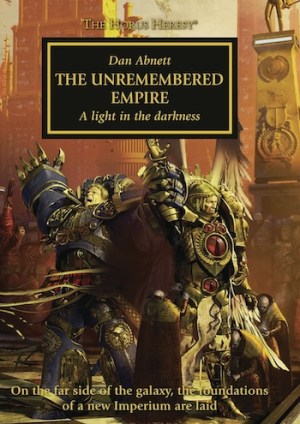
Review: THE UNREMEMBERED EMPIRE by Dan Abnett (Black Library)

AbnettD-HH27-UnrememberedEmpireIsolation, Confusion and Consolidation during the Horus Heresy

Far out on the Eastern Fringe, the realm of Ultramar stands alone. Having weathered the Word Bearers’ attack on Calth and the subsequent Shadow Crusade against the Five Hundred Worlds, the Ultramarines primarch Roboute Guilliman now draws all loyalist forces to Macragge as he contemplates a new future for mankind. With the arrival of more and more fugitives from the war that has engulfed the rest of the galaxy, all distinction between friend and foe is lost – isolated from Terra by fearsome warp storms, is Guilliman making a bid for power to rival even the renegade Warmaster Horus?

In The Unremembered Empire, Dan Abnett is firing on all creative cylinders. It’s an epic novel, in many respects – action-packed, momentous, a type of bridging point in the overall Horus Heresy series. I blitzed through this, and was left desperately wanting more at the end. A very good addition to the series. Absolutely addictive. Continue reading

Recent Acquisitions (Early October)…

BooksReceived-201310

Another clutch of interesting books.

A nice mix, actually. I’m really trying to broaden what I feature on here – who knows how successful I will be in that endeavour. Partly, this is because my day-job involves reading a fair bit of SFF, which means I’m finding myself drawn more to thrillers (e.g. John Sandford) and (literary-)fiction. I’m still going to be reading plenty of SFF, of course (my interest in that is never going to go away). I just hope I can at least somewhat keep on top of all of these titles. Maybe I need to get some more writers involved.

Anyway, here’s what has turned up in the first few days of October…

Abnett-GG1-First&Only-BLCDan Abnett, First & Only (Black Library)

In the war-torn future of the 41st millenium, the Sabbat Worlds Crusade has begun. With the massed ranks of the Imperial Guard hard-pressed by the evil forces of Chaos, mankind must prevail – whatever the cost in lives. Commissar Ibram Gaunt has vowed to lead the men of the Tanith First-and-Only safely through the scheming of rival regiments just as much as the lethal firepower of the enemy.

It’s been fifteen years since the first Black Library novel, First and Only, was published. It is, therefore 15 years since I read it first (I bought it on the first day of publication). In many ways, it was a defining science-fiction book for me. I became hooked on Abnett’s writing, and have read (almost) everything he’s written for Black Library since. The Gaunt’s Ghosts series remains one of my absolute favourites, and this new edition is rather nice. If you haven’t tried the series, yet, then I would certainly recommend that you do. This is a great collection of the original Inferno short stories and more. I may actually take this opportunity to re-read this again, for what must be the fourth or fifth time.

*

CardOS-EndersGameOrson Scott Card, Ender’s Game (Orbit)

The human race faces annihilation.

An alien threat is on the horizon, ready to strike. And if humanity is to be defended, the government must create the greatest military commander in history.

The brilliant young Ender Wiggin is their last hope. But first he must survive the rigours of a brutal military training programme – to prove that he can be the leader of all leaders.

A saviour for mankind must be produced, through whatever means possible. But are they creating a hero or a monster?

An author who is no stranger to many – almost more infamous now, than famous. Ender’s Game is one of the seminal science fiction texts of the 1980s (it was first published in 1985), lauded by many, and even (so I’ve been told) taught in some military/strategy classes. As I’ve mentioned (oh so) frequently on CR, I’m a relative latecomer to SFF, and always leaned more towards fantasy than sci-fi (Star Wars and WH40k notwithstanding). Rather than go back to the beginning, as many people do, I’ve always tended towards picking up newer titles (also because those are the ARCs I get). On Monday, I was invited to attend a Q&A with the cast of the upcoming, long-in-the-making movie adaptation of Ender’s Game. It was a very good event, and the enthusiasm the cast, director/screenwriter and producers had for the story and movie was infectious. So, despite being utterly opposed to the author’s politics and social ‘beliefs’, I am very interested in reading the novel. I’ll be reading it relatively soon, too, in preparation for the movie.

*

DelToro-CabinetOfCuriositiesGuillermo del Toro, Cabinet of Curiosities (Titan)

Over the last two decades, writer-director Guillermo del Toro has mapped out a territory in the popular imagination that is uniquely his own, astonishing audiences with Cronos, Hellboy, Pan’s Labyrinth, and a host of other films and creative endeavors. Now, for the first time, del Toro reveals the inspirations behind his signature artistic motifs, sharing the contents of his personal notebooks, collections, and other obsessions. The result is a startling, intimate glimpse into the life and mind of one of the world’s most creative visionaries. Complete with running commentary, interview text, and annotations that contextualize the ample visual material, this deluxe compendium is every bit as inspired as del Toro is himself.

Contains a foreword by James Cameron, an afterword by Tom Cruise, and contributions from other luminaries, including Neil Gaiman and John Landis, among others.

A gorgeous art and photo book by del Toro on his various movie and comic projects? Yeah, I was definitely going to be interested. I’ve already read through it – it’s a book you can dip in and out of, too – it’s a must-read for anyone interested in the man’s movies and aesthetic. It’s also another example of how gorgeous Titan Books’ products can be. Very highly recommended. I’ll try to get a review up ASAP.

*

Dembski-Bowden-Betrayer(HH)Aaron Dembski-Bowden, Betrayer (Black Library)

The Shadow Crusade has begun. While the Ultramarines reel from Kor Phaeron’s surprise attack on Calth, Lorgar and the rest of the Word Bearers strike deep into the realm of Ultramar. Their unlikely allies, Angron and the World Eaters, continue to ravage each new system they come across – upon the garrison planet of Armatura, this relentless savagery may finally prove to be their undoing. Worlds will burn, Legions will clash and a primarch will fall.

I’ve already read and reviewed this novel, so all I’ll say is that it’s excellent. You can find my complete review, here. Aaron DB’s one of my favourite authors of any type of fiction, and Betrayer is another example of his prodigious talent for characterisation.

*

KymeN-SalamandersOmnibusNick Kyme, Salamanders Omnibus (Black Library)

After the death of their captain at the hands of a traitorous brother, Da’kir and Tsu’gan, battle-brothers and rivals, face enemies from within and without. As their paths diverge and they face trials that will test them to their very limits, their destinies draw them back together for one final confrontation that will decide the fate of the Salamanders Chapter.

Ah, the Salamanders series. Why haven’t I read this yet? Seriously. It should be right up my street, and given how good everything I’ve read by Kyme has been, I really don’t know why I haven’t already read this series. I have the novels already (in eBook), but this omnibus puts everything into chronological order, so what I’m probably going to do is read the short stories and extras in here, switch to the eBooks for the novels, and review it in chunks. Or something. We’ll see. I will read at least some of this series this year. Hopefully. Most recently, I read Kyme’s first full-length contribution to the Horus Heresy series – Vulkan Lives – and it was absolutely superb. If the Salamander novels are even half as good as that, they’re going to be great reads. Watch this space for more (hopefully) soon.

*

McNabA-SilencerAndy McNab, Silencer (Bantam)

1993: Under deep cover, Nick Stone and a specialist surveillance team have spent weeks in the jungles and city streets of Colombia. Their mission: to locate the boss of the world’s most murderous drugs cartel – and terminate him with extreme prejudice.

Now they can strike. But to get close enough to fire the fatal shot, Nick must reveal his face. It’s a risk he’s willing to take – since only the man who is about to die will see him. Or so he thinks…

2012: Nick is in Moscow; semi-retired; semi-married to Anna; very much the devoted father of their newborn son. But when the boy falls dangerously ill and the doctor who saves him comes under threat, Nick finds himself back in the firing line. To stop his cover being terminally blown, he must follow a trail that begins in Triad-controlled Hong Kong and propels him back into the even more brutal world he thought he’d left behind.

The forces ranged against him have guns, helicopters, private armies and a terrified population in their vice-like grip. Nick Stone has two decades of operational skills that may no longer be deniable – and a fierce desire to protect a woman and a child who now mean more to him than life itself.

Another author I’ve not read much of. I now have two of his novels on my shelves to read. I have no idea why I haven’t read anything by him before. Probably because I do tend to be drawn to US-based contemporary thrillers. (Interestingly, I am fine with reading historical thrillers set anywhere, but when they’re modern, I gravitate towards American thrillers… Weird.) I need to break that habit, I think.

*

NivenJ-StraightWhiteMaleJohn Niven, Straight White Male (William Heinemann)

Kennedy Marr is a novelist from the old school. Irish, acerbic, and a borderline alcoholic and sex-addict, his mantra is drink hard, write hard and try to screw every woman you meet.

He’s writing film scripts in LA, fucking, drinking and insulting his way through Californian society, but also suffering from writers block and unpaid taxes. Then a solution presents itself – Marr is to be the unlikely recipient of the W. F. Bingham Prize for Outstanding Contribution to Modern Literature, an award worth half a million pounds. But it does not come without a price: he must spend a year teaching at the English university where his ex-wife and estranged daughter now reside.

As Kennedy acclimatises to the sleepy campus, inspiring revulsion and worship in equal measure, he’s forced to reconsider his precarious lifestyle. Incredible as it may seem, there might actually be a father and a teacher lurking inside this “preening, narcissistic, priapic, sociopath”. Or is there?

You know, I only heard of this book a few days ago, and I can’t for the life of me remember where I heard or read about it… Thankfully, I received a copy from the publisher, and I intend to read it ASAP, on one of my soon-to-be-frequent breaks from SFF. The blurbs for this and Niven’s previous novels are gushing and plentiful, so I have high hopes for this. And I have a soft-spot for novels with academics as protagonists (as a wannabe academic myself, I find them easy to relate to…).

*

Pratchett-ABlinkOfTheScreenTerry Pratchett, A Blink of the Screen (Corgi)

A collection of short fiction from Terry Pratchett, spanning the whole of his writing career from schooldays to Discworld and the present day.

In the four decades since his first book appeared in print, Terry Pratchett has become one of the world’s best-selling and best-loved authors. Here for the first time are his short stories and other short-form fiction collected into one volume. A Blink of the Screen charts the course of Pratchett’s long writing career: from his schooldays through to his first writing job on the Bucks Free Press, and the origins of his debut novel, The Carpet People; and on again to the dizzy mastery of the phenomenally successful Discworld series.

Here are characters both familiar and yet to be discovered; abandoned worlds and others still expanding; adventure, chickens, death, disco and, actually, some quite disturbing ideas about Christmas, all of it shot through with Terry’s inimitable brand of humour. With an introduction by Booker Prize-winning author A.S. Byatt, illustrations by the late Josh Kirby and drawings by the author himself, this is a book to treasure.

I have never read any of Pratchett’s shorter fiction. So when this unexpectedly arrived in my mailbox, I was giddy with excitement and expectation. The only question remains, as it is a given that I will read this, is in what order? Will I be able to resist the temptation to go straight to the Discworld short stories, before reading the others? Or will I be good and read it from front-to-back? A pickle, to be sure, and something that will require some thought.

*

Resnick-TheDoctor&TheDinosaurMike Resnick, The Doctor and the Dinosaur (Pry)

Welcome to a Steampunk wild west starring Doc Holliday, with zombies, dinosaurs, robots, and cowboys.

The time is April, 1885. Doc Holliday lies in bed in a sanitarium in Leadville, Colorado, expecting never to leave his room again. But the medicine man and great chief Geronimo needs him for one last adventure. Renegade Comanche medicine men object to the newly-signed treaty with Theodore Roosevelt. They are venting their displeasure on two white men who are desecrating tribal territory in Wyoming. Geronimo must protect the men or renege on his agreement with Roosevelt. He offers Doc one year of restored health in exchange for taking on this mission.

Welcome to the birth of American paleontology, spearheaded by two brilliant men, Edward Drinker Cope and Othniel Charles Marsh, two men whose genius is only exceeded by their hatred for each other’s guts.

Now, with the aid of Theodore Roosevelt, Cole Younger, and Buffalo Bill Cody, Doc Holliday must save Cope and Marsh not only from the Comanches, not only from living, breathing dinosaurs, but from each other. And that won’t be easy.

This is the fourth book in Resnick’s Steampunk Western series. Sad to say, I’ve only read the first – the middle two are in the US, along with so many of my books, which means they’ve been put on the back-burner. It’s a fun premise, and Resnick can pull it off rather nicely. I’m looking forward to being able to catch up.

*

StewartM-M1-CrystalCaveMary Stewart, The Crystal Cave (Hodder)

The dramatic first novel in the classic Merlin Trilogy, set in fifth century Britain at the beginning of the time of King Arthur.

Fifth century Britain is a country of chaos and division after the Roman withdrawal. This is the world of young Merlin, the illegitimate child of a South Wales princess who will not reveal to her son his father’s true identity.

Yet Merlin is an extraordinary child, aware at the earliest age that he possesses a great natural gift – the Sight. Against a background of invasion and imprisonment, wars and conquest, Merlin emerges into manhood, and accepts his dramatic role in the New Beginning – the coming of King Arthur.

Somehow, I had never knowingly heard of this novel before it arrived (it is the third title for the Hodderscape Review Project). I was talking to Alyssa when it arrived, and she said it was fantastic, so I have no doubt I will like this (she has impeccable taste). A re-telling of the Merlin story? Intriguing.

*

Tidhar-TheViolentCenturyLavie Tidhar, The Violent Century (Hodder)

They’d never meant to be heroes.

For seventy years they guarded the British Empire. Oblivion and Fogg, inseparable friends, bound together by a shared fate. Until one night in Berlin, in the aftermath of the Second World War, and a secret that tore them apart.

But there must always be an account… and the past has a habit of catching up to the present.

Now, recalled to the Retirement Bureau from which no one can retire, Fogg and Oblivion must face up to a past of terrible war and unacknowledged heroism – a life of dusty corridors and secret rooms, of furtive meetings and blood-stained fields – to answer one last, impossible question:

What makes a hero?

Another novel I have already read (and very much liked), this is a must-read take on super-hero mythos, blended with a noir-ish reimagining of the 20th Century. It was the first novel of Tidhar’s that I read, and I was very impressed indeed. I think a lot of people are going to like this. Check out my review, here.

*

Wraight-MasterOfDragonsChris Wraight, Master of Dragons (Black Library)

For millennia, the elves of Ulthuan and the dwarfs of the mountain realm have been friends and allies. Now that time is over and the War of Vengeance has begun. Prince Imladrik, master of dragons and Ulthuan’s finest warrior, is ordered to leave his beloved homeland and lead his host in a war he does not believe in. Facing the fury of the dwarfs, the jealousy of his brother and the ever-present threat of Malekith’s dark elves, Imladrik must balance his love for his wife and home with the thrill of battle.

Another author in the Black Library stable that has been improving in leaps and bounds. I’ve been reading his serialised Horus Heresy novel (Scars) and been very impressed. I haven’t read much of his Warhammer fantasy fiction, though. I enjoyed his novella, Dragonmage, which was also focused on the High Elves and their dragons. This is the second book in the War of Vengeance series, part of the Time of Legends line of novels, but I’ve not read the first – Nick Kyme’s The Great Betrayal. Anyone know if it’s necessary to do so? I know the ‘history’ behind it, but I don’t want to jump right into this if it is a direct sequel-proper to The Great Betrayal

*

ZiskinJW-Styx&StoneJames W. Zisken, Styx and Stone (Seventh Street)

Ellie Stone is a professed modern girl in 1960s New York City, playing by her own rules and breaking boundaries while searching for a killer among the renowned scholars in Columbia University’s Italian Department.

“If you were a man, you’d make a good detective.”

Ellie Stone is sure that Sgt. McKeever meant that as a compliment, but that identity – a girl wanting to do a man’s job-has throttled her for too long. It’s 1960, and Ellie doesn’t want to blaze any trails for women; she just wants to be a reporter, one who doesn’t need to swat hands off her behind at every turn.

Adrift in her career, Ellie is back in New York City after receiving news that her estranged father, a renowned Dante scholar and distinguished professor, is near death after a savage bludgeoning in his home. The police suspect a routine burglary, but Ellie has her doubts. When a second attempt is made on her father’s life, in the form of an “accident” in the hospital’s ICU, Ellie’s suspicions are confirmed.

Then another professor turns up dead, and Ellie’s investigation turns to her father’s university colleagues, their ambitions, jealousies, and secret lives. Ellie embarks on a thorny journey of discovery and reconciliation, as she pursues an investigation that offers her both a chance at redemption in her father’s eyes, and the risk of losing him forever.

Another interesting-sounding novel from Seventh Street. I haven’t read nearly enough of their novels. I shall endeavour to rectify this oversight.

“Scars” Eps.IV-IX by Chris Wraight (Black Library)

Wraight-Scars(HH)-pt4The next six parts of the serialised Horus Heresy novel

Of all the Legiones Astartes, the White Scars of Jaghatai Khan remain the most enigmatic and elusive. Born of a civilisation that prizes honour, speed and fearsome loyalty, their allegiance has yet remained unclear even as the galaxy is torn apart by Horus’s treachery, and both sides have apparently counted them among their potential allies in the war to come. But when the Alpha Legion launch an unexplained and simultaneous attack against the White Scars and Space Wolves, the Khan must decide once and for all whether he will stand with the Emperor or the Warmaster… or neither.

Originally, I was going to read this serialised novel in chunks of three ‘episodes’. However, after leaving things for a little longer than intended, I ended up blitzing though the middle six parts in one go. While I’m still not entirely sold on the serialisation-aspect of this project, I do believe Scars will shape up to be Wraight’s best Black Library work to date. This is a very good novel (so far).

I’m still not entirely sure how best to approach reviewing these episodes. As with the previous review, it’s a little difficult to decide on what is a spoiler, what isn’t, whether it should be approached as if these were a single, complete book? I’m going to try to walk a middle-ground, and just highlight some of the things I really liked about Scars so far, and some more general observations. The synopsis, above, does a good job of situating the reader, and I think only needs a little bit more for the purposes of the review.

Two of the best things about the novel are, first the plethora of Legions represented (eight with ‘proper’ characters, but another on the sidelines, referred to quite frequently), and second, the continued examination of what the new revolt and civil war has done to the Astartes – collectively and individually. Many of the characters are still struggling with the idea of open warfare between the Legions, how peculiar and abhorrent fighting their own kind, their cousins, is.

Fighting another Legion was an unsettling experience: they thought like he did, were as quick as he was and almost as familiar with the layout of his vessel. It was like fighting a mirror.

The Thousand Sons had been different. They’d already been half beaten once the Space Wolves had made planetfall, and their defence had been desperate and messily, confusedly defiant. The Alpha Legion had no such disadvantages: they were in better shape than the Wolves, better resourced and with the advantage of the initiative. They had come looking for this fight, for reasons that even Russ hadn’t fathomed with any precision.

In addition to the confusion borne of the rebellion, the machinations of the Word Bearers and their allies in the Warp has only increased the problems facing the loyalists. Communications are effectively down – messages through the Astonomican are either delayed, garbled, contradictory, or nonexistent. At one point, the White Scars Primarch’s frustrations bubble over:

“I have the strength of the Legion arrayed before me, ready to strike. The ordu has assembled, and yet none can tell me who the enemy is. Tell them if they cannot interpret correctly then I shall come up to their spires and hammer their dreams into order for them.”

And later, he reflects on the situation:

The Khan almost felt like laughing. Nothing made sense. After years insulated from the rest of the galaxy, locked in a campaign that had promised little glory and much routine hard work, every certainty seemed to have been twisted into a comical level of incongruity.

True, these have become central themes of the Horus Heresy series as a whole, but the fact that it remains interesting after so many novels, from so many authors, is a testament to the skills of the writers involved, but also the strength of the overall project. It’s no mean feat to juggle all these novels, short stories, and audio dramas and maintain the quality (in fact, as I’ve mentioned before on the blog, from Graham McNeill’s A Thousand Sons onwards, the quality has been improving).

Wraight-Scars(HH)These episodes are littered with examples that explain the White Scars’ rarefied position among the Legions. They are set very much apart from their fellows. Sure, the Alpha Legion are mysterious, but they are known. They are infamously opaque and mysterious, and yet known because of that. The White Scars have simply been… absent. Off persecuting their own part of the Crusade, away from their brother Legions, without much support. This makes them very difficult to judge. When orders do arrive for the White Scars, however, and the Emperor and Dorn order the Khan’s Legion to return to Terra, to reinforce the throneworld’s defences, the Khan does not react well:

“I will not take direction from anyone, not even the Throneworld that only now, now that its Legions are tearing one another to pieces, deigns to remember that it has eighteen warrior-sons at its service… You are nobody’s slaves… We take orders from no one. We take no one’s word. We are on our own, just as we have always been, and if there is truth to be found in this, then we will find it for ourselves.”

Jagatai Khan is a pretty interesting Primarch. He’s enigmatic, even after reading this much of the novel. But this is, really, the root of his charm and why he remains a popular figure in Warhammer 40,000 mythology. There’s a great scene in which four Primarchs are gathered, shortly after Horus’s investiture as Warmaster (at Ullanor), and we get some interesting insight into his character. For example, this shrewd observation about his brothers:

Fulgrim and the Angel looked similar in some ways. They had the same sculptural faces, the same flamboyant armour. Where Sanguinius looked as though he had been born wearing gold-rimmed pauldrons, though, the Khan had always thought Fulgrim looked to be trying a little too hard. In the end, he guessed that Sanguinius would have been happy to cast off his trappings; Fulgrim gave the impression that he would rather die.

And then, as the four of them (Mortarian is also there – another Primarch who has remained rather out-of-sight for most of the series) discuss Horus’s new position:

Sanguinius smiled. “My brother, I think you are the most inscrutable of us all. I know what Rogal wants, and I know what Roboute wants, but even after so long I have no idea what you want.”

“He wants to be left alone,” said Fulgrim. “To shoot off into the stars and hunt down xenos on those delightful jetbikes. They’re devilishly fast…”

And we get to see just how fast all of the White Scars’ vessels can be. Much to the Alpha Legion’s surprise and detriment…

Things really start to hot up near the end of Ep.V, when White Scar psyker (or “weather witch” as his fellow Astartes call him) Yesugai stumbles across a Sons of Horus ship, crewed by a small band of Salamanders and Iron Hands, who have recently escaped the massacre on Isstvan V. He learns of the betrayal, putting to rest some of the confusion that has resulted from the White Scars’ isolation. This sets into motion the events of episodes VI-IX, which sees the White Scars hurtling towards revelations upon revelations, disappointments and betrayals. The story is shaping up very nicely indeed, and I can’t wait to read the final three parts of the novel.

As well as these larger issues are unfolding, we start to see more of Shiban’s investigation into the mysterious deaths on Phemus – deaths that appear to have been caused by Legion weapons. This leads him to his Terran friend, another White Scar, who is also an active member of a Warrior’s Lodge. A Lodge who may not be working in accordance with the Khan’s wishes, and are probably being manipulated by… well, long-time readers of the series will no doubt know the answer to that.

Of the other Legions featured in the novel, the Space Wolves come out of this in a very interesting light as well. The timeline places the novel shortly after their attack on Prospero to punish Magnus and the Thousand Sons. They are uncharacteristically somber, introspective, as they see the ripple-effects of their actions (sanctioned though they were), which leaves Leman Russ, their warlike, impulsive Primarch, to lament the state of affairs in the galaxy, of which he played an instrumental part in bringing about. Speaking to Bjorn One-Hand (who is well-known to fans of the tabletop game, as the Space Wolves’ dreadnought character, Bjorn the Fell-Handed – he also featured in Wraight’s SMB novel, Battle of the Fang), he muses:

“I never asked him [the Emperor] what he had in mind for us once the Crusade was over,” Russ went on. “I never asked him if we would be needed. Hardly matters now – if this madness can’t be stopped there will never be a time when we are not needed… The irony of it. Horus has given us the purpose we were beginning to lack. He’s made us useful again… Look what a mess we have made of things – me and my beloved brothers. You will have to pick up the pieces.”

Overall, then, this is shaping up to be another superb addition to the Horus Heresy series. Wraight has really outdone himself. I’m enjoying this a great deal. [But, yes, I would have preferred to read this all in one go, rather than in weekly instalments.] Bring on the final three episodes, and the next book in the series, Dan Abnett’s The Unremembered Empire.

The Horus Heresy: Horus Rising, False Gods, Galaxy in Flames, Flight of the Eisenstein,Fulgrim, Descent of Angels, Legion, Battle for the Abyss, Mechanicum, Tales of Heresy,Fallen Angels, A Thousand Sons, Nemesis, The First Heretic, Prospero Burns, Age of Darkness, The Outcast Dead, Deliverance Lost, Know No Fear, The Primarchs, Fear to Tread, Shadows of Treachery, Angel Exterminatus, Betrayer, Mark of Calth, Promethean Sun [Stefan’s Review], Scorched Earth, Vulkan Lives, Scars (I-III), Unremembered Empire

Guest Review: PROMETHEAN SUN by Nick Kyme (Black Library)

Kyme-HH-PrometheanSunReviewed by Abhinav

The Horus Heresy series has proven to be rather spectacular, right from the very beginning with Dan Abnett’s game-changing opener, Horus Rising. As an exploration of the entire origin-mythos that defines the Warhammer 40,000 setting, the series has done well in exposing how this galactic civil war happened, and how all the players reacted to it, each in their own way. Being a multi-author series (projected to go on to roughly 50 full novels and anthologies, plus additional novellas, short stories and audio dramas), the quality hasn’t been entirely consistent, and there have been some let-downs, or books that don’t seem to fit into an ongoing arc.

Two years ago, Black Library changed the game once more, by offering direct exclusive limited-edition novellas set as interstitials within the larger narrative at work. Being limited to a select few thousand copies, these hardback stories with extra content (such as special faux-skin and illustrations) gave way to a lot of controversy with regards to pricing for the series. This was compounded last year by the publisher’s inexplicable decision to change formats mid-series and offer books in hardback and hardback-sized trade paperbacks before the regular and familiar mass market copies were made available.

As such, novellas like Promethean Sun and Brotherhood of the Storm among others have had to field quite a bit of negative criticism completely unrelated to the actual fictional content within. And that’s what I wanted to focus on in this review. Promethean Sun was re-released a few weeks ago as a non-limited hardback with an accompanying eBook, which is what I got. The two-year wait in between definitely didn’t hurt my enthusiasm.

So, on to the review itself. Here’s the synopsis…

As the Great Crusade sweeps across the galaxy, the forces of the Imperium encounter a world held in thrall by the alien eldar. While the Iron Hands of Ferrus Manus and Mortarion’s Death Guard battle against the hated xenos, it is the Salamanders who brave the deepest and most deadly jungles, encountering monstrous reptilian beasts and foul witchery along the way. Ultimately, it falls to their primarch Vulkan himself to thwart the sinister designs of the eldar, if the Legions are to liberate this world and bring illumination to its inhabitants.

Promethean Sun does one thing really, really well: it delves deeply into Vulkan’s psyche and explores his character through the present and the past alike. That’s what the entire story is about. The Primarch of the Salamanders Legion has been a fairly unknown quantity so far, outside of extremely brief cameos in other stories, most notably Graham McNeill’s Fulgrim, if I recall correctly, and so it was great to finally see more of him. Continue reading

“Scars” Episodes I-III, by Chris Wraight (Black Library)

Wraight-Scars(HH)A Horus Heresy Serialised Novel

This is a review of the first quarter(-ish) of the 27th Horus Heresy novel, which is being serialised through Black Library’s website. Reading these, one is left with a bit of a conundrum: how do you review the first three-of-twelve parts of a novel? What constitutes a spoiler, for example?

I’ve decided to approach the installments as if they were the first quarter of a novel, which means all the content is fair game for discussion and mention (although, I have addressed each episode individually, which has made this a rather long review).

I wonder if it might have been better to organise some kind of forum, in which fans of the series could discuss the episodes and novel? There’s so much in these three parts, and given the week-long gaps between each new episode, I think it lends itself quite well to forum-style engagement and discussion.

Anyway, back to the review. First up, here is the synopsis for the full novel:

Jaghatai Khan and his White Scars Legion must choose – the Emperor or Horus? Fresh from their conquest of Chondax and the discovery of Horus’s rebellion, Jaghatai Khan’s warriors stand divided. Long considered one of the less trustworthy Legions, many of the White Scars claim to owe their loyalty exclusively to Terra, and others still to the Warmaster and his warrior lodges. But when a distress call from Leman Russ of the Space Wolves brings the wrath of the Alpha Legion to Chondax, the Khan’s hand is forced and the decision must be made – in the great war for the Imperium, will he side with the Emperor or Horus?

The first Episode was not the strongest start to a novel. It didn’t fully grab me, like most other Heresy novels have – this is, perhaps, a real danger when serialising a novel that has not been specifically written for this format. (Although, it should be stated from the outset that the first three episodes have been chopped up rather well.) It’s also tricky, though, to address: taken as an individual read, it wouldn’t have left me 100% convinced that I wanted to read on. Because I had the next two episodes, though, I can say that Scars could shape up into one of the strongest Heresy novels.

The story opens with two Astartes aspirants, Tamu and Haren. The two characters are going through trials for what I had assumed were the White Scars. It took a few pages to realise they weren’t both trying out for the same Legion, though, which at least explained the different types of name (Haren Svensellen didn’t sound particularly Asian-influenced, as most White Scars’ names are). Haren, it turns out, had been marked for selection by the Luna Wolves, but is reassigned to the White Scars at the last minute. It’s a little bit muddled, if you haven’t memorised the Legion numbers (as opposed to names), but it quickly sorted itself out.

Through Haren’s ordeal, we learn that this is happening after Horus has made a name for himself: “I will become one of you,” he thinks after confronting a Luna Wolf. “For Horus. For Horus and the Emperor, I will become one of you.”

The mix of ‘Asian’-style terminology (“an owlish Khitan from Choq-tan named Jeldjin” – a bit of a clunky example) seemed at times to be rather heavy-handed or excessive. Wraight throws out a lot of new jargon without the best integration. Less, or a more gradual introduction, would have been better. Interestingly, we learn through Haren’s experiences, the White Scars prefer recruits from the Asiatic hive cities, and he finds their “archaic customs, their introversion, their exceptionalism” irritating. The first episode, then, offers an interesting, if truncated, alternative induction story. I liked this a lot, as it suggests that inductions are not always as harmonious or clear-cut as we may have been led to believe.

To make things a bit more confusing, at the end of Episode I, Tamu changes his name as he is inducted, to Shiban. Haren becomes Torghun.

There’s some foreshadowing, as Tamu asks if Terrans are as tough as Chogorians:

“I am glad you are a poet. Only poets can be true warriors.”

“Do the Terrans think the same way?”

Yesugei laughed. “I do not know,” he said. “One day you will meet one. When you do, ask him.”

Not difficult, therefore, to spot that Tamu/Shiban and Haren/Torghun are fated to meet.

Wraight-Scars(HH)-pt1In Episode 2, the story’s scope widens, and we are introduced to a number of other key characters. Ilya Ravallion, a General in the Departmento Munitorum, for example, who is charged with handling the White Scars’ logistics. Through Ilya’s eyes, we get some good commentary on the White Scars’ style – both martial and temperamental.

“They were the elusive ones, the Legion who roamed too far, the ones who had almost broken away entirely, rampaging outwards from the thrust of the Crusade and angling off into the deep void. Prodigal, her superior had called them.”

Assigned to the White Scars, Ilya feels she’s been given a surprising final assignment: “organising the unorganisable, imposing some sense of discipline upon a Legion that treated warfare like a kind of carefree, joy-filled art form.” In the third episode, discussed below, this theme is revisited, and we learn that Ilya “had come to find the White Scars’ amiable indifference to Imperial edicts more endearing than exasperating.”

And finally, we get some examination on Jhagatai Khan, in relation to his brother Primarchs:

“They said Horus Lupercal was the finest commander in the galaxy. They said that the Angel Sanguinius was the mightiest in combat, or maybe Russ of Fenris, or maybe poor tortured Angron. They said Guilliman was the greatest tactician, the Lion the most imaginative, Alpharius the subtlest. None of them gave the Khan a second thought. But then, they hadn’t seen him [in combat].”

We learn a bit more about Shiban and Torghun, and also start to get a glimpse of a rift between Terran-born White Scars and Chogorian-born Astartes. Torghun, for example, is a member of a Lodge (which haven’t featured much in recent HH fiction), which is made up exclusively of Terran-born Astartes. I have a feeling that the rift within the Legion is going to be borne of these hostilities. It’ll be an interest addition to the canon, too – despite their obviously aggressive, homicidal approach to non-humans, none of the Heresy (or WH40k) fiction has dealt with human racial tension. If handled well, this could be very interesting indeed.

The second episode also gives us more idea of the time-period for the novel – the Space Wolves have already burned Prospero (the events of McNeill’s excellent A Thousand Sons and Abnett’s Prospero Burns), and also after the Isstvan Dropsite Massacre. The final portion of this part focuses on the Space Wolves, who are chaffing at having been sent away to discipline Magnus’s Legion – thereby ensuring their absence from Isstvan, which in turn likely helped sway the conflict in favour of the traitors. Their task also prevented them from coming to the aid of their now-fallen brother Legions. Then, while preparations are underway for the Legion return to Terra, an Alpha Legion fleet appears out of the warp…

One of the most interesting scenes is at the start of Episode III. It is set in the Observatory of the Imperial Palace on Terra. Malcador the Sigillite, Primarch Rogal Dorn and Commander Valdor of the Legio Custodes are discussing the state of the galaxy and the newly-erupted Civil War. Through their discussion, we learn just how thin information is.

“I never asked you how it felt, Constantin, to see Prospero burn. Did even your callous soul blanch at that?”

Valdor didn’t miss a beat. “No. It was necessary.”

“Was it?” sighed Malcador. “I did not give the order. I wanted Magnus censured, not destroyed. What was it that made Russ do it? You never could give me an answer.”

Dorn exhaled impatiently. “You know all of this, Malcador. You know all that happened there, just as we do.” He was coldly furious. “Does this need repeating? The Warmaster is at the heart of it, poisoning everything we do, and now he has the blood of three more Legions on his hands.”

This chapter expands once again our understanding of the rivalries and loyalties between the Primarchs. It also re-iterates the strange, almost lonely position of the Khan. The Khan was only really close to two of his brothers: Horus and Magnus. Naturally, this produces some concern among the leaders of the Imperium. As Valdor states, “So there it is. The Khan’s known allies, Horus and Magnus, traitors both.”

As with the aforementioned novels by McNeill and Abnett, Wraight ties in the treason to the events at Nikaea, when the Emperor decreed that all Legions must disband their psychic corps (the Librarians, etc.). As Malcador laments,

“As I said at the time, Nikaea was the root of this. We should have explained things better, though there were reasons, some of which we could never disclose, not there… We were too caught up in what needed to be done. That may be the tragedy of it all – we did not explain.”

Thankfully, we finally meet the Primarch Jaghatai Khan. He had felt rather absent up to this point… As it turns out, Khan has no idea what occurred on Nikaea, hoping instead that Yesugei (who appears to be his second-in-command?) was successful in helping keep the Librarius alive in the Legions.

The Space Wolves and Alpha Legion also face off in the void.

“I wondered if it would become easier,” Bjorn mused.

“If what would?” asked Godsmote.

“Killing another Legion. Killing kinsmen.”

“We’re not there yet.”

“Yes, we are.”

To return to the pending rift within the Legion, we see a little bit more of the Terran-born Astartes’ frustrations.

“As was typical, the White Scars straggling Legion structure made coordination difficult… The Chogorians seemed happy enough with that. They were used to their inscrutable primarch and his impulsive decision-making. The Terrans took it harder, at least those who hadn’t long resigned themselves to the Legion’s haphazard methods of command and control.”

Given that we’re told the process can take well over a decade, I find this a little strange. It’s an interesting development, certainly, and one I haven’t seen in other Heresy fiction. Therefore it is welcome, not to mention also providing the motivation behind the Legion split easier to swallow, but at the same time… They were made into Astartes, elevated to become super-humans. So they didn’t become Luna Wolves – we’ve been led to believe that all humans see all Space Marines as the pinnacle of supra-human evolution, and are in complete awe of them. It seems almost petty that the friction effectively arises because some of them weren’t pick for the right ‘team’.

All in all, despite the weaker first Episode, Scars is shaping up to be a pretty interesting addition to the Horus Heresy series. Wraight’s writing is well-crafted, and the story moves at a brisk, smooth pace. I hope we get some more White Scars background, though, and perhaps some of their Primarch’s history. I haven’t read much about the Legion before (and have read neither Wraight’s previous novel Savage Scars, nor the limited edition novella, Brotherhood of the Storm).

I do, however, think I would have preferred to read this as part of the complete novel, so I’m not sure if I’m going to continue reviewing the episodes in collected chunks, or just wait for the novel to be complete. Part of this is just down to my own personal impatience with reading in small chunks – I much prefer to devour a novel in a relatively quick period, rather than in slow, weekly drips. It’s an interesting experiment, at least.