Review: THE UNREMEMBERED EMPIRE by Dan Abnett (Black Library)

AbnettD-HH27-UnrememberedEmpireIsolation, Confusion and Consolidation during the Horus Heresy

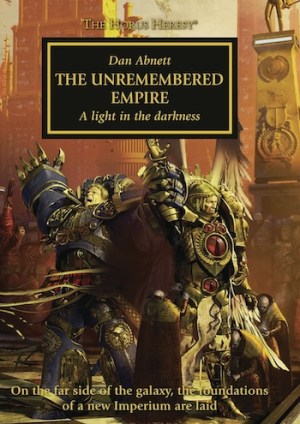
Far out on the Eastern Fringe, the realm of Ultramar stands alone. Having weathered the Word Bearers’ attack on Calth and the subsequent Shadow Crusade against the Five Hundred Worlds, the Ultramarines primarch Roboute Guilliman now draws all loyalist forces to Macragge as he contemplates a new future for mankind. With the arrival of more and more fugitives from the war that has engulfed the rest of the galaxy, all distinction between friend and foe is lost – isolated from Terra by fearsome warp storms, is Guilliman making a bid for power to rival even the renegade Warmaster Horus?

In The Unremembered Empire, Dan Abnett is firing on all creative cylinders. It’s an epic novel, in many respects – action-packed, momentous, a type of bridging point in the overall Horus Heresy series. I blitzed through this, and was left desperately wanting more at the end. A very good addition to the series. Absolutely addictive. Continue reading

“Con Law” by Mark Gimenez (Sphere)

Gimenez-ConLawAnother great Texan political thriller from Gimenez

John Bookman – “Book” to his friends – is a tenured professor at the University of Texas School of Law. He’s thirty-five, handsome and unmarried. He teaches Constitutional Law, reduces senators to blithering fools on political talk shows, and is often mentioned as a future Supreme Court nominee.

But Book is also famous for something more unusual. He likes to take on lost causes and win. Consequently, when he arrives at the law school each Monday morning, hundreds of letters await him, letters from desperate Americans around the country seeking his help. Every now and then, one letter captures his attention and Book feels compelled to act.

In the first of a thrilling new series from the author of international bestsellers The Colour of Law and Accused, Book investigates a murder in the corrupt world of deepest, darkest Texas.

I’m a big fan of Gimenez’s novels. In the early years of his career, he was (too) often compared to John Grisham (another of my favourite authors – and I will admit that’s why I first tried Gimenez’s novels). Personally, I think he carved out an authorial identity all his own far quicker than some other critics. From The Perk onwards, at least, he has been producing some highly addictive, well-crafted thrillers. Con Law, the first in a new series featuring Book, is another excellent example of the author firing on all cylinders. I blitzed through this, and can’t wait for the next book.

Set in Texas, Gimenez crams in a lot of political and social commentary into his novels. As with his previous novel, The Governor’s Wife, Con Law is heavy on the political and social commentary. But, far from being a screed or polemic, the author lets all of his characters have their say. Unlike some writers, who caricature those who don’t agree with them for comic relief, Gimenez offers levity through nostalgia and Nadine, Book’s new intern who has some very strange ideas and habits. Also unlike The Governor’s Wife, this new novel feels far more focused – there is no mid-way shift in style or sub-genre. I’ve thoroughly enjoyed all of Gimenez’s novel thus far, but Con Law felt particularly polished and confident.

The plot is fast-paced, and there are a number of twists and turns, as Book and his intern get to know the people and local politics of Marja. The social divisions, the tensions, and more all come crashing together, stirred up during their investigation. Not everyone comes out unscathed. I’m not really sure how to talk more about the plot without ruining things, so all you need to know is that this is fast-paced and on-the-edge-of-your-seat gripping.

Texas is a fascinating state: its politics, society, and culture are often quite different from other states, even its neighbours. Through the story, the author covers a lot of ground: the state of academia, Texas Republicans and their stranglehold on politics, corporate law in Texas (the easy condemning of land is particularly important, here), the generally conservative temperament and politics of Texans, and how it butts up against transplanted liberals (in Austin, in Marja). Central to Book’s investigation is also fracking, which has become a politically charged issue not only in Texas and the US, but in any country/region with natural gas and oil deposits. Gimenez handles it all very well, and in a deft and fair manner – nobody is made out to be a cartoon, nobody is “right” or “wrong” in their positions, instead we see every side of the arguments, presented as is. It isn’t difficult to ascertain the author’s own mind, of course, but he is not preaching. Given Book’s profession, we also get a couple of scenes set in the classroom, discussing hot-button Supreme Court decisions (Roe v. Wade and Obamacare, of course), and I’m pleased to say, despite devouring a considerable amount of news coverage on those decisions, Gimenez still presented a couple of arguments and interesting tidbits that surprised me. Very pleasant surprise, too.

The characters are well-rounded and quite fun to read about. The working relationship between Book and Nadine is often amusing – despite being relatively young, he finds some of Nadine’s habits confounding. Sometimes she comes across just a little cartoonish, and her lack of certain general knowledge didn’t ring quite true. Nevertheless, it’s easy to forgive this minor niggle, as Gimenez’s writing and plot just pull you along.

Academia, politics, jobs, fracking, social disruption, communities… Con Law touches upon pretty much everything. As a politics and thriller junkie, it felt almost tailor-made for my tastes, and exceeded my high expectations. On the surface, it’s a great story of small-town Texas life and justice. But it also has depth, is intelligent and is expertly crafted. One of his best, I’m glad this is going to be a series. I can’t wait for the next book.

Highly recommended for all fans of thrillers.

Also by Mark Gimenez: The Color of Law, The Abduction, The Perk, The Common Lawyer, The Accused, The Governor’s Wide

“A1 Annual: The World’s Greatest Comics” (Titan Books)

A1-WorldsGreatestComics-Vol.1An interesting collection, from a broad selection of creators and talents

Writers: RON MARZ, MATT WAGNER, DAVE JOHNSON, DAVE ELLIOTT, TOM RANEY, RUFUS DAYGLO, ANDY KUHN, DAVE DORMAN, MARK A. NELSON, W. H. RAUF AND MORE…

Artists: JIM STERANKO, DAVE WILKINS, SAMI BASRI, ALEX HORLEY, TOM RANEY, BRIAN SMITH, D’ISRAELI, GARRIE GASTONNY, MARK A. NELSON, STANLEY ARTGERM LAU, GARRY LEACH, DAVE JOHNSON, BARNABY BAGENDA, SAKTI YUWONO, DAVE DORMAN, STEVE WHITE, ANDY KUHN, KAI LIM, PHILIP TAN, RHOALD MARCELLIUS, MICHAEL T. GILBERT, SUNNY GHO, DOUG BRAITHWAITE AND MORE…

The exciting return of the award-winning graphic anthology series – for readers who want to see inside the mind of the creator, to see what truly makes them tick and witness them doing what they truly want to do!

From all around the world, the greatest comic talents are given full and free rein to explore the art of graphic storytelling.

Reviewing this book offers an interesting conundrum. It’s very bitty, as can be expected from anything referred to as an “annual”. I do, I must admit, tend to prefer a single, longer (or more substantial, at any rate) story. But there were some interesting offerings in this.

With so many people contributing, how do you select which to discuss, if not all of them? I will, therefore, keep this very short. A1: The World’s Greatest Comics is a great taster volume for all the authors and artists who have contributions printed herein. Where it’s the classic-era Kirby tale that opens the book; or Dave Elliott, Toby Cypress & Sakti Yuwono’s “Odyssey” (a Captain America analog – interesting, but sadly riddled with early typos); or Barnaby Bagenda & Jessica Kholinne’s interesting “Weirding Willows” (just three of sixteen stories included), this is an interesting volume. The artwork is varied, of course, and the stories draw from a broad range of genres. If you’re after a single story, this won’t suit, but if you’re new to comics, or want a selection of short, interesting and entertaining ‘samplers’, then this is a good option.

Review: FORTUNE’S PAWN by Rachel Bach (Orbit)

Bach-P1-FortunesPawnThe start of a fun SF series from the author of the Eli Monpress novels

Devi Morris isn’t your average mercenary. She has plans. Big ones. And a ton of ambition. It’s a combination that’s going to get her killed one day – but not just yet.

That is, until she just gets a job on a tiny trade ship with a nasty reputation for surprises. The Glorious Fool isn’t misnamed: it likes to get into trouble, so much so that one year of security work under its captain is equal to five years everywhere else. With odds like that, Devi knows she’s found the perfect way to get the jump on the next part of her Plan. But the Fool doesn’t give up its secrets without a fight, and one year on this ship might be more than even Devi can handle.

I only heard about this series a few weeks ago. About the same time, I learned that Rachel Bach was a pseudonym for Rachel Aaron, the author of the amusing Eli Monpress fantasy series (also published by Orbit). Knowing that, I had a good idea of what I might find in Fortune’s Pawn, and my interest rose as a result. On the whole, this met my expectations, and while flawed, I think it’s a fun, breezy start to a new sci-fi series that will please a great many readers. Continue reading

Lazarus, Vol.1 – “Family” (Image)

Writer: Greg Rucka | Art: Michael Lark, w. Stefano Gaudiano & Brian Level | Colors: Santi Arcas

Forever Carlyle, the Lazarus of the Carlyle Family.

In a dystopian near-future, government is a quaint concept, resources are coveted, and possession is 100% of the law. A handful of Families rule, jealously guarding what they have and exploiting the Waste who struggle to survive in their domains.

Forever Carlyle defends her family’s holdings through deception and force as their protector, their Lazarus. Shot dead defending the family home, Forever’s day goes downhill from there…

Collects: Lazarus #1-4 & “Family: Prelude”

Prior to this, I was perhaps most familiar with Rucka’s first two, excellent Punisher volumes (must remember to finish off that series at some point). On the strength of just those books, I knew I wanted to read more of his work. That’s when I started to read and hear about Lazarus. As soon as this collection was available, I snapped it up and read it in one sitting. All I can say is that the hype is justified. While short, this is a very strong beginning.

The story opens with a pretty long, brutal scene that gives us an eye-popping, wince-inducing introduction to the nature of a Lazarus:

Lazarus-01-Interior1

Despite the above attempted-murder, Forever has plenty of… gumption left in her, and isn’t averse to doling out her blunt Family Justice:

Lazarus-01-Interior8

Over the course of these four issues, we learn about Forever’s psyche – she is unsure about the society in which she lives. She feels disconnected from her family, uncomfortable with her purpose, her nature. One gets the feeling that she’s headed for a break with the Family. It’s going to be an explosive journey, I’m sure.

The book offers a short, tantalizing taste of the Lazarus world, the dystopia controlled by a select few Mafia-on-steroids-like families. We’re not overburdened with world-building, but Rucka gives us just enough in the story to get situated, leaving breadcrumbs for us to follow and keep us guessing and get us hooked. This book is a perfect example of how comics can be used to show us new worlds and stories, without resorting to telling (which I still find strangely common for a visual medium). Forever is sent to parlay with a rival family, the Morrays. We learn through her mission that there is at least one other Lazarus, a member of the Morray family. They have met before, and share a deep affinity for each other’s situation and understanding of their lives – given their nature who else, really, could related? Meanwhile, Forever’s family members, her “brothers and sisters”, are plotting against her, each other, and their father. This does not bode well for the future.

Lazarus-01-Interior7

The pacing is fast but not rushed. It’s a dystopian world, the families appear in total control of the Americas, in a neo-feudal system that benefits the Families, while everyone else is categorised as either “Serfs” or “Waste”. It’s the argument against tyranny and the 1% writ large, exaggerated into a truly crushing social order.

Overall, this book is really quite excellent. I would have preferred a bit more world-building, sure, but I have a feeling this will be unrolled slowly and when necessary over the course of the series. The book is rather slim in length, which might leave people dissatisfied. I certainly would have liked more, but I see why the story was stopped here for the first volume. I can’t wait to read Volume 2. It’s not difficult to see why it has received so much praise. Very highly recommended, but if you need your comics more substantial in length, you may want to wait until the second collection is released/available before diving in them both together.

Lazarus-Vol.01-Interior1

You just might just like it…

Witchblade: Rebirth, Vol.1 – “Unbalanced Pieces” (Top Cow/Image)

Witchblade-Rebirth-Vol.01Writer: Tim Seeley | Art: Diego Bernard | Inks: Fred Benes, Alisson Rodrigues | Colors: Arif Prianto of IFS

In the wake of Top Cow’s Rebirth, Sara Pezzini has relocated from New York to Chicago and struggles to adapt to being a private detective. Pezzini quickly discovers that a change of scenery and occupation hasn’t changed one thing… the Witchblade is still a magnet for the supernatural Quickly drawn into a conflict between two mystical gangs, she must once again balance her responsibility as bearer of the Witchblade with her personal life.

Collects: Witchblade #151-155

I haven’t read a great deal of Witchblade comics, or other comics in Top Cow’s universe (Artifacts, The Darkness), but I’m somewhat conversant in the mythology. I read the first book by Ron Marz, which was itself a reboot/jumping-on-point, but then became distracted by the New 52 and a selection of other books (I’m not proud of it, but… Batman, baby!). After it was announced that Tim Seeley was taking over writing duties, my interest was piqued once again, having rather enjoyed his Hack/Slash horror-comedy series. So I dove in… And rather liked what I found.

I’m not sure that this needs a particularly long review. People who know the series already will know pretty much what to expect – it’s dark, gothic, but also slick. The only major difference is the location, as Sara has moved to Chicago (interestingly, that’s also where Dick “Nightwing” Grayson just moved to in the DC New 52). For new readers, this book has a lot of extra material that gives you some background. It’s not essential to read in order to enjoy this, though, as the concepts are pretty tried-and-true, but with some well-conceived and original developments.

Seeley blends a private investigator storyline and feel with just the right amount of weird in the first issue/chapter to get us intrigued. But then things get really weird – Sara tangles with biker witches, age-sucking creatures with a very strange version of their own ‘Witchblade-armour’, and a strange, supernatural beastie with a long history of fighting bearers of the Artifacts…

Things are not going well for Sara in her new environment, and her sense of displacement and ennui is well written. She’s finding her place, and it’s not going particularly well – on the social, financial, and divine purpose fronts. Add to this a policewoman who has it in for Sara, and a rather unsatisfying romantic (un)attachment with a stage magician harbouring an ulterior motive.

The story is well-written, well-paced and well-realised. Despite my aforementioned lack of fore-knowledge of the extended Witchblade mythos, I didn’t have any trouble following this. It’s weird, it’s sometimes amusing, it’s often creepy. The art team does a great job of bringing Seeley’s story to life on the page in crisp, sharp artwork. It’s eye-catching and vivid. I’m very glad I picked up volumes two and three in the ComiXology sale the other day, as I think I’ll be sticking around for a lot more of this series. I may have to try out the Rebirth The Darkness series, too.

If you are a fan of supernatural stories, filled with the occult, magical and gothic weirdness – not to mention a few gribbly beasties – then Seeley’s Witchblade is absolutely for you. Definitely recommended.

Superman, Vol.3 – “Fury at World’s End” (DC Comics)

Superman-Vol.03-ArtWriter: Scott Lobdell | Artist: Kenneth Rocafort (#13-17,19), Aaron Kuder (#18), Tyler Kirkham (#18), Robson Rocha (#18) | Inks: Aaron Kuder (#18), Jaime Mendoza (#18) | Colors: Sunny Goh (#13-16,18), Blond (#17-19)

H’El has come to Earth. When a mysterious ghost from Krypton’s past comes to Metropolis in hopes of finding the lost planet’s last son, his arrival comes with disastrous consequences for not just Superman, but also for Superboy and Supergirl. H’El has decided that Earth is the place to resurrect Krypton, but the price the lives of everyone on the planet! Guest-starring the Justice League, Wonder Woman, Orion and more!

Collects: Superman #13-17 [+ #18-19]

Continuing my attempts to catch up on a few New 52 titles, before I… uh… give them up… I actually quite like the Superman series. It wobbled a bit early on when the DC Powers That Be (DCPTB) decided to tie it in to the daemonite/Helspont mess that dominated the story-arcs of Grifter and Voodoo, but also roped in Stormwatch (and maybe a couple others?). I liked the greater attention paid to Superman/Clark’s everyday life, as a journalist and as someone navigating the changing industry and also his personal relationships. This collection of issues had a lot of this, too, and I’m certainly glad I read it. However, it also features the Superman issues that tie into the Super-family Event, “H’El on Earth”, which presented some issues for me.

As I just mentioned, I really like the focus on Clark’s non-super life. It’s something other readers really didn’t seem to like in earlier issues/books, but I think some of the most interesting content in the Superman mythos and character comes from his interactions with real life, how he handles his gifts, how he struggles to be “normal”, and how his over-developed sense of Right and Justice makes him stand out as a throwback to classic portrayals of the character or what would be considered “goody-two-shoes”, naïve characters today. For example, this monologue on the idealism of journalism:

Superman-Vol.03-Interior3

Unsurprisingly, Clark loses his job after this…

I’m not sure about the way Clark’s relationship with Lois is being written. His continued difficulty with her moving on, and moving in with Jonathan (although, I can’t remember who that is, exactly), seems forced. Given the timing and the events from the end of Justice League #12 (Superman’s kiss with Wonder Woman, and the start of their relationship), I found it difficult to consolidate his sense of justice and decency and this jealousy (even if it did make him out as more human). I felt bad for Diana, to be honest, that he is with her and yet pining for Lois. Given that the New 52 Superman had been steering clear of a Clark-Lois romance (I thought purposefully), it felt a little bit like a manufactured conflict for Clark. It’s well-written, though. Just felt a little out of place, given the stated intentions of the DCPTB. I would, however, accept that I may have missed something, given how much time lapsed between reading these issues and anything before.

Superman-Vol.03-Interior2

The “H’El on Earth” stuff, which is woven around and over Clark’s ‘mundane’ life, is kind of a typical, Supehumans-Breaking-Stuff-in-Large-and-Improbable-Manner tale. It’s… fine. But if you think about it, highly over-done. I’m looking forward to an understated Superman story. Something that doesn’t require him to just be invincible and strong enough to bench-press more than the weight of the Earth (as we are informed he apparently can do, at the start of issue #13). The exaggeration is, I understand, part of the charm of Superman – for some, it seems to be all they want. But for me, I would really like some more variation in the approach to the character.

Superman-Vol.03-Interior4

I do so love Batman’s cavalier attitude…

After “H’El on Earth”, there are two issues of strangeness, involving Orion (who made out with Wonder Woman in her solo series), and Hector Hammond (of the massively-bloated head – who I last saw in Green Lantern pre-New 52, I think… I don’t quite remember). Issue #19 was not too well written, sad to say. It felt clunky, with some info-dumping, and a little too heavy on telling and lesser writing for the first six pages. What happened? Things improved at Lois’s house-warming party. But then everyone starts to act strangely, and the issue ends as Orion catches up with Superman. I was left none-the-wiser as to what was going on. I guess I’ll have to wait until I can pick up the next few issues (those that will comprise volume 4, I suppose).

Not bad, but starting to show cracks. I hope this gets better, and doesn’t end up spinning its wheels, while the DCPTB try to come up with another cross-series Event to generate sales. In the meantime, I shall investigate some of the older Superman stories – for example, For Tomorrow, Lex Luthor, Superman For All Seasons, Secret Identity and maybe some others.

“Silken Prey” by John Sandford (Putnam/Simon & Schuster)

Sandford-23-SilkenPreyUKMurder, scandal, political espionage, and an extremely dangerous woman. Lucas Davenport’s going to be lucky to get out of this one alive.

Very early one morning, a Minnesota political fixer answers his doorbell. The next thing he knows, he’s waking up on the floor of a moving car, lying on a plastic sheet, his body wet with blood. When the car stops, a voice says, “Hey, I think he’s breathing,” and another voice says, “Yeah? Give me the bat.” And that’s the last thing he knows.   

Davenport is investigating another case when the trail leads to the man’s disappearance, then — very troublingly — to the Minneapolis police department, then — most troublingly of all — to a woman who could give Machiavelli lessons. She has very definite ideas about the way the world should work, and the money, ruthlessness, and sheer will to make it happen.

No matter who gets in the way.

I’m a huge fan of Sandford’s Minnesota-based crime thrillers. In fact, I would say that he’s probably my favourite thriller author bar none. Silken Prey is the 23rd novel in his Lucas Davenport series, and the series just keeps firing on all cylinders. This time, Sandford turns his attention to politics, which always offers new and ‘exciting’ ways in which an investigation can become muddled, dangerous, or even impossible. Lucas is tasked by the Democratic governor to investigate what appears to be a political framing of the Republican Senator. Making things really tricky, of course, is the fact that they are all in the middle of the election. Party politics, dirty tricks, extreme suspicion, and a deadly killer (or two) operating on the sidelines? This is Davenport. He can handle it. Maybe…

The novel displays Sandford’s easy, inviting prose style, the wry humour that has always made this series stand out, and also his engaging and endearing characters. The friendship between Lucas and his various colleagues feels very natural – after 23 novels, how could it not be? The antagonists of the piece are well-drawn, avoiding cartoon-ish cliché or exaggeration. It was nice to see Kidd and Lauren make an appearance, as it feels like a really long time since we saw them last (the two of them had their own, four-book series earlier in Sandford’s career – and I would highly recommend those, too). The novel is uncluttered, unpretentious, and very focused. It’s not a blockbuster thriller, with a focus on character way more than guns or action-scenes.

The ending was just a smidge muddled, as if the author felt he needed to wrap things up relatively quickly, but I think he nevertheless manages to pull it off, and it wasn’t dissatisfying. It didn’t feel rushed, actually. The conclusion also leaves things open for further exploration in a later book (which I really hope Sandford does). I get the feeling that Sandford has some big plans for Davenport’s future, and I can’t wait to read the next book in the series. This far into a series, it is a testament to the author’s exceptional skill as a writer that he manages to make each new novel as gripping and addictive as the last. Long may this continue!

A short-and-sweet review, this. I don’t want to delve too much into the story, as there are a couple of switches and changes at certain points of the narrative. The synopsis, above, should suffice to give you as much as you need. All I can say is that John Sandford is a superb writer, and Silken Prey is yet another strong addition to his beloved series. I will really have to catch up with the companion series, which follows Davenport’s protégé (of sorts), Virgil Flowers. I’ve read the first in that series, but have six more to catch up on. I may plan to do that over Christmas and New Year.

Very highly recommended for all fans of crime thrillers.

“Scars” Eps.IV-IX by Chris Wraight (Black Library)

Wraight-Scars(HH)-pt4The next six parts of the serialised Horus Heresy novel

Of all the Legiones Astartes, the White Scars of Jaghatai Khan remain the most enigmatic and elusive. Born of a civilisation that prizes honour, speed and fearsome loyalty, their allegiance has yet remained unclear even as the galaxy is torn apart by Horus’s treachery, and both sides have apparently counted them among their potential allies in the war to come. But when the Alpha Legion launch an unexplained and simultaneous attack against the White Scars and Space Wolves, the Khan must decide once and for all whether he will stand with the Emperor or the Warmaster… or neither.

Originally, I was going to read this serialised novel in chunks of three ‘episodes’. However, after leaving things for a little longer than intended, I ended up blitzing though the middle six parts in one go. While I’m still not entirely sold on the serialisation-aspect of this project, I do believe Scars will shape up to be Wraight’s best Black Library work to date. This is a very good novel (so far).

I’m still not entirely sure how best to approach reviewing these episodes. As with the previous review, it’s a little difficult to decide on what is a spoiler, what isn’t, whether it should be approached as if these were a single, complete book? I’m going to try to walk a middle-ground, and just highlight some of the things I really liked about Scars so far, and some more general observations. The synopsis, above, does a good job of situating the reader, and I think only needs a little bit more for the purposes of the review.

Two of the best things about the novel are, first the plethora of Legions represented (eight with ‘proper’ characters, but another on the sidelines, referred to quite frequently), and second, the continued examination of what the new revolt and civil war has done to the Astartes – collectively and individually. Many of the characters are still struggling with the idea of open warfare between the Legions, how peculiar and abhorrent fighting their own kind, their cousins, is.

Fighting another Legion was an unsettling experience: they thought like he did, were as quick as he was and almost as familiar with the layout of his vessel. It was like fighting a mirror.

The Thousand Sons had been different. They’d already been half beaten once the Space Wolves had made planetfall, and their defence had been desperate and messily, confusedly defiant. The Alpha Legion had no such disadvantages: they were in better shape than the Wolves, better resourced and with the advantage of the initiative. They had come looking for this fight, for reasons that even Russ hadn’t fathomed with any precision.

In addition to the confusion borne of the rebellion, the machinations of the Word Bearers and their allies in the Warp has only increased the problems facing the loyalists. Communications are effectively down – messages through the Astonomican are either delayed, garbled, contradictory, or nonexistent. At one point, the White Scars Primarch’s frustrations bubble over:

“I have the strength of the Legion arrayed before me, ready to strike. The ordu has assembled, and yet none can tell me who the enemy is. Tell them if they cannot interpret correctly then I shall come up to their spires and hammer their dreams into order for them.”

And later, he reflects on the situation:

The Khan almost felt like laughing. Nothing made sense. After years insulated from the rest of the galaxy, locked in a campaign that had promised little glory and much routine hard work, every certainty seemed to have been twisted into a comical level of incongruity.

True, these have become central themes of the Horus Heresy series as a whole, but the fact that it remains interesting after so many novels, from so many authors, is a testament to the skills of the writers involved, but also the strength of the overall project. It’s no mean feat to juggle all these novels, short stories, and audio dramas and maintain the quality (in fact, as I’ve mentioned before on the blog, from Graham McNeill’s A Thousand Sons onwards, the quality has been improving).

Wraight-Scars(HH)These episodes are littered with examples that explain the White Scars’ rarefied position among the Legions. They are set very much apart from their fellows. Sure, the Alpha Legion are mysterious, but they are known. They are infamously opaque and mysterious, and yet known because of that. The White Scars have simply been… absent. Off persecuting their own part of the Crusade, away from their brother Legions, without much support. This makes them very difficult to judge. When orders do arrive for the White Scars, however, and the Emperor and Dorn order the Khan’s Legion to return to Terra, to reinforce the throneworld’s defences, the Khan does not react well:

“I will not take direction from anyone, not even the Throneworld that only now, now that its Legions are tearing one another to pieces, deigns to remember that it has eighteen warrior-sons at its service… You are nobody’s slaves… We take orders from no one. We take no one’s word. We are on our own, just as we have always been, and if there is truth to be found in this, then we will find it for ourselves.”

Jagatai Khan is a pretty interesting Primarch. He’s enigmatic, even after reading this much of the novel. But this is, really, the root of his charm and why he remains a popular figure in Warhammer 40,000 mythology. There’s a great scene in which four Primarchs are gathered, shortly after Horus’s investiture as Warmaster (at Ullanor), and we get some interesting insight into his character. For example, this shrewd observation about his brothers:

Fulgrim and the Angel looked similar in some ways. They had the same sculptural faces, the same flamboyant armour. Where Sanguinius looked as though he had been born wearing gold-rimmed pauldrons, though, the Khan had always thought Fulgrim looked to be trying a little too hard. In the end, he guessed that Sanguinius would have been happy to cast off his trappings; Fulgrim gave the impression that he would rather die.

And then, as the four of them (Mortarian is also there – another Primarch who has remained rather out-of-sight for most of the series) discuss Horus’s new position:

Sanguinius smiled. “My brother, I think you are the most inscrutable of us all. I know what Rogal wants, and I know what Roboute wants, but even after so long I have no idea what you want.”

“He wants to be left alone,” said Fulgrim. “To shoot off into the stars and hunt down xenos on those delightful jetbikes. They’re devilishly fast…”

And we get to see just how fast all of the White Scars’ vessels can be. Much to the Alpha Legion’s surprise and detriment…

Things really start to hot up near the end of Ep.V, when White Scar psyker (or “weather witch” as his fellow Astartes call him) Yesugai stumbles across a Sons of Horus ship, crewed by a small band of Salamanders and Iron Hands, who have recently escaped the massacre on Isstvan V. He learns of the betrayal, putting to rest some of the confusion that has resulted from the White Scars’ isolation. This sets into motion the events of episodes VI-IX, which sees the White Scars hurtling towards revelations upon revelations, disappointments and betrayals. The story is shaping up very nicely indeed, and I can’t wait to read the final three parts of the novel.

As well as these larger issues are unfolding, we start to see more of Shiban’s investigation into the mysterious deaths on Phemus – deaths that appear to have been caused by Legion weapons. This leads him to his Terran friend, another White Scar, who is also an active member of a Warrior’s Lodge. A Lodge who may not be working in accordance with the Khan’s wishes, and are probably being manipulated by… well, long-time readers of the series will no doubt know the answer to that.

Of the other Legions featured in the novel, the Space Wolves come out of this in a very interesting light as well. The timeline places the novel shortly after their attack on Prospero to punish Magnus and the Thousand Sons. They are uncharacteristically somber, introspective, as they see the ripple-effects of their actions (sanctioned though they were), which leaves Leman Russ, their warlike, impulsive Primarch, to lament the state of affairs in the galaxy, of which he played an instrumental part in bringing about. Speaking to Bjorn One-Hand (who is well-known to fans of the tabletop game, as the Space Wolves’ dreadnought character, Bjorn the Fell-Handed – he also featured in Wraight’s SMB novel, Battle of the Fang), he muses:

“I never asked him [the Emperor] what he had in mind for us once the Crusade was over,” Russ went on. “I never asked him if we would be needed. Hardly matters now – if this madness can’t be stopped there will never be a time when we are not needed… The irony of it. Horus has given us the purpose we were beginning to lack. He’s made us useful again… Look what a mess we have made of things – me and my beloved brothers. You will have to pick up the pieces.”

Overall, then, this is shaping up to be another superb addition to the Horus Heresy series. Wraight has really outdone himself. I’m enjoying this a great deal. [But, yes, I would have preferred to read this all in one go, rather than in weekly instalments.] Bring on the final three episodes, and the next book in the series, Dan Abnett’s The Unremembered Empire.

The Horus Heresy: Horus Rising, False Gods, Galaxy in Flames, Flight of the Eisenstein,Fulgrim, Descent of Angels, Legion, Battle for the Abyss, Mechanicum, Tales of Heresy,Fallen Angels, A Thousand Sons, Nemesis, The First Heretic, Prospero Burns, Age of Darkness, The Outcast Dead, Deliverance Lost, Know No Fear, The Primarchs, Fear to Tread, Shadows of Treachery, Angel Exterminatus, Betrayer, Mark of Calth, Promethean Sun [Stefan’s Review], Scorched Earth, Vulkan Lives, Scars (I-III), Unremembered Empire
“The Shining” by Stephen King (Hodder)

KingS-TheShining2011Perhaps King’s most famous novel. Review by a first-time reader.

Danny Torrance is only five years old, but in the words of old Mr. Hallorann, he “shines” with an exceptional psychic talent. For most of Danny’s life, his clairvoyant abilities have helped him to puzzle out his parents’ troubled relationship, but when his father accepts a position as the winter caretaker for the Overlook Hotel high in the Rocky Mountains, the little boy’s visions spiral into the realm of nightmare.

As blizzards isolate the Torrances, the hotel seems to develop a sinister life of its own. At night, unseen revelers ride the elevators and even the animal-shaped hedges of the topiary prowl the hotel’s grounds like threatening predators. But when Danny meets the woman in room 217, he discovers that the hotel’s phantom guests are more than shadows. Like Danny, the Overlook shines, but the energy it emanates is deadly.

The Shining is one of those novels pretty much everyone knows about. And I wouldn’t be surprised if, like me, they know many references from it without having ever read the book. True, some will know about it from the Kubrick movie (which Stephen King is not too fond of) – although, I haven’t seen that, either. When I got my hands on the novel, I was certainly eager to see what all the fuss was about, and fill in this important gap in my reading history. It is, of course, brilliantly written. But. While it is a fascinating read, there were a couple of things that didn’t quite click for me. I would, however, agree that this is essential reading.

I’m not really sure what to write in this review. It’s a novel that certainly made me think. It’s far more psychological than supernatural (in my opinion). It didn’t “terrify” me, but it was emotionally affecting. Danny, the child, is sympatico, and so many scenes made my heart ache for him. He has “the shine”, a hyper-, supernatural awareness of other people’s emotions, and also telepathic gifts. As he’s only five, he struggles to understand a lot of what he ‘hears’ and taps in to. Jack, his father, is an emotional wreck, fighting against his genetic disposition towards alcoholism and violence. Wendy, Danny’s mother, is the product of a verbally- and emotionally-abusive family (in this case, her mother basically thinks she’s incompetent, a waste of space, and so forth). The majority of the novel is presented through these three filters: Danny’s confusion, his frustration and outright fears; Jack’s suppression of his impulses; Wendy’s self-consciousness and lack of belief in herself. Exacerbating all of their neuroses and hang-ups, is their solitary life at the Overlook Hotel, effectively trapped their during the harsh, inhospitable Coloradan winter. It’s a fascinating, chilling glimpse into the minds of two emotionally damaged parents, and their psychic, confused child.

My ‘issues’ with the novel (for want of a better word) are not with the story, or the majority of King’s approach. It’s a fascinating story of the psychological impact of lifetimes of abuse – both physical and emotional – exacerbated by extreme cabin fever. And some actually supernatural goings on. Maybe. What niggled for me was the relentlessness of King’s characterisation. It was excellently written, and I was engrossed for the majority of the novel, but there were certainly times when I felt that King got into a repetitive cycle – after three or four times of making a point about Jack’s or Wendy’s shortcomings, the fifth and sixth (and sometimes seventh) times around felt like overkill, and the momentum did drop a couple of times. Part One, in particular, was very heavy-handed in its approach to situating the reader in this family’s life and minds. It is a testament to King’s writing skills, though, that he nevertheless brought me back to the story each and every time I started to think things were getting too bogged down.

KingS-TheShining1977Why “maybe”, above, when I mentioned the supernatural? Well, the introduction to the edition I read (Hodder, 2011) could be seen as rather leading. It includes King’s opinion of what actually causes most the weirdness and psychosis in the novel. While I nevertheless came to my own conclusion, and there are certainly some weird and creepy-as-hell goings-on, I think it did prime my impression, or influence how I read the novel. [Maybe it should be an afterword, in future editions?] A really minor complaint, though.

Overall? I’m very glad I finally read this, and I wish I hadn’t taken so long to do so. It’s by no means perfect, but it is frequently engrossing, gripping, and chilling reading. King’s attention to detail throughout is both excellent and also natural. I was reminded of Robert Jackson Bennett’s writing, actually (only, less contemporary than RJB’s), who I read before this. It certainly deserves its place as a literary classic, and an essential read for anyone with an interest in horror, thrillers, psychological tales, and also writing in general. As someone who has read a fair bit of King’s non-fiction (his Kindle Single, Guns, is superb), but never got through the only other novel of his that I’ve tried (Dreamcatcher, which was Messed Up), I’m glad I finally popped my King Fiction Cherry (there has got to be a better way to phrase that…).

I can’t wait to get my hands on Doctor Sleep, the highly-anticipated sequel [oh, I wish I could afford the limited edition of that book…]. Definitely recommended.

***

The Shining was first published by Doubleday in 1977 (cover above). It is now published by Hodder in the UK, and by Anchor in the US.