Mini-Review: THE LANGUAGE OF DYING by Sarah Pinborough (Jo Fletcher Books)

Pinborough-LanguageOfDyingAn affecting, slim tale of loss, family and never-forgotten pain

Tonight is a special, terrible night. A woman sits at her father’s bedside watching the clock tick away the last hours of his life. Her brothers and sisters – all traumatised in their own ways, their bonds fragile – have been there for the past week, but now she is alone. And that’s always when it comes. As the clock ticks in the darkness, she can only wait for it to find her…

Clocking in at only about 125 pages, The Language of Dying nevertheless packs an emotional wallop. A daughter watches over her dying father, as her brothers and sister visit their childhood home. Each is dealing with their own issues and difficulties – be it drug abuse, general unhappiness with their lives, and also their difficulty in dealing with the imminent death of their father. The narrator recounts a number of fond memories and also some extremely painful ones (which, if I recall correctly from a blog-post the author wrote not too long ago, may be at least inspired by certain real events). The book is filled with a great many small, intimate details – it’s quite British, too, in that respect. The family is clearly a broken family, in many ways, and their dealings with each other can be difficult and cause friction. But then, at other times, they reminisce together over happier times. There is perhaps, also, a history of mental instability. This gives a certain dreamlike and questionable quality to a possibly-supernatural slant to the story that is alluded to at the start, and appears again at the end (one I really liked – and I enjoyed the ambiguity).

“… I still look. Forty next birthday and I’m looking out of the window for something that may be imaginary, that I haven’t seen in fifteen years, if ever I saw it at all…”

This is, as I say right at the top, is a powerful, elegant tale of loss and family, and some of the different manifestations of grief. The story is incredibly moving, and I will admit to shedding at least a couple of tears (ahem, ok, more than that). A remarkable, short piece of fiction. Very highly recommended.

Short Story Reviews: RIVEN and HAND OF DUST by John French (Black Library)

Two short stories by one of Black Library’s up-and-comers

FrenchJ-Riven(HH)RIVEN (Horus Heresy)

As one of the vaunted Crusader Host, Brother Crius stood as the representative of the X Legion upon the soil of Holy Terra, but when he learns of the death of his beloved primarch Ferrus Manus at the hands of the traitors, his stoic, mechanical grief imbues him with the strength and resolve to undertake a special mission on behalf of Rogal Dorn himself. Striking out into the stars, he searches for any signs of his lost Iron Hands brethren, hoping to bring them back to Terra to aid in the final defence of the Palace. The question remains – just who has survived the slaughter on Isstvan V, and what yet remains of them?

I’m always happy when a new piece of Horus Heresy fiction is released, and this one is by an author I have not read much by, before. The story follows Brother Crius, a member of the Iron Hands, struggling with the loss of his Primarch, Ferrus Manus. He is tasked by Sigismund, the First Captain of the Imperial Fists to seek out any other survivors of the Isstvan V massacre, and bring them back to Terra to bolster the defence against the eventual attack by Horus’s forces. Heading out, with the support of an Imperial Fists captain, what Crius and his companions discover is not at all what they were expecting – nor, actually, what I was expecting.

I like what French has done with this story. While I wasn’t entirely clear as to why Crius was incarcerated at the start of the story, the author nevertheless has written a pretty great story. We see a little bit more of what makes the Iron Hands tick, and also a little bit of the psychological damage that the death of Ferrus has caused. True, it’s still a relatively short story, so there isn’t too much of this, but I would certainly like to read more about the Legion pre- and post-Ferrus’s death. The final battle is pretty intense, and not over-described (which was certainly welcome to me). Overall, this is a recommended addition to the growing Heresy story.

*

French-AhrimanHandOfDustAHRIMAN: HAND OF DUST

On Prospero, a solitary living soul walks across the shattered world. Beneath the ruined spires, Ahriman, exiled son of Magnus the Red and destroyer of his Legion, contemplates what once was, what is, and what may yet be. And amidst the dust of the long-lost paradise world, the sorcerer faces his mistakes and decides his destiny.

This (very) short story is part of Black Library’s Advent Calendar series of eBooks. It is also the second by French featuring the Thousand Sons (All is Dust, another micro-story, was released early last year). Hand of Dust follows one of the greatest sorcerers of the Thousand Sons traitor legion – Ahriam, the architect of the Rubric that ‘froze’ his fellow legionaries, in an attempt to rescue them from the fate that has plagued the sons of Magnus for centuries.

Hand of Dust is perhaps too short to really have much to write about it. The premise is interesting, and I think it could (and, perhaps, should) have been extended. It’s like a teaser for French’s writing and also his Ahriman fiction. It’s a good one, too. As with Riven, above, French’s writing is pretty solid and well-crafted. It is perhaps not as streamlined and fluid as some of the other, more-established Black Library authors, but it’s still very good. It will certainly be interesting to see how he develops over time.

French also wrote the first Ahriman novel, Ahriman: Exile (cover below), which is out now, and has now been bumped up my tottering TBR mountain. Ahriman also features in Rob Sanders’s Atlas Infernal and Graham McNeill’s superb A Thousand Sons (and a handful of other Horus Heresy novels). French will also be writing a follow-up to Exile, Sorcerer, which is due for publication in 2014.

French-AhrimanExile

“The Emperor’s Children” by Claire Messud (Knopf)

Messud-TheEmperorsChildrenAn interesting tale of privilege in New York, in the lead-up to 9/11

A novel about the intersections in the lives of three friends, now on the cusp of their thirties, making their way — and not — in New York City. There is beautiful, sophisticated Marina Thwaite — an “It” girl finishing her first book; the daughter of Murray Thwaite, celebrated intellectual and journalist — and her two closest friends from Brown, Danielle, a quietly appealing television producer, and Julius, a cash-strapped freelance critic.

The delicious complications that arise among them become dangerous when Murray’s nephew, Frederick “Bootie” Tubb, an idealistic college dropout determined to make his mark, comes to town.

As the skies darken, it is Bootie’s unexpected decisions — and their stunning, heartbreaking outcome — that will change each of their lives forever.

This novel came very highly recommended, but for some reason it took me quite a long time to get around to reading it. I have a weak-spot for novels set in New York City. This is the first one I’ve read that takes a look (near the end) at the impact of 9/11 on inhabitants of the city – not in terms of politics or the War on Terror, but rather as an event that would turn the lives of these protagonists upside down, in both large and small ways. I certainly enjoyed reading the novel, but it’s not perfect. It offers some shrewd, pointed commentary on the foibles and anxieties that face or characterise the lives of privileged (and some not-so-privileged) white youth in New York City.

The friends at the core of the story are quite typical, in many respects. This works in their favour, and makes the novel pretty easy to sink in to. They are from a wealthy set, but each hides their own insecurities from the others. Julius, for example, is down on his luck, and has been hiding the fact that he has resorted to temping in order to make ends meet. Danielle is ticking along, but then develops a relationship with someone she never would have thought possible. Marina is a typical, spoiled, highly privileged daughter of an accomplished, beloved-of-the-NY-literary-set journalist. In the meantime, Bootie, Marina’s awkward cousin with delusions of literary/journalistic grandeur, a surprisingly strong sense of his own iconoclasm, moves to New York, and ends up causing quite the unpleasant stir.

It’s tricky to go into too much detail, as is so often the case. Messud weaves a number of twists and turns into the novel, as her protagonists navigate their way through their personal and professional lives – Marina struggling to finish the long-fallow book project she’s been paid to write (years ago), and also having to deal with her new boyfriend’s obvious distaste and derision for her father’s reputation; Danielle trying to get her productions green-lit, while keeping her new romance secret from her friends (who would undoubtedly disapprove); Julius, whose love-life takes a turn for the better, before spiraling catastrophically; and Bootie’s attempts to make a life in New York, balancing his awe, jealousy and eventual disappointment in Marina’s father (for whom he works as an assistant for a short while).

The novel had two particular strengths. First, the characterisation – which I know I haven’t outlined particularly well, above – was excellent. These are people who are by no means perfect or in any way heroes. There is a natural ugliness, almost, to their personalities: the natural jealousies, the petty narcissism, and so forth. But also their privileged ennui, as they attempt to figure out what it is they are meant to be doing with their lives (something I can sometimes relate to). There were a few uncomfortable moments when I would read one of the characters’ inner struggles, perhaps raise a judgmental eyebrow or sneer, and then realise that I myself had harboured similar thoughts, worries, or jealousies on occasion.

Another thing I really liked about the novel, were the moments in which characters would talk about books. Perhaps a strange thing to pick up on, given that they are universally small and fleeting moments in the story, but I really liked it. For example, when Danielle is looking at her bookshelves in her apartment, a form of biblio-memoir:

… a wall of books, both read and unread, all of them dear to her not only in themselves, their tender spines, but in the moments or periods they evoked. She had kept some books since college that she had acquired for courses and never read — Fredric Jameson, for example, and Kant’s Critique of Judgment — but which suggested to her that she was, or might be, a person of seriousness, a thinker in some seeping, ubiquitous way; and she had kept, too, a handful of children’s books taken from her now-dismantled girlhood room, like Charlotte’s Web and the Harriet the Spy novels, that conjured for her an earlier, passionately earnest self, the sober child who read constantly in the back of her parents’ Buick, oblivious to her brother punching her knee, oblivious to her parents’ squabbling, oblivious to the traffic and landscapes pressing upon her from outside the window.

Messud does a great job of giving each character their own voice (although, sometimes only slightly different from others), and she’s doing a great job of deconstructing her protagonists and their neuroses and petty jealousies. But, and this is my only real issue with the novel: it could have been trimmed down, I think. There were times when it felt like the novel veered off into an unnecessary tangent, without adding enough to the story to justify it, or being too mundane to really be worth it. I also think the author has never found an over-long sentence she didn’t like. There were, for my taste, far too many run-on sentences. There were so many instances when a well-placed full-stop would have done wonders for the prose and reading experience; any number of sentences that were begging to be broken up into easier-read sizes. Take, for example, this paragraph (which is by no means the worst offender):

As they each gingerly dismantled and consumed their fanciful dishes — in her case at least, a fancy that, Danielle thought but did not say, was less original and extraordinary than the restaurant’s reputation and price had led her to expect, and therefore disappointing, as she had chosen the venue to impress — Danielle proceeded to explain that she had been taken with his use of the term, that she had, perhaps wrongly, heard in it a certain echo, the suggestion of an ethos that she thought might be found, to greater or lesser degrees, in certain other publications or presentations, and that she, in her producer’s role, had thought to articulate into, well, a movement.

Or this stuttering, shorter example: “and there was, had been, at the very sight of him, at the front of the line at the restaurant, a pull that Danielle felt to be inevitable, personal, even spiritual — a magnetic attraction.” And the use of near-repetition to make or reinforce a point (“having felt, and felt keenly”).

There are, of course, moments of levity that break up what could otherwise become a rather heavy-handed narrative. Mostly, this occurs when theses privileged characters are confronted with simple situations they are entirely ill-equipped to deal with (thing that would, ordinarily, be dealt with by the Help). For example, when Marina’s cat, Pope, dies:

“I’m sorry, Daddy — it’s just the Pope. She’s not — I mean, she’s dead.”

“Oh.” The two of them stood side by side without approaching. “You’re quite sure?” Murray asked, scratching at the back of his head.

“Yep. Sure.” The cat, a black blot on the duvet, didn’t move.

“Is your mother asleep?”

“Hours ago.”

“Hmm. Worse things could happen than leaving her there for the night, don’t you agree?”

The idea seemed somehow sacrilegious to Marina, though whether the offense was against the cat or the bed and its imminent occupant, she couldn’t have said. “Don’t dead things, you know, leak?”

“Not overnight, I wouldn’t think. And it’s pretty cool in here.”

And this, later moment in which they discuss what to do with books from university…

“What did you major in, in college?” she ventured again, after a time.

“Poli Sci.”

“Mm-hmm.”

“You must have been English, right?”

“Does it show that badly? We all were. I was double, English and Philosophy. I don’t remember a thing.”

“Who does?”

“Seriously, though, I look at the books on my shelves and it’s clear that I read them, back then, but I can’t remember ever doing it, and I don’t have the first idea what they might be about.”

“Read them again, then?”

Danielle sighed. “Not now. Maybe someday. I look at them and wonder who I was, you know? It’s a long time ago. I’m thirty.”

“You should throw those books away.”

“Like, in the garbage?”

“Like that.”

“Sacrilege. It would be.”

“Do you hang on to clothes you haven’t worn for ten years? Or bags of pasta, or cans of beans?” Danielle did not need to answer. “What is it about books? Perfectly rational people get crazy about their books. Who has time for that?”

“I measure my life out in books.”

“You should be measuring your life by living. Correction: you shouldn’t be measuring your life. What’s the point?”

Ultimately, The Emperor’s Children is a richly drawn, well-observed story of how these friends and relatives navigate their world. The characters develop naturally over the course of the story, and while they felt rather cookie-cutter at the beginning, they quickly developed their own voices. Despite the sometime-trouble I had with Messud’s drawn-out prose-style, this is a recommended read. I’ll be sure to read her latest novel, The Woman Upstairs, very soon.

Mini-Review: “A Time to Kill” by John Grisham (Arrow)

GrishamJ-ATimeToKillGrisham’s debut novel didn’t really work for me, sadly…

When Carl Lee Hailey guns down the monsters who have raped his ten-year-old child, the people of Clanton see it as a crime of blood and call for his acquittal.

But when extremists outside Clanton hear that a black man has killed two white men, they invade the town, determined to destroy anything and anyone that opposes their sense of justice.

Jake Brigance has been hired to defend Hailey. It’s the kind of case that can make or break a young lawyer. But in the maelstrom of Clanton, it is also the kind of case that could get a young lawyer killed.

The story of Grisham giving away millions of dollars’ worth of A Time to Kill first editions is pretty well-known, now. After his first publisher went bankrupt, Grisham had to buy 1,000 copies of the 5,000 print run. Here’s what he told Newsweek:

“I took all the books down to the local library and we had a big book party. When the party was over, I still owned 882 copies… so I started giving books away. We took them back to my office and packed them in the reception area. The boxes were everywhere, and I would just give them away. If one of my clients wanted a book, I’d try to sell it. If not, I’d give it away. I’d sell them for 10 bucks, five bucks. I used them for doorstops. I couldn’t get rid of these books… These 5,000 books were the only first editions of A Time to Kill. That book today is worth about $4,000. I had 1,500 of them in my law office at one time. So that’s my big mistake — that’s about $6 million, the way I do the math.”

When I re-read A Time To Kill recently, I found it rather tricky. I’m a huge fan of Grisham’s novels, and have read them all – only two haven’t hit the mark for me (The Street Lawyer and, sadly, this one). But this one just didn’t have the skill and addictive quality of his later work. Mainly, that boils down to the way in which it was written, rather than the story itself, which is pretty great.

Put simply: it’s not as polished as the novels that came afterwards. Sure, it’s a great story and premise, and it is – for the most part – well structured. However. The novel is nevertheless over-written and the content shows a distinct lack of authorial and editorial restraint. Grisham, and his characters, describe and explain everything. One sees only the early signs of the master storyteller he would become. There are plenty of tangents that aren’t quite as well incorporated to the main narrative as it perhaps could have been. They also often felt longer than was necessary. Despite this niggle, though, I kept reading.

One thing I do want to point out, and a major plus, is that Grisham doesn’t pull any punches. His characters are well-developed, diverse, and each of them is a mix of good and bad traits. I can’t really comment on how True To Its Times it is, as I only six when this was first published. But the community and society are presented in a pretty open-eyed manner. The racism, divisions, mores are laid bare for the reader. The characters are what make the novel, though. The story, if the writing had been a little more polished and restrained, would have been superb – perhaps why it worked so well as a movie?

I’m certainly interested to see how Sycamore Row turned out (I have it on my Kindle already, just need to read it): the same main character, combined with his years of experience and authorial improvement? It could be a stunning thriller. I think I’ll have to move it up the TBR mountain. Grisham fans will enjoy it, but I’m not sure they’ll like this as much as his later novels (or, really, immediately following novels…).

Marvel Graphic Novel Catch-Up: Fearless Defenders, Avengers, and Thor

GraphicNovelsRead-201311-1

Three new Marvel NOW collections that I’ve read and enjoyed recently. I had my doubts about the new re-launch/re-boot, but I have actually rather enjoyed the stories themselves (despite, sometimes, only have movie knowledge to get me situated…).

Reviewed: Avengers, Fearless Defenders, Thor: God of Thunder

FEARLESS DEFENDERS, Vol.1 – “Doom Maidens”

FearlessDefenders-Vol.01Writer: Cullen Bunn | Artist: Will Sliney | Colors: Veronica Gandini

New team! New villains! New creators!Valkyrie and Misty Knight are the Fearless Defenders, and not since Power Man and Iron Fist has an unlikely duo kicked this much – well, you know.

Collects: Fearless Defenders #1-6

Cullen Bunn offers up  an all-female team of super-heroines, with a distinctly mythological slant. The story is fun and quirky, with Bunn’s signature, gentle humour often on display – witty asides, amusing narrative moments, and pretty great characterisation. I wasn’t wholly gripped, as I have been with some of his other work (The Sixth Gun remains one of my favourite series of all time). The artwork is good, sometimes a little exaggerated (think Marvel in the 1990s, perhaps). There’s some darkness in the story, too, which offered a nice balance to the levity, although I think I would have preferred to see that a little more developed. By the end, I thought I knew the characters rather well, but that the story had been a bit thin.

It was recently announced, I think, that this is being cancelled. That’s a pity, as I think this could have grown into something pretty cool, if given time. I’ll certainly be reading the remaining issues, though.

*

AVENGERS, Vol.1 – “Avengers World”

Avengers-Vol.01Writer: Jonathan Hickman | Artist: Jerome Opeña (#1-3), Adam Kubert (#4-6) | Colors: Dean White, Justin Ponsor, Morry Hollowell, Frank Martin, Richard Isanove (#1-3), Frank D’Armata (#4), Frank Martin (#5-6)

The greatest heroes in comics together on one unbeatable team! The Avengers “go large”, expanding their roster and their sphere of influence to a global and even interplanetary level. When Captain America puts out his call – who will answer? Big threats, big ideas, big idealism – these are the Avengers NOW!

Collects: Avengers #1-6

Captain America and Iron Man are rebuilding the Avengers. They’re using a more sophisticated organisational model, this time (it’s not as dull to read about as that sounds…). Meanwhile, Ex Nihilo, Abyss and Aleph have been terra-forming Mars and lobbing “evolution bombs” at Earth, re-writing Evolution. As you do. And, collaterally, killing whole bunches of people all over the world. Naturally, this irks the Avengers. After the core Avengers team confronted them at the start, Iron Man, Hulk, Black Widow, Thor and Hawkeye are held captive by these new baddies. Ex Nihilo likes to monologue. Cap is sent back to Earth to “bring everyone”. And then… We get one of the most anti-climactic conclusions in issue/chapter 3. It’s a total deus-ex-machina, couldn’t-be-bothered moment. Sadly fails to deliver, and I felt rather disappointed.

Avengers-Vol.01-Interior4

Recruiting, Avengers-Style

The second story in the book looks at the clean-up after the evolution bombs, from different perspectives, coupled with the backgrounds of some newer Avengers recruits (new for me, at any rate). First, Hyperion (a rather emo-God-type from another dimension, who seems to miss his former station on his world). Second, Smasher (a female “guardian”, or “subguardian” – basically, a Green Lantern with cool tech, a mask instead of a ring, and attached to the Shi’ar Empire, rather than the, uh, Guardians…). And third, Captain Universe (who appears to be a god… or perhaps the origin of all things… It’s not entirely clear…).

Avengers-Vol.01-Interior9

Three Moments of Levity: Bruce Banner explains himself (top), Thor confuses Tony (bottom, left),
and Thor is unimpressed by puny human’s idea of “Godlike”…

Overall, though, this isn’t a bad start to the new Avengers series. There’s a lot of rather cryptic information. Certainly, the Avengers are going Bigger. Hopefully it won’t become too silly in the future, but I am looking forward to reading Vol.2, “The White Event”. The artwork is pretty fantastic, too. Lots of great detail, rich colors, and it really pops throughout.

*

ThorGodOfThunder-Vol.01Thor: God of Thunder, Vol.1 – “The God Butcher”

Writer: Jason Aaron | Artist: Esad Ribic | Colors: Dean White (#1), Ive Svorcina (#2-5)

Throughout the ages, gods have been vanishing, their mortal worshippers left in chaos. Now, Thor follows a trail of blood that threatens to consume his past, present and future. The only hope for these ravaged worlds is for Thor to unravel the gruesome mystery of the God Butcher!

In the distant past, Thor follows the bloody wake of murdered gods across the depths of space. In the present, the Thunder God discovers a forgotten cave that echoes with the cries of tortured gods… and is shocked to find himself among them! And thousands of years from now, the last god-king of a ruined Asgard makes his final stand against the God Butcher’s beserker legions. As three Thors from three eras race to stop the God Butcher, the full extent of his vicious scheme takes terrifying shape!

Collects: Thor – God of Thunder #1-5

Another great start to a new Marvel NOW series. This is the first Thor solo series I’ve ever read, and I think Aaron does a great job of offering a starting point – given that the story hops between three times (past, present, and very far future), there’s no need to be greatly versed in the Thor mythology (Norse or Marvel’s). We see the character develop a bit, and a millennia-long struggle against the God Butcher, who – true to his name – has been working his way through the various pantheons of the universe, culling the numbers of deities. Thor, the only one to give him much of a challenge, has been chosen as the Last, in order that he sees his fellow gods killed, one-by-one.

It’s a solid story, and I’m certainly going to try to stick with the series for a little while. The writing is great, the story and artwork complement each other brilliantly, too. Definitely recommend this one to anyone who either likes the character already, or wants somewhere to jump on.

ThorGodOfThunder-Vol.01-Interior1

“The Crystal Cave” by Mary Stewart (Hodder)

StewartM-M1-CrystalCaveOne of the best-loved interpretations of the Merlin Myth

Fifth century Britain is a country of chaos and division after the Roman withdrawal. This is the world of young Merlin, the illegitimate child of a South Wales princess who will not reveal to her son his father’s true identity. Yet Merlin is an extraordinary child, aware at the earliest age that he possesses a great natural gift – the Sight.

Against a background of invasion and imprisonment, wars and conquest, Merlin emerges into manhood, and accepts his dramatic role in the New Beginning – the coming of King Arthur.

Hm. How to review a book that is well-written, well-conceived, but didn’t fire one’s imagination? In brief, I suppose, is the best answer. I received this as part of the Hodderscape Review Project, which has been a great way to try out some classics of genre fiction. True, only one has truly wormed its way into my mind (Stephen King’s The Shining), but I am very happy that I’ve had the opportunity to read these books (this is the third so far). I’m especially looking forward to the next title in the project (by none other than Ursula le Guin…). The Crystal Cave, however, must also be put on the Shelf of Classics That Disappointed.

Despite this, there is a fair bit to like in this novel. Stewart’s prose is well-crafted and fluid – it reminded me of Robin Hobb’s Assassin’s Apprentice, actually, in style. The characters are interestingly portrayed and well-drawn. Despite these things, the story itself just didn’t grab me enough to make me love it. This is one of the first novels that, after I told friends and family that I was going to read it, was universally met with comments along the line of, “It’s great!” and “It’s fantastic!” Sadly, I just didn’t get swept up by it. The story took too long to get going. I did, however, enjoy how Stewart brought in Merlin’s gift of Sight into the story, and developed it over the course of this first book – he first comes across as incredibly observant, and then we start to see his knowledge of things he couldn’t possible know.

As far as Merlin/Arthur interpretations go, I can certainly see why this has been so popular, and how that popularity endures today. Of the many other versions of this story that I have read (most recently, I think, DC Comics’ Demon Knights and Maurice Broaddus’s Knights of the Breton Court), this is probably the best conceived and in-depth.

It is perhaps the long-game approach that Stewart took that makes the novel not really work for me. It suffers from being too obviously the first part of a series – the characters, ideas and so forth aren’t developed enough, and I didn’t think the plot moved forward enough. Sadly, this means I haven’t got the bug to seek out the rest of the series. At least, I am not in any hurry. As someone who will happily sit through thousands of pages of epic fantasy trilogies (most recently, Joe Abercrombie and Peter V. Brett – both authors for whom I had some catching up to do), it is perhaps strange to say this book didn’t work for me.

That’s quite possibly the most carefully-written, sitting-on-the-fence review I’ve ever written. I’m not proud of it. I just couldn’t rustle up much verve to dig deeper. Which is never a good sign when it comes to a novel. I’m sure, in the future, I’ll give this another try. As it stands, though, it didn’t work for me, and I don’t want to belabour the point.

“Wonder Boys” by Michael Chabon (Harper Collins / Random House / Open Road)

Chabon-WonderBoysA University Professor’s Crippling Writer’s Block and Drug-Fuelled Self-Destruction

Grady Tripp is a pot-smoking middle aged novelist who has stalled on a 2611-page opus titled Wonder Boys. His student James Leer is a troubled young writer obsessed by Hollywood suicides and at work on his own first novel. Grady’s bizarre editor Terry Crabtree and another student, Hannah Green, come together in his wildly comic, moving, and finally profound search for an ending to his book and a purpose to his life.

This is the second of Michael Chabon’s novels that I’ve read – and in a very short time, too. I still have no idea how to review The Amazing Adventures of Kavalier & Clay, which may rank as one of my all-time favourite novels. (Needless to say, it’s not difficult for me to see why it won the Pulitzer Prize.) Wonder Boys, the novel Chabon wrote before Kavalier & Clay, is a rather different novel. It’s nowhere near as long, for one thing – and yet, strangely, it feels far more rambling and unfocused. I enjoyed it a great deal, and zipped through it in just a couple of days. Chabon has a wonderful way with words that can make even the mundane a pleasure to read about.

The main character is almost archetypical, struggling author with writer’s block. Wonder Boys is basically the story of his long-time spiral of self-destruction coming to a head. Over the course of a single weekend, his wife leaves him, his affair takes a shocking turn, lots of people realise that he’s a nightmare and kind of feckless. He also has to attempt to keep his rather predatory editor away from one of his potentially-suicidal students. Along the way, there is a dead dog, one of Marilyn Monroe’s jackets, a shoot-out in an alley, and also a massive dead snake. And some Korean Jews. And a heavy amount of drug consumption.

Chabon-WonderBoysORI haven’t read much literary fiction (or whatever genre this is meant to be in), but there are some tropes that are popping up. They seem to be predictable in their unpredictability. Strange things happen. People do really weird things (see, for example, the bacchanal in The Secret History). They react in slightly melodramatic ways. And yet… there is a way that Chabon writes these little weirdnesses that feels very natural. Realistic, and not actually forced or jarring.

Without walking through the whole plot, it’s tricky to know what to write for this review. I am not aiming for a review in the style of the New Yorker, The New Republic, or Harper’s, so I’m not going to attempt to deconstruct this in any intellectual or academic manner. That’s not what the blog is for. What I will say, though, is that if you’re after a slightly strange, well-written novel about a writing professor at a small Ohio University going crazy, then this is for you. It’s witty, engaging, rather addictive, and very quirky.

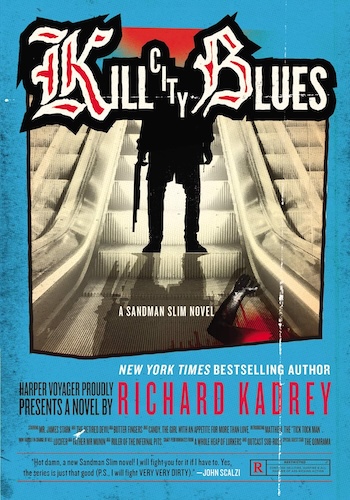
Review: KILL CITY BLUES by Richard Kadrey (Voyager)

Sandman Slim is back on Earth, Averting Apocalypse & causing mischief…

James Stark, aka Sandman Slim, has managed to get out of Hell, renounce his title as the new Lucifer, and settle back into life in LA. But he’s not out of trouble yet. Somewhere along the way he misplaced the Qomrama Om Ya, a weapon from the banished older gods who are also searching for their lost power.

The hunt leads Stark to an abandoned shopping mall – a multi-story copy of LA – infested with Lurkers and wretched bottom-feeding Sub Rosa families, squatters who have formed tight tribes to guard their tiny patches of this fake LA. Somewhere in the kill zone of the former mall is a dead man with the answers Stark needs. All Stark has to do is find the dead man, get back out alive, and outrun some angry old gods-and a few killers-on his tail.

In the fifth Sandman Slim novel, we get more of the same. In both a good and less-good way. Kadrey serves up another dose of gritty, sometimes gnarly, often amusing supernatural urban fantasy. All the hallmarks of the Sandman Slim series are on display – the interesting and inspired twists on classic urban fantasy and horror denizens and creatures. His characters are quippy and interesting, not to mention developing rather nicely. The action is well-written, and doesn’t take over from the plot (of the novel or series’ meta-plot). I still love Kadrey’s version of Hell, God, Lucifer and Samael (former Lucifer). All the characters feel very real, now, even if they are outlandish (Kasabian, for example). Continue reading

“The Secret History” by Donna Tartt (Vintage/Penguin)

TarttD-SecretHistoryI finally get around to reading the mega-hit novel of a mysterious group of college friends

Richard Papen arrived at Hampden College in New England and was quickly seduced by an elite group of five students, all Greek scholars, all worldly, self-assured, and, at first glance, all highly unapproachable. As Richard is drawn into their inner circle, he learns a terrifying secret that binds them to one another…a secret about an incident in the woods in the dead of night where an ancient rite was brought to brutal life…and led to a gruesome death. And that was just the beginning….

Another quick review, this (I’m still trying to figure out how best to review literary fiction). The Secret History has been an international mega-hit, and is frequently listed on Must Read books of the decade, your life, and so forth. As a result, it has been on my radar for years. But, because I am never lacking in reading material, I just never got around to buying it. After a particularly acute bout of book-restlessness, I decided it was time for a change from the SFF genres, and picked this up. I read it over a few very satisfying days, evenings and one night (I ended up finishing it at around 3am). It’s not perfect, but it is certainly engrossing and well-written.

The Secret History is a great novel, in many ways. It’s excellently written, and engagingly told. The characters are varied, quirky, and fun to read about (or, as is the case a coupleof times, uncomfortable to spend time with). This characterisation of college students is rather cliché, but I suppose it suits the story – I refer to the peripheral characters, here (drunks, drug-taking, not particularly bright or upstanding). The wild debauchery of Hampden College is merely a backdrop to the main attraction, despite them partaking in it as well. The focus of the novel are the five students in the exclusive Greek classes, and also our narrator, Richard.

There was something that didn’t ring true for me with this group, though: that everybody liked Bunny. Throughout the novel, he is an obnoxious, irritating presence, and I could never quite put my finger on why any of these characters professed to like him. Not a thing he did or said was redeeming or remotely attractive. It does, however, make it easier to believe how quickly our protagonists could turn on him (as we’re informed in the prologue). There were some affectations that didn’t ring true at all – although, because it was difficult to place the novel in a specific time/decade, I may have misunderstood the occasional thing.

The novel is pretty long, but it rarely felt like it was rambling or bloated. I appreciated Tartt’s attention to detail, and the way she realised the world and characters on the page. It is sometimes self-consciously intelligent and pretentious, but that can be forgiven, as it’s perhaps meant as a reflection of her characters (they are a group of young people who are oh-so-prone to affectations and pretentions). The narrative is sometimes disconnected, but always gripping. The final half of the novel, in particular, was riveting, and I stayed up well into the night to finish it off – thinking “one more chapter” at the end of each and every one.

This is a story of betrayal, loyalty and ultimate sacrifice. The way the characters must hide and tip-toe around what they have done, to hide it from their peers, the police and their mentor is plotted very well. Their tension and anxieties felt realistic and palpable. The ending was a tad melodramatic, and I’m pretty sure it didn’t have to end so. I can’t fault Tartt’s ‘world-building’, though.

I’m extremely glad I read this. It’s not the best novel I’ve ever read, but it has certainly added another author to my must-read list. As soon as I finished this, I bought the eBook of The Goldfinch, Tartt’s latest novel. I’m not sure exactly when I’ll have the time to read it, but I hope it is very soon.

Recommended.

“Scars”, Ep.X-XII by Chris Wraight (Black Library)

Wraight-Scars(HH)The final serial episodes of this Horus Heresy novel

Of all the Legiones Astartes, the White Scars of Jaghatai Khan remain the most enigmatic and elusive. Born of a civilisation that prizes honour, speed and fearsome loyalty, their allegiance has yet remained unclear even as the galaxy is torn apart by Horus’s treachery, and both sides have apparently counted them among their potential allies in the war to come. But when the Alpha Legion launch an unexplained and simultaneous attack against the White Scars and Space Wolves, the Khan must decide once and for all whether he will stand with the Emperor or the Warmaster… or neither.

I’m going to keep this very brief, as this review covers the final quarter of a novel. Why ruin it for everyone? The synopsis above is that for the novel as a whole. I must say it is possibly Wraight’s best so far. Everything I’ve reported on from the first nine episodes is just as evident and well-written as in the chapters that have come before. We learn more about the White Scars, and their strange place alongside the other Legiones Astartes, and the Imperium at large. Wraight sets up a lasting conflict and antagonism that (I assume) continues into the “present” Warhammer 40,000 timeline. Two Primarchs face off against each other, and the result of that exchange dictates the fate of the White Scars going forward. These three episodes pack in a lot of action, and the battle-scenes are very well-written (better, even, than Wraight’s Battle of the Fang). I particularly liked the attention paid to the Scars’ as a Legion split in two – mainly because it’s not been particularly well-addressed in other novels. Wraight’s writing is excellent throughout – clear, crisply composed, and briskly paced.

To be honest, a good amount of the story’s impact was lost as a result of the serialisation – hitting cliffhanger moments works for TV series, but not so much for a Horus Heresy novel. Even though I read them in chunks or multiple episodes, I’m used to read a novel in no more than five days (when they’re really long) and as little as one or two days. Stretching one out over a couple of months just didn’t work for me. An interesting experiment, though.

Nevertheless, with the whole novel now available, I would certainly recommend this as a must-read for all fans of the Heresy series. Wraight’s first full-length foray into the era is a triumph of military sci-fi. I certainly look forward to his next offering.

The Horus Heresy: Horus Rising, False Gods, Galaxy in Flames, Flight of the Eisenstein, Fulgrim, Descent of Angels, Legion, Battle for the Abyss, Mechanicum, Tales of Heresy, Fallen Angels, A Thousand Sons, Nemesis, The First Heretic, Prospero Burns, Age of Darkness, The Outcast Dead, Deliverance Lost, Know No Fear, The Primarchs, Fear to Tread, Shadows of Treachery, Angel Exterminatus, Betrayer, Mark of Calth, Promethean Sun, Scorched Earth, Vulkan Lives, Scars (I-III, IV-IX), The Unremembered Empire

[I’m going to work at filling in those review-blanks – some I’ve already read, but there are a couple of oversights that need addressing. As I am always thirsty for more Heresy fiction, I think I may have to catch up pretty soon. Starting with Graham McNeill’s Mechanicum. Fallen Angels is the only other I’ve never read.]