Mini-Review: “La Santasima” by Teresa Frohock

Frohock-LaSantisimaA brilliant, dark short story from one of my favourite authors.

It’s also a story that any review of length will ruin. It’s timely, incisive and haunting – it is a blending of the supernatural with the ongoing illegal immigration across the US-Mexican borders. Frohock has written a brilliant story that highlights the dangers and issues that those desperate to enter the States will face, as well as the people who will take advantage of and prey on their desperation. At the same time, it is a touching story of family ties.

Here’s the synopsis…

Sebastian’s friend Carlos claims that La Santa Muerte watches over the poor, the ones that the Church abandons. He promises Sebastian that La Santa Muerte will be his patron saint, that she will protect him and grant his wishes.

Death comes for us all. Keep her as your friend.

Sebastian is disappointed as prayer after prayer is rejected by the saint, and he loses faith. One night his sister Lucía joins him, and La Santa Muerte answers their prayer to bring their brother home…

On top of that, the eBook has a great piece by the author at the end, talking about the genesis of the story. If you haven’t read Frohock’s work, yet, you must. Best of all, La Santisima is free on Smashwords!

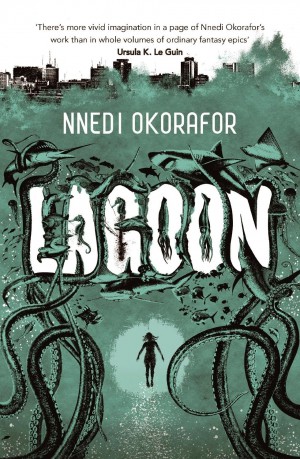
Review: LAGOON by Nnedi Okorafor (Hodder)

OkoraforN-LagoonA gripping, beautifully-written science fiction novel set in and around Lagos.

A star falls from the sky. A woman rises from the sea.

The world will never be the same.

Three strangers, each isolated by his or her own problems: Adaora, the marine biologist. Anthony, the rapper famous throughout Africa. Agu, the troubled soldier. Wandering Bar Beach in Lagos, Nigeria’s legendary mega-city, they’re more alone than they’ve ever been before.

But when something like a meteorite plunges into the ocean and a tidal wave overcomes them, these three people will find themselves bound together in ways they could never imagine. Together with Ayodele, a visitor from beyond the stars, they must race through Lagos and against time itself in order to save the city, the world… and themselves.

“There was no time to flee. No time to turn. No time to shriek. And there was no pain. It was like being thrown into the stars.”

This is the first novel I’ve read by Nnedi Okorafor, and it won’t be my last. I started reading it on the first day it arrived in the mail – I was putting it on my TBR shelf, and flipped it open at the first page. Thirty minutes later, I was still reading and had sidelined my then-current read. Lagoon is beautifully and intelligently written, addictive, well-paced and a must read. Continue reading

Review: BROTHERHOOD OF THE STORM by Chris Wraight (Black Library)

Wraight-HH-BrotherhoodOfTheStormA White Scars Horus Heresy Novella

As word of Horus’s treachery spreads to fully half of the Legiones Astartes, Terra looks to the remaining loyalist Space Marines to defend the Imperium. One group, however, remains curiously silent in spite of apparent efforts from both sides to contact them – the noble Vth Legion, Jaghatai Khan’s fearsome White Scars. In the ork-held territory of Chondax, a bitter war has been raging since the Triumph at Ullanor, and only now do the sons of Chogoris return their gaze to the heavens…

Originally published as a limited edition, Black Library has finally released Brotherhood of the Storm for a wider audience, in both hardcover and eBook. It’s well timed, as the characters within feature prominently in the latest full-length Horus Heresy novel, Scars. And, happily, this does not disappoint – Wraight has really upped his game with his Heresy fiction. While this novella was not quite as good as Scars, it was still a cracking story, filled with a good balance of furious action and away-from-the-battlefront context and character development. Continue reading

“Libriomancer” by Jim C. Hines (Del Rey UK/DAW Books)

Hines-LibriomancerUKAn action-packed, bibliocentric adventure

Isaac Vainio is a Libriomancer, a member of a secret society founded five centuries ago by Johannes Gutenberg. As such, he is gifted with the magical ability to reach into books and draw forth objects.

But when Gutenberg vanishes without a trace, Isaac finds himself pitted against everything from vampires to a sinister, nameless foe who is bent on revealing magic to the world at large… and at any cost.

This novel is an urban fantasy with a difference, and one that should really appeal to a broad swathe of SFF bibliophiles. Indeed, it has a little something for everyone. It’s fast-paced, amusing, cleverly devised, and above all enjoyable.

There’s a lot going on in the novel. The world building and magic system are great, and certainly endearing to someone who reads as much SFF as I do. How often have you wished you could reach into a book and take something out of it? Well, in Libriomancer, that is exactly what the protagonist is able to do. Using this device, Hines is able to mention a whole host of classics of the SFF genres.

“Libriomancy was in many ways a lazy man’s magic. There were no wands, no fancy spells, no ancient incantations. No hand-waving or runes. Nothing but the words on the page, the collective belief of the readers, and the libriomancer’s love of the story.”

One of the things that really shines through, therefore, is the authors clear love for these authors, novels and genres. It is also through this device that Hines is able to make his urban fantasy tale stand out from the pack – this is not your average UF, by any stretch of the imagination. In some ways, though, it is every urban fantasy – the proliferation of vampire fiction, for example, has had a real impact on the world in which Issac et al operate: there are now so many different variations of vampire (and werewolf, etc., etc.), all inspired or caused by accidental meddling with the contents of series.

Hines-LibriomancerFor the most part, the novel rattles along at a good pace, and from the moment Isaac’s library is invaded by vampires at the start, until the revelations and ‘boss fight’ at the end, it rarely lets up. I felt a slight dip in the middle, perhaps, but it picks up again nicely, once Isaac and Lena start making proper headway into their investigation. The characters are varied and well-rounded, and develop appropriately over the course of the novel. Hines writes some great combat/fight scenes, too, taking full advantage of how varied a battle can be when you have a potentially limitless variety of weapons to choose from (assuming, of course, that you have the appropriate book to hand…). This could have felt silly or forced, but it didn’t – the author managed to make this unbelievably awesome skill fit very well into the story, and he places ‘realistic’ limitations on the magic, too. I really wish I was a libriomancer… And I would also like a pet fire spider. Despite the fact that it would probably make my skin crawl…

Speaking of Lena, Isaac’s partner. I’m not 100% sure that her origin story and nature, and the way they are handled in the story, really do what they’re supposed to. That may sound vague, but I don’t want to ruin the story for others, and it’s not really that central a concern for the story. I think he was trying to make a statement about the male gaze, masturbatory teenage male fantasies, and so forth, but I don’t think the point was made as well as intended. I did, however, also learn why people find Gor novels so hilariously awful (I’ve seen them mentioned a lot, but had no clue what they were, or why they were considered so terrible). Certainly, Hines is able to weave into the story some good commentary on the state of the genre(s), and contemporary conversations and debates that are energising the readership and blogosphere, without it being clunky.

Alongside the excellent magic system, there was also some interesting commentary on contemporary, non-fiction issues. Particularly, PTSD, and the way they Hines attached this to the libriomancer idea of “locking” people (and books). I thought he handled and discussed this very well. (It is, again, not a huge part of the story, but it stood out for me.)

Overall, then, Libriomancer has a really intriguing premise, and is very well-executed urban fantasy. This was my first Hines novel, and it won’t be my last. Roll on the sequel, Codex Born!

***

Libriomancer is out now as an eBook, and will be published in paperback by Del Rey UK on March 6th, 2014. The novel is also already out in the US, published by DAW Books. Codex Born is also already out as an eBook (in both the UK and US), and Del Rey UK published it in trade paperback at the end of last year. The UK and US covers are below.

HinesJC-MEL2-CodexBorn

Review: Tanya Huff’s “Confederation” #1-3 (Titan Books)

Reviewed by H.

HuffT-Confederation1to3

A cracking first three novels in Huff’s military science-fiction series

In the distant future, humans and several alien races have been granted membership in the Confederation — at a price. They must serve and protect the far more civilized species who have long since turned away from war. When her transport ship is shot down, a routine diplomatic mission across the galaxy becomes anything but, and Staff Sergeant Torin Kerr must fight to keep her platoon alive.

These three novels – Valour’s Choice, The Better Part of Valour, and The Heart of Valourare the first in Huff’s Confederation series, which have finally made their way to UK shores thanks to an extensive new deal with Titan Books (who are also publishing Huff’s Enchantment Emporium novels, The Silvered, and, perhaps, more in the future?). The series is already at five books in the US (published by DAW), with a sixth, Peacemaker (TBC) in the works. These novels are a lot of fun.

The main character, Sergeant Torin Kerr is a great protagonist, and a great guide to this future setting. She is likeable. She plays the part of frontline officer who is willing and able to keep the Top Brass in check, able to navigate military politics without treading on others’ toes. She’s a great character – gutsy, capable, and kick-ass. Everything a reader could hope for, from a veteran Marine.

Kerr’s tendency to talk back does bite her in the ass in The Better Part of Valour, when she is sent on a “special mission” for speaking her mind to a superior officer: she is assigned as leader of protective detail of a scientific exploratory team, who have been dispatched to investigate an enormous, derelict spaceship. Naturally, things do not turn out as simply or as smoothly as originally hoped. By the third novel, Kerr’s military career has become a bit less action-packed, and she’s found herself sidelined into attending endless briefings and debriefings, with no apparent end in sight. So, when she’s offered the chance to go to Crucible, the Marine Corps training planet, as a temporary aide to Major Svensson, she readily agrees. It was meant to be an easy assignment, lasting no more than a month, while the Major tests out his new body (his previous deployment reduced him to little more than a brain and a spinal cord…). Upon arrival on the planet, however, all hell breaks loose, and it’s up to Kerr to look after a platoon of green recruits, to keep them alive until the cavalry (hopefully) come to rescue them.

The other races Torin and her comrades face and fight are all interestingly portrayed and developed – whether they are villains or just strange allies (who, uh, eat humans…), they can be just as fun as the more humorous characters. Through the various species’ and characters’ interactions, Huff does a good job of exploring our reactions to the Other, and also how we can overcome differences to work together for common purpose.

The battle and combat scenes in all three of the novels are very well-written: intense, fast-paced and ‘realistic’ – no doubt, the author has benefited from her own military career and also her family’s. Although, I must admit that reading about the characters and seeing them interact and develop was more of interest to me (military sci-fi is not my usual bag of tea). After reading these, I’ll have to check out The Silvered (fantasy) and also The Enchantment Emporium (urban fantasy) – it’ll be interesting to see if Huff writes as well in those genres as in this one, although I have no doubt she does.

Overall, therefore, while Valour’s Choice is perhaps my favourite thanks to the newness and sense of discovery I felt while reading it, the series maintains its quality and addictiveness over the next two books – there’s a great balance of humour, story, and action. The changing supporting cast also keeps the stories fresh, although sometimes they took a little bit of getting used to. The novels are quick, fun reads that are not dumbed down. I blitzed through them, and can’t wait to read the next one! Keep them coming!

Valour’s Choice, The Better Part of Valour, and The Heart of Valour are all available now in the UK from Titan Books. The fourth and fifth novels in the series – Valour’s Trial and The Truth of Valour – will be published in April and June, respectively.

For Fans of: Rachel Bach, Elizabeth Moon, Robert Heinlein, David Drake, Jack Campbell, Star Wars, Star Trek, Firefly, Battlestar Galactica

Princeless Vol.1 – “Save Yourself” (Action Lab)

Princeless-Vol.1Writer: Jeremy Whitley | Art: M. Goodwin

Princeless is the story of Princess Adrienne, one princess who’s tired of waiting to be rescued. Join Adrienne, her guardian dragon, Sparky, and their plucky friend Bedelia as they begin their own quest in this one of a kind, action packed, all-ages adventure!

Collects: Princeless Vol.1 #1-4

This was a very pleasant surprise. It’s a progressive, all-ages comic book that should have massive appeal across age groups. The story is witty, well-written, and the artwork is filled with amusing and eye-catching details. I really enjoyed this, and think a lot of others will, too.

The story and ‘message’ (not wanting to get too academic about this) is also very good. It’s a story about a princess rebelling against the Fantasy/Fairy Tale Archetypes. It begins with her shrewdly pointing out the idiocy of sticking princesses in towers in the middle of nowhere guarded by hungry dragons. It’s the only time the financial flaw in such a plan has been pointed out… The rest of the book picks up on a number of fantasy tropes, not to mention the archaic conventions related to women (young, old, noble, and peasant). There were so many scenes that made me laugh or smile. Not only the moment when our heroine discovered the sword under her bed (“Oooh. Shiny.”); but also the excellent scene in which she acquires her own, proper armour.

Princeless-Vol.1-Interior5

I won’t go into any more detail than that, as I think it would ruin many of the other jokes. You’ll find a great protagonist in Adrienne, you’ll grow attached to her new (almost Chewbacca-meets-dog) dragon companion, her zany new ally, and her brother is pretty great, too. I urge everyone to read this. If it found its way into the hands of young readers everywhere, as well as adults’, then it could do a lot for breaking down gender barriers in storytelling and genre fiction/media (in the long and short term).

Princeless-Vol.1-Interior6

Princeless is a must-read for anyone looking for a progressive, fun comic book. Also perfect for anyone who enjoyed Frozen and other similar movies. I really can’t wait to read volume two. Very highly recommended.

Short Story Reviews: FORSWORN and THE FACE IN THE WINDOW by Brian McClellan

A pair of short stories set in the world of McClellan’s Powder Mage fantasy series. McClellan continues to impress and these two stories (which follow previous short stories The Girl of Hrusch Avenue and Hope’s End) do a wonderful job of adding more to the world he’s creating. And heightening my anticipation for The Crimson Campaign

McClellanB-PM-ForswornFORSWORN

Erika ja Leora is a powder mage in northern Kez, a place where that particular sorcery is punishable by death. She is only protected by her family name and her position as heir to a duchy.

When she decides to help a young commoner — a powder mage marked for death, fugitive from the law — she puts her life and family reputation at risk and sets off to deliver her new ward to the safety of Adro while playing cat and mouse with the king’s own mage hunters and their captain, Duke Nikslaus.

Occurs 35 years before the events in Promise of Blood.

This is a great novella. This time, we’re in Kez, and we learn about their strict censure of powder mages – lowborn mages are executed, but highborn mages can forswear their gifts and live (branded). It is set a long while before the novel, as is mentioned above, and it’s only at the end that McClellan connects it with Tamas and his revolution. I really liked the way he wrote all of the characters. The story is very well-paced, and the fight scenes are expertly done. The author continues to impress, the more of his work I read.

Very highly recommended.

*

McClellanB-PM-FaceInTheWindow(BCS140)THE FACE IN THE WINDOW

Taking place two years before the events in Promise of Blood, “The Face in the Window” relates the story of Taniel’s trip to Fatrasta and his first meeting with a mysterious girl named Ka-poel.

Published in Beneath Ceaseless Skies issue #140.

The author announced this rather suddenly on his website and via Twitter, just as I was finishing Forsworn. Naturally, I went straight to Amazon and bought it… It’s a great story, too, one that has a slow build to a sudden, appropriate ending. It was great to read of Taniel’s first meeting with Ka-poel (my favourite character from Promise of Blood, probably). It’s set in the muggy, oppressive, dragon-infested swamps, and Taniel attaches himself to a regiment who end up devastated by their enemies. With Ka-poel’s help, he seeks revenge on the Privileged who murdered his company.

Much shorter than Forsworn, McClellan nevertheless offers a satisfying story. You don’t have to have read Promise of Blood, but you will probably get a bit more out of “The Face in the Window” if you have.

*

Brian McClellan’s Promise of Blood is published in the UK and US by Orbit Books. The next novel in the series, The Crimson Campaign is due to be published in May 2014. I can’t wait!

Mini-Review: HONOUR TO THE DEAD by Gav Thorpe (Black Library)

Thorpe-HH-HonourTheDead(eBook)The prose version of an audio-drama

As Calth burns, the Battle Titans of the Fire Masters legion take to the streets of the city of Ithraca, ready to massacre the fleeing civilian population in the name of their new, dark masters. But the remaining loyalist engines of the Legio Praesagius – the True Messengers – still stand ready to defend the Imperium, even in the face of almost certain death. With the nearby Ultramarines forces scattered and lost, the people of Ithraca must fend for themselves as gigantic war machines unleash apocalyptic weaponry across the ravaged skyline…

This is a pretty good short story. It doesn’t really require a particularly long review, however. It was nice to see Titans featured a bit more prominently, and to see first-hand their devastating, over-the-top capabilities.

Near the beginning, there were a few very sudden changes in P.O.V. or scene, without properly-delineated shifts, which threw me a couple times. I quickly dropped back into the narrative, however. I also liked the variety of perspectives, offering not only that of opposing Astartes factions (Ultramarines, for example), but also Titan crews and mere mortals and survivors of the bombed out city.

The only real weakness to the story was Princeps Tyhe (the princeps of a renegade Warhound titan), who speaks like a bad, pulp villain:

“Is it not beautiful, my sweet? … See the ants spilling from their nests to be crushed. So weak and pathetic. But kill them we must! Our comrades in the Word Bearers require deaths, and deaths we shall give them. Deaths by the dozen! Death by the hundred, by the thousand!”

He even delivers a long, Evil Villain Monologue, one page later. I couldn’t help but cringe a little, whenever he was speaking.

Overall, then, this is certainly not Thorpe’s best work. But, it is nevertheless an enjoyable, quick read for a gap between novels. It doesn’t come close to matching the quality of Deliverance Lost or any of Thorpe’s other Horus Heresy fiction.

Also on CR: Interview with Gav Thorpe (2011)

Horus Heresy Series (Novels & Anthologies): Horus Rising, False Gods, Galaxy in Flames, Flight of the Eisenstein, Fulgrim, Descent of Angels, Legion, Battle for the Abyss, Mechanicum, Tales of Heresy, Fallen Angels, A Thousand Sons, Nemesis, The First Heretic, Prospero Burns, Age of Darkness, The Outcast Dead, Deliverance Lost, Know No Fear, The Primarchs, Fear to Tread, Shadows of Treachery, Angel Exterminatus, Betrayer, Mark of Calth, Promethean Sun, Scorched Earth, Vulkan Lives, Brotherhood of the Storm, Scars (I-III, IV-IX), The Unremembered Empire, Vengeful Spirit (2014)

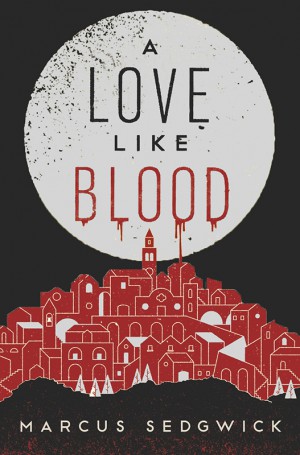
“A Love Like Blood” by Marcus Sedgwick (Mulholland)

Sedgwick-ALoveLikeBloodA gripping, chilling psychological thriller

“I’ve chased him for over twenty years, and across countless miles, and though often I was running, there have been many times when I could do nothing but sit and wait. Now I am only desperate for it to be finished.”

In 1944, just days after the liberation of Paris, Charles Jackson sees something horrific: a man, apparently drinking the blood of a murdered woman. Terrified, he does nothing, telling himself afterwards that worse things happen in wars.Seven years later he returns to the city – and sees the same man dining in the company of a fascinating young woman. When they leave the restaurant, Charles decides to follow…

A Love Like Blood is a dark, compelling thriller about how a man’s life can change in a moment; about where the desire for truth – and for revenge – can lead; about love and fear and hatred. And it is also about the question of blood.

This wasn’t what I was expecting. I had expected a good novel, with perhaps a supernatural component. Instead, what I found was an excellent psychological thriller about obsession and the science and mythology of blood. Sedgwick’s first novel for adults is damned good, and a must-read of the year. Continue reading

“Black Moon” by Kenneth Calhoun (Hogarth)

CalhounK-BlackMoonUKAn interesting premise, well-executed, but still slightly flawed

“A black moon had risen, a sphere of sleeplessness that pulled at the tides of blood-and invisible explanation for the madness welling inside.”

The world has stopped sleeping. Restless nights have grown into days of panic, delirium and, eventually, desperation. But few and far between, sleepers can still be found – a gift they quickly learn to hide. For those still with the ability to dream are about to enter a waking nightmare.

Matt Biggs is one of the few sleepers. His wife Carolyn however, no stranger to insomnia, is on the very brink of exhaustion. After six restless days and nights, Biggs wakes to find her gone. He stumbles out of the house in search of her to find a world awash with pandemonium, a rapidly collapsing reality. Sleep, it seems, is now the rarest and most precious commodity. Money can’t buy it, no drug can touch it, and there are those who would kill to have it.

I hadn’t heard of this novel before it arrived through the post. As someone who has a soft-spot for post-apocalyptic novels (and the various sub-genres that covers), and also someone who has always suffered from varying degrees of insomnia, Black Moon’s premise jumped out at me. Given its slim length, too, I decided to read it right away. What I found was a novel that is, strangely, both excellent and also wanting.

To be sure, one of the things that drew me into the narrative was the insomnia aspect. In this story, rather than ravenous zombies prowling the streets and eating the living, we have a population suffering from true insomnia – no sleep whatsoever, rather than the more common syndrome that restricts sleep and prevents restfulness. As a result, the majority of the global human population is going through the debilitating symptoms of hallucinations, dissociative disorder, emotional turmoil, and eventual death. On top of this, and here’s where the peril for non-sufferers comes in, those suffering also experience homicidal rage when they are either confronted with someone they believe to be a “sleeper” or if they actually witness someone sleeping. The descriptions of what those in the early stages of suffering experience was very close to home, and I immediately sympathised with them all. [Interestingly, and rather meta, I ended up reading Black Moon well into the wee hours of the day, unable to sleep myself…] Here’s one example (I share Carolyn’s frustrations):

“Unlike Carolyn, he had never had trouble sleeping. Early in their relationship, his ability to drop off anytime, anywhere, had been a point of occasional contention. It offended her not only in that she felt that he was using sleep as a means of avoidance, but also because she held sleep so precariously. The slightest noise or change in the light could wake her. Her mind, roaring in the chassis of her skull, pounced on painful memories and worries about the future of the challenges of her studio work, batting them around for hours as she tossed and turned. Meanwhile, he snored at her side. They had decided that sleep was his super-power…”

CalhounK-BlackMoonUSDespite a great premise, however, the novel felt rather underdeveloped and, perhaps, far too short. Calhoun can certainly write, and his prose and pacing drew me on through the novel at quite a clip. However, we are never really given the chance to get to properly know the characters, which left me rather uninvested in some of their fates. Certain characters were far stronger than others (Biggs, Felicia, for example) and I think their storylines offered greater storytelling potential than a couple of the others (Chase, for example, who was a little irritating by the end). I think this would have benefited from being longer, which would have allowed us to feel the tensions of the world a bit more, get to know the characters better, and become invested in their struggles. The work-around developed by the sleep institute was arrived at rather suddenly and out of the blue, too, which robbed yet more of the tension.

True, the novel is structured and composed in a way that reinforces the hallucinatory symptoms of prolonged true-insomnia, which made it rather disjointed at certain points (on purpose) while at the same time evoking an appropriate atmosphere. This was a solid attempt to do something different, which is always welcome, but the vagaries of what I was reading often just obfuscated certain elements of the story, which meant my investment waned as things became worse.

Ultimately, there were certainly things I liked in Black Moon – the insomnia-induced zombification and mania, for example, and also the work-around that they develop (which, while suddenly introduced to the story, was also pretty cool), and the aforementioned stronger characters. Sadly, however, I didn’t love the book. It will be interesting to see what the author comes up with next, though, and I await his next novel with anticipation.