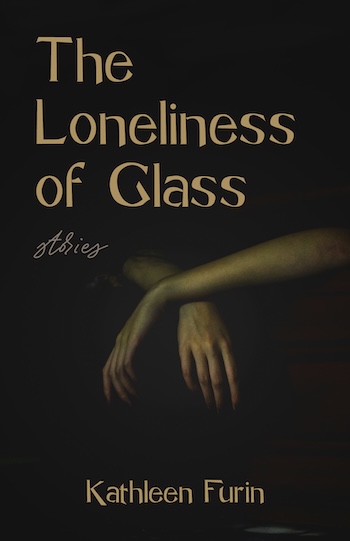
 Today, we have an excerpt from The Loneliness of Glass, a short story collection by prolific short fiction writer and editor Kathleen Furin. Publish today by Cornerstone Press, the collection explores “themes of racial and socioeconomic divides, intergenerational trauma, and women’s bodily autonomy, and how they connect”. Here’s the official synopsis:
A young woman who has lost her half-sister in a tragic murder makes a decision that will doom a dog; a woman becomes obsessed with a cookie jar at an Airbnb; a woman in an interracial marriage returns to her hometown for the first time since she married and must confront what she was taught about race; a woman with unusual powers embeds pieces of dead creatures in the jewelry she creates.
Featuring women on the borders, Kathleen Furin’s stories show how a deepening understanding of inner truths can challenge one’s social belonging, and how this tension between inner and outer selves serves or destroys.
Grappling with complicity, the characters in The Loneliness of Glass struggle as they learn how an intent to “save” others is often fraught with hypocrisy and can lead to self-destruction.
*
“The Loneliness of Glass”
Claudine wasn’t a witch; in fact she was practically the opposite of a witch. The lie about witches was that they were evil when really, deep down, they were just at peace with their own wombs, their own selves, at peace with the blood that flowed from deep inside them, with their milky breasts, the layers of fat that kept the hormones that produced the magic that gave life to everything and everybody. She didn’t have that kind of peace and wasn’t sure she ever would. She wasn’t yet a ghost, although she would have enjoyed that immensely, would have loved terrifying the pampered tourists who hid their pain inside their bellies as they polished their cheekbones and glossed their pale lips. Sometimes she thought it was her burning desire to become a ghost that gave her the power to avoid death, even when she pursued it like the fierce lovers who’d once pursued her. She’d learned that from early on—the more you wanted something the less likely you were to ever get it.
So. She wasn’t a witch, but she had certain powers:
Men wanted her—always, no matter what. Even men who didn’t want to want her would want her if she wanted it. This was useful.
Dead things called her—through scent, usually, although maybe just as often through a humming, a tingling under her skin, and maybe just as often through a humming she could hear. She wouldn’t be able to explain this if she had to. Since her death calls were a topic that she had never discussed with anybody, she’d never had to reason it out. It was clear enough to her that there was no sense to it.
Some dead things didn’t call her, of course. She would have gone insane years ago amid the constant cacophony. Sometimes she tried to categorize the things—never a human, not even when it had been her Tom, never anything bigger than a deer, rarely something of the sea.
She was a water-feeler. The minute she immersed herself in a body of water she could sense every living thing around her. Although this had been terrifying when she was a child, it, too, was useful, especially when the dead thing calling to her was submerged itself.
From a young age she’d had these gifts. Her own mother had panicked, the first time they’d gone down to the water and her mother had held her aloft over the brimming waves, dipping in her tiny toes. Claudine had kicked so furiously and made such a commotion that the clammers in their tall yellow boots had rushed over, certain Claudine’s mother must be abusing her somehow. That poor woman. She never could handle Claudine, had no idea what kind of an energetic something she’d brought into the world. Her mom had kept her away from the water after that, but they’d moved out to the island when Claudine was seven years old, and there’d been no avoiding it since.
Claudine would never forget her first experience of wading into the water as a young girl. At first she’d felt a sensation like a fountain of frigid water being tossed at her back, constant, furious; then she’d felt movement and pulse all around her. She’d scurried out, terrified of the crabs she could feel burrowed nearby, the way they scuttled and waved, as if they were saying hello hello, ostensibly welcoming her in but really just making fun of her behind her back, like the girls at her new school. But she’d taught herself to get used to it, especially after she realized that when she was busy sensing what was in the water, the din of the calling dying stopped. She trained herself to use her gift, forcing herself to stay submerged and learning to recognize what was around her, until she began to love being immersed in the water. Sometimes she laughed at oblivious tourists, splashing just feet away from disdainful sharks. If only they knew what she knew, could feel what she felt! That could clear out the tourists for the summer, clear out the pushpull of their judgmental eyes as they lifted her jewelry dismissively then dropped it back down. Few people would ever swim in the ocean if they knew how close to predators they so often were.
She knew, of course, that the sharks didn’t want to eat humans. Human skin was covered with chemicals that smelled like desert or pineapple, causing one cancer as it tried to fight another. This repelled sharks, turning their ancient, iron guts. Human flesh, laced with its inability to live without the distraction of drink or lust or greed, repulsed them. They needed to eat something that wasn’t a lie, and human beings had been lying to themselves and each other well before pale-booted feet stomped onto these shores.
So she loved the water, loved it in the same way she’d loved Tom, once, loved him at first sight, loved him away from his childhood sweetheart, loved him into disaster, loved him in the chapel his mother insisted on, loved him even more after the birth of the daughter who’d leave for meth, the daughter who smelled like her own milk and who forced Claudine to fall in love with her body, if only for the miracle of its efficiency. Her breasts would tingle, mother’s magic, and she’d awaken to see Molly’s tiny mouth already in motion, even before she opened her eyes. Tom would smile over at her with delight, and she’d feel as content as she could outside of the water.
*
Excerpted from The Loneliness of Glass © 2026 by Kathleen Furin.
Reprinted with permission from Cornerstone Press. All rights reserved
*
Kathleen Furin’s The Loneliness of Glass is out today, published by Cornerstone Press.

