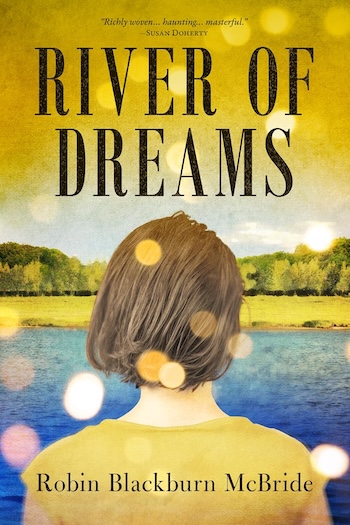
 Today, we have an excerpt from River of Dreams, the latest novel by Robin Blackburn McBride. The novel, which blends elements of metaphysical fiction, feminism, historical settings, and elements of the supernatural, is out now, published by Guernica Editions. The excerpt (chapter 3), follows after the synopsis.
A near-tragic accident. A life-changing phenomenon. A calling she couldn’t foresee.
Toronto, 1914. Avery Conlon’s world turns upside down in an instant. Overhearing a comment that casts doubt on her blood ties with the mother raising her, the despairing twelve-year-old runs away―but ends up falling through a river of ice. Dragged out and on the edge of death, she awakens with secret, heightened powers of perception… and a vision of a strange woman.
Learning to navigate her new abilities to sense what others cannot, and dreaming repeatedly of a mysterious silvery boy, Avery vows to track down the truth of her past. As a young adult in the 1920s, she becomes a nurse at a hospital for the insane where her gift for healing leads to possible answers about her mother, Avery’s second sight, and whether her uncertain future can include real love.
Will Avery step into her greatest destiny?
In this enthralling narrative of one woman’s journey, author Robin Blackburn McBride explores the power of intuition and giving voice to the silenced. And as the character grows from a vulnerable young girl to a strong person seeking to take charge of her fate, readers will delight in this suspenseful tale of self-discovery and romance.
*
Chapter 3
Arrow
At the bottom of the toboggan hill, the sky behind me to the south was gleaming. Panting and sweating, I’d just about forgotten why I was running to hide and think. I was almost to a place where no one could see me.
When Dad had brought me to the Sunday school party, carrying my sled, why hadn’t he asked me what was wrong? Usually, when we traipsed anywhere together, I’d begin us a round of “I Spy,” and my little eye would fix on something sparkly—the steel hub of a wagon’s half-sunk-in-the-snow back wheel, the glint of sun on a gas lamp’s frosty pane, the iced iron tip of a fence post poking through a drift. Then, after offering a clue, I’d wait for his questions, all swirly with clouds of steam, until Dad solved it. Which he always did. But today, I hadn’t been looking ahead, only down at my heavy boots. They were shuffling through sludge the whole way to the park, as my father smoked his pipe and muttered a thing or two about the cold. And that after delivering me, he’d head across town to work. Dad’s Saturday routine. Yet nothing had been routine about our walk. When I hadn’t said anything, shouldn’t he at least have tried to start the game? And if I hadn’t answered—which, owing to the lump in my throat, I wouldn’t have—shouldn’t Dad have stopped and looked at me? At the hill, after handing me my sled, he’d patted my shoulder, straightened my coat collar, and said, “Be home by three, or your mother’ll fret.” Then he’d patted my white hat. “Enjoy yourself, girl.”
But why hadn’t Dad’s eyes met mine? Was he afraid?
Nuts. I’d been right, hadn’t I? Mother must have talked with him about me upstairs while I’d sat waiting for my father in my thick woolen coat and itchy scarf on the club chair, beside the bowl of apples. Stuffing a shiny red McIntosh into my pocket, I’d shut my eyes. But had I heard their conversation? No. Not in words. Yet their whispery creaks and silences, like a film reel spinning static before the movie-house piano sounded—well, those things had told me something. And Dad not looking at me straight just gave me another reason to worry.
Back at the top of the toboggan hill, I’d been wishing for a dark theatre, not the laughter and shrieks of fifty children. I wanted to hide inside a story on a screen—one that nobody was pretending was the truth. Holy smokes. Had Mother and Dad really been lying to me my whole life? No, they couldn’t have been. Could they? Who was I? Whose was I? What if this was all a mistake, and I’d been making things up in my head? I’d nodded at the Sunday school teacher and at the two girls who were calling my name, but I’d needed to be alone to think, so—down the slope I went. At the bottom, brushing myself off, I’d picked up my sled and run.
Now, in the valley, wind shushed through the late-winter reeds, all rustly above the snow. The sky was grey. A quarrel of sparrows, fluttering on the frigid air, vanished. Taking a breath, listening to the odd chirrup and whistly breeze, I felt my shoulders relax a little. As I hurried north, the two classmates who’d been waving to me were out of range of hearing, and I couldn’t see the toboggan hill anymore. Glancing over my shoulder, what I saw instead were the flats and factories, and the jail, and the isolation hospital all looming above the Don River, its current hidden in a dull, white tomb. Nobody skated on the March ice.
After crossing the bridge to the eastern bank, I paused to check behind me again as a button slipped from my blue coat and sank into the snow. Aw shucks. The top one. Yet, tightening my scarf, I knew this wasn’t the time to stop and look for it. Trudging past a copse of crab tree skeletons, I remembered the apple in my pocket and pulled it out. One crunch set a gull’s ghostly wings into the air. It was only as I was hurrying along the rise beside the train tracks that I heard voices. Hell’s bells. Turning, I saw the two girls and the teacher waving and skittering against the grey, like distant birds. More congregants were flocking. Then, squinting, I made out the form of a man running behind the group to catch up. Dad? Cripes! Why hadn’t he gone to work? Well, I’d botched things, hadn’t I? One of them must have seen me leave. Stopping to face the faraway crowd, I dug my boots into the white crust and hollered: “I’m all right!” But that didn’t stop their murmuration from swelling over the flat. “I just want to be alone a while!” Oh, brother.
I was hot—not just my body under the layers of wool, but my flushed face and temper, too. Why couldn’t they just leave me alone to think? My cheeks were prickling. Were they the colour of my apple? Pocketing the fruit, I kept going—this time at a sprint. After all, I was minutes ahead, and I could still outrun them, couldn’t I? But to where? The graveyard. That was one place I’d have a chance to disappear. Looking west across the river, I spied the tangle of trees and tombstones on the far hill, protruding like crooked teeth. Then, in front of me on the ground, I spied a frost-covered fallen branch. “Something that is silver.” My whisper swirled and faded. Picking up the icy stick, I left my sled. When the freight train came chuffing along the tracks, I raised my branch in the air and shook it, scampering down to the bank where a fox darted out across the snow, and I stopped.
Wow. She was graceful and plush. Foxes were good at hiding, weren’t they? Should I follow her? No.
Well—yes.
The animal bounded across the frozen river toward Necropolis hill, a red arrow on the ice. So, I bounded, too. And when she paused on the far shore and whipped around, yipping and woofing, I halted mid-river. What was she saying to me? And why did her voice put the taste of copper pennies in my mouth? Oh, God. I knew. But before I could turn and run back, a sound lower than the train’s rattle splintered and grumbled. Then I could feel it—the ice cracking. And I dropped into the dark water.
*
Robin Blackburn McBride’s River of Dreams is out now, published by Guernica Editions in North America and in the UK.

