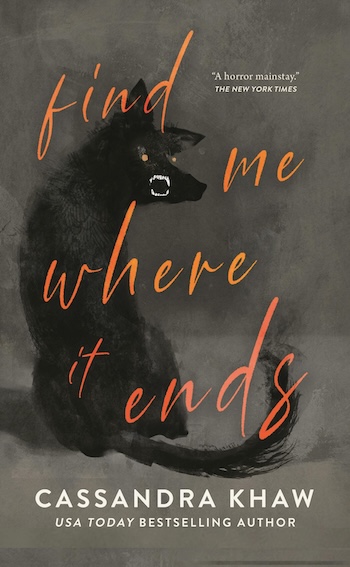
 Next week, Tor Nightfire will publish the latest horror novella from the always-excellent Cassandra Khaw: Find Me Where it Ends! Every new book by Khaw is something to celebrate, so we’re very happy to be able to share an advance excerpt with our readers. Before we get to the excerpt, here’s the synopsis:
A woman wakes up to find the black hound of Death at her front door in this hauntingly beautiful tale…
Antigone is no stranger to death.
For the women of her family, death always comes in the form of a black dog.
When Antigone’s own black dog arrives, she isn’t afraid. She invites it inside, where it soon becomes a daily source of companionship and comfort. It also forces her to reflect on the life she’s led — the parts of herself she’s hollowed out for the sake of others, and the bone-deep exhaustion that’s hounded her every step.
Her Death’s arrival must be a sign, permission to finally let go. To rest. Because while mortality is inevitable, living is a choice.
But a good death comes at a price.
And now, on with the excerpt…!
*
Three months before… The black dog arrived at Antigone’s stoop about an hour after daybreak and lay there as dawn bled syrupy golden light over its dark pelt, the air sweltering already, warm and damp as the animal’s mouth. If there’d been anyone present to see the dog, they would have said it looked like an exemplary example of a German shepherd; not show quality, but gorgeously vital nonetheless, a handsome beast who’d flourished under the attentive care of a well-resourced owner. More importantly, perhaps, as they watched it drape itself over the cobbled steps, they would have said it looked happy. And it was. Though a psychopomp first, it was still a dog second and, even if it wasn’t alive in the traditional sense, even if it was more metaphor than flesh, an idea given breath and bone and boundless affection for one solitary thing in the lonely cosmos, it was nonetheless alive enough to relish being warm.
The small things mattered.
They always did.
Antigone opened the door to retrieve her morning paper just as the dog rolled onto its back, tongue lolling out of its mouth, the red muscle obscene against the shining black of its coat. At the sight of the creature, the woman let out a breath like she’d been struck.
“Shit.”
The dog’s ears pricked in her direction.
She stared at it for another minute, taking occasional sips from the tooth-yellow mug of tea she held in an increasingly rattly hand. The words World’s Best Aunt flaked from the dented ceramic of the cup. There’d been a time when Antigone’s bloodline had been unburdened with blessings, or at least that was what the genealogical records she had inherited suggested. Most of her predecessors had suffered nothing more than an affinity for herbalism, a gift they used to tremendous effect, all of them doulas and veterinarians and doctors to a woman. But then around the time of Antigone’s great-grandmother, something changed. Suddenly, they lost their uncanny acumen for sifting through the wilderness for what was needful—no more talent for finding echinacea under a wreath of snow or knowing the precise temperature a poultice needed to be brewed. They began seeing their deaths instead.
Not in portents, nor in the patterns of the stars. Not in the way the tea leaves clumped in the bottom of their cups. But as dogs of varying shapes, coal-eyed hounds who would come as their ends slunk closer. It was a petty and purposeless miracle, useless even as an indicator of when one was meant to tidy their affairs: the canines sometimes came days before their deaths, sometimes months, even years, little more than ambulatory memento mori, so honestly, what was the point?
It was something Antigone often wondered. Everyone knew they were going to die. She supposed these psychopomps—always dogs, always black as the inside of a casket or the belly of an urn—must do something other than announce that the clock of their lives would stop. Maybe they salved the process somehow: provided comfort, protection through the transition between worlds. Certainly, her grandmother’s death made that theory seem plausible.
The old woman had already known she was going to die about six months before the dog began announcing its presence with nightly baying, a cacophony she met with pinch-mouthed frustration, the cancer having licked what sentimentality she had left from inside her bones. Like I don’t know it’s there, she’d rasp, scowling out the window at her Death, a small black terrier Antigone had secretly quite liked. Despite its noisiness, it never did more than sit primly beside a streetlight in view of Antigone’s grandmother’s hospital room, waiting with the practiced dignity of an upscale chauffeur, little tail wagging erratically, like a heart running out of hours. And Antigone had thought perhaps, if dying was as gentle as the animal looked and as soft as the black fleece of its fur, there was no reason to be afraid of it.
(She was in the room when her grandmother passed at last, a week after the dog came to wait below her window, and it was as tender a death as Antigone could have hoped for the old woman, as anyone could have aspired to: one long stuttering breath and that was all.)
Despite this, Antigone’s mother took no chances when her own Death came one bright freezing morning ten years later: a massive, rust-eyed cane corso who had somehow let itself into her apartment while she was asleep. At the sight of it, she had allegedly (Antigone had nothing but the woman’s letters to go by) finished her coffee, sought out the revolver she kept in her desk, and written several extensive letters of instruction to Antigone and a single long letter of apology to Antigone’s sister. Her missives to the former detailed the logistics of accessing her estate: one explained, in frank but nearly bored terms, that she regretted leaving Lisa but wasn’t about to take her chances when her Death looked so monstrous and she was certain Antigone could be a reasonable caretaker. She invited her eldest to prove her wrong, but expressed hope she would not.
Then, presumably, she shot herself.
According to the coroners, she had shot herself in the heart, making the kind of mess she’d never had tolerated in life. Antigone had been thirty-two when she did it, old enough to be relatively unflustered by the funerary arrangements that followed but young enough still to feel grossly betrayed by the turn of events. Later, she would wonder if the dogs were prescriptive of the grief that resulted from said death but the thought depressed her too much to keep it, so Antigone buried it with her mother’s remains.
And now here she was: forty, with her own Death stretched outside her door, a mug of tea cooling in her right hand.
“Well,” said Antigone after a few more minutes, uncertain as to what to say when one’s end arrived too early. “I suppose you might as well come inside.”
 To her surprise, Antigone found some comfort in how quickly her Death made itself at home on her couch, a happy sprawl of limbs like a shelter puppy at peace at last. Its pelt had a refractive quality, she realized, a grackle-like iridescence that made it slightly less real. It was quiet too and odorless, neither of which were qualities she anticipated. Antigone had expected the thing to gnaw open the cushions, to chew apart the tassels of her throw pillows, to autopsy the massive knitted merino blanket her last boyfriend had abandoned along with their relationship. Instead, it just stared at her with doting patience, one paw crossed over another.
“It shouldn’t be here yet,” said Antigone into the phone as the great orange cat that haunted her garden flattened itself up against the window to stare balefully at the dog. “It isn’t time. You know it isn’t.”
Antigone could almost hear her sister Lisa shrug in answer. It’d been several years since the two had seen each other in person. Lisa loved the desert more than she did anything else in the world, an obsession Antigone found as comprehensible as their mother’s suicide. But alien as the whole thing was, she understood that just because she found something unpalatable, it didn’t mean everyone else shared a similar aversion. One woman’s yuck was another’s yum.
Or something like that.
“Maybe we were wrong. We were barely adults when we did our research,” said Lisa breathily, exhaling. She’d picked up a nicotine habit after learning it wouldn’t be a respiratory situation that ultimately took her out, explaining to Antigone that even if it was a repellent vice, it seemed almost offensive to not indulge when she had a kind of immunity to its consequences. (“I’m living the life all those smokers wished they could.”)
Antigone laughed. She couldn’t help herself. Her Death thumped its tail against a pillow, and there was weight to the sound she hadn’t expected.
“Maybe you’re right about us being wrong. But if you are, you should probably stop smoking.”
“My Death hasn’t come for me,” said her sister languorously. “If it does, I’ll do it then.”
“When it does.”
“I’ll take my chances, Annie. No need to harp.”
Antigone and Lisa had spent a year reviewing the possible routes to their waiting deaths, and while Antigone had stopped before she could identify what specifically killed her, she knew it’d be a long, long time for her (longer, she’d secretly thought, than she might want it to be, long enough for her to plead for it to be over) before the end.
And yet here the dog was.
Not for the first time she wished she’d interrogated that distant future more, had investigated if there were permutations to anticipate, if she could circumvent longevity with good choices or if all paths dragged her to the same black door. But it’d hurt to see their aunt rummage through belly after belly, freeing loops of pale intestine gone blue from the morgue’s cold and great shining slabs of liver even though their owners were dead. It felt wrong. To see those corpses scooped out so she and her sister could divine what’d come. After a year, Antigone couldn’t stomach it any longer. Unlike Lisa, she’d always been tender with her dead.
“Do you think maybe it just decided to show up early?” said Antigone. “Just for shits and giggles?”
“Could be. Maybe it just wanted to remind you it’s there.”
Unable to answer, Antigone redirected their conversation to banalities: Antigone’s garden (“The garden’s gardening, as the youth might say.” “As the youth might say, Annie? God, we’re getting old.”), her nephew Johan’s fourth birthday and how he had demanded skulls from the guests (“It was the day in the dunes when the buzzards showed him their museum. He became obsessed after that.”), the speed with which autumn was approaching, how climate change colored the foliage early (“We’re probably the last generation to have a relatively normal life, I’m afraid.”), musings about retirement because neither of them were young any longer (“The dog’s proof it’s time to think about that,” said her sister, with her usual brisk heartlessness. “Life’s for living, isn’t it? Better start cracking.”), Antigone’s plan for adopting kittens (“Just take in the cat in your backyard. Who cares if it belongs to someone else? It clearly wants you to adopt it. Didn’t you say it was leaving you gifts? Interesting little bones and feathers instead of dead birds?”), her sister’s aspirations of owning a parrot.
“It’d probably outlive us all,” said Antigone. “And then it’d just be alone, an immortal flying toddler with claws and a bad temper.”
Her sister’s laughter broke over the call like a river through an old dam.
“Unless Johan gets married one day. God, I hope it does. It’d be so fucking funny if he and his spouse had to deal with that because my last wishes included, be nice to the bird.”
“That’s your son you’re talking about.”
“It took twenty hours to deliver him. I call this payback.”
They said their I-love-yous shortly after, promising to call again soon, knowing they’d forget but it was the thought as always that counted, the knowledge that, in an emergency, the other would be there, even if they—Lisa more than her sister but she was the artist of their family–were inconsistent with their check-ins, their how-are-yous and holiday cards, and Antigone hung up. The silence stretched its jaw. It was evening now, somehow, the hours having run from her like the hare from the hounds. The sun puddled on her living room floor; it looked like melted butter on the bright carpet, or maybe warm fat. Her Death was still there, watchful, swallowed by the growing shadows.
“What do you want?”
It kept staring.
“Are you here to take me away? If not, why did you come?”
In answer, it let out a thin impatient whine, pouring from the couch onto the carpet. As it moved, Antigone saw proof again of what it was: its pelt seemed to eat the evening light. It was a negative space, a hole cut into the universe in the shape of the dog. Or would be if not for those amber eyes, like coins for the ferryman, the luster rubbed out of them by desperate hands.
“Go away if you’re not going to be useful,” tried Antigone.
Her Death whined again and did not.
Over the next few weeks, Antigone would discover, much to her relief, that while her Death could eat bacon from her hand, it didn’t have an actual digestive system, per se. There was no cause to walk it around her neighborhood, although more days than not she did so anyway, discovering in the process a queer pleasure in its company, a kind of pride in her own brazenness: here she was, not only aware of her mortality, but bold enough to keep its company. Look, she sometimes thought of saying to her neighbors whenever they bent down to stroke her Death’s velvet ears. Look at how my Death trots leashless beside me, inured to distraction. Look at how brave I am to walk it like I’m its master.
Very soon, summer began yielding to fall, a leaf at a time, and Antigone found herself startled at how quickly the trees became sheened with red and gold, the days like thread unspooling through her fingers; she couldn’t seem to hold on to any of it. The cold never seemed to want to wait. Somehow, this was her eighth year in the town. For most of her life, she’d disdained suburban living, once even branding it as anemic when her mother suggested Antigone move into the house opposite her own. (It’d seemed unthinkable then when she was young. There was a city to love, a girl she might even marry one day when their careers reached sufficient velocity and they were older, wiser, kinder to the idea of making real space for another person. San Francisco hadn’t yet become insurmountably expensive, and Antigone remembered thinking maybe, maybe this was the life she was meant for.) But then their mother died and her sister had been too pregnant to do the work of sorting through the former’s personal effects. So, Antigone, ironically, moved into her mother’s home instead of its mirror, which still sat vacant eight years later, save for the ghosts that stared at Antigone from its windows. She’d never intended to stay, had wanted to linger only for as long as it was necessary to unravel the knot the dead made of their lives once they were gone, but the months and the weeks and the days twisted together like the fibers of a rope until they’d pulled taut around her, and suddenly she was bound.
Eight years. Whenever Antigone thought too hard about it, she could feel a scream ballooning in her chest, so she didn’t. It wasn’t all bad, though. The house, once shucked of her mother’s possessions, was spacious enough to accommodate all of Antigone’s passions, including the tidy storing of them, and the garden, well, it loved her better than even a wife might. As for the town, it had coffee shops and a grandiloquent reliquary of the cinema, rocailled and stuccoed to within an inch of its life, its insides frescoed with faded re-creations of Michelangelo’s best works. There was a bookstore as well, run by a green-eyed girl who was fastidious about making sure the shop was stocked with the best and the latest queer literature (Antigone would have loved the place even if it had none of those things; it was here she met Vera, her first and dearest friend in the town); a pottery school; a dance academy (mostly for children, but Sundays they hosted age-agnostic ballroom socials for whoever was interested); a Whole Foods; an ice-cream parlor; an antique store; even an art gallery that would occasionally showcase internationally feted if incredibly niche work. No, it wasn’t a bad life here, but it fit like a hand-me-down from someone who’d never met Antigone, far too tight around her throat.
Antigone thought about this and more as she led her Death to and fro, back and forth across her life, while passersby cooed over how well- mannered it was, how restrained, how intelligent. Once in a while, an acquaintance would ask, gently, like the question was something fragile, “Aren’t you a cat person, though?” And Antigone would smile laconically in reply, shrugging.
“Things change,” she would say, wondering each time why the words felt like goodbye.
*
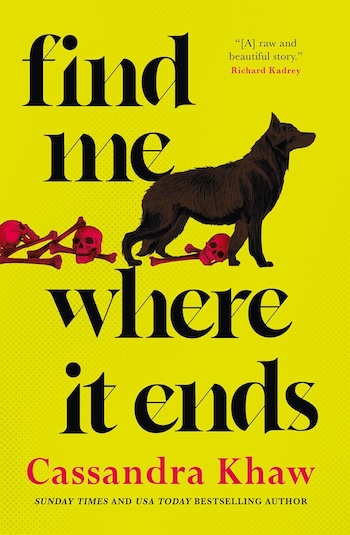
Cassandra Khaw’s Find Me Where it Ends is due to be published by Tor Nightfire in North America and Titan Books in the UK, on October 6th.
Also on CR: Interview with Cassandra Khaw (2016); Guest Post on “Everything in Exhausting…”; Review of “Fine Print” in Walk Among Us

