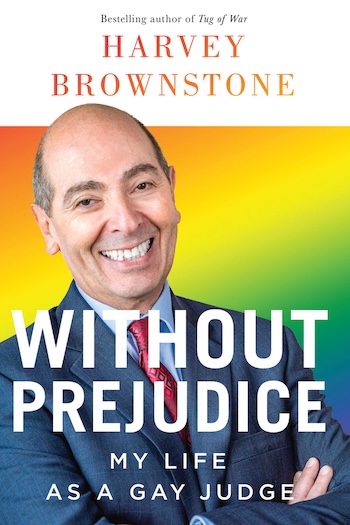
 Today, we have an excerpt from Without Prejudice, the memoir of Harvey Brownstone, Canada’s first openly gay judge. The book tracks his life from his tumultuous childhood, through to his distinguished judicial career. The memoir is also in the process of being adapted into a movie of the same name, and starring David Arquette.
The excerpt covers some of the author’s thoughts on life on the bench, what it means to be a judge, and some of his early observations and training.
The book is out now, published by ECW Press. Here’s the synopsis:
This searing and unforgettable memoir chronicles the turbulent trajectory of Canada’s first openly gay judge. Harvey Brownstone recounts the astonishing obstacles he confronted and surmounted with fearless resolve, including parental rejection, poverty, depression, homophobia, institutional inertia, and professional sabotage.
Harvey Brownstone’s story is a tumultuous, sometimes hilarious, and uplifting journey from bullied child to outcast after coming out to his parents, to trailblazing lawyer, to distinguished judge.
Brownstone colorfully details his momentous and inventive judicial career marked by his numerous innovations of the justice system, particularly revolutionizing Ontario’s child support enforcement program.
In retirement, he is no longer shackled by the restraints traditionally imposed on the judiciary, and thus Brownstone provides a frank, unfiltered, and refreshing glimpse into the inner workings of the justice system, boldly delineating the strengths and weaknesses of criminal and family courts, both of which he claims are sorely in need of comprehensive reform. His remarkable story, reinventing himself from high-profile judge to highly acclaimed talk show host, is a testament to the resilience and triumph of the human spirit.
*
CHAPTER 11: LIFE ON THE BENCH
No matter how many times a lawyer has appeared in court, nothing can fully prepare him or her for being a judge. There’s no school to attend or course one can take, although judges regularly attend continuing education programs to keep abreast of the law.
The only training a newly appointed judge gets prior to presiding in court is to “shadow” other judges for several weeks before being sworn in. That means sitting silently on the dais next to the judge, observing everything he or she says and does. The regional senior judge chose the judges I was to shadow. “I’ve selected a variety of judges who demonstrate a broad spectrum of judicial styles,” he said. “Harvey, this is your chance to learn what to do and what not to do. It’s the last time you’ll ever get to see your colleagues in action, because once you’re sworn in, you’ll be flying solo in your own courtroom. So make the most of it.”
I vividly remember the first time I sat on the dais next to a brand-new colleague. From that elevated vantage point at the front of the courtroom, the view was so different than it had been when I stood at the counsel table as a lawyer facing the judge. Now the lawyers were facing me, and the witness box was right beside me. I was struck by the immense honour and privilege that had been bestowed upon me, and was eager to soak up all the wisdom, expertise, and judging “tips” my colleagues could impart.
My first day of shadowing was in criminal court, observing one of the most notorious judges on the Bench, Justice Bill Ross, a wild-eyed, eccentric man in his late sixties with long, unruly, frizzy grey hair that bounced when he spoke and gesticulated. His extreme impatience, sarcastic and off-colour quips, and mercurial temper were legendary. I’d appeared before him numerous times as a lawyer and always found him amusing, in a menacing kind of way. Now, sitting directly beside him, in such close proximity to a man renowned for his impulsive and erratic behaviour, I was more than a little apprehensive about what I was about to witness and how his behaviour might reflect on me. Would the lawyers appearing before us assume he was training me to become just like himself? Would his actions tarnish my reputation before I even began presiding? Would I suffer from guilt by association?
Our first case involved a bank robber who pleaded guilty. The accused, a man in his mid-twenties, had a lengthy record of previous offences, though much less significant ones, and he had been in and out of jail since he was a teenager. After listening to the submissions of the prosecution and defence lawyers, Justice Ross simply pronounced, “Sir, I sentence you to seventeen years.” That was it. No reasons given. During the morning recess I asked how he’d arrived at that sentence. “Simple,” he answered. “I looked down at the calendar in front of me and saw that it was the seventeenth day of the month. So I gave him seventeen years.” As the day wore on, it became abundantly clear that I’d been sent to Justice Ross’s court to learn what not to do.
Several days later, I sat beside another judge, a kind-hearted, soft-spoken woman beloved by defence counsel and loathed by prosecutors. She conducted two criminal trials and found both accused not guilty, even though I thought the evidence of guilt in both cases was overwhelming. Over lunch, I asked her what it was about the evidence that raised a reasonable doubt as to the guilt of the two accused. She said, “Well, the way I see it, I wasn’t there when the incidents happened, so I can’t really be sure what happened. How am I supposed to know if someone’s telling the truth or lying? So if an accused gets up and says he didn’t commit the offence, that’s enough to raise a reasonable doubt in my mind.”
Hmm, I thought, no wonder the defence lawyers love her! From one extreme to the other, I was building my understanding of what to avoid.
And yet another judge, Ayres Couto, an irascible, crotchety old curmudgeon, well-known for never having a reasonable doubt, advised me, “Harvey, this job is easy. If the accused is guilty, send him to jail. If he’s innocent, give him a fine.” I swear, you can’t make this stuff up.
The next day I sat beside a kindly, soft-spoken family court judge in his late fifties who was notorious for being indecisive. He greeted me first thing in the morning with, “Harvey, if I play my cards right, we’ll be out of here by noon and I’ll take you for a nice long lunch.” The docket was filled with a lengthy list of hotly contested motions brought by hostile ex-partners fighting over custody, visitation, and child support. I wondered what “playing his cards right” meant. How in the world could my colleague complete such a lengthy list of cases before lunchtime?
I soon found out. In the first motion, we listened to the wife’s lawyer’s submissions, and then the husband’s lawyer made his submissions. The judge sat there poker-faced, saying nothing. He then heaved a great sigh and said, “Counsel, it seems to me that if you really try to talk to your clients and work with each other more effectively, you’ll be able to work this out. I want you all to go out in the hall and don’t come back in here until you’ve reached a resolution.” The same thing happened with the next three motions we heard. We then took the morning recess.
I was astonished and confused. Wasn’t it obvious the parties were in court because they couldn’t resolve their disputes? Why was the judge assuming the lawyers hadn’t tried hard enough to negotiate a resolution before coming to court? He hadn’t even asked them what efforts they’d made to reach a consensus. Wasn’t it the judge’s job to make a decision when the parties were at a stalemate? And besides, if he was going to urge them to try to negotiate an agreement, shouldn’t he have given them some feedback on their positions to point them in the right direction?
During the recess, I peppered the judge with all those questions. He responded, “Harvey, here’s the thing. These parents all have young children and will have to deal with each other for the next twenty years. They chose each other to have children with, so like it or not, they’re stuck with each other and they have to make the best of it. They must find ways to work with each other as co-parents so they can raise their kids without constantly coming to court, expecting judges to do the parenting for them. The best thing judges can do for them is to keep pressuring them to communicate, cooperate, and compromise with each other.”
Unsatisfied with his “pie in the sky,” Pollyanna response, I pressed on. “Of course we should encourage parents in conflict to reach agreement, and in a perfect world, that would happen in every case. But we all know this isn’t a perfect world. Some people are unreasonable, obstinate, and stubborn. Weren’t courts created for the precise purpose of having a neutral third party, a judge, resolve disputes when people just can’t do it themselves?”
He replied, “I get it. But parents aren’t like other litigants who sue each other and never have to see each other again. Parents have to be there for their children until they grow up, and often far beyond that. Too many judges let parents off the hook by deciding everything for them in motion after motion. We’re babysitting these parents, and in the long run we’re not doing them any favours. And we’re certainly not doing ourselves any favours either. Look at the family courts. They’re imploding with far too many cases. We’ve become victims of our own success by making it far too easy for parents to abdicate their responsibilities.”
Risking irking him even further, I still wouldn’t give up. “In my experience, people don’t choose to come to court lightly. Litigation is terribly expensive, time-consuming, unpredictable, and stressful. I think you should assume, when these people are standing there before you, that they and their lawyers have made every reasonable effort to settle the matter. They desperately need closure. They need you to make a decision so they can move on with their lives. And if you don’t do it, I think you’re the one who’s abdicating his responsibilities.”
Oops, now I’d gone too far. My vexed colleague shot me a look of righteous indignation, stood up, put his judicial robe back on, and in a decidedly stern tone of voice said, “Harvey, you seem to think judges are best qualified to decide these disputes, but you’ll soon find out that we’re not mind readers and we don’t have magic wands or crystal balls. If I were to decide what should happen to these people’s children, how do you know I’d be right? What if I’m wrong? I’d be blamed for whatever happened to those kids. But if the parents decide for themselves, then I can’t be blamed. Your first responsibility as a judge is to protect yourself. We’ll just have to agree to disagree. It’s time to get back into court.”
Back in the courtroom, one case after another was adjourned on consent to another day. The lawyers had clearly seen the writing on the wall: This judge was not going to make any decisions, so it’d be a waste of time to argue their cases. They’d convinced their clients to postpone their motions and perhaps try to get their cases transferred to another judge. And just like my colleague predicted, the docket was completed by lunchtime. Nothing substantive was achieved in his court that day.
Not surprisingly, my colleague remembered he had an important errand to run, so he couldn’t have lunch with me. He wished me well, saying, “Thanks for the stimulating conversation. Can’t wait to get your thoughts over lunch one day after you’ve been on the job for a few months.” I’m still waiting to have that conversation and that lunch.
Luckily, I also shadowed some wonderful judges, including Justices Mary Jane Hatton, Joe James, David Main, Harvey Salem, and Sam Darragh, who exemplified the very best qualities we all want to see in judicial officers. They taught me so much about how to manage unruly lawyers, litigants, witnesses, and audience members; how to assess evidence; how to formulate and deliver decisions; and much more. And perhaps most importantly, they taught me to take my work seriously, but never to take myself too seriously. As you’ll read in the forthcoming chapters, I put these lessons to good use.
*
Excerpted in part from Without Prejudice: My Life as a Gay Judge by Harvey Brownstone.
Copyright © by Harvey Brownstone, 2026.
*
Harvey Brownstone’s Without Prejudice is published by ECW Press, and out now.

