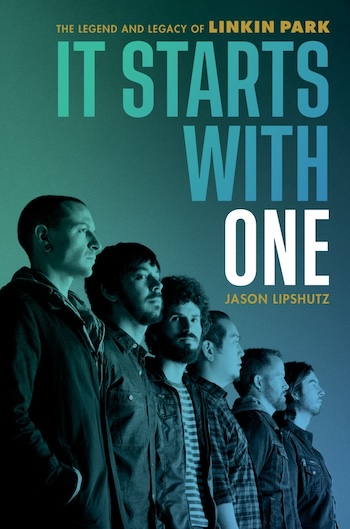
 The definitive, must-read biography of Linkin Park
Linkin Park is one of the 21st Century’s biggest, and most important, rock bands. All it takes is one quick glance at the numbers— 11 Top 40 hits on the Hot 100 and six No. 1 albums on the Billboard 200, over a dozen massive tours, 27 major award wins, 100+ million records sold worldwide, over 30 million monthly Spotify listeners —to realize that when it comes to the metrics of music consumption and fandom, there’s no bigger group in recent memory. And yet, despite their enduring legacy within rock, there’s never been a full, comprehensive biography of Linkin Park—until now.
In IT STARTS WITH ONE: The Legend and Legacy of Linkin Park, Billboard’s executive director of music, Jason Lipshutz, chronicles the innovation and influence of this legendary band, from their early childhoods to the moment their paths crossed to the genesis of their iconic first album, Hybrid Theory, and all that followed. Not only were they able to synthesize trends in pop and hip-hop amidst the post-grunge era and nu metal boom, then constantly reinvent their sound over multiple albums, Linkin Park’s radically vulnerable lyrics also helped usher in a new era of artists (and fans) more open to discussing mental health and prioritizing inclusivity. Led by their front men, Chester Bennington and Mike Shinoda, who balanced each other out artistically, Linkin Park never shied away from songs that put their issues front and center, for the world to see and feel. Tragically, Chester succumbed to his demons and passed away in 2017, but the music endures—and in order to truly appreciate the band’s singular power to bring people together, we need to take a closer look at how exactly Linkin Park changed popular music.
Through in-depth reporting and interviews, as well as new reflections from their collaborators and contemporaries, IT STARTS WITH ONE explores how one band made such a big impact on modern music, effectively cementing Linkin Park’s long overdue place in music history.
Jason Lipshutz’s It Starts With One is the second book I’ve read about Linkin Park. The first was Jeff Blue’s One Step Closer (2020), a memoir by one of the music executives who discovered the band and helped them along their first steps towards international superstardom. Lipshutz’s book is, in my opinion, far superior, and a must-read for all fans of Linkin Park. The book should also appeal to anyone with an interest in turn-of-the-millennium rock/metal. I very much enjoyed this.
Back in early October 2000, I remember seeing an ad in a music magazine for Linkin Park’s upcoming debut album, Hybrid Theory – my attention was grabbed by the image of frontman Chester Bennington’s forearm flame tattoos, which made up the majority of the full-page ad. I hadn’t heard of the band at that point, but I filed away the band’s name and album title, and bought it on release day at HMV in Manhattan. This started a decades-long love for the band and their music (especially their first two and final albums with Chester). Hybrid Theory was on heavy rotation pretty much until Meteora was released in 2003 (bought it in Tower Records in Kumamoto, Japan), and then I not infrequently just alternated between the two records. After MP3 players entered my life, LP songs outnumbered everyone else on my various playlists for at least a decade. (A couple of other bands have since overtaken, but many cuts from Hybrid Theory and Meteora will always remain.)
It Starts With One is a wide-ranging history of one of the biggest bands of the last twenty-plus years, and the author takes readers on an engaging, well-researched trip through Linkin Park’s history. He takes his time introducing readers to each of the band members: their early connections and musical educations, and the key moments and early influences that helped to form their approach to creating music. Lipshutz does a great job portraying the band’s career: the pre-Chester Bennington years, their early attempts to get a record deal, the departure of original vocalist Mark Wakefield, the incredible impact of Chester’s arrival, and the various other hurdles they overcame — not least the ways industry people tried to change the band to “fit” in with the bands that would be their contemporaries. (Thankfully, the band had the courage of their convictions, and were ultimately proven very right.) The author also deals with Chester’s passing with compassion, and without sensationalizing what happened. Unsurprisingly, Bennington gets a lot of space in the book, and the stories from his youth are harrowing. I will always believe that he is one of the greatest vocalists rock/metal has ever had: his range is awe-inspiring.
Given how long they have been a band, and even taking into consideration the seven-year hiatus after Chester’s tragic death in July 2017, it’s interesting that Linkin Park didn’t actually release that many albums: only seven between 2000 and 2017, not including side-projects and other distractions. Lipshutz details the band’s growth as a band, the evolution of their sound (about which he isn’t always complimentary – more on that later), and how the band’s success afforded them greater creative freedom to experiment and do what they wanted. Some of their experimentation was outside of Linkin Park, and Lipshutz also spends time discussing these side-projects. The author draws on multiple sources to paint a pretty extensive portrait of the band’s rise, including interviews with the members, others connected to the band, and a wealth of journalism available.
When it came to Lipshutz’s critical response to LP’s first two albums, there was very little I disagreed with. These chapters of the book, which covered their rise from newbies to dominant force, make up the strongest portion of the book. The author’s love for the band and the impact of these albums emanates from every page, and is part of what makes It Starts With One such a great read. Even when I disagreed with Lipshutz’s opinions about certain albums and songs, the book remains engaging and interesting. I really struggled to put this down, when real life intruded.
During the 2000s, I read everything I could find about Linkin Park, and purchased all of their albums and DVDs – I even bought a region-free DVD player to watch Frat Party at the Pancake Festival (ah, early-aughts rock/metal naming conventions…), because it wasn’t available in the UK. Even as some of their later albums didn’t really work for me, Hybrid Theory and Meteora remain among my favourite albums. All that is to say that I thought of myself a pretty well-versed in most things Linkin Park. I therefore wasn’t sure how much of Lipshutz’s biography of the band was going to be new to me. Turns out: a lot. Lipshutz has written what will probably go down as the definitive biography of this band: it’s exhaustive without being exhausting, even-handed, and clearly a labour of love. It is not hagiographic, which is also a plus. It is also, importantly, very well-written, and it stands amongst the best on my music-related bookshelves. (He also narrates the audiobook very well, in case you prefer to listen.)
Very highly recommended.
*
Jason Lipshutz’s It Starts With One is out now, published by Hachette in North America and in the UK.
Follow the Author: Goodreads, Instagram, BlueSky
***
A Self-Indulgent, Slightly-Deeper-Dive into the Linkin Park Albums and Lipshutz’s Opinions
This next bit is more about my own opinions about Linkin Park’s albums. I disagree with some of Lipshutz’s opinions and takes on the albums, but I wanted to separate this section of the piece because it is not meant as a critique of It Starts With One – if you are a fan of the band, then I really can’t stess how much I recommend you read it. I just wanted to take this opportunity to discuss, in a bit more detail, what he wrote about the LP albums. In other words, I wanted to indulge in my music-journalist past for just a little bit. (I cut this section down quite a lot, too…)
So, as mentioned in the review proper, I pretty much agree with Lipshutz’s reactions to Hybrid Theory and Meteora. The band’s debut arrived on the scene like a wrecking ball. It offered a near-perfect blend of heavy-and-abrasive and pop-sensibilities, appropriate production, and a tightness that made it infinitely replayable. Sure, I would have liked the album to be longer, but there is something laudable in the fact that they kept it short, therefore never outstaying their welcome. The same is true for Meteora.
When the author gets to the Minutes to Midnight (2007) era, however, I found myself disagreeing with some of the author’s opinions. I can’t speak to the band’s motivations, because I haven’t spoken to them. All I have to go on are the albums themselves, and what I remember of their reception and magazine articles of the time. Each of Linkin Park’s albums from MTM onwards have a handful of stand-out tracks, many of which evoke the energy of their first two albums. But the albums never felt as cohesive and essential, nor the songs as good. (Excluding One More Light, which I’ll come back to.)
Lipshutz describes A Thousand Sons (2010) as LP’s “Kid A”. This probably explains why I didn’t particularly like it. (Radiohead are, in my opinion, one of the most overrated, boring bands ever.) Lipshutz observes that ATS was messy, but then overanalyzes and reaches by saying every moment was purposeful and powerful. I don’t know for certain, but it started to feel like Lipshutz’s reactions and opinions to LP records at this point started to change, perhaps because this is around the time he became a professional journalist? This is something that happens whenever someone transitions from fan to critic—and I think this is true for all types of criticism: music, literature, movies and television. Lipshutz still clearly loves the band, but what impresses him seems to change.
I do agree that their oft-nixed plans for the album — it was, variously, a concept album and a video game soundtrack, before settling on “just” being an album — probably explain the messiness. ATS was, apparently, their effort to break out of the industry and creative expectations their success had created. They were suffering creative restlessness, despite their many side-projects over the years that gave them plenty of space to explore and experiment. To me, any attempts to explain the band’s middle albums (Minutes to Midnight, A Thousand Sons, and Living Things) as examples of incredible artistic growth and innovation ring a bit hollow. They are all still very much LP. They just didn’t hit the same. It’s possible this is because they were spending so much time on other projects, but Lipshutz doesn’t really engage with this as an explanation. Not every band will hit every time. On these albums, they (frequently) missed. Experimentation is laudable, and should be encouraged. But this doesn’t mean that in every instance it’s successful. Nor should misfires be treated as the end. That the band didn’t quit experimenting and growing, and instead just release a Hybrid Theory clone, is a good thing.
If you believe/accept that Linkin Park’s third and fourth albums were expressions of artistic brilliance, experimentation, and creative independence, then there’s only one way to interpret the sound of Living Things: an admission of defeat. It certainly seems to have been a recognition that they had to stick to “being Linkin Park”. And yet, I don’t remember this being the narrative at the time — sure, I wasn’t a professional music journalist like Lipshutz, but I was a obsessive/passionate music fan stage, subscribing to five music magazines, and writing my own fanzine (MWRI, RIP). The author describes it as a “back-to-basics” album. Which, in music journo parlance, is “we understand what the fans want and that’s what we made”. I guess one problem is that there’s nothing wrong with this, but there’s a tendency to criticize some bands for doing this.
(Look at Machine Head, who have made a few experimental digressions from what they do best, but have produced some of their best work on recent albums: 1999’s The Burning Red, for example, was quite the diversion, but 2022’s Of Crown and Kingdom is a distillation of everything Machine Head is, and is one of the best metal albums of the past decade.)
Lipshutz spends some time discussing the fact that the band was beaten for awards around MTM and ATS by Arcade Fire. He seems quite irked on the behalf of Linkin Park, which is nice, but I think it’s just because those albums simply aren’t as good as they could have been. Only half of Living Things was good (the half that was more like LP of old); The Hunting Party was forgettable (I had to look it up to remind myself which songs were on it, and I still didn’t really remember any of them), but Lipshutz describes it as “thrash wizardry”. (What?)
I will, however, come to the defense of 2017’s One More Light, Chester Bennington’s final album. While it is also not a “typical” LP record—leaning as it does more pop/rock, and featuring more collaborators and writers than ever before—it felt far more genuine in its emotions and melodies than the band’s “Kid A”-era albums. Perhaps unrealistically, the album has also acquired a greater impact following Chester’s death—it’s difficult to listen to some of those lyrics and not back-fill a message. The injection of others’ ideas seemed to have reinvigorated the band, despite its oft-confused reception from fans and critics. (It took a little while for it to click with me, but I’ve come to love many of the songs, and still listen to it frequently in its entirety.) Lipshutz’s description of OML as a “brightly-colored collection of singalongs” and “hyper-catchy coziness” was just weird. Yes, there’s an undeniable pop-bounce to songs like “Talking to Myself”, but “Heavy” and the title track are anything but cozy and “brightly-colored”. “Good Goodbye” is one of their more interesting experiments, too, and was my introduction to Stormzy. The album is far more varied than the author’s description suggests (though he is absolutely correct: it’s not at all heavy). Based on Lipshutz’s discussions about the previous albums, I was surprised that he didn’t like OML more — the experimental risks are there, the band is exploring different styles and ideas, but they actually land a bit better here. Is it because it is commercial? It used to be that was the death-knell of a band’s coolness, in metal, but I had assumed we’d matured out of that phase. The author draws on some of the coverage of the album at the time of its release, and sometimes it was difficult to separate his opinions from those of the rock/metal community at large. Anyway: it’s a great album, and I think people should give it a fair shake. If you don’t like it, fine.
Ultimately, albums 3-5 were just not as strong as the first two, which makes Lipshutz’s analysis feel like it’s trying too hard. (He also, I think, gives the band a bit too much credit for making songs about mental health more-acceptable to the mainstream—they undeniably did it very well, but I don’t think this was nearly as groundbreaking as the author suggests.)
The first two albums were so raw, obviously genuine, and immediate. The experimentalism of what followed didn’t resonate in the same way. Or, it felt like they were trying too hard to Be Different, or straining for their Joshua Tree or Kid A moment. Perhaps this is why One More Light lands better: it’s not just that it has more of a pop sensibility, but it once again felt genuine and sometimes (lyrically) raw. Chester’s lyrics have always explored difficult topics, his past and experiences, and also more general struggles that people go through. But there was something in Hybrid Theory, Meteora, and One More Light that was missing in Minutes to Midnight, A Thousand Suns, Living Things, and The Hunting Party.
I haven’t given the band’s latest release, From Zero (2024), much of a listen. Chester is one of the best vocalists that rock/metal has had, so new singer Emily Armstrong has very big shoes to fill. Perhaps unfairly, I don’t think she’s quite up to the task. Clearly, many people disagree with me, but for me it doesn’t feel like Linkin Park anymore. But that’s ok! I don’t have to like everything they do. And maybe their next album will land for me. I’m keeping my ears open.
Lipschutz also discusses the anniversary editions of Hybrid Theory and Meteora, and how Mike Shinoda et al worked to put them together and release them. The book remined me that I hadn’t spent any time with the Meteora anniversary edition. Its released passed me by, because aside from the single “She Could”, there wasn’t much about the Hybrid Theory boxset that grabbed my attention. The anniversary Meteora boxset, though, has far more interesting rarities. Disc 6, for example, which includes the surprise hit “Lost”, but also Disc 4 with its instrumental songs. There are a fair number of instances of heavier music underlying Chester’s vocals (e.g., on “Massive”), which offered an interesting contrast with what eventually made it onto the records. While I can see why these songs didn’t make the cut, they are definitely worth a listen.

