 Let’s start with an introduction: Who is Jonathan D. Beer?
There’s an existential question and a half…
Hello, to you and your readers. I’m Jonathan D. Beer. I’m a freelance writer for Black Library, and more generally a writer of science fiction and fantasy stories. I live in Edinburgh, Scotland, with one tiny cat and another that is part-fox, part-sentient rug.
I read War Studies at university, which was less about studying maps with arrows on it than I had been led to believe. I started writing for Black Library in 2020, just after the Covid-19 lockdown, and I still can’t believe I actually get to do this.
You’ve had two recent novels published by Black Library: Tomb World and Dominion Genesis. How would introduce them to potential readers?
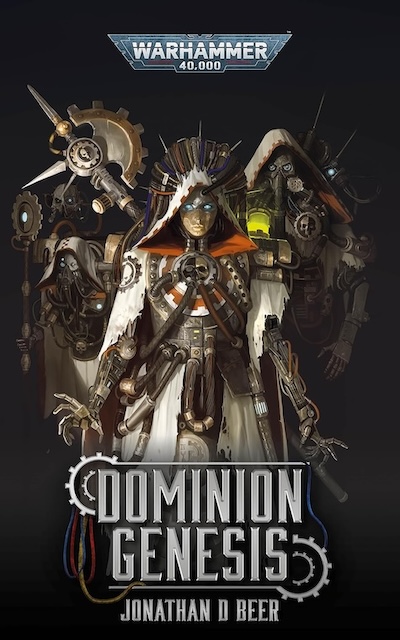
Dominion Genesis is an exploration of how the Adeptus Mechanicus deals with trauma and loss, through the eyes (or, rather, the ocular implants) of Explorator Superior Talin Sherax.
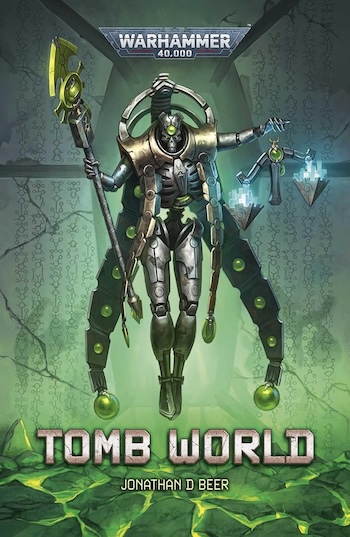
Tomb World is the journey of a Necron praetorian, a guardian of the necrontyr’s codes of law and honour, after she is stripped of that honour by a betrayal.
 What inspired you to write the novels? And where do you draw your inspiration from in general?
In both cases, I was asked by the editors “would you be interested in writing for the Mechanicus/the Necrons? We thought that an explorator/praetorian would be a good fit.” From there, I was left to decide which stories, centred on those archetypes, I wanted to pitch.
More specifically, with Dominion Genesis I honed in pretty quickly on the survivors of Gryphonne IV. The loss of their forge world, the destruction of their pride and identity as the most mighty bastion of the Machine God outside of Mars, is fertile ground to explore how a faction that exalts logic and the machine, but who are still highly emotional beings, deal with tragedy and trauma.
For Tomb World, I again started with what the most interesting aspect of the archetypal praetorian is – their longevity, as the only Necrons not to go into the Great Sleep, and their role as the bearers of so much of what is left of the necrontyr they once were. Seeing what happens when that honourable identity is stripped away – forcibly, as is made clear at the start of the novel – was the emotional throughline around which I could graft the events of the story.
How were you introduced to the WH40k setting, and genre fiction in general?
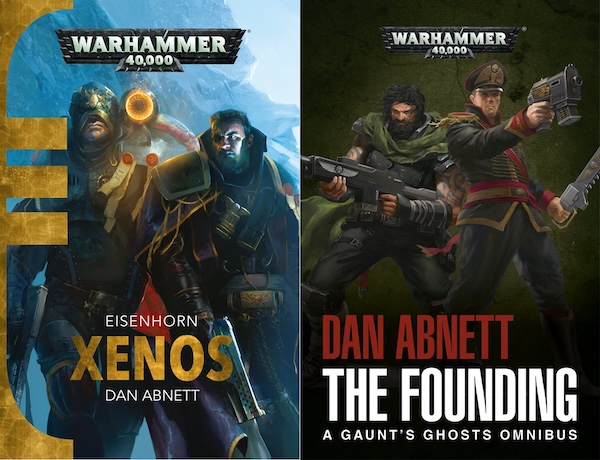
A friend in University wanted me to get the 4th edition boxset, so one Friday gave me the Eisenhorn trilogy and the Gaunt’s Ghosts Founding trilogy. The following Monday, I gave them back to him, having devoured them all and become absolutely hooked on the grimdark world of the far future, then marched down to begin collecting what ended up as a moderately large Space Marine army.
With regard genre fiction in general, I had quite a poor education in my youth. I’m a bit of a completist when it comes to authors I like, so most of my teens were spent reading Bernard Cornwell and Terry Pratchett. It was only later that I branched out into fantasy and sci-fi proper, and I still consider myself to be woefully illiterate of my chosen genre. I’m doing my best to rectify that, one book at a time.
Given the scale and scope of the WH40k setting, what are the challenges and benefits of playing in this sandbox?
The most important is not so much a challenge as a rule for fiction writing in general — you have to keep your characters at the centre of the story. It can be tempting to focus on the scale and grandeur of the 40K setting, and certainly the aesthetic and feel of the world does a lot of heavy lifting and offers an incredible canvas on which to paint, but you have to keep the story centred squarely on your characters, their actions and their consequences.
The other advantage is the sense of community I have found with other Black Library writers. The cliché of the lone writer, tapping away at their keyboard into the wee hours, is absolutely true, but fortunately there is an amazing group of fellow Warhammer writers to throw ideas around with and generally break down that sense of isolation and fear that somehow you are Doing It Wrong.
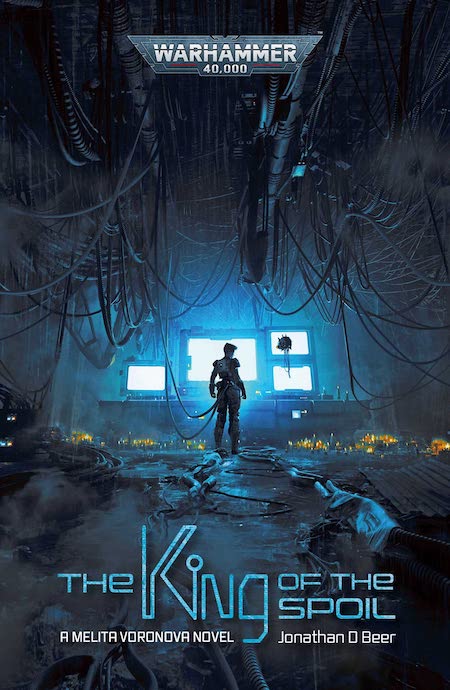 Both of these new novels focus on what might be described as “tech-heavy” factions: the Necrons and Adeptus Mechanicus. Your Warhammer Crime novel, The King of the Spoil (which I really enjoyed) also has a prominent, heavily-augmented character. Is there something specific that draws you to these factions and types of character?
I was asked to take on both factions, and (as I mention in the foreword of the limited edition of Tomb World) I was quite apprehensive about taking on the Necrons, since I had to follow the fantastic books by Rob Rath and Nate Crowley. The Mechanicus were less intimidating, mainly because they are absolutely fascinating and have been one of my favourite 40K factions. There is such a rich vein of imagery and history to them, and great variety in the types of characters that fill their ranks. While it was interesting going from the street-level life in the Imperium in The King of the Spoil (my first 40K novel) to the grand and frankly cosmic scale of Dominion Genesis, I was delighted to be asked to take on the Omnissiah’s followers.
That being said, I have joked with my editor that at some point I will need to write about characters who have, you know, faces…
When did you realize you wanted to be an author, and what was your first foray into writing? Do you still look back on it fondly?
I started thinking about writing in earnest as I finished university. I had gone off to study with the intention of being a historian, but I realised as it was coming to an end that it was, quite frankly, much easier to invent stories than to be beholden to the facts of the past.
I was fortunate that, at the same time as I started writing short stories for myself, I joined the newly created Black Library Bolthole, a forum set up by Sarah Cawkwell and other BL fans. It was the best possible place for me to chat about Warhammer lore, the craft of writing, work on writing exercises and critique each other’s work. There are more than a few alums of the Bolthole, including Sarah herself, who went on to write for Black Library. I look back on the years on that forum with immense fondness – without question, I would not be writing for BL today if it wasn’t for the support and encouragement I gained from its members.
Do you have any other projects in the pipeline, and what are you working on at the moment?
Beyond the coy reply that you should keep an eye on Warhammer Community for any and all Black Library announcements, I am working on my own projects. I have aspirations towards writing some near-future science fiction, starting (if I can ever make the time) with a novel about the life of the first person born on the Moon. I am hoping to put down the first draft of that in earnest later this year.
What are you reading and watching at the moment?
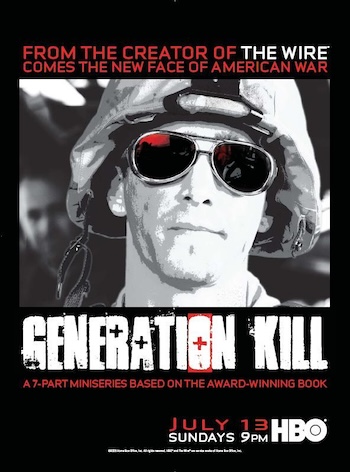 I’ve just finished watching Generation Kill, the 2008 mini-series from David Simon and Ed Burns (of The Wire) based on the book by Evan Wright, who was embedded with a battalion of US Marines during the invasion of Iraq. It is a hell of a show, with exceptional performances showing the bleak reality of modern military operations. I will be thinking about it for a good long while.
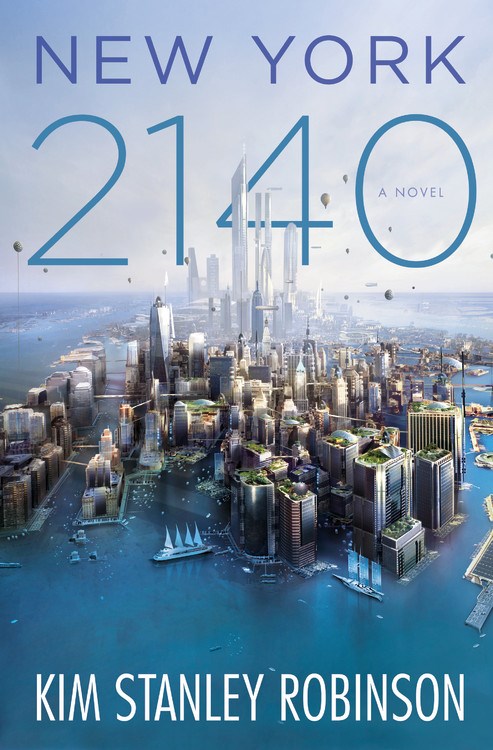 I’ve been on a bit of a Kim Stanley Robinson kick recently, having been engrossed, horrified, and oddly uplifted by The Ministry for the Future. I’m about halfway through New York 2140, set in a flooded New York after climate change lifts the sea level 50ft. It’s typically KSR, and I’m looking forward to seeing where it goes.
Oh, and I strongly urge everyone to see Project Hail Mary, on the biggest screen possible. It is a great film, in which every single person involved was working at the top of their game.
If you could recommend only one novel or book to someone, what would it be?
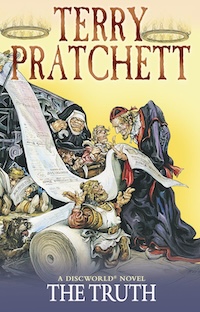 If I could only recommend one, it would have to be The Truth, the 25th Discworld novel by Terry Pratchett. I cannot imagine the course of my life if I hadn’t encountered the Discworld as a young teenager, and The Truth was the first one I read. It is a marvellous, typically Pratchettian story, with great characters, an engaging plot, and a central theme that will stay with you long after you put it down (to inevitably pick up a different Discworld novel).
What’s something readers might be surprised to learn about you?
The truth is that I’m a deeply uninteresting person, having never had any adventures, nor having done anything unexpected. I suppose readers might be surprised to learn that I have read The Silmarillion, but not The Lord of the Rings, and my first foray into writing was a terrible self-insert fan-fic set before the Dagor Bragollach when I was about fourteen. Truly, my nerdery began at a young age.
As a fan of the setting, but acknowledging no authority over the lore: What do you think happened to the two purged/redacted Legions?
Hoo boy… I think the Imperium of Mankind is built on lies made into holy truths by the weakness of those who could not face the reality of their existence. I think that the fate of those two Legions is one of those lies, one of the many hypocrisies that are the foundation stones of the Imperium. There are many theories, and the joy and horror of the setting is that they could all be true…
What are you most looking forward to in the next twelve months?
In these bleak times, it’s important to find things that bring joy and anticipation. I am deeply invested in watching the progress of the Artemis II mission (as of this writing the Orion capsule has just entered the lunar sphere of influence, where the pull of the Moon’s gravity is now greater than that of the Earth’s). I’m looking forward to making the time to start work on some original short stories and novels. And there’s always the garden, which is perpetually about halfway to being done, but is always a joy to walk out into.
*
Jonathan D. Beer’s Dominion Genesis and Tomb World are out now, published by Black Library in North America and in the UK.
Also on CR: Review of The King of the Spoil
 Civilian Reader