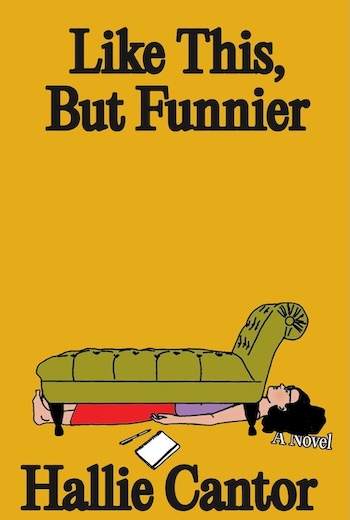
 Interesting premise, but ultimately a strangely familiar story
TV writer Caroline Neumann is thirty-four and mired in professional envy and self-hatred. Even Harry, her usually supportive therapist husband, thinks it’s time for her to press pause on her career ambitions and focus on getting pregnant, despite Caroline’s serious ambivalence about having children.
When Caroline accidentally stumbles on Harry’s patient session notes and offhandedly mentions what she finds in a meeting with a producer, the momentum of Hollywood takes over. Before she knows it — and unbeknownst to Harry — Caroline finds herself pitching a TV show about the deepest, darkest secrets of her husband’s favorite patient, a woman known to Caroline only as the Teacher.
Amid the indignities of the Hollywood development process, Caroline must balance her burning desire for professional validation against her own morality and the health of her marriage. And when Caroline forms a real-life relationship with Teacher herself, the lines between art and life begin to blur further, shaking up Caroline’s understanding of what it means to be the “likeable female protagonist” of her own life.
One of my most-anticipated novels of the year (yes, I’m a big fan of Hollywood-related books), and this one had a very promising premise. It’s well-written, and the characters are believable and mostly well-composed. However, most of the commentary about and critique of Hollywood felt familiar, which made this a less-satisfying read than hoped.
Caroline is a struggling comedy writer. She’s in Los Angeles, stuck in a cycle of “development” and piece-meal work that seems to never go anywhere. A chance opportunity to develop a novel into a TV show for a well-known and bankable movie star offers some hope to reduce financial and social anxieties that have been building within her. While she’s been struggling to find a place for herself in Hollywood, her psychologist husband has been settling in nicely to his new career. His work is rewarding and he often shares some tidbits with Caroline at the end of the day. One patient in particular catches her ear, and one day she comes across a particularly juicy tidbit in some of Harry’s notes. In a moment of panic, she slips this idea into a pitch meeting and the executives jump on it. Anxiety (so much anxiety) ensues, as Caroline navigates the snowballing project and her sense of betraying her husband and his client.
Cantor can clearly write, and her characters are believable and well-drawn. However, they are also predictable. There were few scenes that were ultimately surprising — usually, I guessed what would happen after a couple of paragraphs. The novel also takes a common sitcom trope and runs with it: that of a small decision made by the protagonist which then spirals out of control. However, in this case it’s one that ultimately needn’t have caused any problems whatsoever. Caroline’s anxiety is maybe understandable initially, but the pitch so quickly changes and spirals far beyond what anyone could reasonably assume was an “unethical” genesis.
Many of the observations and critiques of Hollywood are quite familiar, as I’ve already noted. This may be an unfair criticism, given how much I follow the industry; because I read so many biographies, histories, and novels, and also listen to a fair number of podcasts (shout out to Kim Masters’s The Business, and Matt Belloni’s The Town in particular), it felt like I had either heard/read all of this before, or already come to many of the same conclusions. Cantor should, however, get a lot of credit for including such a range of commentary and critiques — often, you’ll find a book or novel is focused on just the one issue with Tinseltown’s primary business and practitioners; but, in Like This, But Funnier, the author manages to provide a pretty sweeping picture without leaving the reader feeling bludgeoned or lectured.
The pages of contradictory “notes” that Caroline is sent by the various members of the “team” are well-composed and somewhat amusing, playing with the common critique of non-creatives in Hollywood having no real imaginations of their own — a theme that runs through much of the novel. However, given that there is very little original ground covered in the novel, one might wonder how many notes Cantor was given, requesting the story be smoothed out to be more familiar to readers…
After finishing, I couldn’t help but think the title ended up a little ironic. I did want a novel like this, but maybe a bit different (not necessarily funnier). Cantor’s prose is excellent, her characterization very good, and the plotting well-paced. I am, therefore, very keen to see what she writes next. If you haven’t read many Hollywood novels, but are looking for a story about a writer navigating the ever-more-precarious “creative industries”, then I would recommend you maybe give this novel a try.
*
Hallie Cantor’s Like This, But Funnier is due to be published by Simon & Schuster in North America and in the UK, on April 7th.
 Civilian Reader