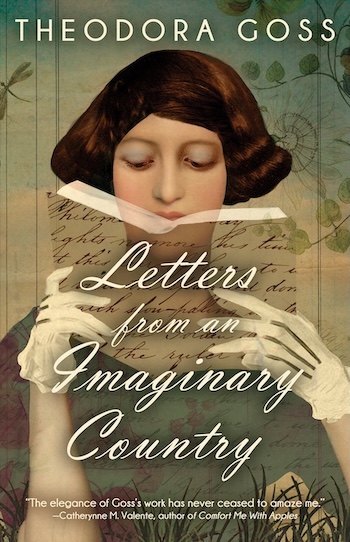
 On November 11th, Tachyon Publications are due to publish a new collection of short fiction by Theodora Goss: Letters From an Imaginary Country. To mark the occasion, and give readers a taste of what’s in the book, CR has been provided an excerpt to share with our readers. Here’s the book’s synopsis:
Roam through the captivating stories of World Fantasy, Locus, and Mythopoeic Award winner Theodora Goss (the Athena Club trilogy). This themed collection of imaginary places, with three new stories, recalls Susanna Clarke’s alternate Europe and the surreal metafictions of Jorge Luis Borges. Deeply influenced by the author’s Hungarian childhood during the regime of the Soviet Union, each of these stories engages with storytelling and identity, including her own.
The infamous girl monsters of nineteenth-century fiction gather in London and form their own club. In the imaginary country of Thüle. Characters from folklore band together to fight a dictator. An intrepid girl reporter finds the hidden land of Oz—and joins its invasion of our world. The author writes the autobiography of her alternative life and a science fiction love letter to Budapest. The White Witch conquers England with snow and silence.
*
Dr. Prof. Ülla Pálev
Department of Languages and Literature
National University of Arts and Letters, Brázlov, Thüle
Dear Dórika,
Yosefína and I met at Kafé Gustav yesterday after her seminar, and we missed you so much! I remember when M. Gustav called the three of us the Weird Sisters from Macbeth—or perhaps their younger, more chic versions. At least, you and Yosefína are still young, while I am rapidly becoming an old woman. If age wasn’t turning my hair white, this government would be!
Honestly, it’s getting worse every day. They already controlled the radio and television stations. Now they’ve taken over the main opposition website by the particularly modern expedient of purchasing it. Viktor Yurgi’s nephew owns it now, and it’s turned into a mouthpiece for nationalist propaganda—when it’s not obsessed with celebrity gossip. At least in the old days you could see the censorship in action. In my childhood, if Luchenko wanted to shut down a newspaper, he would send in the police. The editor would be put in prison, and we would stand outside the prison walls, chanting and holding candles—or flowers. It was flowers during the day, and candles at night, if I remember correctly. But that was so long ago, before you and Yosefína were born. Did I tell you that I met my Üwe, rest his soul, at a protest rally?
This new blend of capitalism and authoritarianism is particularly toxic, as you would say in your American slang. How do you fight it? Or rather, how do we fight it? Because I’m quite certain that it’s coming for the universities next. There are already rules about what can be taught in the primary and secondary schools. Soon they will start focusing on the university curriculum, and tenure will not save an old radical like me. I told Yosefína to get out while she still can. What kind of career could she possibly have here, as long as this God and Motherland party is in power? Goddamn motherfuckers, is what I call them, but only to you and Yosefína. Because I am too old to go to prison. Although I will continue to teach the history of Thüle, good and bad, as long as they let me.
I wish I could do more, like in the old days, when Üwe and I had our underground press and distributed pamphlets through cafés and radical bookstores. But the young people must do it now. It is their turn to fight, if they can get off their TikToks or whatever else they are doing. You know, just yesterday I had to take away two mobile telephones from students who were using them in class? I’m sure they will mention that on course evaluations.
Well, I’ll stop complaining. The real reason I am writing, of course, is to send you the enclosed newspaper article. I thought you might find it amusing. Ever since a farmer said he saw King Ottokar in a barley field near Dombrátz, there have been sightings of that crazy old tyrant—usually in rural areas. At least one of the opposition candidates (from the Greener Thüle party, I think) claims Ottokar is returning to clean up the corruption in government. If only he would! Of course, our charming Deputy Prime Minister (that’s Yurgi’s other nephew) says these sightings show that Ottokar is blessing their version of illiberal, EU-skeptical, NATO-reluctant Thüle with his presence. He wants to commission an Ottokar rock opera for Foundation Day. It’s exactly the sort of ridiculousness I would expect from the current government, but I thought you, as a folklorist, would appreciate it.
I hope you are well, my dear, and that you will be able to come next summer as we planned—if the political situation doesn’t deteriorate further. But I’m very much afraid that it will, and I fear for my students and colleagues.
With love,
Ülla
Ministry of Culture, Ottokar kír Palatz
Brázlov, Thüle
Dear Dr. Prof. Theodora Goss!
It is our great pleasure to recognize your achievement in publishing Under the Northern Lights: Folk and Fairy Tales of Farthest Thüle, which makes the traditional tales of Thüle available to an English-speaking audience, with the King Ottokar Award. This award is given annually to those who have advanced the cause of Thüle in scientific, artistic, or commercial sectors. The award comes with a prize of 500 zloty, and is given at an award ceremony in Brázlov. The government of Thüle will be pleased to pay for your travel expenses, to include one economy-class ticket and two nights at the Brázlov Intercontinental Marriott. The award will be given at the recently refurbished Opera House. If you choose to attend in person, please be prepared to make a speech of no more than five minutes. If you cannot attend in person, your speech may be recorded and sent directly to the Office of Cultural Affairs, which will place it online with a recording of the award ceremony. In either case, please send the proposed text of your speech to Miss Isola Járvinen at the Office of Cultural Affairs at least five days before the ceremony for approval, keeping in mind that the award ceremony is not an appropriate forum for political discourse.
Again, congratulations on your significant achievement! We hope to see you in Brázlov.
Sincerely,
Bozram Ifik, Undersecretary for Cultural Affairs
On behalf of President Viktor Yurgi
From: yosefinag@brazlovuni.te
To: theogoss@bu.edu
Dear Dóri,
I understand how you feel about the award ceremony—absolutely I do. You would certainly be justified in refusing to accept the award and publishing your op-ed in the New York Times. I agree with it completely. Nevertheless, I ask you as a friend to do what is against your nature—to come and accept the award, even to make a gracious speech approved by the government censors. And not to publishing anything—at least not now, not yet.
Remember when we traveled together in that rented Citroën, with its bottom almost rusted out? Remember the little villages in the mountains, and that time our auto sank into the mud, and we thought we would have to spend the night under the oak and pine trees of the Bírkenséa? Then we saw a fox with its eyes gleaming in the darkness, and help came to us so unexpectedly. I will never forget the strangeness of that night. I petition you in the old phrase, by the bones of my mother and her mother before her, please come. I will explain later, but not in an email—a university email account is not as private as it used to be.
You ask how things are going here. What can I say? Ülla is still smoking those terrible brown cigarettes that will certainly be the death of her, if her heart does not kill her first. Certainly events at the university have not lowered her blood pressure. Mikkel has given up teaching altogether. We used to talk about having children, but how could we bring a child into the world, as is it is now? Still, the apricot trees are starting to blossom again in Saint Kinga Park. Spring always comes again, no matter how dark and bleak the winter.
When you come—please come—we will sit beneath them again, the three of us, drinking coffee and complaining about the state of the world. I look forward to that.
With a kiss from me, and one from Ülla,
Yosi
From: rachelc@nyt.com
To: theogoss@bu.edu
Dear Theo,
Of course I’m disappointed that you want to pull the op-ed, but I understand. One of our reporters, Jordan Kirov (his father is Thülian), is on the ground in Brázlov, and he thinks the situation is particularly volatile right now. He says the students are organizing protests, and once they start, the teachers’ unions will probably follow—he expects government crackdowns. Obviously I don’t want you to put your friends at the university in danger.
But I really object to this idea of going to pick up the award in person. Judging from Jordan’s emails, it’s NOT SAFE, not even for an American. He’s thinking of getting out himself and establishing a base just over the border in Ruritania. At least that’s in the European Union, or is it the Schengen Area, I always forget. Seriously, don’t do it—I’m begging you. Charles and Leslie and I want many articles from you on Eastern European politics, and folk festivals, and whatever you want to write about—hell, write an article on Thülian cuisine! We’ll fit in in somewhere. I can talk to the cooking and lifestyle editors. Just don’t risk your life in a potentially dangerous situation—not to pick up some stupid, or even not-so-stupid (I know it’s an honor, yada yada), award. Just don’t.
Love and a big hug,
Rachel
Rachel Cohen, Opinion Editor
The New York Times
*
Theodora Goss’s Letters From an Imaginary Country is due to be published by Tachyon Publications in North America and in the UK, on November 11th.
Here’s the collection’s table of contents:
- Introduction by Jo Walton
- “The Mad Scientist’s Daughter”
- “Dora/Dóra: An Autobiography” (original to this collection)
- “Cimmeria: From the Journal of Imaginary Anthropology”
- “England Under the White Witch”
- “Frankenstein’s Daughter”
- “Come See the Living Dryad”
- “Beautiful Boys”
- “Pug”
- “A Letter to Merlin”
- “Estella Saves the Village”
- “Pellargonia: A Letter to the Journal of Imaginary Anthropology”
- “Lost Girls of Oz”
- “To Budapest, With Love”
- “Child-Empress of Mars”
- “Letters From an Imaginary Country” (original to this collection)
- “The Secret Diary of Mina Harker” (original to this collection)
 Civilian Reader