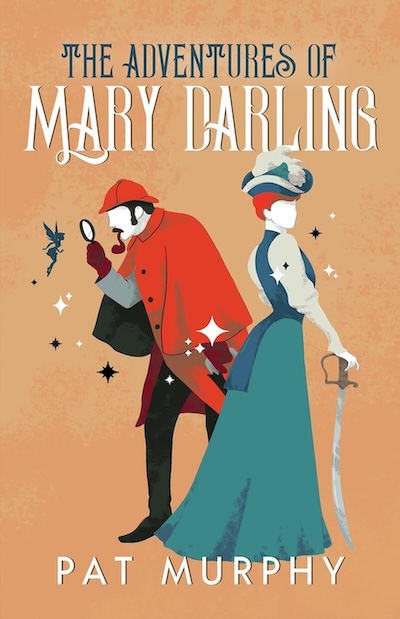
 Next month, Tachyon Publications are due to publish The Adventures of Mary Darling by Pat Murphy, a “subversive take on both Peter Pan and Sherlock Holmes”. I don’t think I’ve seen anything that attempts to merge those two stories, so this sounds like it could be quite interesting. To introduce readers to the characters, the publisher has provided CR with an excerpt to share with our readers. First, here’s the synopsis:
Mary Darling is a pretty wife whose boring husband is befuddled by her independent ways. But one fateful night, Mary becomes the distraught mother whose three children have gone missing from their beds.
After her well-meaning uncle John Watson contacts the greatest detective of his era (but perhaps not that great), Mary is Sherlock Holmes’s prime suspect in her children’s disappearance. To save her family, Mary must escape London — and an attempt to have her locked away as mad — to travel halfway around the world.
Despite the interference of Holmes, Mary gathers allies in her quest: Sam, a Solomon Islander whose village was destroyed by contact with Western civilization; Ruby, a Malagasy woman on an island that everyone thinks is run by pirates (though it’s actually run by women); Captain Hook and the crew of the Jolly Roger; and of course, Nana, the faithful dog and nursemaid.
In a witty and adventurous romp, The Adventures of Mary Darling draws on the histories of women and people indigenous to lands that Britain claimed, telling the stories of those who were ignored or misrepresented along the way.
*
Dr. Watson sat by the fire at 221B Baker Street, reviewing his notes on one of the adventures he had shared with his friend, Mr. Sherlock Holmes. Holmes was at the table, working on a monograph about poisons—specifically about deadly potions that could be made with ingredients commonly found in the average household.
Watson gazed out the window. In the snow, Baker Street looked beautiful. So peaceful. Snow hid many things that people would rather not see, covering the soot that darkened the buildings, the horse manure in the gutters, the piles of rubbish in the alleys, and even the beggars that huddled in doorways.
Watson heard the clip-clop of a horse’s hooves and the rumble of wheels on cobblestones below. The sound stopped beneath their window. “We have a visitor,” Watson remarked. “Someone must be in desperate need to seek out your help on such a cold night.”
Holmes put down his pen. “A man, by the sound of it.” He glanced at Watson. “I know it’s a hansom cab by the pace of the horse and the sound of the wheels—lighter than a growler but not so quick as a dogcart. I hear only one passenger alighting—a respectable woman would not be in a hansom cab alone. And any woman would wait for the assistance of the driver to alight. But our visitor is too impatient for that.”
The visitor’s impatience was confirmed by a frantic knocking at the door. Watson moved to stand, but Holmes waved him back into his chair. “Don’t disturb yourself, Watson. Allow me.”
Watson heard a man’s voice, speaking loudly, quickly. Watson could not make out the words, but he recognized the voice. It was George Darling, his niece’s husband. In an instant, Watson was out of his chair, comfort forgotten.
“What’s wrong?” Watson asked, as George entered the room. The man’s hands were shaking—from strong emotion, from the cold, or perhaps from both.
“Mary needs you, John. Mary… I… we need your help.”
Though George addressed his appeal to Watson, Holmes answered. “We will do everything we can.” Holmes’ tone was calm and reassuring. He led George to the chair that Watson had vacated. “But first, you must calm yourself. Watson, get the brandy.”
Watson poured George a glass of brandy and draped a blanket over the man’s shoulders to ward off the chill.
George Darling was a tall, thin man with regular features and dark wavy hair. He was twenty-nine years of age, but he had the air of a much older man. Watson had always thought him rather dull. George took himself very seriously and expected others to do the same. He worked as a senior accountant in a Capel Court brokerage firm and was always talking about stocks and shares in a deadly earnest tone. Years ago, when George had come to Watson to ask for Mary’s hand, Watson had thought him an odd match for Mary, who was a lively, strong-minded young woman. But Watson was glad that his niece had married well and settled down.
“What’s happened?” Watson asked.
George downed the brandy. “The children are gone.” His voice was low and pained. “The policeman says they’ve been kidnapped.”
“Tell the story from the beginning,” Holmes said. He pulled a chair near George and seated himself upon it, leaning forward and giving the man his full attention. “Leave nothing out.”
George recounted the events of the evening, ending with the discovery that the children were gone. “Then I came here. I left Mary in the nursery, in case the children returned. Liza is with her. The constable has gone to make a report. Please come back with me, John. Mary needs you.”
“You were quite right to come and get us,” Holmes said. “We must hurry to examine the crime scene before Scotland Yard shows up to obliterate any clues.”
As they rode in the hansom cab to Mary’s house, Watson caught flickering glimpses of Holmes’ face in the light of street lamps. Clearly Holmes was eager to help Mary in this time of need, but Watson wished he did not look quite so cheerful, delighted to have an intriguing case, even one involving pain to Watson and his family.
Holmes stopped the cab a block away from number 14.
“The house is around the corner,” George said.
But Holmes was already out of the cab. He had brought a lantern, which he immediately lit. He began walking slowly toward number 14, leaving Watson and George to follow. As Holmes walked, he studied the street and the houses on either side. When he reached number 14, he continued past the house, frowning down at the marks in the snow. Then he turned and walked back to number 14. “Which window leads to the nursery?” he asked George.
George pointed to the open window on the third floor.
“Here now—hold this.” Holmes handed George the lantern, then moved from the doorstep to the ground directly beneath the nursery window. “Come along. I need the light here.”
George followed with the lantern. Having inspected the ground, Holmes lifted his eyes to stare at the wall—a brick wall with no ivy, no drainpipe, nothing to cling to.
As Watson watched, Holmes stepped closer, his nose inches from the bricks.
George gave Watson a beseeching look. “We really must go inside,” he said. “Mary needs us.”
“I’ll go up,” Watson told George. Watson knew Holmes would be at this for a while. “I’ll check on Mary.”
“George, keep that lantern up,” Holmes said. “I need the light.”
As Holmes searched for marks too subtle to catch the attention of anyone less discerning, Watson climbed the stairs to the nursery. There he found Mary sitting on the window seat. The casement windows were open wide. Despite the fire, the room was cold.
Mary’s back was straight. She was deathly pale. Her hands were in her lap, her right hand clenched in a fist; her left, wrapped tightly around the fist, as if to restrain it. Her face was streaked with tears. Nana sat at Mary’s feet.
Watson set his doctor’s bag on the floor and sat beside her. “Mary,” Watson said, touching her shoulder. “You will catch your death of cold sitting here.” He started to pull the windows closed.
“No! Please, Uncle, leave them open! They must stay open.”
Watson shot a glance at Liza. The servant girl stood by the fire, a shawl over her shoulders, her face a picture of misery.
“She won’t let me close them,” Liza murmured.
“I will leave them open just a bit,” Watson said soothingly. “I won’t latch them. But you must move out of this draft. Liza, fetch a blanket and brandy.”
By the time Watson heard Holmes’ footsteps on the stairs, Mary was seated in the chair by the fire. Watson had covered her with a blanket and forced her to sip some brandy.
At the nursery door, Holmes stopped and surveyed the room. “Is this room just as it was when you arrived home?” he asked George.
“Yes,” George said. “When we returned home, the room looked just as you see it. We have changed nothing.”
“The windows were wide open when I arrived,” Watson said. “I pulled them closed.”
“Yes, that’s right,” George said. “Other than that, it was exactly like this.”
“Is that the dog’s kennel?” Holmes asked, gesturing to the kennel beside the wardrobe.
“Yes, that’s Nana’s,” George said.
Watson stared at the kennel. “Why didn’t Nana chase the kidnappers away?” he asked. He knew that dog and a more dedicated animal did not live. She would have given her life to protect the children. “She never would have allowed a stranger to take them.”
George put his hand to his forehead, hiding his eyes. “I tied Nana in the yard. She had misbehaved. I was punishing her. It was my fault Nana wasn’t in the nursery. It’s all my fault.”
Oblivious to George’s distress, Holmes crossed to the wardrobe, opened the door, and considered the clothing within. “Is any of the children’s clothing gone?” he asked George.
George frowned, looking flustered. “I’m not sure. Mary? Is any clothing gone?”
“The boys were wearing their nightshirts. Wendy was in her nightgown,” Mary said softly. “All their other clothes are all here.”
“They left without jackets,” Holmes said. “Without shoes.”
Mary nodded, tears running down her cheeks.
Watson moved to stand behind his niece, putting his hand on her shoulder. He could feel the tension in her muscles. “You have the world’s best detective working on your behalf,” Watson told his niece. “We’ll find the children.”
*
Pat Murphy’s The Adventures of Mary Darling is due to be published by Tachyon Publications in North America and in the UK, on May 5th.
 Civilian Reader
[…] You can read an excerpt here! […]
LikeLike