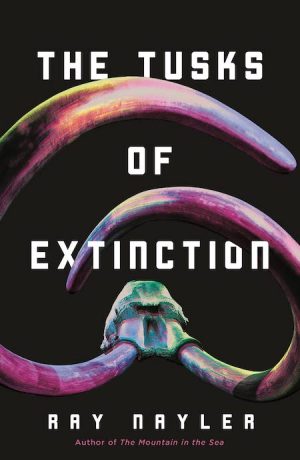
 An intriguing, intelligent, and empathetic “eco-thriller”
When you bring back a long-extinct species, there’s more to success than the DNA.
Moscow has resurrected the mammoth, but someone must teach them how to be mammoths, or they are doomed to die out, again.
The late Dr. Damira Khismatullina, the world’s foremost expert in elephant behavior, is called in to help. While she was murdered a year ago, her digitized consciousness is uploaded into the brain of a mammoth.
Can she help the magnificent creatures fend off poachers long enough for their species to take hold?
And will she ever discover the real reason they were brought back?
Ray Nayler’s novel The Mountain in the Sea has been generating a lot of buzz since its publication, and racked up a number of award wins and nominations (most recently, the Locus Best First Novel Award). When The Tusks of Extinction popped up available for review, I thought it would be a good introduction to the author’s work, and I dove in as soon as I got it. I’m happy to report that I enjoyed it, and it’s a well-written and engaging eco-mystery.
At first, it took me a little while to get situated in the story. (I’ll note I was traveling when I started it, which meant my first few reading sessions were a bit fractured and short, so this may have been my problem, not the book’s.) When I was able to give the novella some proper attention, I found myself sinking into the story and getting invested in the various character’s stories — and, in a couple of cases, their fates. The story is told through a small handful of characters, each offering quite different perspectives on the ecological situation of this future: those who wish to genuinely protect and revive the environment, those who wish to profit from the return of mammoths and other ancient creatures, those swept up into illegal trades through family or situation, and, of course, the mammoths.
Nayler does a very good job of painting a picture of this future in relatively tight, focused passages — it’s not too removed from our present, but obviously some certain ecological disasters have been fast-forwarded. Similarly, the author does a good job of making sure his characters are properly three-dimensional — again, done very well in a relatively small amount of space. (So many novellas fail to do this, and that’s usually why people say they “should have been longer”.) It’s tricky to go into too much detail without throwing out spoilers, but quickly: many of these characters have duelling agendas and needs. Those who aren’t ideological nevertheless can be conflicted by their actions and the needs of their professions. Vague, I know, but Nayler does a very good job of creating full, well-rounded and realistic characters.
I thought the idea of having to employ a human’s consciousness into the mind of a recently-resurrected species was an intriguing idea: in some ways, it perfectly exhibits the arrogance of humans, believing that we can become so expert in other species as to tell them how to be — in this case, telling a mammoth how to mammoth. (“Mammoth-splaining?) Nayler does a great job of bringing these creatures to life on the page — he doesn’t anthropomorphize them, despite the human consciousness that is driving and teaching the herd. The threat posed to the mammoths (and, by extension, elephants today) is conveyed intelligently and empathetically.
In some ways, this is a bit of a strange novella, but one that ultimately packs a fair punch. If you’re a fan of eco-thrillers/cli-fi, then I think you’ll find a lot to like this The Tusks of Extinction. It also serves as a very good introduction to Nayler’s writing, if you’re looking for something a little shorter than a full length novel to dip into.
Recommended.
*
Ray Nayler’s The Tusks of Extinction is due to be published by Tor.com in North America and in the UK, on January 16th, 2024.
Follow the Author: Website, Goodreads, Instagram, Twitter
Review copy received via NetGalley
 Civilian Reader