An Interview with ALMA KATSU

KatsuA-I3-DescentUKA few days ago, a copy of Alma Katsu’s third novel, The Descent dropped through the mailbox. It is the third novel in the author’s The Immortal trilogy, but I didn’t (at the time) know too much about the series or the author, so I took the opportunity to send her some questions.

Who is Alma Katsu?

As a girl, I wanted to have a magical, fantastical life but the outlook was kind of narrow and grim, and I think that’s why I turned to creating my own worlds in fiction. Then, funnily enough, I ended up having a life that was the stuff of fantasy: working in intelligence, traveling, doing all this technical, math-y stuff that I never would’ve thought possible for a little storyteller. Lesson: you never know where life will take you. Continue reading

Christmas Fiction Review Catch-Up: Jonathan Dee, A.S.A. Harrison & John Niven

I am falling terribly behind on my reviews. So, in order to get caught up a bit more on the backlog, I’ll be combining some reviews into thematic posts (of sorts). This one takes a look at three non-SFF novels I’ve read recently.

***

DeeJ-AThousandPardonsJonathan Dee, A Thousand Pardons (Corsair)

Ben and Helen Armstead have reached breaking point and it takes one afternoon – and a single act of recklessness – for Ben to deal the final blow to their marriage, spectacularly demolishing everything they built together.

Helen and her teenage daughter Sara leave for Manhattan where Helen takes a job in PR – her first in many years – and discovers she has a gift for spinning crises into second chances. But can she apply her professional talent to her personal life?

I rather enjoyed this. It was a quick read, but not perfect. The novel starts out with the sudden, spectacular dissolution of Helen’s marriage to Ben, who is quite the narcissist experiencing quite the midlife crisis and breakdown. The first part of the novel follows Helen as she makes her way to New York, and stumbles into a PR job. She has a knack for coaxing out appropriate, believable apologies out of her clients. For a short time, she is able to enjoy this success. Then the novel brings Ben back into the narrative, and we get a more even-handed impression of the two characters – while I had enjoyed reading about Helen, and it did take a little while before reorienting myself for Ben’s side of the story, the novel benefited from them both being central. Dee’s prose is fluid, and I rattled through this novel at quite the pace. At times, though, things moved perhaps a little too fast – Helen’s advancement in the PR business jumps ahead slightly, and Dee doesn’t give much time over to Helen and Sara’s new lives in the big city. I think the author could have spent some more time exploring what each of the characters was going through.

Nevertheless, A Thousand Pardons is an enjoyable novel about a marriage in ruins and a family in crisis; about the limits and joys of self-invention; and about the peculiar seduction of self-destruction. It is also the tale of redemption and forgiveness, of sorts, and the enduring connection families can feel with each other, despite some of the most difficult of circumstances. It’s not a bad introduction to Dee’s fiction, and I enjoyed it enough to convince me to pick up The Privileges at some point in the not-too-distant future.

*

HarrisonASA-TheSilentWifeUKPBA.S.A. Harrison, The Silent Wife (Headline)

Todd Gilbert and Jodie Brett are in a bad place in their relationship. They’ve been together for twenty-eight years, and with no children to worry about there has been little to disrupt their affluent Chicago lifestyle. But there has also been little to hold it together, and beneath the surface lie ever-widening cracks. HE is a committed cheater. SHE lives and breathes denial. HE exists in dual worlds. SHE likes to settle scores. HE decides to play for keeps. SHE has nothing left to lose. When it becomes clear that their precarious world could disintegrate at any moment, Jodie knows she stands to lose everything. It’s only now she will discover just how much she’s truly capable of…

Oh, how I wanted to love this book. For months, it seems, I’ve seen so much praise and a constant trickle of links for great and gushing reviews on Twitter. The book itself is covered in eye-catching blurbs from prominent authors, reviewers, and so forth. So how was it? Well… Politely? It wasn’t for me. Bluntly honest? I was bored. Throughout. I didn’t like either of the main characters. He is a douche, a lecherous cheater, who seems to only appreciate what his wife does for him and the fact that she’s attractive. She is fastidious to a fault, ordered and lacking any impulsiveness and rather bland:

“Meticulous planning has its merits. Life at its best proceeds in a stately manner, with events scheduled and engagements in place weeks if not months ahead. Scrambling for a last-minute date is something she rarely has to do, and she finds it demeaning.”

Now, I understand that both of the characters were probably meant to come across as either a complete ass (him) or quietly in denial about everything (her), but damn it doesn’t make for interesting reading. The synopsis above is not the whole synopsis. I cut the following:

“A chilling psychological thriller portraying the disintegration of a relationship down to the deadliest point when murdering your husband suddenly makes perfect sense.”

I found this as chilling as tepid tap water. That being said, in terms of prose and construction, The Silent Wife is very competent. The author’s prose are very well constructed, which is really the only reason I kept reading. That bit about the novel being a “chilling psychological thriller”? I was waiting for that to happen right up until I turned the final page. Maddeningly bland. This was the biggest let down of the year, I was left wondering if what I bought and read was the same book everyone else had been talking about…

*

NivenJ-StraightWhiteMaleJohn Niven, Straight White Male (William Heinemann)

Kennedy Marr is a novelist from the old school. Irish, acerbic, and a borderline alcoholic and sex-addict, his mantra is drink hard, write hard and try to screw every woman you meet.

He’s writing film scripts in LA, fucking, drinking and insulting his way through Californian society, but also suffering from writers block and unpaid taxes. Then a solution presents itself – Marr is to be the unlikely recipient of the W.F. Bingham Prize for Outstanding Contribution to Modern Literature, an award worth half a million pounds. But it does not come without a price: he must spend a year teaching at the English university where his ex-wife and estranged daughter now reside.

As Kennedy acclimatises to the sleepy campus, inspiring revulsion and worship in equal measure, he’s forced to reconsider his precarious lifestyle. Incredible as it may seem, there might actually be a father and a teacher lurking inside this “preening, narcissistic, priapic, sociopath”. Or is there.

This was a very pleasant surprise. There was a bit of a rocky start – the first couple of chapters painted an awful picture of the protagonist, and I worried that I’d always struggle to engage with him. However, Niven very quickly surprised. Straight White Male ended up being one of my favourite reads of the year.

Kennedy, our protagonist, starts off as one ugliest protagonists I’ve read about. He’s kind of awful: spoiled, wasteful, a drunkard, lewd, a sex addict with an unhealthy disrespect for women (sleeping with someone in the cloak room at his wedding, juggling multiple porn platforms at once)… He’s a complete narcissist. He’s not a pleasant guide for a lot of the opening chapters, which did make me wonder if I wanted to continue reading. Everyone else Kennedy interacts with is as well-written as this asshole, which made me stick with it, and eventually we learn why Kennedy is the way he is, and see his character develop. Niven can definitely write, and write very well, which kept me coming back. So, if you aren’t a fan of anti-hero protagonists, I’d recommend still sticking with the book, as it gets very good.

I really liked the way Kennedy gets to say and do all the things I bet many people living and working in or with Hollywood would love to say to all the self-important, pompous “artistes” with inflated senses of their own genius… He doesn’t shy away from opining on their flaws (or shouting  them at prima donna, uneducated actors). His internal and external commentary is often very funny. He’s also honest about why he does certain things. Kennedy is also not sparing on his frustrations with the publishing industry, either.

“Busy jumping from rewrite to polish to dialogue pass because, of course, all this was easier (and much more remunerative) than spreading his intestines across the page for two fucking years writing a novel. Because the only things he wanted to write about he couldn’t. He wasn’t blocked so much as… finished. The novel? That was a man’s business. He was done with it. Not that anyone knew that yet of course.”

What was most interesting, however, is how Niven slowly unveiled the tragic story of Kennedy’s sister, and how that has effected his behaviour. A lot of what he does, in the end, seems like avoidance and alcohol-fuelled coping and distraction. After the story shifts to the UK, things move quite a bit faster, too, which was a little disappointing. I would have liked some more… well, everything, really. Rather than reading that as an indictment of the novel, consider it my way of saying I wish it had been longer, because it was so good. Which it was.

Straight White Male is a very good novel on some of the many neuroses and coping mechanisms to which men can turn. Funny, irreverent, touching, and well-written, this is definitely recommended.

An Interview with PAT CADIGAN

CadiganP-Chalk

A few days ago, I got an email from an editor at This Is Horror, a UK indie publisher. I haven’t been the biggest of horror readers, but the email was about Pat Cadigan’s latest chapbook, Chalk. I was intrigued, and will hopefully have it read and reviewed in the near future. I’ve been aware of the multi-award-winning Cadigan for years, though, and so I took this opportunity to interview the author. So, here we chat about her work, the chapbook, writing, and more…

Let’s start with an introduction: Who is Pat Cadigan?

CadiganP-SynnersI’m a recovering American and the mother of a grown son. I’ve lived in North London for almost eighteen years. Most people would know me as a science-fiction writer. All my novels are hard science-fiction (meaning they’re based on things that are possible now). I’ve won the Arthur C. Clarke Award twice, once in 1992 for Synners and again in 1995 for Fools. I’ve won the Locus Award three times: once for my short story, “Angel,” once for my collection Patterns, and most recently for my novelette, “The Girl-Thing Who Went Out For Sushi,” which also received the Hugo Award in 2013. In between, I had cancer but it’s gone now. I keep busy.

I thought we’d start with your fiction: Your latest novellette (or chapbook, if you will), Chalk, was recently published by This Is Horror. How would you introduce it to a potential reader? Is it part of a series?

It’s not part of a formal series, but it is one of several pieces of short fiction set in the neighbourhood where I grew up in Massachusetts. They’re generally set in the early 1960s and while they contain autobiographical elements, they are not the story of my life. I just borrowed a few things to riff on. Or riff off.

What inspired you to write this particular story? And where do you draw your inspiration from in general?

Michael Wilson asked me if I’d be interested in doing a chapbook and I said yes. I’d never done a chapbook before and I’m always up for a new experience. I read the previous ones from This Is Horror and found them all satisfyingly variegated (and quite good). So I prayed to the Story Fairy (Dept. of Horror) and this is what I got.

CadiganP-Chalk

I know how that must sound. My creative process is a black-box operation and I’ve been at this long enough (34 years professionally) to know what works best for me: tell brain to think, consider the elements involved – genre, length, my personal taste; allow the associations to marinate overnight in REM sleep; return to task the next day, try writing a paragraph, see what happens. The first paragraph written isn’t always the first paragraph of the story and it usually undergoes editing if not outright retro-fitting, depending on what I discover in the course of writing the story.

Paragraphs that don’t work end up in my fragment box for recycling.

How were you introduced to genre fiction?

We met in the dark. We’d already been making out for some time before I said, “Say honey, what’s your name?”

I had a library card for longer than I can remember. My mother would take me to the library with her and find books to read to me. Eventually, I learned to read myself and discovered that all the cool stuff was in the science fiction section. In those days – when dinosaurs roamed the net, before the discovery of flame – the genre wasn’t as stratified as it is now. Everything was science fiction – Heinlein, Bradbury, Clarke, Tolkien, Mervyn Peake’s Gormenghast books, Richard Matheson, Jack Finney – anything with a fantastic element was science fiction. Judith Merrill used to edit a best-of-the-year anthology that was the same way – pure-quill hard SF by Mack Reynolds and Walter M. Miller, Jr., sat cheek-by-jowl with oddities from Bernard Malamud, John Cheever, and Tuli Kupferberg. My ambition was to be good enough to get into one of those anthologies. I still want to be that good.

PatCadigan-IntroToGenre

How do you enjoy being a writer and working within the publishing industry? Do you have any specific working, writing, researching practices?

I love being a writer and I wouldn’t do anything else. For most of my life, I’ve had additional responsibilities – school, an outside job, motherhood, looking after my aged parent – so I learned to write as and when: late at night, early in the morning, lunch hour, weekends, sometimes reaching around the baby napping in my front-carrier to the keyboard, in hospital waiting rooms, on the train. If you really want to do something, you figure it out.

When did you realise you wanted to be an author, and what was your first foray into writing? Do you still look back on it fondly?

I don’t remember a time when I didn’t want to be a writer. As soon as I knew books and stories were written by people, I knew I was one of those people. My mother gave me her old Underwood typewriter – it was a monster. It must have weighed about five hundred pounds. You had to really bang on the keys and all the capital letters were half a line up from the rest of the word. I started out at 3 or 4, always typing “Chapter One” first. Finally my mother suggested that I should maybe try writing a short story first to get the hang of storytelling. But I preferred trying to write novels. Eventually, I hand-wrote several novels that were my cracked version of a mystery series. It was a kind of a cross between Nancy Drew and Trixie Belden, with occasional supernatural flourishes. I was very disciplined. Every chapter had to run both sides of the page, no less, no more.

UnderwoodTypewriter

This is an Underwood. It looks heavy as all get-out…

Later I had a sort of Doc Savage in space thing going for a while – by then, my Aunt Loretta had given me her portable typewriter, which was a lot easier on the fingers than the Underwood. Then sometimes, when my mother worked weekends, I’d go with her. She worked in the admitting office of a hospital and I wasn’t supposed to be there but as long as I sat in the back office and kept quiet, nobody minded. There I met my first IBM Selectric; I couldn’t imagine a machine more advanced, more futuristic. Selectrics were so expensive back then, only businesses had them.

IBMSelectricII

Somewhere in there, I read the Isaac Asimov issue of F&SF in which he talked about his early attempts at writing, including something he called The Greenville Chums At College. I was delighted; I could relate. I’d just left the Greenville Chums stage of my own development and I knew I would persevere.

What’s your opinion of the genre today, and where do you see your work fitting into it?

PatCadiganI love genre and I read for pleasure as much as I can. But I don’t think of my work as “fitting into it.” I write genre fiction because I love genre fiction. I don’t write critical essays and I don’t do reviews, so you’ll have to forgive me for not answering that question.

People love genre fiction, in every medium – print (including e-print), TV shows, movies, and of course games (when was the last time you heard about a game that was all real, all the time?). If you want to see writers treated like rock stars, go to the American Library Association convention and watch how they react to children’s and YA authors. YA authors who work in genre get the most attention and adulation, because they keep kids reading.

Fine art is fine art and I have drawn inspiration from it in many forms. But to be brutally honest, the things people internalise most come from popular culture, particularly the genre portion. Everything I Ever Needed To Know I Learned In Kindergarten was soon followed by Everything I Ever Needed To Know I Learned From Star Trek. Some people might scoff but people tend to take their cues from things they enjoy, that give them pleasure, more often than from things they’ve been told are good for them.

So if people turn to entertainment, I try to provide good entertainment.

What other projects are you working on, and what do you have currently in the pipeline?

Right now I’ve just crawled out of Deadline Hell into Deadline Purgatory. I said yes to a lot of short fiction requests and they all came due around the same time. I have to plan better in the future so I can go back to work on the novel based on “The Girl-Thing Who Went Out For Sushi.”

KingS-DoctorSleepUKWhat are you reading at the moment (fiction, non-fiction)?

I’m reading a lot of science and books about the solar system. I had to take a few days away from everything so I could read Doctor Sleep, and I’ll probably re-read some other Stephen King books. When it comes to writing about the human condition, nobody does it better. Even if the books themselves aren’t completely successful – which doesn’t often happen – they still contain brilliant passages of superb writing and characters that are as real as anything.

And like everyone else, I’m waiting for the next Game of Thrones book from George R.R. Martin. At last, epic fantasy with a dirty face, dirtier clothes, permanent scars, and body odour. And occasional dragons.

LindaLovelaceForPresidentI read a lot of crime fiction and thrillers, too. I like Nicci French and Minette Walters, among others.

What’s something readers might be surprised to learn about you?

I was an uncredited (and fully-clothed) extra in Linda Lovelace For President.

What are you most looking forward to in the next twelve months?

The London Worldcon. That’s going to be great!

***

Be sure to follow Pat Cadigan on Twitter and Live Journal; and also This Is Horror on Twitter on Facebook. Chalk is available to buy in print and eBook formats.

Artwork: “Gotrek & Felix: The Serpent Queen” by Joshua Reynolds (Black Library)

I must have said it a hundred times on the blog, now, but I really must get around to reading Josh Reynold’s Road of Skulls, his first full-length novel featuring my favourite Dwarf Slayer and human companion… In advance of that, though, I spotted the artwork for Reynolds’s next novel in the series, The Serpent Queen:

ReynoldsJ-G&F-SerpentQueen

Sorry for the low-quality image, but I wanted to share the cover anyway. It’s one of my all-time favourite fantasy series, so I’m always excited for news and more fiction (even if it does take me altogether too long to get around to reading them…). Here’s the synopsis:

Gotrek and Felix: unsung heroes of the Empire, or nothing more than common thieves and murderers? The truth perhaps lies somewhere in between, and depends entirely upon whom you ask… Travelling to the mysterious south in search of a mighty death, the Slayer Gotrek Gurnisson and his human companion, Felix Jaeger, find themselves caught up in a battle between warring kingdoms. Captured by the sinister Queen Khalida and forced to do her bidding, the adventurers must brave the horrors of the sun-soaked Land of the Dead, where the dead do not rest easy.

Serpent Queen is due to be published in March/April 2014. Road of Skulls and David Guymer’s City of the Damned are available now from Black Library. In addition, the first in the series, William King’s Trollslayer, has recently been re-released as part of the Black Library Classics series – it is, in my humble opinion, a must-read.

Gotrek&Felix-AlsoAvailableNew

Uncanny X-Men, Vol.1 – “Revolution” (Marvel NOW)

UncannyXMen-Vol.01A so-so ‘start’ to a new Uncanny X-Men series…

Writer: Brian Michael Bendis | Artist: Chris Bachalo (1-4), Frazier Irving (#5) | Inks: Jaime Mendoza, Tim Townsend, Al Vey, Victor Olazaba & Frazier Irving | Colours: Chris Bachalo & Frazier Irving

The true flagship X-Men series returns… NOW! In the wake of the Phoenix event, the world has changed and is torn on exactly what Cyclops and his team of outlaw X-Men are – visionary revolutionaries or dangerous terrorists? Whatever the truth, Cyclops, Emma Frost, Magneto, and Magik are out in the world gathering new mutants and redefining the name Uncanny X-Men. But the challenges that they must overcome are fierce: once again, robotic Sentinels hunt the team and the mutants they protect… but when you find out who’s doing the hunting, your jaw will drop! And if that’s not enough, there’s a mole on Cyclops’s team – but who is it?

Collects: Uncanny X-Men #1-5

This is not a bad start to one of the Marvel NOW re-launch titles. Nevertheless, I had some issues with it, but they are more related to the overall direction of the Marvel NOW titles than this series per se. So: some good, some middling.

UncannyXMen-Vol.01-Interior3

Sentinels!

Yes, Uncanny X-Men is quite fun, and this book has a cheeky and gentle wit and humour running throughout – Bachalo’s artwork is a wonderful medium to realise this on the page, too. I’ve really grown to like it from Wolverine & the X-Men, despite initially not being too sure if I did. Speaking of W&tXM, the humour in Uncanny X-Men is very reminiscent of that, so I wonder if it is a conscious effort or just something Bachalo brings to the books he’s working on? Either way, I enjoyed it.

That being said… I understand that Cyclops, Emma Frost and Magick are struggling with their powers – they’re misfiring, malfunctioning, or out of control. They all were infused by the Phoenix Force in Avengers vs. X-Men, after all – and, if I remember correctly, there was a mention of at least Scott’s difficulties coming to terms with his reduced control and powers in AvX: Consequences (or possible in volume one of All-New X-Men?). But… Why is Magneto having difficulty with his powers? He wasn’t taken over by the Phoenix Force. I don’t remember that coming up before, nor any reason being given for it.

UncannyXMen-Vol.01-Interior1

The new mutants Cyclops & Co. have added to their numbers – new young recruits, people manifesting new powers since the arrival and dispersal of the Phoenix Force, are fun. It does mean, though, that we’re seeing another series that is probably trying to attract younger readers, something more in common with Wolverine & the X-Men (another similarity, perhaps only brought to mind lazily by Bachalo’s involvement). This despite fertile ground to explore a number of deeper issues. For example, who is culpable for the whole AvX mess (as they point out, it was Iron Man’s mistake that split the Phoenix Force into five hosts in the first place…). There is plenty they could explore with this series, but instead it looks like they’re going to wander off into other areas (the final chapter of the book turns the focus on to Magick and her misfiring powers). Revolution felt sadly unfulfilling and thin.

UncannyXMen-Vol.01-Interior2

Love this bit. “Did he actually call a time-out?”

I don’t know, ultimately, what I think about this book. Some of it I really liked (the art and humour), but some of it irked me because I think the whole franchise may have made some real problems for itself with these endless mass Events, crossovers, etc. I’ll probably still check out book two, but I’m in no hurry to do so. So this is recommended, but perhaps for real Marvel fans only, and not for just-casual readers.

UncannyXMen-01B-SkottieYoung

Skottie Young’s Variant Cover for #1
[Because I can’t pass up an opportunity to share Young’s work…]

Keeping Elfy at Christmas…

WarhammerArmies-HighElves4thOver a decade-and-a-half ago(ish), I was rather addicted to reading the background sections, stories, and special character histories from the Warhammer Armies range of books published for Games Workshop’s tabletop game. They used to be considerable books, actually, before a decision was made to strip out much of the background information, army and character histories, etc. [Boo!] Because of my peripatetic upbringing, I never actually had anyone to play the game(s) with, though, despite my obvious interest in and affection for the fantasy and science fiction systems GW produced – understandably, there was only so much patience my over-worked father could have for them. So, I made up for this by devouring the books and writing Extremely Bad fan-fiction. Like, really, really bad…

Anyway, while selecting my Christmas reading for my trip to Canada, I realised something: an Elf trend. True, it’s a trend that has been broken with a massive time-gap in the middle, but one Christmas, I found Warhammer Armies: High Elves waiting for me under the tree [pictured, above]. Including this year, for the last three Christmases, I will have read William King’s Tyrion & Teclis trilogy. These two characters feature heavily in the (very well-read, now-fallen-apart) edition of WA: HE that I had, which is perhaps partly why I have enjoyed the trilogy so much.

So, I guess, this is how I keep Elfy over Christmas…

*

William King’s Blood of Aenarion, Sword of Caledor and Bane of Malekith are all available now, published by Black Library. I would also strongly recommend the Gotrek & Felix series, which he created.

KingW-Tyrion&TeclisTrilogy

I apologise (only a little) for the fact that this post was, basically, all about getting to use that pun…

Books Received (December)

BooksReceived-201312

A nice selection again, this month – and a mixed bag, to boot. Two publishers have four books each – Headline and Arrow/Random House – but it’s a testament to their varied lists that they aren’t all the same (saving two Star Wars novels). Headline, actually, has been really impressing me this year: they buy and publish a great range of titles, and as far as I can tell are often pushing the boat out, too. It’s been a (thankfully) slower month, too, so I have some chance of actually being able to catch up on some/most of this. It certainly helps that a couple of these have been on my Must-Read list for a long while (here’s looking at Breach Zone, Razor’s Edge and Scoundrels), but the unexpected arrivals look interesting, too.

ColeM-SO3-BreachZoneUKMyke Cole, Breach Zone (Headline)

The Great Reawakening did not come quietly. Across the country and in every nation, people began “coming up Latent,” developing terrifying powers — summoning storms, raising the dead, and setting everything they touch ablaze. Those who Manifest must choose: become a sheepdog who protects the flock or a wolf who devours it…

In the wake of a bloody battle at Forward Operating Base Frontier and a scandalous presidential impeachment, Lieutenant Colonel Jan Thorsson, call sign “Harlequin,” becomes a national hero and a pariah to the military that is the only family he’s ever known.

In the fight for Latent equality, Oscar Britton is positioned to lead a rebellion in exile, but a powerful rival beats him to the punch: Scylla, a walking weapon who will stop at nothing to end the human-sanctioned apartheid against her kind.

When Scylla’s inhuman forces invade New York City, the Supernatural Operations Corps are the only soldiers equipped to prevent a massacre. In order to redeem himself with the military, Harlequin will be forced to face off with this havoc-wreaking woman from his past, warped by her power into something evil…

Another opportunity to feature Myke’s novels and that cover? Why yes, I shall most certainly be taking that. Anticipation is very high for this novel, from a number of readers and reviewers. I’ve had it for a week, now, but I’m saving it for my Christmas break, so I can read it without worrying about having to interrupt reading by going to work… I loved the first two books in the series (see below for review links), and I have high expectations for this one. It’s becoming a bit of an end-of-yearly ritual, reading the new Myke Cole novels. Let’s hope there are many more years of this tradition still to come.

Also on CR: Reviews of Control Point and Fortress Frontier, Interview with Myke Cole, Guest Post by Myke Cole (Inspirations)

*

Harris&Golden-CemeteryGirl1-PretendersCharlaine Harris & Christopher Golden, Cemetery Girl: The Pretenders (Jo Fletcher Books)

She calls herself Calexa Rose Dunhill — names taken from the grim surroundings where she awoke, bruised and bloody, with no memory of who she is, how she got there, or who left her for dead.

She has made the cemetery her home, living in a crypt and avoiding human contact. But Calexa can’t hide from the dead — and because she can see spirits, they can’t hide from her.

Then one night, Calexa spies a group of teenagers vandalizing a grave — and watches in horror as they commit murder. As the victim’s spirit rises from her body, it flows into Calexa, overwhelming her mind with visions and memories not her own.

Now Calexa must make a decision: continue to hide to protect herself — or come forward to bring justice to the sad spirit who has reached out to her for help…

A slim graphic novel, the first of three (I believe), by mega-selling True Blood author Charlaine Harris and New York Times bestselling author Christopher Golden. I’ll be reading this hopefully tonight, actually, so expect a review sometime pre-Christmas, I expect (I have a fair number of reviews I need to catch up on writing…).

Also on CR: Interview with Christopher Golden

*

HarrisonASA-TheSilentWifeUKPBA.S.A. Harrison, The Silent Wife (Headline)

A chilling psychological thriller portraying the disintegration of a relationship down to the deadliest point when murdering your husband suddenly makes perfect sense.

Todd Gilbert and Jodie Brett are in a bad place in their relationship. They’ve been together for twenty-eight years, and with no children to worry about there has been little to disrupt their affluent Chicago lifestyle. But there has also been little to hold it together, and beneath the surface lie ever-widening cracks. HE is a committed cheater. SHE lives and breathes denial. HE exists in dual worlds. SHE likes to settle scores. HE decides to play for keeps. SHE has nothing left to lose. When it becomes clear that their precarious world could disintegrate at any moment, Jodie knows she stands to lose everything. It’s only now she will discover just how much she’s truly capable of…

I picked this up in Sainsbury’s. It’s been all over the place, and the London Tube are lined with massive posters advertising the novel, plastered with masses of glowing, gushing quotations and blurbs. A little slow to the party, perhaps, but I started reading it this morning. Only a little bit in and it’s good. So far, it’s good. Haven’t seen yet what makes people gush so much about it, but still early days.

*

FordR-SH2-ShatteredCrownRichard Ford, The Shattered Crown (Headline)

BLOOD OATHS ARE SWORN AND BROKEN IN A CITY FACING TOTAL ANNIHILATION AS FORD’S EPIC FANTASY SERIES CONTINUES.

Heroes must rise …

The King is dead. His daughter, untested and alone, now wears the Steel Crown. And a vast horde is steadily carving a bloody road south, hell-bent on razing Steelhaven to the ground

… or the city will fall

Before the city faces the terror that approaches, it must crush the danger already lurking within its walls. But will the cost of victory be as devastating as that of defeat?

The second novel in Ford’s Steelhaven (grimdark fantasy) series. I have the first novel on my shelf, but have yet to dive in. I’ve heard some pretty great things, though, and I had the pleasure of chatting with Richard at WFC 2013 in Brighton. He was a very nice fellow. I hope to get to this in the new year, along with the first book. Maybe make a reading week of the two.

Also on CR: An Interview with Richard Ford

*

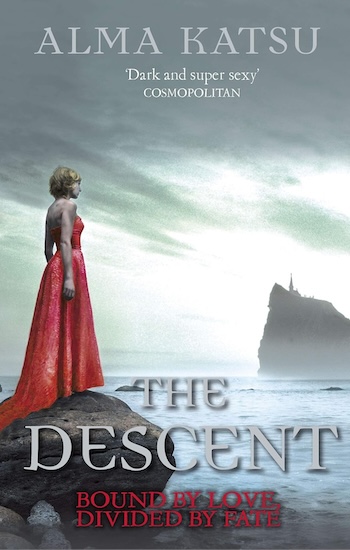
Katsu-T3-DescentAlma Katsu, The Descent (Arrow)

Lanore McIlvrae has been on the run from Adair for hundreds of years, dismayed by his mysterious powers and afraid of his temper. She betrayed Adair’s trust and imprisoned him behind a stone wall to save Jonathan, the love of her life. When Adair was freed 200 years later, she was sure that he would find her and make her existence a living hell. But things turned out far different than she’d imagined.

Four years later, Lanore has tracked Adair to his mystical island home, where he has been living in self-imposed exile, to ask for a favor. She wants Adair to send her to the hereafter so she may beg the Queen of the Underworld to release Jonathan, whom she has been keeping as her consort. Will Lanore honor her promise to Adair to return? Or is her intention to reunite with Jonathan at any cost?

Of all the forces of the universe, the most mysterious, confounding, and humbling is the power of love. The epic story of love and loss, magic and destiny that began with The Taker and sparked a chase around the world in The Reckoning comes to a surprising conclusion with The Descent.

This sounds kind of interesting, although I didn’t realise it was the third in the series… Nuts. Not sure when I’ll be able to get around to reading the first two, but I will put it on the Want To Read list, at the very least. We’ll have to see.

*

LeGuinUK-LeftHandOfDarkness1992Ursula le Guin, The Left Hand of Darkness (Orbit)

Winter is an Earth-like planet with two major differences: conditions are semi-artic even at the warmest time of the year, and the inhabitants are all of the same sex. Tucked away in a remote corner of the universe, they have no knowledge of space travel or of life beyond their own world. And when a strange envoy from space brings news of a vast coalition of planets which they are invited to join, he is met with fear, mistrust and disbelief…

This is one of the classics of science fiction. Naturally, it is also one of the many novels I have never read… So it was nice that this came up as part of the Hodderscape review project (they have teamed up with Orbit for this month’s title). I’ll hopefully get it read A.S.A.P.

*

LeonardA-MothAndSparkAnne Leonard, Moth and Spark (Headline)

A THRILLING QUEST, FORBIDDEN LOVE AND AN EMPIRE ON THE BRINK. MOTH AND SPARK IS THE PRINCESS BRIDE MEETS GAME OF THRONES … WITH A DASH OF JANE AUSTEN.

He’s cursed with an impossible task. She’s blessed with magical visions.

Together they can save a divided Empire.

Prince Corin has been given the task of freeing the dragons from their bondage to the Empire. However, it seems that that not even the dragonriders themselves know how these terrifying beasts are kept under control.

When Tam, a doctor’s daughter, arrives in the capital she makes an amazing discovery: she is a Seer, gifted with visions.

Sparks fly when Corin and Tam meet … but it’s not all happily ever after. Not only is the prince forbidden to marry a commoner, but war is coming to Caithen. Torn between love and duty, they must work together to uncover the secret that threatens to destroy their country.

I don’t really know much about this novel. I’ve seen it mentioned here-and-there, not to mention in the Headline Catalogue I was reading not so long ago. I’m intrigued, certainly – “Game of Thrones meets Jane Austen” is an interesting way of pitching a novel, even if Martin’s epic has become a bit of a publicity crutch in fantasy circles. Never seen it twinned with Austen, though, which is why it caught my attention. I have high hopes for this one. Will probably read it in the new year, after I get back from Canada. [Also, that’s a really nice cover…]

*

StevensT-InformationistUKTaylor Stevens, The Informationist (Arrow)

Vanessa Munroe deals in information – covert information. With an extraordinary intellect, a physique that allows her to pass as either male or female, and ruthless martial arts skills, she offers a unique service to anyone – government or individual – who’ll pay her.

Now a Texas oil billionaire has hired her to find his daughter, who vanished in Africa four years earlier. Where international investigators have tried and failed, Munroe follows a cold trail far into the lawless lands of central Africa.

And then things spin out of control.

Pulled deep into the mystery of the missing girl, Munroe finds herself cut off from civilisation and left for dead. Her only hope of discovering the truth – and of getting out of Africa alive – is to face up to the violent past that she’s fought so hard to forget.

The first in Stevens’s Vanessa Michael Munroe series, this sounds like a pretty intriguing thriller. Not sure exactly when I’ll get to it, but hopefully not in the too-distant future. Sounds like an interesting protagonist, and I like the idea of another thriller set in Africa (it’s been a while since I last read one set there).

*

Wells-SW-RazorsEdgeMartha Wells, Razor’s Edge (Century/ Lucas Books)

Times are desperate for the Rebel Alliance. Harassment by the Empire and a shortage of vital supplies are hindering completion of a new secret base on the ice planet Hoth. So when Mid Rim merchants offer much-needed materials for sale, Princess Leia Organa and Han Solo lead an Alliance delegation to negotiate a deal.

But when treachery forces the rebel ship to flee into territory controlled by pirates, Leia makes a shocking discovery: the fierce marauders come from Leia’s homeworld of Alderaan, recently destroyed by the Death Star. These refugees have turned to pillaging and plundering to survive — and they are in debt to a pirate armada, which will gladly ransom the princess to the vengeful Empire… if they find out her true identity.

Struggling with intense feelings of guilt, loyalty, and betrayal, Leia is determined to help her wayward kinspeople, even as Imperial forces are closing in on her own crippled ship. Trapped between lethal cutthroats and brutal oppressors, Leia and Han, along with Luke, Chewbacca, and a battle-ready crew, must defy death — or embrace it — to keep the rebellion alive.

The first of a new series of novels – Empire and Rebellion, focusing on the core characters from the movies, and adding to that era’s canon. I’m really looking forward to reading this, and also the next in the series, Honour Among Thieves by James S.A. Corey. [Interestingly, going to the series page on Goodreads, you will see “Untitled Luke Skywalker Novel by Kevin Hearne”, due out in 2015 – that could be very cool, too. Watch this space!]

I’m hoping this novel, Scoundrels (below), and also Crucible herald a shift in Lucas Books’ approach to writing fiction in the Star Wars universe: no more nine-book, drawn-out series. Please. They were getting a little tiresome – which is partly why I struggle to rustle up the enthusiasm for reading Apocalypse… But I hopefully will relatively soon, so I can enjoy the aforementioned Crucible.

*

Zahn-Scoundrels(SW)Timothy Zahn, Scoundrels (Arrow)

To make his biggest score, Han’s ready to take even bigger risks.

But even he can’t do this job solo.

Han Solo should be basking in his moment of glory. After all, the cocky smuggler and captain of the Millennium Falcon just played a key role in the daring raid that destroyed the Death Star and landed the first serious blow to the Empire in its war against the Rebel Alliance. But after losing the reward his heroics earned him, Han’s got nothing to celebrate. Especially since he’s deep in debt to the ruthless crime lord Jabba the Hutt. There’s a bounty on Han’s head — and if he can’t cough up the credits, he’ll surely pay with his hide. The only thing that can save him is a king’s ransom. Or maybe a gangster’s fortune? That’s what a mysterious stranger is offering in exchange for Han’s less-than-legal help with a riskier-than-usual caper. The payoff will be more than enough for Han to settle up with Jabba — and ensure he never has to haggle with the Hutts again.

All he has to do is infiltrate the ultra-fortified stronghold of a Black Sun crime syndicate underboss and crack the galaxy’s most notoriously impregnable safe. It sounds like a job for miracle workers… or madmen. So Han assembles a gallery of rogues who are a little of both — including his indispensable sidekick Chewbacca and the cunning Lando Calrissian. If anyone can dodge, deceive, and defeat heavily armed thugs, killer droids, and Imperial agents alike — and pull off the heist of the century — it’s Solo’s scoundrels. But will their crime really pay, or will it cost them the ultimate price?

Excellent, the paperback edition of this highly-anticipated novel! Zahn also wrote one of my favourite Star Wars trilogies, The Thrawn Trilogy, and I’ve been eagerly reading everything else he’s written for the franchise. This is a rather long novel, so the hardcover was utterly impractical for someone who has a three-hour commute into London for work. It would have just become destroyed. So, now that I have the novel in a more-manageable size, I may read on the plane to Canada on Wednesday. We’ll see.

*

Fairest, Helheim, Numbercruncher, Peter Panzerfaust, Sex, The Walking Dead (Graphic Novel Catch-Up)

ComicsRoundUp-20131213

Another round-up of recent reads. I’ve actually been reading a lot more comics/graphic novels than I’ve been reviewing, but I’ve decided to review only the ones I feel really ‘need’ a review. That is, those that inspire particularly strong opinions, or from series that I am particularly fond of already. Others, for example The Walking Dead, have been reviewed plentifully already and my positive reviews wouldn’t really add much to the discussion. But this didn’t stop me from writing something here anyway.

Reviewed: Fairest Vol.3, Helheim Vol.1, Numbercruncher, Peter Panzerfaust Vol.1, Sex Vol.1, The Walking Dead Vols.1-6

*

Fairest-16-ArtFairest, Vol.3 – “The Return of the Maharaja” (Vertigo)

Writer: Sean Williams | Artist: Stephen Sadowski | Inks: Phil Jimenez | Colors: Andrew Dalhouse

When Nalayani seeks the help of the Maharaja to save her village from the Dhole, she uncovers a secret that could change the Fables Universe forever: the still alive and long-thought dead Prince Charming!

Collects: Fairest #15-20

I have made it quite clear on the blog that I’m a big fan of Bill Willingham’s Fables series – it is, without a doubt, one of my top five series of all time. Unusually, the spin-off titles have likewise been excellent (the two Cinderella mini-series, the longer-but-now-complete Jack of Fables, and now Fairest). Fairest was actually the first series in the Fables-verse I tried, and have since devoured as much of the rest as I can (thus-far) afford. The first two story-arcs in this series were fantastic, and especially the second written by Lauren Beukes. This third book, while still excellent, suffered from some minor pacing issues. At the same time, I think it relies on a little more existing knowledge of the main Fables series than previous books have. This is no bad thing (although, it did present a number of spoilers for me, having not read beyond the fifth deluxe collection). The alternative location (Indu) was interesting, and allowed for some refreshingly different mythological influences – ones that have appeared before in the main series, but were never as prominent as they are here.

Overall, though, this is another great addition to the growing Fables canon, and one I would strongly recommend to all lovers of fairy tales and fables.

*

Helheim-Vol.01-TPBHelheim, Vol.1 – “Witch War” (Oni Press)

Writer: Cullen Bunn | Artist: Joëlle Jones | Colors: Nick Filardi

“Once the threshold of Helheim is crossed, not even gods can escape.”

The age of Vikings. Savage wild men, dark creatures, and hideous undead are pawns in the war between witches. A hero named Rikard pays the ultimate price in this conflict… but his fight is far from over. Raised as a draugr – an undead killing machine – Rikard is meant to be used as a weapon in the supernatural conflict. But Rikard will not be controlled. And where the draugr treads, death follows!

Collects: Helheim #1-6

Now this is a very cool start to a new spin on Viking mythology. I don’t want to get too much into the story, as it’s fast-paced and the game is always evolving and moving forward. If you are a fan of Vikings, supernatural horror, great comic art, and solid story-telling, then this is a must. The artwork is superb – Joëlle Jones has a real talent for this genre, and draws some amazing, sometimes-gribbly combat and horror scenes. Witches, demons, the undead, Draugr, and plenty of Viking action. Great fun.

Helheim-01-Interior1

The end of the book leaves plenty of room for more stories in this setting, of which I hope there are many on the way!

*

PeterPanzerfaust-Vol.01Peter Panzerfaust, Vol.1 – “The Great Escape” (Image)

Writer: Kurtis J. Wiebe | Artist: Tyler Jenkins | Colors: Alex Sollazzo

A coming of age tale told through the eyes of a group of French orphans during World War 2 who are saved by a brave and daring American boy named Peter. As they travel together, they get tangled up in the French Resistance in Paris, fighting a growing German presence under the leadership of a fanatical SS officer hell bent on wiping them out! Using the Peter Pan story as a touchstone, Peter Panzerfaust reinvents familiar character and plot elements in a unique and creative way.

Collects: Peter Panzerfaust #1-5

I picked this up on a whim. I’d seen the writer’s name attached to a couple of new, very intriguing series, and decided to try out this book. I’m a big fan of the Peter Pan story (the movie Hook was a surprisingly large part of my childhood… I think I’ve seen it about six times), and this is a particularly interesting, well-crafted adaptation. Although, really, it’s more of a strong homage than adaptation. There are obvious parallels, but Wiebe has really managed to create something pretty original. The story is very well plotted, moving at a brisk-but-unhurried pace, and the characters experience both the highs and lows of living during a war. It was quite moving at times, too. The artwork is pretty interesting, too, with a rather distinctive aesthetic – the characters are slightly otherworldly and waifish, even impish, at times, but it is never a distraction or visually jarring.

Overall, this is a really interesting start to a quirky, recommended series. I can’t wait to read the next volume.

*

Numbercruncher (Titan Comics)

Numbercruncher-1to4

Writer: Si Spurrier | Artist: P.J. Holden | Colors: Jordie Bellaire

Dying young, a brilliant Mathematician enters the afterlife and discovers a way to cheat the terrifying Divine Calculator. He schemes to be endlessly reincarnated within the lifespan of the woman he loves, no matter how often the violent bailiffs of the Karmic Accountancy cut-short each life. It falls to one such agent – the surly Bastard Zane – to put a stop to the time-twisting romance!

From the brilliant mind of Simon Spurrier comes this new, bizarre story. It is part love-story, part resurrection myth, thriller and also whodunnit. It’s also a bitch to review: there are so many twists and turns, that to spend really any time talking/writing about it would rob these surprises of all their power. I knew basically nothing when I read it, and as a result this was a very fresh story. It builds very nicely over the course of the four issues (which also include a number of interesting extras), and I had no idea how it was going to end. A really pleasant surprise, this only raised my admiration for Spurrier’s creative talents.

Highly recommended.

*

Sex-Vol.01Sex, Vol.1 – “The Summer of Hard” (Image)

Writer: Joe Casey | Artist: Piotr Kowalski

Retired superhero Simon Cooke has returned to Saturn City to live life as a “normal” civilian. Easier said than done!

This is a tricky one to review. If I’d been reading Sex issue-by-issue, just once a month, I may not have got past the second instalment. It took too long to start, really. At the end of this collection (eight issues), it still felt like the story had some way to go before the depth was properly explored (no double entendre intended).

The motivations and psychologies of the characters are only just starting to take shape and make sense (there have been a few jumps, obfuscations, etc.). Simon Cooke actually feels a little flat – we’re basically told he’s having difficulty with his re-assimilation into “normal” life (he’s a billionaire a la Bruce Wayne, in a city starkly divided along socio-economic lines – how “normal” can his life be?). He only started becoming interesting right near the very end of the book. Some of the characters who enter his orbit have a lot of potential, though. Maybe the second book will cement things into their proper places, but I do worry that’s too late for readers to wait or commit to.

At the same time, the story is not, in many ways, what I was expecting. This is both good and bad. I had hoped for something in the vein of a less-ugly version of The Boys, exploring the idea of superheroes in their “down-time” or after their retirement, but minus the… I don’t know, skeezy quality? Instead… We basically only get a prologue to something maybe bigger. In many ways, “Sex” is a bad title – attention-grabbing, certainly, and descriptive of some of the content (which does venture into the psycho-sexual, and/or graphic territory), but the main character, Cooke, is pretty much a complete prude. Anyone who’s looking for just a smutty comic will come away disappointed, and anyone who’s hoping for more nuance (like me), will likewise come away feeling a little dissatisfied. It has the beginnings of something pretty interesting, but maybe the expectation of making this a “naughty funny book” eclipsed the storytelling that should have been the priority?

Overall, then, this is probably going to shape up in an interesting way, but the pacing as a monthly comic will likely disappoint many, and will probably lose readers along the way. A pity. This had potential.

*

The Walking Dead, Vols.1-6 (Image)

WalkingDead-Vols.1to3

Writer: Robert Kirkman | Artist: Tony Moore

The world we knew is gone. The world of commerce and frivolous necessity has been replaced by a world of survival and responsibility. An epidemic of apocalyptic proportions has swept the globe, causing the dead to rise and feed on the living. In a matter of months society has crumbled: no government, no grocery stores, no mail delivery, no cable TV. In a world ruled by the dead, the survivors are forced to finally start living.

What is there, really, left to say about The Walking Dead that hasn’t been said already? It’s a phenomenon all by itself. The premise is great – what happens after the apocalypse? Kirkman has been on the record stating that he imagined this series going on indefinitely, because he was dissatisfied with zombie movies’ and fiction’s tendency to just end. The series has now hit its 18th collection, I believe, so I still have a lot of catching up to do.

I’d seen the first series of the AMC TV show (and really enjoyed it), but never really felt much interest in reading the comic series that spawned it – despite my newfound interest in comics in general. As has been so often the case in the past couple of years, following a sale on ComiXology, I gave the first couple of collections a try, and was damn-near hooked! I have a fondness for post-apocalyptic stories and series (probably for exactly the clichéd or textbook reason most people like them), and this is a pretty great one.

It’s interesting how the story has unfolded over these six books: characters have come and gone (often brutally), but it is not always at the jaws of a zombie (or horde thereof). Kirkman and Co. have focused on the survivors, how they cope – or not – with the new reality they find themselves in. There are plenty of shocking moments, often rendered in arresting full-page pieces. The black-and-white artwork suits the story and mood, too, and there’s plenty of great use of shadows and darkness from which the zombies do lurch and grab.

I do sometimes wonder how on earth they’re going to keep this going and interesting over the course of such a long series. But, I’m certainly interested in finding out – not to mention also catching up with the TV series, which has diverged quite a bit from the series, I hear (from a Rolling Stone cover story). On the strength of these six books, though, I would say the series absolutely deserves the success it has enjoyed. Definitely recommended.

WalkingDead-Vols.4to6

President Obama in Comics: An Interesting and Peculiar Selection from the Sub-Sub-Genre…

President Obama has already featured in a number of comic books: be they comic/graphic adaptations of his life story, campaign-biography style one-shots, or cameos in established series comic series (such as Marc Guggenheim’s Avenging Spider-Man, below). Few presidents have excited the imaginations of such a broad segment of the American public and creative industries as has the 44th president. As someone who is interested in the cross-over areas of politics, media and pop culture, these past five years have been a fertile time for alternative presidential coverage.

BarackObama-01

Boom Studios’ Barack Obama 2012 Election Issue

ObamaComicCovers

Barack Obama: The Comic Book Biography (IDW, 2012); Marvel’s Amazing Spider-Man: Election Day Cover, 2008 (above) and interior pages (below)

AmazingSpiderMan-ElectionDay-Interior0

Most recently, IDW Comics published The Other Dead (currently at issue #4), which is elevator-pitched as “Zombie Animals Devour the World”. The longer-form description sounds like a familiar, fauna-twist on The Walking Dead:

“As a weary community braces for the onslaught of an incoming superstorm, an even more insidious force grows right under their noses! When a sudden outbreak turns every animal in sight into raging, flesh-craving monsters, a colorful cast of characters will have no choice but to contend with THE OTHER DEAD!”

But, as the series unfolds, and the infection spreads across America, a diverse cast of characters – “ranging from a demon-obsessed death metal band to a paranoid survivalist to the President of the United States himself” – will try to contend with and combat “the most unpredictable zombie outbreak in history.” I don’t have any interior page previews featuring the president, but of the 11 cover variants that have thus-far been revealed for the first four issues, there are two (#1 and #4) that feature President Obama prominently, toting some serious firepower:

OtherDead-ObamaCovers

The Other Dead issues #1-4 are out now, published by IDW Comics. The series is written by Joshua Ortega and Digger T. Mesch, cover artwork is by Kevin Eastman, interior artwork is by Qing Ping Mui, and colouring by Blond.

An Interview with TOBY VENABLES

Venables-HOS1-KnightOfShadows

Today, an interview with horror author Toby Venables, whose latest novel Knight of Shadows was recently published by Abaddon Books. We chatted about the changing nature of genre fiction, writing, undead vikings, and a 12th Century James Bond…

Let’s start with an introduction: Who is Toby Venables?

He’s a fictional construct I’ve been working on for several decades, with mixed success. I just couldn’t nail who or what this character was. He worked as an artist (badly), busked a bit, then worked at a press agency, then got a job in the library of a Cambridge College (alongside Simon Blackwell, who went on to create Armstrong and Miller’s street-talking airmen, and writer of The Thick Of It – it was basically a waiting room for aspiring writers). Finally he got involved in magazine journalism and became an editor, and things seemed to be getting somewhere. He launched magazines in Cambridge, Oxford and Bristol, doing interviews with all manner of celebs. He chatted with Bill Bailey and Eddie Izzard. He met one of his childhood heroes, Ray Harryhausen. He even turned down dinner with Cate Blanchett. It was all starting to come together, in a rather name-droppy kind of a way. Then it all changed again. He went freelance, working as a copywriter, started teaching film stuff at Anglia Ruskin University, and began writing film scripts – one of which went through a long period of development and is even now awaiting the green light. Then suddenly novels happened when he pitched an apparently daft idea – Vikings and zombies – to Abaddon, and they said “yes”. Because it was four fifths historical novel, that led to Knight of Shadows. But also a kind of semi-career in academia as “the zombie guy”. (Are you still following this? Not that these things aren’t interesting, but it’s all a bit chaotic, story-wise.)

I think I’m finally getting somewhere with him, but it’s been a long haul – I wouldn’t blame someone for having got fed up with it around 1992.

Venables-HOS1-KnightOfShadows

Your latest novel, Hunter of Sherwood: Knight of Shadows, was published by Abaddon in October. How would you introduce the novel to a potential reader? Is it part of a series?

It’s set during the Third Crusade, when Richard the Lionheart is off fighting – possibly never to return – and Robin Hood is having his merry way with England. But it’s not primarily about Hood. Our hero is Guy of Gisburne – the man traditionally cast as the villain in the Hood legends. And it is not merely the same old tale told from Gisburne’s perspective. He is an agent for Prince John and a true hero, and Hood is far from the great saviour we have come to know. In fact, he is a psychopath. The trouble is, half of England seems to think he’s wonderful… Originally, it was to be a series, much like Abaddon’s Pax Britannia (steampunk), or Malory’s Knights of Albion (Arthurian, obvs), but after discussions we decided to make it a trilogy – which was fine by me, as it meant I got to write them all, and also had the opportunity to develop a more distinct story arc that would unfold through the three books. There are gaps in the timeline, though, so there is potential to go back and see what Gisburne got up to in the summer of 1192, for example. I think some short stories about his lesser missions would be great. But first things first…

What inspired you to write the novel? And where do you draw your inspiration from in general?

VenablesT-VikingDeadThe “inspiration” was, initially, very journalistic. It was a brief, in effect, brought to me by Abaddon’s Commissioning Editor David Moore, who had the idea to do a series which featured Guy of Gisburne as a kind of 12th century James Bond. Who could resist that..? Because I’d written The Viking Dead for Abaddon, which had a historical setting, he thought I might be a good candidate to take this on, then I fleshed it out and built the story, the characters and the motivations that made the cogs mesh. So, it was kind of a gauntlet thrown down – the sort of challenge that I absolutely love – and I’m immensely grateful to David and Abaddon for the opportunity to do it. Such challenges don’t suit every writer, but they are a spur for me.

In general, though, what inspires me most is cinema. Although I’m working primarily in prose, overall I’m more influenced by films than by other prose fiction, and I think anyone reading the books will spot that. I try to write in a cinematic way, but also I do make direct – or, sometimes, rather obtuse – references to films I love. In Knight of Shadows there’s a Fistful of Dollars bit, a Raiders of the Lost Ark bit, a First Blood bit… I even crowbarred a reference to The Italian Job. And there are some obvious thematic connections with The Dark Knight. But all those things have a place in the story that is completely logical (let’s face it, many of those films already owe a huge debt to classic stories, legends and folklore). It’s important that it’s not just gratuitous – but also I want to relate the action to things that people will know. That’s partly to give it a relevance and immediacy, but also to bring home the fact that those people were, in many ways, just as bold, resourceful, fallible or funny as we are now. Often I find I want to emphasise the familiar, rather than the exotic, which is perhaps an unusual approach for what is loosely termed “fantasy”. It’s easy to see the past as some kind of foreign land. Maybe it is that, to some extent – but it’s a foreign land from which we all came. For me, part of the excitement of history is seeing its direct relevance to today, and finding those points of connection. Maybe that’s why “a 12th century James Bond” struck such a chord.

Venables-MovieInfluences

How were you introduced to genre fiction?

Crikey. When was it ever not there..? There’s an example I often cite, which is the Beowulf and Grendel story. It was read out to us at school, and the whole bit with the wrenching off of the arm left a strong impression. I think it was the first time I was conscious of something being “horror” – of being simultaneously repelled and excited. I still love that story, and intend to write a version of it some day. A big, dark, monstrous novel. Then as I grew up I started to read a lot of science fiction. I kind of worked backwards, starting with 2000AD, then Ray Bradbury and classic hard SF writers like Asimov, Clarke and A.E. Van Vogt, then H.G. Wells, then Frankenstein. Kind of an archaeological excavation of SF. I also had a very nerdy Tolkien period when I was about 14. I made up totally impractical alphabets and watched the whole of Wagner’s Ring Cycle on TV. I still love that. It’s like proto-cinema.

How do you enjoy being a writer and working within the publishing industry? Do you have any specific working, writing, researching practices?

My background is in journalism, and much of what I’ve learned, and my approach to writing, is coloured by that. I was a very undisciplined writer before that, hardly ever finishing anything. Working in journalism taught me about deadlines, and that sometimes getting something done is better than getting it perfect. We’d all love more time to hone what we do, I think, but striving for perfection can become a bottomless pit from which the finished work never emerges. It’s good for the ego to make occasional mistakes and to learn to live with them. The books for Abaddon were written very quickly, with little opportunity to fuss over them. I still did, but at least there was an editor telling me to stop. Otherwise I’d still be faffing about with the twentieth draft of The Viking Dead, and have nothing in print.

Research is something I adore, but if you’re not careful it can become all-consuming – a pleasant diversion from the actual work of writing. It is important to me that things are feasible within their period. I have also woven a lot of actual history (and quite a few historical characters) into the mix, and have tried to ensure that it all fits. But there comes a point where you have to put the research aside – having, hopefully, absorbed enough of it – and just let the characters do their thing. I do sometimes obsess over small details – I’d rather include something real than make it up, if there is indeed something real to be drawn upon – but overall I try not to be pedantic. Some hard-line historical reenacters will not do a thing unless they can find a specific precedent for it in the historical record. I’m not like that. As long as it is possible – and logical, and interesting – I’m happy. People then were not so different from us – just as intelligent, creative and eccentric – and so would have used their ingenuity just as much as we do. Probably more so, through sheer necessity. That’s my fundamental approach. Basically, if a thing was possible, someone probably did it, which opens up some interesting possibilities – such as dreaming up 12th century gadgets for this 12th century James Bond.

When did you realize you wanted to be an author, and what was your first foray into writing? Do you still look back on it fondly?

Venables-AuthorPicHa ha – kind of… I’ve always been a writer. I just didn’t realise it. At university I studied English Literature and Art History, but also did studio work (painting, sculpting, etc.). At one point it looked like I might be an artist – and, in fact, I worked as a printmaker for a year after uni (making angst-ridden, Munch-style views of Cambridge that no one actually wanted to buy) – but nearly all of the artwork I did during the three years of my degree involved words. I should have caught the clue, really.

The first writing I remember doing was a ghost story in primary school. Our English teacher read it out, and said nice things about the description. Grown-up kind of things really. He was a wonderful teacher – not at all patronising, which was a rare thing. Looking back, the fact that he treated it as a piece of writing and not something by a kid made a huge difference. It was incredibly encouraging. Naturally, given this early success, I wrote several sequels, and even developed a recurring character. Later, when I was a teenager, I wrote a totally unpublishable “novel” – part SF, part comedy, part psychedelic concept album. If that sounds bad, it was, it really was… It was actually written in a series of episodes, Dickens-style, and several school friends became devoted readers. But Dickens it ain’t. Some bits of it were quite good, but mostly it was just a bit embarrassing, pandering to my captive audience. And I blatantly nicked elements from everywhere: The Hitchhikers’ Guide, TV programmes, films and anything else that we were into. It was full of in-jokes. I just made it up as I went along, which was how I thought novels were written at the time. Consequently, it had a really crappy, cobbled together soap-style ending. I still have it somewhere. Hopefully it’ll never see the light of day, though it probably taught me more than I realise.

What’s your opinion of the genre today, and where do you see your work fitting into it?

It’s incredibly rich and diverse at the moment, with lots of crossovers from one genre to another, and also one medium to another. Harry Potter, swiftly followed by Peter Jackson’s Tolkien adaptations, have changed the entire landscape – so much so, it’s hard to remember what it was like before. My wife is also a writer, and when we were first touting TV scripts around about ten years ago, the big frustration was that no one here wanted genre. They thought it wasn’t viable on British TV and repeatedly said “We’d love to make this, but we just can’t…” Then Dr. Who came back, and it all went bananas – genre everywhere. The massive growth of the internet has meant that fan fiction has kind of gone crazy, too. That’s inspired and revealed a lot of new talent. There’s a down side to all this, though – and I don’t just mean 50 Shades of Grey. Spurred by this appetite for genre, publishers and writers have started tapping completely new markets – essentially the people who were never really into genre before, but who seem like they might respond a “lite” version. So, we now have some very undemanding, rather wishy-washy stuff out there. I’ve nothing against Twilight and others in themselves – there’s room for it all – but they’re just not my thing. Some of these are the literary equivalent of alcopops – hard stuff made into brightly coloured, fizzy drinks so they’re palatable for teenagers who don’t want their tastes challenged. Mostly I feel it’s a lost opportunity, because cinema shows us that it’s possible to do user-friendly stuff and still say something worthwhile, as with all those great films of the ’80s – ET, Back to the Future, Gremlins, and so on. The key difference is that those were made by people who were really into it, and who knew their genre inside-out. Now we have examples of genre by people who apparently aren’t really into genre, for an audience that isn’t really into genre. That’s never gonna set the world on fire – though some people will hate me for saying so.

Where I fit into all this, I have no idea! I think the direction I would like to go is historical fiction, with the occasional horror/SF mash-up. I like unexpected combinations. I just want it to surprise me, and I think most readers want that too. The wizards/dwarves/dragons variety of fantasy isn’t really my thing – at least in terms of what I want to write. The Beowulf novel, when I get around to it, will feature a big dragon, however. It’s old skool – not a noble creature that someone with a funny name has to bond with so he/she can ride it like a big scaly horse, but a ravening monster. Something that has to be destroyed.

What other projects are you working on, and what do you have currently in the pipeline?

The current thing is the second book of the Gisburne series, whose working title is The Red Hand. It’s about a crazed killer who Gisburne is tasked with stopping and the action takes place mostly in and around medieval London. Think Silence of the Lambs meets Sherlock Holmes – with swords. I’m also planning something rather different, albeit using similar geography – a steampunkish zombie extravaganza set in Victorian London. It’s called Zombie & Son, and is kind of all my favourite 19th century novels put into a blender. With zombies. It begins in a very real, gritty world – no fantasy elements at all – but gradually spirals out of control until London has become a kind of surreal hell on earth (insert joke poking fun at the state of modern London here…). There’s also a screenplay which is waiting to get made. It’s completely different – a contemporary heist/action movie with kind of a western feel to it.

What are you reading at the moment (fiction, non-fiction)?

Fiction: Kim Newman’s Anno Dracula. I’ve been meaning to read it for years, but also Zombie & Son (see above) is also set in late Victorian London with some steampunkish elements. Best to make sure I’m not just rewriting what Kim wrote 20 years ago. That would be silly. I don’t think it’s likely – they’re actually very different worlds – but it’s nice to have an excuse to call this “research”. Also, I just got Dan Simmons’ Song of Kali, which I am very much looking forward to. I absolutely loved The Terror – nine parts amazing historical novel, and one part mind-bending horror. Fabulous book. Song of Kali has been described as one of the most terrifying novels ever written. Who can resist that?

Venables-Reading

Non-fiction: lots of books about things medieval – especially 12th century London (for book two). It’s a tricky period in some respects; the next century is when things really take off and the city undergoes massive expansion, so most of the studies of medieval London tend to focus on the 13th-14th centuries (unlike Paris, for which there’s masses of detailed information about the year 1200). But that in itself makes the earlier period of the place interesting to me. Lots of things just beginning, lots of unrealised potential.

What’s something readers might be surprised to learn about you?

I won the Keats-Shelley Memorial Prize in 2001, for an essay on Shelley’s “Ozymandias”. The (rather modest) prize was £1,000 and I spent it on a cherry red Fender Telecaster. Very rock ‘n’ roll – or it would be if I was actually any good on it.

What are you most looking forward to in the next twelve months?

52 weekends! I might even get away with idling on some of them… But also, the second Guy of Gisburne book will be finished (I hope) and out. Then I’ll be on to book three, and embarking on Zombie & Son in between. That takes me back to my zombie roots, but steampunk style – and I get to destroy Victorian London along the way. Can’t wait.

***

Both Knight of Shadows and Viking Dead are out now in paperback and eBook!