Short Story Review: “Know Thyself” by Andy Smillie (Black Library)

Smillie-KnowThyselfMore superb Flesh Tearers from Smillie

Sent to meet with Flesh Tearers Chapter Master Gabriel Seth to discuss a recent incident in which the Flesh Tearers and Space Wolves came to blows, Inquisitor Corvin Herrold boards the flagship of the Chapter, the mighty Victus. But when he discovers a shocking secret, Herrold finds himself a prisoner of Sanguinius’s most dangerous sons, and his audience with the Master of the Flesh Tearers proves more perilous than he could have ever imagined.

Andy Smillie has done it again: he has managed to portray characters that should be mindless, ferocious psychopaths in a nuanced, relatable, and not-unsympathetic manner. What Aaron Dembski-Bowden does in long-form, Smillie has mastered in this shorter-format.

It was really interesting to see how the Flesh Tearers’ command deal with the Inquisition, and their extreme means of conveying unto those who deem them heretics and corrupt what lies at the heart of their character. It’s not pretty, nor is it supposed to be. The Tearers are the way they are, a distillation of the more brutal aspect of their originator Primarch, Sanguinius.

This is a superb short story, and I can’t wait to read more by Smillie. I really must get caught up with Flesh of Cretacia

More Flesh Tearers by Andy Smillie: Beneath The Flesh, Torturer’s Thirst

[This story was originally published in the Black Library Weekender Anthology 2012: Saturday.]

Four HORUS HERESY Short Stories by Graham McNeill, Rob Sanders, James Swallow & Gav Thorpe (Black Library)

HorusHeresy-Logo

Near the end of July, Black Library released four Horus Heresy short story eBooks through their website. Naturally, as a real Heresy junky, I gobbled these up ASAP. All four are pretty different, offering alternative perspectives on different events and times during the galaxy-spanning civil war that dictates much of how mankind operates in the 41st Millennium (the ‘present’ for the game and system). So, here are four mini-reviews of these excellent stories… Continue reading

Dead Cat Bounce… [Musical Interlude]

DEAD CAT BOUNCE – I learned about this band today. I went to school with the lead singer. Haven’t spoken to him since school (too many years ago to admit to…). This is kinda surreal. But they’re funny, and actually talented… So check ’em out.

First, a song for Movember…

Hack/Slash, Vol.9 – “Torture Prone” (Image)

Writer: Tim Seeley | Artist: Daniel Lester | Colors: Mark Englert

In a dark future ruled by the Murder Messiah, street witch Liberty Lochs is on a mission to change the past. Meanwhile, horror heroes Cassie Hack and Vlad must contend with an obsessive serial killer, and a duo of slashers they thought they’d already put down.

Collects: Hack/Slash (Image) #1-4

I heard about this series last year, when I saw the second, massive omnibus edition in The Strand in New York. I had no idea what it was all about, and didn’t have enough cash to buy it. Then, after Seeley was announced as the new writer for Witchblade, I decided to give his back catalog a look (I tend to do this sort of thing). I started with the mini-series published by Image, My First Maniac, which I enjoyed a great deal. Little did I know that none of the original, pre-Image series was available on ComiXology (please fix this soon…!). This is also why I am, quite inexplicably, willing to start with the ninth volume of a series. With the final issue now out, it seemed like a great time to dive in and read the whole lot (there were only 25 issues published by Image). All in all, this is a solid, quirky, original, slightly unsettling comic. Pretty cool, then.

[This is another review that has been languishing for quite some time. A lot more graphic novel reviews to come, as I power through in my catch-up.]

To kick things off, it might be a good idea  to share the synopsis from Volume 1, as it lays out the root premise of the series quite nicely:

“In every slasher movie, there’s one girl who makes it all the way to the end. She’s the survivor… the last girl. Meet Cassie Hack, the lone survivor of an attack by a vicious slasher called The Lunch Lady. Now Cassie, along with her monstrous partner, Vlad, travel the country, hunting down other slashers before they can leave a trail of blood and terror.”

In this book, we’re dropped right back into the already-established story, but I didn’t find myself particularly lost (there’s a handy dramatis personae at the start of each issue, which will help locate other new readers). The story sees Cassie and Vlad separated from their companions, drawn away by the Acid Lady – a lurker (catch-all term for the beasties and other supernatural antagonists) with the body of an implausibly sexy woman, and the ability to dissolve others with a mere touch, as well as the ability to control them through contact. The two sides have clashed before, in a previous story-arc.

HackSlash-02-Interior1

Those breasts are ridiculous!

Cassie and Vlad are forced to examine their situation and partnership – Vlad feels a little taken for granted. They decide to jettison their friends by the end, and to strike out on their own. Before that, though, they need to deal with the undead creatures who are attacking their friends… Revelations abound.

The humour in the series is pretty good. It sometimes errs a little too close to puerile/sophomoric for me, but I’d be lying if I said it never made me chuckle (see below).

HackSlash-04-Interior2

Ah, boobs-in-the-face. A winning strategy in motivating your monster sidekick…

The demon dog, for example, was quite amusing. And poor Cat Curio (“Girl Sherlock”)… her story was amusing because she was more hapless than not, yet surprisingly effective and capable in a really strange way…

HackSlash-01-Interior3

Those two middle panels made me chuckle.

Overall? This is quite fun. The artwork is reminiscent of Zenescope’s cover aesthetic, at times (including the bottom-accentuating cover visual), and some bodies are bizarrely shaped (particularly the women, all of whom are buxom and curvy – I wonder if this is part of the tongue-in-cheek, knowing nods to slasher movies, and the high number of gorgeous women in those, too…?). But, in general, this is a strange, slightly bonkers horror comic that is filled with tongue-in-cheek humour, bloody monster hunting, and a pretty good story.

I haven’t managed to get the next volume (“Dead Celebrities”), yet, but as soon as I have the available, disposable funds, I’ll be sure to expand my collection. I did, however, get hold of Seeley’s Revival, which was on sale through ComiXology a little while ago. I hope to review that very soon, as I’ve dipped in already and think it’s equally weird and cool. (Wow, that has got to be the least eloquent endorsement, true as it is…)

I’d recommend this for anyone looking for something a little different – a mix of horror, comedy, supernatural, and even a smidgeon of super-hero themes. Seeley’s a talented writer, and I look forward to reading a lot more of his work.

Batman & Robin, Vol.2-3: “Batman vs. Robin” & “Batman and Robin Must Die!” (DC)

Batman&Robin-Banner

I’m still catching up with a huge backlog of comics/graphic novel reviews, but I decided to collect these two books together. Partly because they’re obviously connected, but also because I wanted to get the reviews out of the way. After liking the first volume in Grant Morrison’s Batman & Robin run far more than I anticipated (I’ve written plenty of times how I think he’s highly over-rated), I dove in to the second and third volume pretty soon afterwards. (Told you I was being slow with reviewing…) Sadly, my pleasant surprise at the quality of volume one evaporated with these two books. These are, frankly, not so good.

Volume 2: “Batman vs. Robin”

Batman&Robin-Vol.2Writer: Grant Morrison | Artist: Cameron Stewart (#7-9), Andy Clarke (#10-12) | Colors: Alex Sinclair (#7,10-12), Tony Avina (#8-9,11) | Inks: Scott Hanna (#10-12)

The new Batman and Robin uncover clues involving the mysterious death of Bruce Wayne before facing off against each other in a heated battle instigated by Robin’s mother that both heroes will regret – if they live through it! Featuring a 3-issues storyline that ties into the best-selling BLACKEST NIGHT event titled “Blackest Knight,” this new collection is a must-have for both new readers and longtime fans of Grant Morrison’s Batman epic as the superstar writer unveils more of his genre-defying masterplan!

Collects: Batman & Robin #7-12 (pre-52)

We start in London. And this is the Grant Morrison I know. The story contains some thinly-veiled (to a Brit, at least) social and political commentary. Nothing wrong with this per se, but it wasn’t particularly well-done. Also, #7 (the first chapter in this book) was a bit muddled, to be honest. Suddenly, Batwoman’s there (why?), and also the Knight & Squire. Frankly, this was not good, following the previous issues.

Newcastle vs. London? Really? Writing a Geordie accent is never a good idea. Just sayin’.

The Batwoman story and presence was dealt with in two pages. There was some linkage to Morrison’s Event that killed Batman. It was not great, and rather rushed. Oh, and then Damian takes over as chairman of the board for Wayne Enterprises! At age 10! Of course! That isn’t moronic at all!

This book starts the return of Bruce Wayne. The story has moments which are quite fun, but the dialogue can sometimes be awful… (“It’s like the whole house is coming to life.” – #10, p.11) The story jumps forward, after getting us some way through the ‘treasure hunt’, only to not bother with the end of it. This just reinforces my belief that Morrison is a lazy writer. The story was half-assed. Really disappointing. At the same time, I didn’t see the end coming. So there’s that, I suppose.

*

Volume 3: “Batman and Robin Must Die!”

BMROBBMD_DLX_DJ.qxdWriter: Grant Morrison | Artist: Frazer Irving (#13-16), Cameron Stewart (#16) | Colors: ?

On the eve of Bruce Wayne’s return to Gotham City, the new Batman and Robin team that battled crime during his absence must deal with the return of The Joker.Then, Grant Morrison connects the BATMAN & ROBIN story with the bestselling THE RETURN OF BRUCE WAYNE in the climactic showdown between Batman and The Black Glove.

And in a story illustrated by acclaimed artist David Finch, learn what happens to Dick Grayson after the “real” Batman returns.

Collects: Batman & Robin #13-16 (pre-52)

So, so sloppy.

That is basically how I feel about this book. It feels like Morrison is in a hurry to get things over with. The book ends with Batman Incorporated established – an event that spawned one of the worst books I’ve read. It is a dismal finish. Bruce Wayne just appears back in action at the end. There’s no real development of why or how (I assume one had to read The Return of Bruce Wayne and who knows how many other books/issues to get the full story).

So much has happened to the Bat-franchise during Morrison’s tenure at the helm, and I’m not at all convinced it’s all (or even mostly) good… This was, in many ways, complete gibberish. Maybe, as I’m sure die-hard Morrison fans will argue/wail, I just don’t “get” it, that he’s writing on a level that is above my comprehension. Ultimately, though, I just think he’s a bad writer.

I think I’ll probably just borrow the New 52 Batman Incorporated from my local library (it gets an excellent selection of New 52 books in), as once again he’s been handed the reins for another game-changing event. (Seriously, how can anyone think he’s the best choice, when compared to everyone else currently writing for a Bat-title?!)

I much prefer Peter Tomasi’s take on Damian Wayne, in the New 52 Batman & Robin. Tomasi’s writing overall is also superior in pretty much every way. Actually, everyone else working on Batman-related titles is doing a better job by far. I think I’m done attempting to find the supposed genius and/or magic in Morrison’s work. It just isn’t there, and I’m disappointed every time. Well, always except for one instance: Action Comics #0 wasn’t bad.

*

A closing comment for both of the books: the art is good. The one benefit of Morrison’s reputation, is that DC has allowed him to work with some exceptionally talented artists. For that, at least, we can be very grateful. The artists who worked on both of these books do a great job throughout.

*

One final comment: At least the Pink Flamingo wasn’t present in these books. He was an utterly ridiculous character.

Ok. I’m done, now.

Guest Post: “Language and World-Building” by Emily Croy Barker

CroyBarkerE-ThinkingWomansGuideToRealMagicWhat sort of languages do they speak in other worlds? I gave some serious thought to this matter in writing my novel, The Thinking Woman’s Guide to Real Magic — and was intrigued and inspired to discover, in reading about the life of J.R.R. Tolkien, that the same question had helped spark the creation of Middle-earth itself.

Tolkien was 22 years old and a philology student at Oxford University when he encountered the eighth-century Old English poem Crist by Cynewulf. As Colin Duriez writes in J.R.R. Tolkien: The Making of a Legend, the poem included a couple of lines that Tolkien found intensely evocative:

Eala Earendel engla beorhtast

Ofer middangeard monnum sended.

“Hail, Earendel, of angels the brightest,

Sent over middle-earth to mankind.”

Tolkien was struck particularly by the name “Earendel,” which has roots in older, Germanic languages and which he called “euphonic to a peculiar degree.” It inspired him to write his own poem about a hero’s quest.

Instead of just borrowing the name “Earendel,” however, as a good philologist Tolkien worked out an equivalent in Elvish, the private language that he had been developing from Norse and Germanic roots. Earendel becomes “Eärendil” in Tolkien’s poem – and in the sprawling mythology that would eventually underlie The Lord of the Rings and The Silmarillion.

“…The name could not be adopted just like that,” Tolkien later wrote. “It had to be accommodated to the Elvish linguistic situation, at the same time as a place for this person was made in legend.” Elvish, he went on to say, “was beginning, after many tentative starts in boyhood, to take definite shape at the time of the name’s adoption….” In a foreword to The Lord of the Rings, he wrote that the legends and myths of Middle-Earth were “primarily linguistic in inspiration and was begun in order to provide the necessary background of ‘history’ for Elvish tongues.” For Tolkien, the creation of a fantasy world, its history, and its language were inextricably intertwined.

CroyBarkerE-AuthorPicCreating my own fantasy world, I kept that lesson in mind. In my novel, Nora, a graduate student in literature, wanders into an entirely different world, where she ultimately begins the study of magic. Before that, however, she has to learn the language.

Luckily, she’s able to pick up the basics of the common tongue, Ors, while under a translation spell. But it still takes her a while to grasp the nuances of the language and to develop real fluency, not to mention to lose the unfortunate accent that she accidently acquired while under the spell. As she masters Ors, she also learns more about the strange, often frustrating new world in which she finds herself. There are 12 different words for sheep. Given names in the ruling class are all patronymics. Women are supposed to speak slightly differently—more hesitantly—than men. Nora learns just what some of her new friends think of her when she overhears them referring to her with a pronoun used for inanimate objects, animals, or servants.

I want to be perfectly clear: In inventing a language, I was nowhere near as rigorous, analytical, or sophisticated as Tolkien was. There’s no Ors dictionary or grammar. But including just a few details of how the language worked added interesting texture to the world that I’d imagined.

It also helped me show how foreign this place initially seems to Nora. More than once, she’s frustrated because there’s no Ors equivalent for the English word she has in mind. For an academic like Nora, being suddenly illiterate is quietly terrifying. The first time that she even begins to feel at home in this alien world is when she picks up a child’s lesson book in Ors and realizes that she can teach herself to read.

Language is what we build stories out of. We can also use it to build worlds.

***

Emily Croy Barker is the author of THE THINKING WOMAN’S GUIDE TO REAL MAGIC, published by Penguin US this month. To find out more, be sure to follow Emily on Facebook and Twitter.

An imaginative story of a woman caught in an alternate world—where she will need to learn the skills of magic to survive

Nora Fischer’s dissertation is stalled and her boyfriend is about to marry another woman.  During a miserable weekend at a friend’s wedding, Nora wanders off and walks through a portal into a different world where she’s transformed from a drab grad student into a stunning beauty.  Before long, she has a set of glamorous new friends and her romance with gorgeous, masterful Raclin is heating up. It’s almost too good to be true.

Then the elegant veneer shatters. Nora’s new fantasy world turns darker, a fairy tale gone incredibly wrong. Making it here will take skills Nora never learned in graduate school. Her only real ally—and a reluctant one at that—is the magician Aruendiel, a grim, reclusive figure with a biting tongue and a shrouded past. And it will take her becoming Aruendiel’s student—and learning magic herself—to survive. When a passage home finally opens, Nora must weigh her “real life” against the dangerous power of love and magic.

The novel has been described as perfect for fans of Lev Grossman’s Magicians and Deborah Harkness’s A Discovery of Witches.

Guest Post: “Post six. Sweet and Dandy: Toots and the Maytals (Chapter: Six days later – A conversation about Ska)” by Celine Kiernan

Kiernan-IntoTheGrey

Into the Grey is a ghost story about twin brothers, Pat and Dom Finnerty, whose lives are turned upside down by the loss of their home and by a subsequent haunting. The book has quite a few chills, there’s quite a bit of political history in it, much exploration of death and loss – but there’s also a lot of love and kindness in it, a fair few laughs and a lot of bravery. I thought I’d have a bit of fun with that side of the book on this blog tour, so these posts will be all about music! Why certain songs feature in the story, what they mean to me, what memories are associated with them etc . Into the Grey is set in the Irish seaside town of Skerries in 1974, all the songs featured are evocative to me of both that time and that (very real) place. As you will see, they all speak very much to the story, too, and to the characters and the rather desperate situation with which they find themselves entwined.

NOTE: I can’t say much about the final two songs for fear of spoilers. But here, for the penultimate track, Toots and the Maytals, Sweet and Dandy. Hell to the yeah. I dare you not to tap your feet. This is the start of Pat finding his ‘home sound’, his place—his voice I guess. It is also a restoratively happy sound in the wake of much darkness and loss.

Post Six

James slipped The Sensational Maytals from its sleeve and put on side one. I’d never heard music like it. It was like a blast of fresh air. It made me sit up straight. Don’t get me wrong, I liked music, all sorts, whatever I could get a chance to listen to. But from the minute “It’s You” started to play, I felt – I don’t know how to put it – I remember thinking, I’m home! I found home!

That’s how much I loved it.

“Kill Shot” by Vince Flynn (Simon & Schuster)

Flynn-KillShot

A second novel of Mitch Rapp’s early CIA career

For months, Mitch Rapp has been steadily working his way through a list of men, bullet by bullet. With each kill, the tangled network of monsters responsible for the slaughter of 270 civilians becomes increasingly clear. He is given his next target: a plump Libyan diplomat who is prone to drink and is currently in Paris without a single bodyguard.

Rapp finds him completely unprotected and asleep in his bed. With confidence in his well-honed skills and conviction of the man’s guilt, he easily sends a bullet into the man’s skull. But in the split second it takes the bullet to leave the silenced pistol, everything changes. The door to the hotel room is kicked open and gunfire erupts all around Rapp. In an instant the hunter has become the hunted. Rapp is left wounded and must flee for his life.

I am a huge fan of Vince Flynn’s novels – I’ve read them all except the latest, now. Sadly, the author passed away earlier this year, so there is actually only the one other novel (which I will read A.S.A.P.). Flynn’s novels are action-packed, tightly written, and always a great read. If you’ve never read any of the Mitch Rapp novels (or Term Limits, the set-in-the-same-time prequel of sorts), then I highly recommend that you do. Kill Shot was a little bit different, following on from American Assassin, the first novel set during Rapp’s very early career as a CIA assassin. It’s a very good novel.

The novel starts with a scene between Irene Kennedy and the CIA shrink, Lewis. They’re talking about Rapp, his incredible proficiency and fish-to-water acclimation to his new job – he’s only been with the Company for a year at this point, and is proving brutally efficient and competent at killing…

“I’m talking about the fact that he is a one-man wrecking ball. That he has methodically, in a little over a year, accomplished more than we have accomplished in the last decade. And let’s be brutally honest with each other.” Lewis held up a finger. “The ‘what’ that we are talking about is the stone-cold fact that he is exceedingly good at hunting down and killing men.”

There’s some nice foreshadowing for the future novels set after this discussion between the shrink and Irene (it continues off-and-on during the novel). For example, this snippet, which foreshadows Term Limits

“Justice is blind, and if you train a man to become judge, jury, and executioner . . . well, then you shouldn’t be surprised if he someday fails to see the distinction between a terrorist and a corrupt, self-serving bureaucrat.”

Rapp, in the meantime, is in Paris, executing one of the terrorists involved in the ring that took down the plane that killed his college sweetheart. The operation doesn’t go as planned, as someone was waiting for Rapp. The next morning, the news breaks in Washington that Libya’s Oil Minister has been killed along with three innocent civilians and four unidentified men. The French authorities are certain that the gunman is wounded and on the loose in Paris. Rapp’s handlers have only one choice, of course: deny any responsibility for the incident and pray that their secret asset stays that way, avoiding capture and dying quietly. Naturally, Rapp is unlikely to do so, and decides to get to the bottom of the situation, and hunt down the rat in the chain of command.

Rapp’s paranoia and relative newness in the business sets in motion a series of events dictated by his training and also belief that he’s been set up by someone very close to him – specifically, and for a short while, the potential that Irene was the one that spilled the beans:

“She was by necessity the person who knew the most about him, and the details of this mission. His orders came from her. If anyone were in a position to set him up it would be her.”

With nobody to trust, he resorts to his wits to get to the bottom of things, as the two sides – Rapp’s and the CIA’s – circle each other, attempting to ascertain the other’s motives. Slowly, though, the truth comes out, and Rapp is able to channel his… attentions in the appropriate direction.

The novel is not as fast-paced as Flynn’s previous novels, and felt slightly drawn out at times. Key events and moments helped maintain interest, however, as we see Rapp growing more into his new role, and everyone else coming to terms with just how good he is at his job. Flynn also offers a fair bit of discussion and commentary on the nature of psychosis and psychopathy and their potential connection to those with careers in the military – especially with regards to special forces.

Given the early setting, it was also interesting to see a different, undeveloped side of Stansfield’s, Irene’s and Rapp’s relationships. They trust his skills, but they have not yet developed the intense bond of trust that we saw even in Transfer of Power (a novel that helped light the fire under my thriller addiction).

I ended up not taking too many notes for this novel – this is not exactly a surprise, when it comes to thrillers or novels that I become engrossed in. It is a very good thriller, and I was drawn on throughout, devouring this far quicker than most novels I’ve read recently.

Overall, this is a very good novel. Not the author’s best, but certainly a must-read for fans of the series and also for thriller fans in general.

Vince Flynn’s final novel, The Last Man, is out now.

Series Chronology: American Assassin, Kill Shot, Term Limits, Transfer of Power, The Third Option, Separation of Power, Executive Power, Memorial Day, Consent to Kill, Act of Treason, Protect and Defend, Extreme Measures, Pursuit of Honor, The Last Man

Horus Heresy Exclusive – Last Chance to Order (Black Library)

Kyme-HH-ScorchedEarthA new Horus Heresy Exclusive, chronicling the aftermath of the Isstvan Dropsite Massacre

Nearly a quarter of a million loyal Space Marines lost their lives on Isstvan V – the Dropsite Massacre lasted only a few hours, and yet the Iron Hands, Raven Guard and Salamanders were slaughtered by those they had once called kin. With the disappearance of their primarch weighing heavily upon their hearts, Ra’stan and Usabius of the XVIIIth Legion leave behind their fellow survivors and strike out into the Urgall Depression. Their mission: to find what, if anything, remains of mighty Vulkan…

I was lucky enough to get an early excerpt of this novella. Not enough to write a full review, but if you were on the fence about it, I can report that Kyme’s firing on all cylinders with this book.

Some of you may have caught my review of Promethean Sun, the author’s first Black Library exclusive (also a Horus Heresy story featuring the Salamanders Legion). I wasn’t as impressed with that as I had hoped to be, and it did make me a little worried about Scorched Earth and Vulkan Lives. My fears have been proven unfounded, however.

In Scorched Earth, Kyme offers a great glimpse at the post-massacre fight for survival on Isstvan, as a pair of Salamanders witness the brutal aftermath of Horus’s treachery. Atmospheric and well-composed, this bodes very well for Vulkan Lives, the author’s first full-length Heresy novel. (I started Vulkan Lives this morning, and so far I am really enjoying it, and it promises to offer something rather different from many of the previous Heresy novels. Review hopefully next week.)

Be sure to order Scorched Earth TODAY!

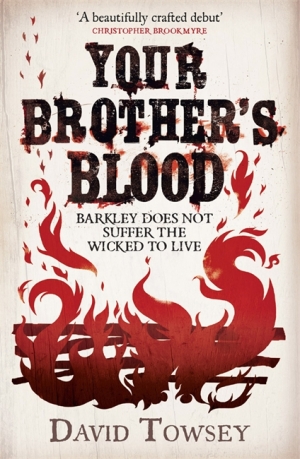
Friday Read: YOUR BROTHER’S BLOOD by David Towsey (Jo Fletcher Books)

TowseyD-1-YourBrothersBloodI have a real soft-spot for zombie apocalypse and dystopian future fiction. While on one of my frequent Let’s Trawl The Internet for upcoming books information, I stumbled across David Towsey’s debut, Your Brother’s Blood, which seems to offer something a little different to your typical zombie-horror novel. Here’s the synopsis:

The earth is a wasteland, with no technology, science, or medicine – but the dead don’t always die. Those who rise again are the Walkin’…

Thomas is thirty-two. He comes from the small town of Barkley. He has a wife there, Sarah, and a child, Mary; good solid names from the Good Book. And he is on his way home from the war, where he has been serving as a conscripted soldier. 

Thomas is also dead — he is one of the Walkin’. 

And Barkley does not suffer the wicked to live.

Perhaps this will be a nice contemporary of Daryl Gregory’s Raising Stony Mayhall? Regardless, here is an excerpt from the novel, one of my Most Anticipated of 2013… Continue reading