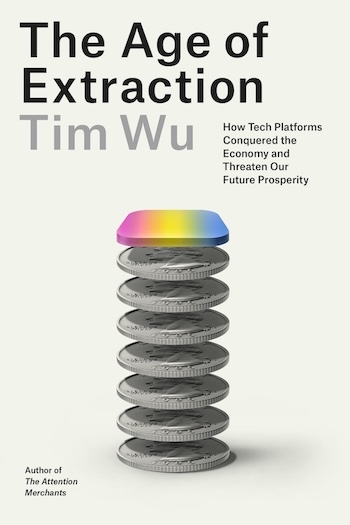
Upcoming: THE AGE OF EXTRACTION by Tim Wu (Knopf)

The other day, I finished Cory Doctorow’s highly recommended Enshittification, in which Tim Wu’s work is mentioned — and, consequently, I was reminded to check to see if he had a new book coming out. In November, Knopf are due to publish The Age of Extraction, which looks highly relevant to my interests and maybe a good companion book to Doctorow’s; certainly it looks like a book that will be of interest to anyone who observes today’s tech/online ecosystem with wariness, suspicion, frustration, and maybe contempt. Here’s the synopsis for The Age of Extraction:

Tim Wu explores how today’s dominant platforms manipulate attention, extract wealth, and deepen inequality — urging us to recognize their influence and reclaim control to create a balanced economy that works for all.

Our world is dominated by a handful of tech platforms. They provide great conveniences and entertainment, but also stand as some of the most effective instruments of wealth extraction ever invented, seizing immense amounts of money, data, and attention from all of us. An economy driven by digital platforms and AI influence offers the potential to enrich us, and also threatens to marginalize entire industries, widen the wealth gap, and foster a two-class nation. As technology evolves and our markets adapt, can society cultivate a better life for everyone? Is it possible to balance economic growth and egalitarianism, or are we too far gone?

Tim Wu — the preeminent scholar and former White House official who coined the phrase “net neutrality” — explores the rise of platform power and details the risks and rewards of working within such systems. The Age of Extraction tells the story of an Internet that promised widespread wealth and democracy in the 1990s and 2000s, only to create new economic classes and aid the spread of autocracy instead.  Wu frames our current moment with lessons from recent history — from generative AI and predictive social data to the antimonopoly and crypto movements — and envisions a future where technological advances can serve the greatest possible good. Concise and hopeful, The Age of Extraction offers consequential proposals for taking back control in order to achieve a better economic balance and prosperity for all.

I was first introduced to Wu’s work via his 2016 book, The Attention Merchants, which I would also recommend.

Tim Wu’s The Age of Extraction is due to be published by Knopf in North America (November 4th) and Bodley Head in the UK (November 13th).

Follow the Author: Website, Goodreads, BlueSky

Review: NUMBER GO UP by Zeke Faux (Crown Currency/W&N)

FauxZ-NumberGoUpUSHCAn engaging, entertaining journey through the world of crypto, from boom to bust
In 2021 cryptocurrency went mainstream. Giant investment funds were buying it, celebrities like Tom Brady endorsed it, and TV ads hailed it as the future of money. Hardly anyone knew how it worked — but why bother with the particulars when everyone was making a fortune from Dogecoin, Shiba Inu, or some other bizarrely named “digital asset”?

As he observed this frenzy, investigative reporter Zeke Faux had a nagging question: Was it all just a confidence game of epic proportions? What started as curiosity — with a dash of FOMO — would morph into a two-year, globe-spanning quest to understand the wizards behind the world’s new financial machinery. Faux’s investigation would lead him to a schlubby, frizzy-haired twenty-nine-year-old named Sam Bankman-Fried (SBF for short) and a host of other crypto scammers, utopians, and overnight billionaires.

Faux follows the trail to a luxury resort in the Bahamas, where SBF boldly declares that he will use his crypto fortune to save the world. Faux talks his way onto the yacht of a former child actor turned crypto impresario and gains access to “ApeFest,” an elite party headlined by Snoop Dogg, by purchasing a $20,000 image of a cartoon monkey. In El Salvador, Faux learns what happens when a country wagers its treasury on Bitcoin, and in the Philippines, he stumbles upon a Pokémon knockoff mobile game touted by boosters as a cure for poverty. And in an astonishing development, a spam text leads Faux to Cambodia, where he uncovers a crypto-powered human-trafficking ring.

When the bubble suddenly bursts in 2022, Faux brings readers inside SBF’s penthouse as the fallen crypto king faces his imminent arrest. Fueled by the absurd details and authoritative reporting that earned Zeke Faux the accolade “our great poet of crime” (Money Stuff columnist Matt Levine), Number Go Up is the essential chronicle, by turns harrowing and uproarious, of a $3 trillion financial delusion.

It seems like I’ve been reading a lot about crypto, recently. I remain deeply skeptical of the whole “industry” (but then, I’m not a huge fan of gambling or scams in general). Zeke Faux’s Number Go Up seemed to have been very well-received, so I decided to take one more dip into the subject. I was not disappointed: this is a very well-researched and written book, not to mention entertaining and engaging throughout. I really enjoyed it. Continue reading

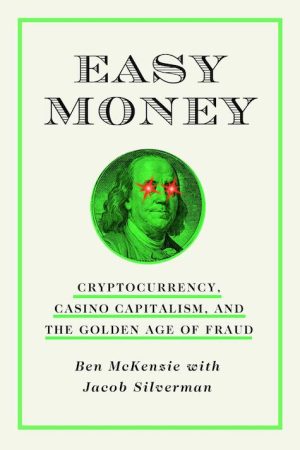
Quick Review: EASY MONEY by Ben McKenzie w. Jacob Silverman (Abrams)

McKenzieSilverman-EasyMoneyUSHCAn excellent deep-dive into the murky world of crypto
At the height of the pandemic, TV star Ben McKenzie was the perfect mark for cryptocurrency: a dad stuck at home with some cash in his pocket, worried about his family, armed with only the vague notion that people were making heaps of money on something he — despite a degree in economics — didn’t entirely understand. Lured in by grandiose, utopian promises, and sure, a little bit of FOMO, McKenzie dove deep into blockchain, Bitcoin, and the various other coins and exchanges on which they are traded. But after scratching the surface, he had to ask, “Am I crazy, or is this all a total scam?”

In Easy Money, McKenzie enlists the help of journalist Jacob Silverman for an investigative adventure into crypto and its remarkable crash. Weaving together stories of average traders and victims, colorful crypto “visionaries,” Hollywood’s biggest true believers, anti-crypto whistleblowers, and government operatives, Easy Money is an on-the-ground look at a perfect storm of irresponsibility and criminal fraud. Based on original reporting across the country and abroad, including interviews with Sam Bankman-Fried, Tether cofounder Brock Pierce, Celsius’s Alex Mashinsky, and more, this is the book on cryptocurrency you’ve been waiting for.

An excellent piece of long-form journalism, Easy Money is a must-read for anyone who has looked at the crypto world and thought, “That doesn’t seem legit” — a category in which I very much include myself. I came away from Easy Money better and more informed on the workings of crypto and all the ways in which it is used and abused by a growing number of grifters. This is a very good book, and as the authors write: it’s a “parable of money and lying, or rather a parable of fake money and lying for money.”. Continue reading

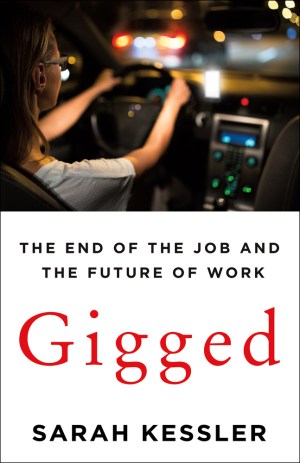
Upcoming: GIGGED by Sarah Kessler (St. Martin’s Press)

KesslerS-GiggedUSSarah Kessler‘s upcoming book looks really interesting. The gig economy has come to dominate a few sectors, and seems to be spreading. To someone who is an accidental freelancer (I didn’t expect to be one so soon in my career), Gigged therefore looks really interesting and relevant. Even though the book is focused on the gig economy in the United States, I think it will resonate with readers in other countries, where gigging is fast becoming a wider experience of life and work. Here’s the synopsis:

The full-time job is disappearing—is landing the right gig the new American Dream?

One in three American workers is now a freelancer. This “gig economy” — one that provides neither the guarantee of steady hours nor benefits — emerged out of the digital era and has revolutionized the way we do business. High-profile tech start-ups such as Uber and Airbnb are constantly making headlines for the disruption they cause to the industries they overturn. But what are the effects of this disruption, from Wall Street down to Main Street? What challenges do employees and job-seekers face at every level of professional experience?

In the tradition of the great business narratives of our time, Gigged offers deeply-sourced, up-close-and-personal accounts of our new economy. From the computer programmer who chooses exactly which hours he works each week, to the Uber driver who starts a union, to the charity worker who believes freelance gigs might just transform a declining rural town, journalist Sarah Kessler follows a wide range of individuals from across the country to provide a nuanced look at how the gig economy is playing out in real-time.

Kessler wades through the hype and hyperbole to tackle the big questions: What does the future of work look like? Will the millennial generation do as well their parents? How can we all find meaningful, well-paid work?

Gigged is due to be published by St. Martin’s Press on June 12th, 2018.

Follow the Author: Goodreads, Twitter