“Scars” Episodes I-III, by Chris Wraight (Black Library)

Wraight-Scars(HH)A Horus Heresy Serialised Novel

This is a review of the first quarter(-ish) of the 27th Horus Heresy novel, which is being serialised through Black Library’s website. Reading these, one is left with a bit of a conundrum: how do you review the first three-of-twelve parts of a novel? What constitutes a spoiler, for example?

I’ve decided to approach the installments as if they were the first quarter of a novel, which means all the content is fair game for discussion and mention (although, I have addressed each episode individually, which has made this a rather long review).

I wonder if it might have been better to organise some kind of forum, in which fans of the series could discuss the episodes and novel? There’s so much in these three parts, and given the week-long gaps between each new episode, I think it lends itself quite well to forum-style engagement and discussion.

Anyway, back to the review. First up, here is the synopsis for the full novel:

Jaghatai Khan and his White Scars Legion must choose – the Emperor or Horus? Fresh from their conquest of Chondax and the discovery of Horus’s rebellion, Jaghatai Khan’s warriors stand divided. Long considered one of the less trustworthy Legions, many of the White Scars claim to owe their loyalty exclusively to Terra, and others still to the Warmaster and his warrior lodges. But when a distress call from Leman Russ of the Space Wolves brings the wrath of the Alpha Legion to Chondax, the Khan’s hand is forced and the decision must be made – in the great war for the Imperium, will he side with the Emperor or Horus?

The first Episode was not the strongest start to a novel. It didn’t fully grab me, like most other Heresy novels have – this is, perhaps, a real danger when serialising a novel that has not been specifically written for this format. (Although, it should be stated from the outset that the first three episodes have been chopped up rather well.) It’s also tricky, though, to address: taken as an individual read, it wouldn’t have left me 100% convinced that I wanted to read on. Because I had the next two episodes, though, I can say that Scars could shape up into one of the strongest Heresy novels.

The story opens with two Astartes aspirants, Tamu and Haren. The two characters are going through trials for what I had assumed were the White Scars. It took a few pages to realise they weren’t both trying out for the same Legion, though, which at least explained the different types of name (Haren Svensellen didn’t sound particularly Asian-influenced, as most White Scars’ names are). Haren, it turns out, had been marked for selection by the Luna Wolves, but is reassigned to the White Scars at the last minute. It’s a little bit muddled, if you haven’t memorised the Legion numbers (as opposed to names), but it quickly sorted itself out.

Through Haren’s ordeal, we learn that this is happening after Horus has made a name for himself: “I will become one of you,” he thinks after confronting a Luna Wolf. “For Horus. For Horus and the Emperor, I will become one of you.”

The mix of ‘Asian’-style terminology (“an owlish Khitan from Choq-tan named Jeldjin” – a bit of a clunky example) seemed at times to be rather heavy-handed or excessive. Wraight throws out a lot of new jargon without the best integration. Less, or a more gradual introduction, would have been better. Interestingly, we learn through Haren’s experiences, the White Scars prefer recruits from the Asiatic hive cities, and he finds their “archaic customs, their introversion, their exceptionalism” irritating. The first episode, then, offers an interesting, if truncated, alternative induction story. I liked this a lot, as it suggests that inductions are not always as harmonious or clear-cut as we may have been led to believe.

To make things a bit more confusing, at the end of Episode I, Tamu changes his name as he is inducted, to Shiban. Haren becomes Torghun.

There’s some foreshadowing, as Tamu asks if Terrans are as tough as Chogorians:

“I am glad you are a poet. Only poets can be true warriors.”

“Do the Terrans think the same way?”

Yesugei laughed. “I do not know,” he said. “One day you will meet one. When you do, ask him.”

Not difficult, therefore, to spot that Tamu/Shiban and Haren/Torghun are fated to meet.

Wraight-Scars(HH)-pt1In Episode 2, the story’s scope widens, and we are introduced to a number of other key characters. Ilya Ravallion, a General in the Departmento Munitorum, for example, who is charged with handling the White Scars’ logistics. Through Ilya’s eyes, we get some good commentary on the White Scars’ style – both martial and temperamental.

“They were the elusive ones, the Legion who roamed too far, the ones who had almost broken away entirely, rampaging outwards from the thrust of the Crusade and angling off into the deep void. Prodigal, her superior had called them.”

Assigned to the White Scars, Ilya feels she’s been given a surprising final assignment: “organising the unorganisable, imposing some sense of discipline upon a Legion that treated warfare like a kind of carefree, joy-filled art form.” In the third episode, discussed below, this theme is revisited, and we learn that Ilya “had come to find the White Scars’ amiable indifference to Imperial edicts more endearing than exasperating.”

And finally, we get some examination on Jhagatai Khan, in relation to his brother Primarchs:

“They said Horus Lupercal was the finest commander in the galaxy. They said that the Angel Sanguinius was the mightiest in combat, or maybe Russ of Fenris, or maybe poor tortured Angron. They said Guilliman was the greatest tactician, the Lion the most imaginative, Alpharius the subtlest. None of them gave the Khan a second thought. But then, they hadn’t seen him [in combat].”

We learn a bit more about Shiban and Torghun, and also start to get a glimpse of a rift between Terran-born White Scars and Chogorian-born Astartes. Torghun, for example, is a member of a Lodge (which haven’t featured much in recent HH fiction), which is made up exclusively of Terran-born Astartes. I have a feeling that the rift within the Legion is going to be borne of these hostilities. It’ll be an interest addition to the canon, too – despite their obviously aggressive, homicidal approach to non-humans, none of the Heresy (or WH40k) fiction has dealt with human racial tension. If handled well, this could be very interesting indeed.

The second episode also gives us more idea of the time-period for the novel – the Space Wolves have already burned Prospero (the events of McNeill’s excellent A Thousand Sons and Abnett’s Prospero Burns), and also after the Isstvan Dropsite Massacre. The final portion of this part focuses on the Space Wolves, who are chaffing at having been sent away to discipline Magnus’s Legion – thereby ensuring their absence from Isstvan, which in turn likely helped sway the conflict in favour of the traitors. Their task also prevented them from coming to the aid of their now-fallen brother Legions. Then, while preparations are underway for the Legion return to Terra, an Alpha Legion fleet appears out of the warp…

One of the most interesting scenes is at the start of Episode III. It is set in the Observatory of the Imperial Palace on Terra. Malcador the Sigillite, Primarch Rogal Dorn and Commander Valdor of the Legio Custodes are discussing the state of the galaxy and the newly-erupted Civil War. Through their discussion, we learn just how thin information is.

“I never asked you how it felt, Constantin, to see Prospero burn. Did even your callous soul blanch at that?”

Valdor didn’t miss a beat. “No. It was necessary.”

“Was it?” sighed Malcador. “I did not give the order. I wanted Magnus censured, not destroyed. What was it that made Russ do it? You never could give me an answer.”

Dorn exhaled impatiently. “You know all of this, Malcador. You know all that happened there, just as we do.” He was coldly furious. “Does this need repeating? The Warmaster is at the heart of it, poisoning everything we do, and now he has the blood of three more Legions on his hands.”

This chapter expands once again our understanding of the rivalries and loyalties between the Primarchs. It also re-iterates the strange, almost lonely position of the Khan. The Khan was only really close to two of his brothers: Horus and Magnus. Naturally, this produces some concern among the leaders of the Imperium. As Valdor states, “So there it is. The Khan’s known allies, Horus and Magnus, traitors both.”

As with the aforementioned novels by McNeill and Abnett, Wraight ties in the treason to the events at Nikaea, when the Emperor decreed that all Legions must disband their psychic corps (the Librarians, etc.). As Malcador laments,

“As I said at the time, Nikaea was the root of this. We should have explained things better, though there were reasons, some of which we could never disclose, not there… We were too caught up in what needed to be done. That may be the tragedy of it all – we did not explain.”

Thankfully, we finally meet the Primarch Jaghatai Khan. He had felt rather absent up to this point… As it turns out, Khan has no idea what occurred on Nikaea, hoping instead that Yesugei (who appears to be his second-in-command?) was successful in helping keep the Librarius alive in the Legions.

The Space Wolves and Alpha Legion also face off in the void.

“I wondered if it would become easier,” Bjorn mused.

“If what would?” asked Godsmote.

“Killing another Legion. Killing kinsmen.”

“We’re not there yet.”

“Yes, we are.”

To return to the pending rift within the Legion, we see a little bit more of the Terran-born Astartes’ frustrations.

“As was typical, the White Scars straggling Legion structure made coordination difficult… The Chogorians seemed happy enough with that. They were used to their inscrutable primarch and his impulsive decision-making. The Terrans took it harder, at least those who hadn’t long resigned themselves to the Legion’s haphazard methods of command and control.”

Given that we’re told the process can take well over a decade, I find this a little strange. It’s an interesting development, certainly, and one I haven’t seen in other Heresy fiction. Therefore it is welcome, not to mention also providing the motivation behind the Legion split easier to swallow, but at the same time… They were made into Astartes, elevated to become super-humans. So they didn’t become Luna Wolves – we’ve been led to believe that all humans see all Space Marines as the pinnacle of supra-human evolution, and are in complete awe of them. It seems almost petty that the friction effectively arises because some of them weren’t pick for the right ‘team’.

All in all, despite the weaker first Episode, Scars is shaping up to be a pretty interesting addition to the Horus Heresy series. Wraight’s writing is well-crafted, and the story moves at a brisk, smooth pace. I hope we get some more White Scars background, though, and perhaps some of their Primarch’s history. I haven’t read much about the Legion before (and have read neither Wraight’s previous novel Savage Scars, nor the limited edition novella, Brotherhood of the Storm).

I do, however, think I would have preferred to read this as part of the complete novel, so I’m not sure if I’m going to continue reviewing the episodes in collected chunks, or just wait for the novel to be complete. Part of this is just down to my own personal impatience with reading in small chunks – I much prefer to devour a novel in a relatively quick period, rather than in slow, weekly drips. It’s an interesting experiment, at least.

Four HORUS HERESY Short Stories by Graham McNeill, Rob Sanders, James Swallow & Gav Thorpe (Black Library)

HorusHeresy-Logo

Near the end of July, Black Library released four Horus Heresy short story eBooks through their website. Naturally, as a real Heresy junky, I gobbled these up ASAP. All four are pretty different, offering alternative perspectives on different events and times during the galaxy-spanning civil war that dictates much of how mankind operates in the 41st Millennium (the ‘present’ for the game and system). So, here are four mini-reviews of these excellent stories… Continue reading

Short Fiction Round-Up: Hillary Jordan, Brian McClellan, Tom Rachman & Frank Cavallo

CivilianReader-Shelves3

I’ve been reading a selection of short stories over the past couple of weeks, but I keep forgetting, or getting distracted from posting the reviews. So, to speed things up, I’ve compiled this selection of four reviews. Each is very different to the others, and offers something different. Not all of them were great, but each has something to offer the reader with a couple of hours to spare – either on a commute, or in between longer reads as palate cleansers. I had a lot more to say about one of them, but it is part of a much larger, decade-spanning series.

Reviewed: Frank Cavallo’s Into the Valley of Death, Hillary Jordan’s Aftermirth, Brian McClellan’s The Girl of Hrusch Avenue, and Tom Rachman’s The Bathtub Spy Continue reading

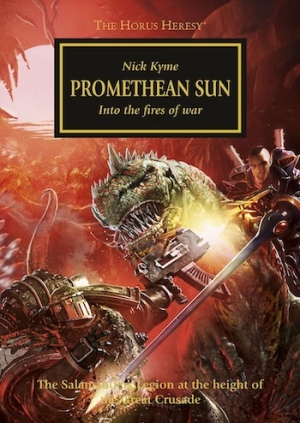
Review: PROMETHEAN SUN by Nick Kyme (Black Library)

KymeN-HH-PrometheanSunFormer Limited Edition Novella gets a wider release

As the Great Crusade sweeps across the galaxy, the forces of the Imperium encounter a world held in thrall by the alien eldar. While the Iron Hands of Ferrus Manus and Mortarion’s Death Guard battle against the hated xenos, it is the Salamanders who brave the deepest and most deadly jungles, encountering monstrous reptilian beasts and foul witchery along the way. Ultimately, it falls to their primarch Vulkan himself to thwart the sinister designs of the eldar, if the Legions are to liberate this world and bring illumination to its inhabitants.

Promethean Sun was Black Library’s first limited edition Horus Heresy novella. As someone who couldn’t afford it back then, naturally I grumbled quietly to myself about missing out on this part of the series – which has, actually, been a superb example of sustained, multi-volume and multi-author storytelling. There have been wobbles, of course, but for the most part this series has been amazingly strong. So, back to this book. After reading it, I realise I shouldn’t have grumbled. Sad to say (and very surprisingly), this was a disappointment, with greater weaknesses than strengths. The story meanders, the writing’s not as strong as I know Kyme can produce, and Vulkan’s characterisation feels off. For completists only, I would say. Continue reading

Upcoming: “Grimoire of the Lamb” by Kevin Hearne (Del Rey/Orbit)

Hearne-5-GrimoireOfTheLambJust caught this via the Twitters, and decided to share it on here. I’m a big fan of Kevin Hearne’s Iron Druid Chronicles – despite having only read the first two, and being really slow about getting to the rest. Hearne announced today that there will be a new eNovella, GRIMOIRE OF THE LAMB, released on May 7th, 2013, in the U.S. Here’s what the author wrote on his website:

“This is an eBook novella on sale at Amazon, B&N, Kobo, iBooks, etc., for $2.99. It’ll be available in the UK, Australia, and affiliated territories too, albeit with a different cover, and I believe (but haven’t confirmed) that it will be on audio too in the US & Canada…”

So it will be arriving in other territories, hopefully around the same time. With regards to the story, Hearne wrote,

“It’s set in 2005, four years before HOUNDED. Aenghus Óg hasn’t found him yet, Granuaile isn’t bartending at Rúla Búla, but we do get a cameo from the widow MacDonagh.”

Here’s the official synopsis, from Del Rey:

When he’s not vanquishing villainous gods or dodging demons, two-thousand-year-old Druid Atticus O’Sullivan can be found behind the counter of Third Eye Books and Herbs in modern-day Tempe, Arizona, literally minding his own business. But when an evil sorcerer – and amateur shoplifter – snatches an ancient Egyptian tome of black magic, The Grimoire of the Lamb, Atticus is not sheepish about pursuing him to the ends of the earth… or at least to the Land of the Pharaohs.

Unfortunately, Atticus already has enemies in Egypt – including cat goddess Bast, who wants her own book of mischief back from the Druid. In the streets of Cairo, she sends a feline phalanx after Atticus and his Irish wolfhound, Oberon. With fur still flying, Atticus must locate the sorcerer’s secret lair – where he will face killer crocodiles, spooky sarcophagi, and an ancient evil Egyptian who’s determined to order the sacrificial lamb special tonight.

Atticus in Egypt? Count me in. If you haven’t read any of the series before (shame on you!), then this could be a great point to give it a try.

Also on CR: Reviews of Hounded and Hexed, and an Interview with Kevin Hearne

The Iron Druid Chronicles: Hounded, Hexed, Hammered, Tricked, Trapped, Hunted (Novels) | Two Ravens & One Crow, Grimoire of the Lamb (Novellas)

Hearne-IronDruid2013

Gotrek & Felix: “The Reckoning” by Jordan Ellinger (Black Library)

Ellinger-G&F-TheReckoningA Novella from the Upcoming Gotrek & Felix: Lost Tales

Gotrek and Felix: unsung heroes of the Empire, or nothing more than common thieves and murderers? The truth perhaps lies somewhere in between, and depends entirely upon whom you ask… Summoned back to Barak Varr by the outraged King Grundadrakk, the pair discover that a terrible crime has been committed – the dwarfen hold’s Book of Grudges has been stolen, right out of its sealed vault. Given that his own name appears upon its fading pages, Gotrek is honour-bound to join an expedition to recover the ancient tome. How far will the trail lead, and just what manner of individual would seek to rob the dwarfs of their vengeful legacy

I’m not a fan of buying novellas individually if they will be released later in a collected anthology, but when The Reckoning was released, I really fancied a short dip back into the Warhammer setting with my two favourite characters. And luckily, this story is really rather good.

To be honest, The Reckoning didn’t start too well, as the captain of the Dorabella was given a bit of a cliché accent. (The Dorabella is the ship on which our heroes are fleeing a mob intent on capturing them for… something they may or may not have done.) The story is set twenty years since the Window Tax Riots in Altdorf, the event that resulted in Gotrek and Felix’s first encounter – and, as can happen from time-to-time, after much alcohol resulted in Felix pledging to write Gotrek’s epic.

A group of heavily armoured Dwarfs attack the Dorabella, board it and apprehend our much-put-upon heroes. Apparently, Gotrek committed a crime before leaving Barak Varr (which he visited on his way to the Slayer Shrine to make his oath).

The best thing about this novella is the amount of detail it adds to Gotrek’s back-story. We learn a little more of his life pre-slayerdom. For example, I don’t remember knowing before this that he was a master engineer (it’s entirely possible I just forgot – there have been quite a lot of novels, now…).

“Where are we going?”

Gotrek’s single eye glittered. “To Barak Varr. I want to see for myself how these fools let someone into my vault.”

After examining the vault, Gotrek, Felix and their Dwarven captors recognise that there’s something else entirely going on, and so they descend into the tunnels below Barak Varr. As is so often the case with Gotrek and Felix, they are in pursuit of the mischievous and malicious Skaven, who have apparently stolen something very dear to the Dwarfs. We don’t really get to know the new dwarf characters as well as I would have liked, but it is by no means much of a problem – the action comes fast and often, and the story moves along at a good clip. The Skaven they are after are also an interesting, Goulding-Gotrek&Felix-LostTalesunique bunch, and I think Ellinger’s done a great job writing a new spin on the neverending war between the rat-kin and Dwarfs. (I won’t spoil what it is, but it’s well-written and executed.)

The Reckoning reminded me of the early Gotrek & Felix short stories, and particularly those found in Trollslayer. The atmosphere, the tight prose, and the sword-axe-and-sorcery fun. It was, therefore, very enjoyable and a most welcome addition to the series.

Overall, then, this is a really good novella, and I’m now really looking forward to reading the other three in Gotrek & Felix: The Lost Tales, which will be published in August 2013. I really don’t know why I’m still taking so long to read Josh Reynolds’s Gotrek & Felix: Road of Skulls novel… (Soon!)

“Blood Blessing” & “Reaper” by Sarah Cawkwell (Black Library)

Cawkwell-ValkiaShortStories-ReviewHeader

I have been woefully slow about reading Sarah Cawkwell’s full-length fiction for Black Library. I therefore decided to address this and, to get me in the mood for Valkia the Bloody, I thought I’d read the latest two (of three) short stories that feature Valkia, daemon princess and consort of the blood god Khorne (the third I have already read and reviewed). Both of these stories were considerable improvements on what I’ve read by Cawkwell in the past, and I really enjoyed both.

BlackLibrary15-02-BloodBlessing (Cawkwell)Blood Blessing

Approached on a blood-soaked battlefield by the terrifying, yet enthralling, Valkia the Bloody, a dying warrior is offered a choice: a bloody end or a life of eternal slaughter.

This is a (very) short story from Black Library’s 15th Birthday collection. It’s narrated as though Valkia is addressing the fallen warrior, but as if she is detached and rehearsing what she will say to him, when the time comes. It’s rather good.

“If you choose glory, Khorne will raise you up to more than you could ever imagine you could be. You will fight the Battle Eternal in His name, the endless thirst for blood and the desire to bring skulls to His Throne driving you ever onwards. You will fall countless times in those wars, banished to the eternal realm by the foul magic and enchanted blades of the living, but you will rise again and again.”

I liked the idea of a daemon taking a role similar to that of the Valkyrie from Norse mythology – only, here, she is a twisted and sinister version, and rather than carrying off the souls of brave warriors to Valhalla, she is offering bloodthirsty killers the chance to fight for eternity.

The extremely short format has meant Cawkwell has had to restrain some of the over-writing that has, in my opinion, weakened some of her previous BL work (especially the first Valkia short story). This is by no means Cawkwell’s weakness alone, I should point out: it is something that affects a number of BL’s authors (I had the same problem with Rob Sanders’s Atlas Infernal, for example), and it is a real hazard whenever something Chaotic is involved in a story. Here, however, Cawkwell has written a very tight, sharp slice of Warhammer fiction.

Overall, Blood Blessing is a masterfully-written and very well-constructed vignette, one that should appeal to fans of Warhammer, and perhaps also act as a good introduction to anyone interested in this character.

*

Cawkwell-ReaperReaper

Empire Captain Kale von Kessel lies dying upon the field of battle after a doomed defence against the forces of Chaos. As the enemy leader – the infamous consort of Khorne, Valkia the Bloody – approaches to claim his head in the name of her dark master, von Kessel realises that his life of battle has been leading to this moment, and that Valkia wants more than just his head – she has been sent to claim his very soul.

This is another very good story. It’s longer (though still only a short story), which means it gives us a little bit more time with Valkia on the battlefield. We get to see how she addresses and approaches those warriors she has chosen. It has a pretty similar premise to the story reviewed above, but instead of a one-sided narrative, here Valkia takes us into the mind and past of von Kessel. It’s quite sinister, actually, as Valkia walks us through the imperial captain’s warlike… tendencies. It’s interesting to see her twist von Kessel’s perception, to pull back the veil on the many lies he’s been telling himself about his bloodlust.

As with Blood Blessing, Reaper is tightly written, with an overall dark atmosphere, and plenty of restrained-though-vivid description. It’s another taste of Valkia’s life and character, and it certainly piqued my interest in reading more about her and her bloody exploits.

“Berthold’s Beard” by Joshua Reynolds (Black Library)

ReynoldsJ-BertholdsBeardA Gotrek & Felix short story

When Gotrek and Felix agree to help an impoverished nobleman reclaim his birthright, they are thrown into a battle for survival against a creature from their darkest nightmares.

Previously printed in the Black Library Weekender 2012 Saturday Anthology, Berthold’s Beard is a quick tale featuring the Dwarf Slayer and his human companion. It’s quite fun, too, indicating once again that the Gotrek & Felix franchise remains in safe hands.

Berthold’s Beard captures the tone and fun of William King’s and James Nathan Long’s G&F fiction, but does not ape their style. The story is an odd one, to be sure, but no less fun for it. It is, however, very short, which makes it rather tricky to review without spoiling everything. Our heroes have been hired by an heir to the Berthold line, to complete a legacy quest – they must travel to the ancient Berthold family country estate and return with something, by way of proving the nobleman’s heritage and therefore gaining access to the family’s vast fortunes. Sounds easy, right? Yeah, it’s really not that simple. But then, it never is when Gotrek and Felix are involved…

If you’re a fan of the series, then this short story will tide you over until you can get hold of the latest novel, Road of Skulls (out now in paperback and eBook). As I said, the series is in very safe hands, and Reynolds has faithfully recreated the fun and adventure of the previous instalments of the series. I’m really looking forward to reading his first full-length contribution (I may read it next week, we’ll see).

If you’ve never read the series, I think it’s about time you pick up either the first Omnibus paperback, or at least the Trollslayer eBook. If you’re worried because you’ve never read any Warhammer fiction, then this would also be a perfect starting point. (Many moons ago, that’s exactly what this series was for me.)

Recommended.

***

UPDATE: Apologies for getting the second author’s name wrong – it was, of course, NATHAN Long who took over from Will King.

“Yarrick: Chains of Golgotha” by David Annandale (Black Library)

Annandale-Yarrick1-ChainsOfGolgothaAn excellent Commissar Yarrick Novella

From the ashes of the Second War of Armageddon a hero of the Imperium emerged. War-torn and bloody, Commissar Yarrick swore vengeance on the beast that escaped his righteous wrath, the despoiler of Armageddon – Ghazghkull Thraka.

Tracking down the ork warlord to the desolate world of Golgotha, Yarrick leads an armoured company to destroy the beast but does not reckon on Thraka’s cunning. Ambushed, his army all-but destroyed, Yarrick is captured and awakes to find himself aboard the beast’s space hulk facing a fate worse than death…

This is a very fine science fiction novella. Annandale has been writing for Black Library a while, now, and with each new release I am even more impressed. Taking on one of the most beloved Imperial characters from the Warhammer 40,000 canon, though, could be a daunting task. Annandale has risen to the task admirably, however, and has managed to capture the essence of Yarrick and his struggle against Ghazghkull excellently. Chains of Golgotha absolutely does his subjects justice.

The story is told from multiple perspectives, but predominantly from Yarrick’s. The others, from Colonel Rogge and Teodor Helm, for example, add extra colour and allow Annandale to step back and show us how those around Yarrick see him. It offers a nice juxtaposition with his own insecurities and recognition of how people view him. His loyal aide de camp, Lanner, is very good at keeping Yarrick grounded, for example.

“For my pains, my reward was a barrage of outrages too studied to be real. They were theatre for my benefit, and it was theatre that I needed, especially since Armageddon. It was one thing to be aware of one’s own legend. Lanner made sure I didn’t believe in it.”

The story takes place two years into this current campaign, and it is not going very well for the Imperial forces. Yarrik has accepted that he has a nemesis, an enemy who is making statements in his attacks and strategies aimed at him, taunting him at the same time as destroying as many Imperial forces as possible. That nemesis is Ghazghkull Mag Uruk Thraka, a hulking beast of an ork warlord, who has been uniting hundreds, if not thousands, of ork warbands and has cut a bloody swathe across space. He is not an opponent to take lightly, but nor is he a typical ork leader.

“As much as it disgusted me to even articulate the thought, there was a monstrous truth that had to be faced: Thraka had the potential to become the ork emperor.”

Late in this campaign, we join Yarrick as he is leading his army to a rendezvous point. It’s been a long, hard-fought campaign, and as well as the continued depravations of the ork forces, support for the war (political and moral) has waned precipitously.

“I had to fight tooth and nail for every tank, every rifle, and every man of my army, every single day since the enthusiasm for the crusade had evaporated in its second year.”

Little does Yarrick know, however, that things are going to get much, much worse for him. As the Imperials are ambushed and their troops either butchered or captured, Chains of Golgotha morphs into a very interesting, unique Warhammer 40,000 tale. We’re taken aboard a vast space hulk, and Yarrick comes face-to-face with Thraka. As I just said, though, this is a highly original story, and nothing plays out as I expected. I will, therefore, not spoil any more of the plot – needless to say, though, this worked for me on every level.

Chains of Golgotha is a great intro to the character. I really liked the tone and voice of the story and of Yarrick. Annandale’s writing is excellent, as well. The author has a gift for giving all of his characters distinct personalities and voices. It hasn’t always worked for me in the past (Mephiston, sadly, was rather odd in Eclipse of Hope), but he nails it in this novella. I’ve also really enjoyed some of his other work (Carrion Anthem, especially). In this story, he once again shows his gift for bringing the maelstrom of warfare to life on the page – it’s an absolute whirlwind at the start, but on the hulk it becomes much closer, more atmospheric and in some ways even more brutal.

Yarrick: Chains of Golgotha is a fantastic novella, and hopefully the first of many Yarrick tales to come. Annandale is definitely one of Black Library’s best up-and-coming authors.

Highly recommended.

[Chains of Golgotha is also available as a special edition hardcover, but I bought the eBook edition.]