 Twenty years ago today, I posted my first fiction review on Civilian Reader. That is… pretty wild.
Before creating CR, I’d been reviewing music for my own fanzine that I’d been running for about four years. I first put that together using Microsoft Publisher, and printed, stapled, and mailed it out to the handful of subscribers I had. After I discovered this thing called “blogging”, while studying journalism, I shifted everything online. (It’s just so much easier, quicker, and cheaper — no more multipacks of printer ink!)
I wanted to do something to mark the occasion, and more than just the one post marking the milestone, and have been mulling this ever since I noticed we were coming up to the 20th anniversary. I’m still not entirely sure what I want to do, so I’ll have to keep thinking about (hopefully) interesting and related things to do. I am currently toying with revisiting early books I read and reviewed for the website, and taking a look at “Before Civilian Reader” books that I love and think deserve a little more attention. (Basically, it’ll be an excuse to re-read some older favourites.) I’m hesitant to make any concrete plans, though, as I invariably don’t follow through on “reading plans” or “reading goals” for a variety of reasons.
The first book review I ever wrote was for Richard Morgan’s Market Forces, for my university paper. It was a good book, and I thought I wrote a pretty good (albeit too-long-for-print) review, which was then butchered for publication. What went to press stripped out the discussion of what actually made the novel interesting and worth reading. So, I decided to create my own space to review books.
In the Beginning…
While my first review was fiction, I didn’t review much fiction to begin with on my own site. Instead, for most of the first year or so, I focussed on writing non-fiction reviews — all of which I eventually shifted to a different blog, dedicated to just non-fiction. The website was a good way to get hold of the non-fiction books I thought might be useful for my studies (up-to-date politics and international relations books were often missing from the university library, and took forever to get in). I will be forever grateful to the university presses and others who sent me titles for review; particular hat-tips to Princeton University Press and Basic Books for the many books over the years. After a while, though, I found myself needing a break from politics and history, and started reading and reviewing more fiction.
First, it was a lot of tie-in fiction: mainly Black Library’s novels and also Star Wars. But, as with my first review, also plenty of thrillers. As an aside: it’s often confused me that some people who know me in real life can refer to me as “just a science fiction blogger” because a) I read more fantasy than SF, and b) crime, thrillers, and non-fiction far outweigh SFF in my reading. I’m not at all embarrassed by my interest in SFF. (In fact, those who think I should be are the ones who should be embarrassed, and ashamed of their closed-mindedness and pretension.) It’s just not an accurate reflection of what CR covers.
*
Book One
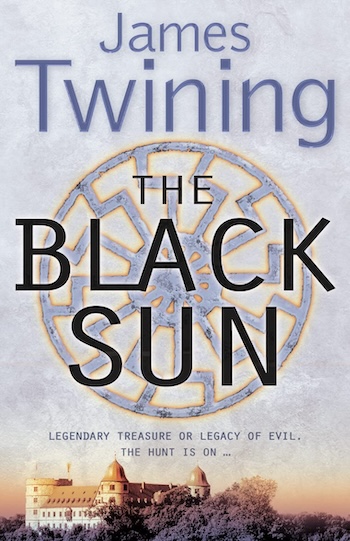
The first review I published on CR was for James Twining’s The Black Sun (Harper Collins), the second novel in the author’s Tom Kirk mystery/thriller series. I remember thoroughly enjoying at least the first two books in this series. I remember buying the first book, The Double Eagle, on a whim at Waterstones in Durham, because the hardcover was promotionally discounted (maybe £10?). It was just the type of thriller I was looking for at the time, and I pre-ordered the sequel as soon as I could.
If you haven’t heard of the author and his series, I’d say it should appeal to fans of Matthew Reilly, James Rollins, Sam Bourne, Dan Brown, Steve Berry, Clive Cussler, and others of that type. If you enjoy books like action/adventure movies with a dash of historical conspiracy, in other words, you could enjoy these books.
Here’s the synopsis, which I didn’t used to include with my reviews (but now do, to help avoid spoilers):
In London, an Auschwitz survivor is murdered in his hospital bed, his killers making off with a macabre trophy-his severed left arm.
In Fort Mead, Maryland, a vicious gang breaks into the NSA museum and steals a second world war Enigma machine, lynching the guard who happens to cross their path.
Meanwhile, in Prague, a frenzied and mindless anti-Semitic attack on a Synagogue culminates in the theft of a seemingly worthless painting by a little known Czech artist called Karel Bellak.
A year has passed since Tom Kirk, the world’s greatest art thief, decided to put his criminal past behind him and embark on a new career, on the right side of the law . Then three major thefts occur, and suddenly Tom is confronted with a deadly mystery and a sinister face from the past.
And here’s the original review:
Sequel to The Double Eagle, The Black Sun is a fine sophomore novel from a truly talented British author.
James Twining has managed to write a twisting tale of historical intrigue and action, while not falling foul to the cliches and pot-holes that affect Dan Brown. There’s no dubious religious connotations or huge leaps into left field to help his arguments and premises. True, he’s clearly made some of the background up, but then that’s why this book is found in the “Fiction” section of Waterstone’s…
Delving into the myths and oddities of the Nazi SS, The Black Sun is another tale starring Tom Kirk, The Double Eagle‘s art-thief-cum-action-hero that we all fell in love with last time around. This time, Tom is thrown into a dangerous quest after a number of high-profile thefts of art and a coding machine. Not to mention the arm thieves took from a concentration camp survivor…
Twining’s style is so fluent and flowing that it is impossible to put this book down. Drawing us through the story with his prose and premises, the story rattles along at a fair clip, never pausing for long enough to catch our breath before a new twist is revealed. From London to St Petersburg, the action is varied and exciting, utilising all the best thriller devices, yet never coming across as tired, cliched or plagiaristic. Twining has his own voice, but one that sounds familiar and comfortable.
Fluid and eloquent, The Black Sun is a delight to read. One of this year’s must-have thrillers.
***
Oh my.
Reading that, it’s clear that I was playing the part of Reviewer. The language is somewhat hyperbolic, which I kind of regret now. Not because I didn’t enjoy the book, but to my older, “wiser” ears it just… clangs. I can’t help but cringe at my writing. As I mentioned above, before writing book reviews, I spent years writing music reviews, and it’s clear to me that some of the stylistic conventions of that genre of writing has bled over into this. I was also young and way more (vocally) enthusiastic about things than I am now. As I get older, I seem to have banished my emotions to a nether realm, from whence they will never return…
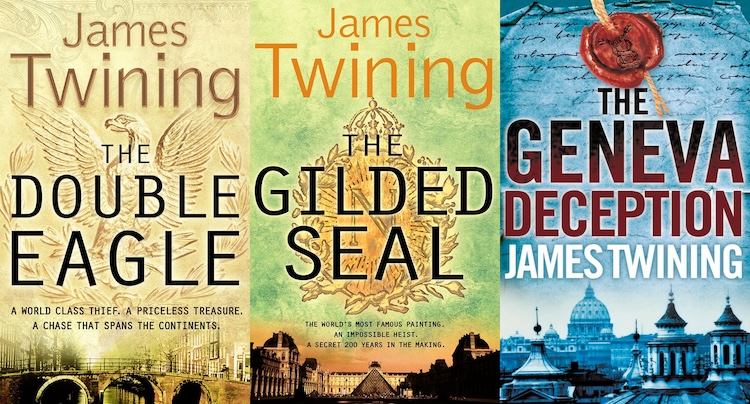
There were ultimately four more novels in Twining’s Tom Kirk series: The Double Eagle, The Black Sun, The Gilded Seal, and The Geneva Deception, all published by Harper Collins in the UK. They are still available as eBooks, at least.
The author’s Wikipedia page notes, “In 2009, Twining announced on his website that he was working on the fifth Tom Kirk novel.” However, there has been no new information about this or any other book by the author since 2010. I think he’s now the CEO of an insurance company or something.
*
As I continued my studies, my reading and reviewing shifted overwhelmingly towards history and politics, which I think ultimately mellowed the language I would employ in my fiction reviews (for the better, I think we can all agree). I do think I improved over time. At least for a time, anyway: in recent years, I’ve been far less focused on writing reviews of the books I’ve been reading, so those muscles have atrophied a bit. Part of why I reduced the number of reviews I was writing — especially for books I didn’t received from a publisher for review, was because I started to think I was repeating myself too much. I started to wonder if I actually had anything interesting/worth saying. So, I stepped back for a little bit, and try to be a bit more selective about which books get the full review treatment.
*
CR20
To sum up… Expect something to celebrate the 20th anniversary of Civilian Reader. I’ll mark the content with “CR20” in each title and also as a tag.
Feel free to leave requests and/or suggestions in the comments.
 Civilian Reader