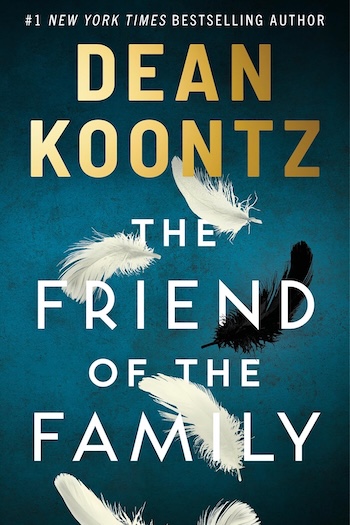
 Today, we have an excerpt from The Friend of the Family, the latest novel from Dean Koontz. The latest novel from one of the most prolific and popular suspense authors working today, it was recently published by Thomas & Mercer. Here’s the synopsis:
A girl liberated from a carnival sideshow discovers her mysterious purpose…
The human “oddities” in the Museum of the Strange are less wondrous than the gawking rubes had been promised. But Alida is something else. The real thing. Traveling Depression-era America from carnival midways to speakeasies, Alida is resigned to an exploited and lonely life on the road as the museum’s golden ticket. Until she’s rescued by two compassionate strangers.
Franklin and Loretta Fairchild see in Alida a gifted and uncannily well-read girl in need of a loving touch and a family. With the openhearted couple and their three precociously imaginative children, Alida finds it. Yet despite everyone’s overwhelming generosity and acceptance, Alida knows she is still a very different kind of girl. Her dreams bear that out. They’re vivid, unsettling, and threatening. Alida fears that they’re also warnings. And that it’s the Fairchilds who may need rescue from a bad, bad world.
Alida will do anything to help those she now holds nearest and dearest. Empowered with a purpose to vanquish evil, she will not fail her family.
*
Chapter One
For much of my life, I had no last name. During those years, I never felt at home or loved. I was called Alida, a name under which I lived in miserable circumstances with unusual companions.
Everyone called Forest Farnam “Captain,” which was how he billed himself. He had never been a captain of anything, and his real name was not Forest Farnam. Although he claimed to be six feet tall, he would have been five nine if he’d taken the two-inch lifts out of his boots. A person of ample dimensions, Captain wore three-piece tweed suits even on the hottest days, but he perspired no more than a penguin dwelling in the Antarctic. He remained perpetually pale regardless of how much time he spent outdoors, as if he were immune to natural light just as he was inoculated against respect for natural law.
McKinsey Shows, the country’s largest traveling carnival, which owned all its rides and select other attractions, also leased midway space to entrepreneurs. The shooting gallery, the high-striker, the mouse-in-the hole scam, the various winner-every-time games, and the grab joints that offered eat-while-you-walk fare were all owned by individuals who made an excellent middle-class living. The Captain operated a popular ten-in-one, an attraction that put on display ten “human wonders,” which he called “freaks” in private. Each of the ten had his or her stall along a sawdust-carpeted viewing corridor that wound from one end of the tent to the other. Outside, luridly illustrated banners provided a backdrop to the pitchman—often Captain—who ballyhooed the passing crowd, swearing on his mother’s grave that the experience of a lifetime awaited them inside.
In Captain Farnam’s Museum of the Strange, as it was called, most of the “biological oddities” were less wondrous than the rubes had been promised. The man with the “iron throat” was actually just a sword swallower, a former vaudeville performer from Pittsburgh. At four hundred pounds, the bearded lady was said to be the fattest of her kind in all the world, which maybe she was or maybe she wasn’t, but at least the beard was real. Rubberman was double-jointed and capable of seemingly impossible postures, though he could not shake hands with himself behind his back as boldly depicted on the banner outside. The littlest person on display was Miss Cora Wallingham, an achondroplastic dwarf with shortened extremities and a large head. Cora was a buoyant, witty woman. While many of her fellow performers refused to converse with the marks, Cora enjoyed answering questions from them, charming even the most boorish individuals.
Conrad Heinz, a kindly man cursed with a mean face and a third eye in his forehead, gave the customers more of what they expected. Although the orb was milky white and blind, it rolled in its shallow socket, seeming to focus on this or that face among the crowd. When he growled, most women and more than a few men recoiled in fear.
In spite of all that Conrad had to offer the morbidly curious, I was the main attraction in the Museum of the Strange. Onstage, I wore only the bottom of a two-piece bathing suit. No one was likely to entertain erotic fantasies about me. I was minimally clothed for the sole purpose of exposing my unique nature so that the paying customers would feel they had gotten their money’s worth.
Most of the time, I sat on a padded stool, though twice an hour I was required to “parade,” as Captain called it, moving about the small stage, which had a mirrored back wall so that the marks could fully appreciate how different I was from them.
I had learned to deafen myself to everything they said to one another and to me. I rarely glanced at them, and when I did, they looked like wide-eyed fish peering through the wall of an aquarium, nothing but silence issuing from their open, moving mouths.
Judge not lest you be judged. That is one of the principles by which I live as best I can, although I am not always faithful to my intention. When I was very young and first put on display, I watched the rubes as they watched me. I saw among them dark souls who took pleasure in the sight of me for whatever reasons, and others who clearly found me disgusting. Sometimes there were men with pity in their eyes and women unable to hold back tears, but their compassion was no more meaningful to me than the contempt and sick delight of the others. Whatever sympathy they felt for me was insufficient to inspire them to take action that might free me from enslavement. Although I wasn’t old enough to attend grade school, perhaps they convinced themselves that I enjoyed a variety of options and had considered all paths forward and had chosen a life of servitude and degradation. I forgave them. Day by day, year after year, I forgave them and wished no ill upon them. I ceased to hear the marks and ceased to see them except as a blur of faces, because it was easier to forgive them en masse than as gaping, goggling individuals.
Judge not lest you be judged. I was incapable of forgiveness when it came to Captain Farnam. I judged him. I imagined a place in Hell awaited him, that in fact it was Hell from which he had come into my life.
He claimed that my mother—of whom I had no memory—was his sister and that she supported his adoption of me when I was two years old. He possessed a thick sheaf of legal documents to support his contention. I was nine before I began to suspect his official-looking paperwork was a sheaf of forgeries. However, in 1922, child welfare wasn’t a big concern of authorities, who had finally passed a law restricting child labor only six years earlier. If a crusading lawyer took my case, Captain knew how to buy his way out of any kind of trouble. If he retained custody of me following a legal skirmish, he would make my life even more miserable than it had been.
Besides, I had no money or skills with which to support myself. A penniless “biological oddity,” alone in the world, seemed certain to fall into the hands of some monster more vicious than Captain. At least my current keeper never beat me or exhibited the slightest sexually perverse interest in me.
The nine other oddities in the Museum of the Strange were contract performers, as was usually the case in freak shows. They prospered, receiving a slice of the box office. In the offseason, mid-October through mid-March, they retreated to their homes in Gibsonton, Florida, a small town that welcomed carnies and even oddities from McKinsey Shows and all other carnivals in America. Those with the strangest deformities could live relatively quiet lives in that community.
I had no contract, no slice of the box office. To all intents and purposes, I was owned by Forest Farnam.
*
Dean Koontz’s The Friend of the Family is out now, published by Thomas & Mercer in North America and in the UK.
Follow the Author: Website, Goodreads, Instagram

 Civilian Reader