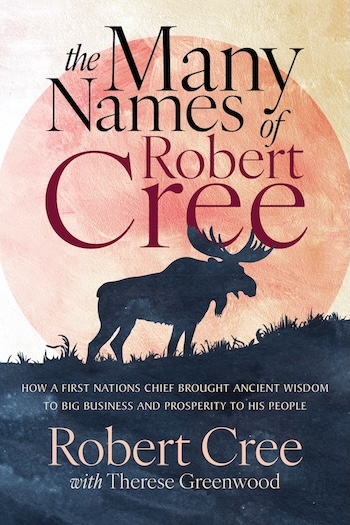
 Today we are very happy to share an excerpt from The Many Names of Robert Cree: How a First Nations Chief Brought Ancient Wisdom to Big Business and Prosperity to His People, the new autobiography by Fort McMurray First Nation chief Robert Cree (w. Therese Greenwood). Recently published by ECW Press, here’s the synopsis:
A vital account of the life and many names of Robert Cree, and his plan for a peaceful, sincere, and just path to reconciliation in an angry and chaotic world.
His mother called him “Bobby Mountain.” Elders called him “Great Man.” His people called him “Chief.” Oil men called him “Mr. Cree.” But the government called him “Number 53.” Robert Cree was all of these while facing his people’s oppressors and freeing the ghosts of tortured spirits.
The Many Names of Robert Cree is his first-person account of survival in a brutally racist residential school system designed to erase traditional Indigenous culture, language, and knowledge. It is also the story of an epic life of struggle and healing, as Cree takes the wisdom of his ancestors and a message of reconciliation to the halls of government and to industry boardrooms.
In the storytelling tradition of his people, Cree recounts his early years in the bush, his captivity at a residential school, his struggles with addiction, his political awakening as one of Canada’s youngest First Nation Chiefs, and the rising Indigenous activism of the late 20th and early 21st centuries. He also recounts the oil industry’s arrival on his poverty-stricken reserve and the ensuing struggle to balance economic opportunity with environmental challenges.
Throughout, Cree’s leadership is rooted in his unshakable commitment to the sacred traditional teachings of his people. His beliefs give him the strength to focus on hope, dignity, and building a better future for his community. Now a respected Elder and spiritual leader, Cree champions forgiveness as a powerful force that can bring healing and transformation for all.
*
Chapter 17: I Laughed and Laughed
One evening after dinner, my uncle told Tommy and me that, early the next morning, the three of us would head out to the bush in his truck. He had his own trapline out there, and for extra money he cut down trees and sold logs to other farmers to use for fence posts. It was a big production because the bush was dense and the trees were big and heavy. My uncle needed his tractor for most of the work, but where the ground was too uneven or the trees too thick, he used a team of horses to haul out the logs. He wanted one of us to drive the tractor back to the farm, and the other would bring home the horses and wagon. Uncle Lawrence would drive his truck back.
Things started out fine. We were up bright and early for another of my aunt’s delicious breakfasts. As soon as we were finished, Uncle drove us out to the site. He started up the tractor and checked it over to make sure it was running okay. Tommy and I harnessed the two horses to the wagon. Uncle Lawrence had good horses, fast and well trained. He took great care of them and was proud of them. After he got the tractor going, he checked over the harness to make sure we did a good job hitching up the team. The horses were well rested and ready to go, jostling around in their traces and eager for some exercise. Everything looked good, so he jumped in his vehicle. Before his truck was out of sight, Tommy came up with another competition.
“Do you want to take the horses or the tractor?” Tommy said.
“I don’t care which one,” I said. “It’s up to you.”
“I’ll take the horses,” Tommy said. “You take the tractor, and let’s see who gets home first.”
“Are you sure? The tractor should beat the horses.”
“You’re going to have to go along the road. I’m going to take a shortcut,” Tommy said. “I am going to cut across some fields.”
“I don’t think that will be enough to beat the tractor.” “I think I can do it,” he said.
“Okay,” I said, but I was starting to get that anxious feeling again. Uncle would not want us racing. When he taught me to drive the tractor he said there was always a danger of it turning over and seriously injuring or even killing the driver. I also knew he never raced his horses because he saw them as having an important job to do on the farm. But Tommy could not be talked out of it. I also thought I could easily beat him, so I pushed down my worry and agreed to the race.
“Let’s get ready to start at the same time,” said Tommy. “I will do a countdown.”
“You go first because I know this tractor is going to fly,” I said. “I will give you a head start.”
Tommy took off, and I let him get quite far before I started. Once I hit the gravel road, I put it in third gear and flew along. I kept watching for Tommy but I could not see him anywhere. Soon I passed where his shortcut should have brought him out to the road, but I still could not see him. I figured he was way the heck behind me. Sure enough, I got home first, and Uncle Lawrence walked out into the farmyard when he heard the tractor engine.
“Oh, you made it,” he said.
“Yeah,” I said. I was nervous because I knew Uncle Lawrence would be unhappy with what we had done. Even though my uncle had never scolded me or lifted a hand against me, my brain was expecting a severe punish-ment. I knew in the core of my being that my uncle was not the sort of person to send me back to residential school or kick me out of his house. But the message was not getting to my brain, which was sounding alarm bells in expectation of something horrible. I associated breaking the rules with horrible, brutal, painful punishment. I could not imagine another way to deal with someone who did something wrong.
“Where’s your cousin?” my uncle asked.
“He must be close by now,” I said. “If you want to go back inside, I’ll let you know when he gets here.”
Uncle had just gone back in the house when I saw Tommy flying down the road. The horses were running hard, and Tommy was slapping the lines on their backs to get them to go even faster. I ran out and flagged him down so that he could pull up the team before he got into the farmyard. White, foamy sweat lathered the horses and coated the leather harness. The horses stood with their heads down and gasping in deep breaths of air. It was obvious they had been driven hard.
“Drive the wagon around back,” I said. “You don’t want Uncle to see the horses like this. He’s going to give you a good strap for that.”
“Oh, don’t worry about that,” Tommy said. “He won’t say anything.”
He went ahead and drove the wagon into the front yard, and Uncle Lawrence was standing outside. He took one look at his horses and shouted, “Tommy!”
“What?”
“What did you do to my horses? They’re all lathered up!” “Nothing.”
“It looks like these horses have been going full speed from the moment they left the trapline,” Uncle said. “You must have made them run all the way. What the hell is wrong with you?”
Uh-oh, I thought. Here we go.
I saw my uncle start towards the wagon and Tommy hopping off it, hitting the ground at a run. He was going fast, but my uncle was right behind him, and he was going pretty fast, too. It took a lot to get my uncle to lose his temper, but there was no way he could stand for what had been done to those horses. He chased Tommy around the farmyard while my fear and anxiety kept growing as I stood rooted to the spot. Uncle kept yelling and Tommy kept running until my aunt stepped out onto the porch to see what the racket was about. Tommy made straight for her, and once he got there, his dad really chewed him out — deservedly so — for treating the horses so badly.
But that was it. No strap. No beating. Even though it must have been obvious to Uncle Lawrence that Tommy and I were racing, Uncle never said a word to me about it. The entire time I stayed with him, Uncle Lawrence never said one harsh word or raised his voice to me. But even though Tommy did not get a big punishment, I didn’t think the incident with the horses was over. It was too big a violation, and we had stepped too far over the line. I was also sick at the thought that I’d disappointed Uncle Lawrence after he was so good to me. I knew he needed to teach us a lesson and could see he was deliberating on how to do that. Once again, I waited anxiously for the other shoe to drop, and, again, it didn’t take long.
Soon Uncle Lawrence came home with a beautiful colt that needed to be trained. My uncle said he would get us whatever supplies we needed, but it was up to Tommy and me to train the young horse so that he could work on the farm. How we did it was up to us.
The colt, which Tommy named Joker, was smart, high-spirited, and easily spooked. He hopped around a lot, put his ears back, and swished his tail non-stop. Tommy and I decided to start out slow and let him get used to his new home. For the next few days, right after breakfast, we rushed out to see Joker. We fed him, brushed him, and talked to him so that he could get to know us. We led him around the farmyard as he adjusted to his surroundings and seemed happy to see us coming, probably because we gave him apples and carrots. Then we got down to the business of training him.
The first thing we did was build a stone boat, a type of sledge with a flat bottom that a horse drags across the ground. It is good for moving heavy objects that might break an undercarriage, like the big stones farmers pick out of their fields to prevent damage to their ploughs. My uncle got us the wood we needed, and Tommy and I nailed boards together for the bottom. Then we put posts across the front and bolted down big metal hoops for attaching the harness. We needed the stone boat to be solid enough that we could stand on it while Joker pulled it around.
My uncle gave us lots of time to train Joker to wear the harness and pull the stone boat. I would hold Joker as Tommy tried to carefully slide the harness over his back. Joker jumped all over the place trying to get away and shake it off. I liked calming Joker, talking to him, and stroking his neck until he settled down. When we finally got the harness on his back and properly buckled up, Joker got nervous again. He kept looking all over the place and dancing around, and I kept stroking him and talking to him. We did the same thing over and over for days. We always rewarded him for being a good horse. We were proud of how smart he was, how quickly he understood what we were trying to get him to do. All he knew from us was affection and respect.
When Joker finally settled back down, we trained him to listen. He learned what whoa meant. To get him moving we made a clicking noise with our tongues. It did not take long before he knew the sounds and what was expected of him. It was a very big day when we put the harness on Joker, attached it to the stone boat, and stepped on for our first ride. Tommy had to hold the reins, of course. It was very exciting the first time Joker leaned into the harness, and we started moving forward. We would never forget the feeling of accomplishment, as well as our pride in Joker and what we had trained him to do.
I told you my uncle was a very smart man. Instead of hitting or punishing us, he offered Tommy and me the chance to follow the traditional teaching of respect for an animal that Creator gave us and the purpose it served. My uncle trusted us to figure it out, and without even realizing it, we trained Joker according to the traditional teachings. We praised and thanked him when he did something good, and when he made a mistake, instead of whipping him we found a new way to teach him. We learned, too. We would never again treat a horse badly to win a silly bet.
It was good to be living in a place where every day I was surrounded by traditional teachings. I had almost forgotten how wonderful it felt. I felt that part of my brain, my connection to the wisdom of the ancestors, start to wake up. I still had a lot of work to do to get back to my true path. But I was learning again. Thanks to Tommy, I was also starting to see things in the world around me that brought laughter and joy.
*
Excerpted in part from The Many Names of Robert Cree: How a First Nations Chief Brought Ancient Wisdom to Big Business and Prosperity to His People by Robert Cree with Therese Greenwood. Copyright © by Robert Cree and Therese Greenwood, 2025. Published by ECW Press in North America and in the UK.
Follow the Author: Goodreads
 Civilian Reader