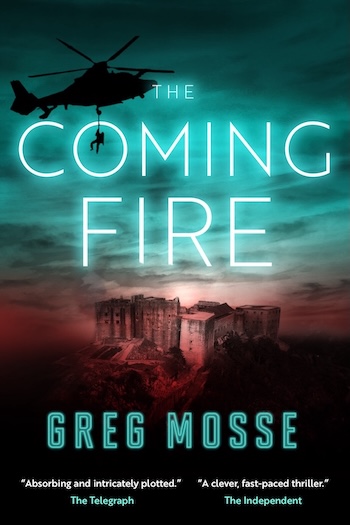
 Next week (July 17th), Moonflower Books are due to publish the third book in Greg Mosse‘s Coming Darkness series: The Coming Fire. To mark the release, and give readers a taste, they have provided CR with a short excerpt to share. First, here’s the synopsis:
First came the darkness.
Then the storm.
Now Alex has no choice: it’s time to face the fire.
Following a fighter jet crash in the Haitian hinterland, special agent Alex Lamarque is taken captive by a violent, drug-addled gang, the only authority in this lawless territory.
Unknown to Alex, his lover Mariam Jordane has escaped the deadly flood of her home valley in the Pyrenees. But Mariam, along with Alex’s mother Gloria, is trapped on the wrong side of the world, facing a crescendo of dangers: the AI viruses crippling the digital state; the breakdown of law and order; and unexpected, terrifying news from a Paris observatory.
Four thousand kilometres to the south, in the remote Sahara, the consequences of the cataclysmic events at the Aswan dam continue to reverberate throughout the world.
With the woman he loves presumed dead, his mother in danger, and no hope of rescue, Alex must tackle his greatest challenge yet: break free from the gang, uncover the truth, and finally face the perpetrators of the global conspiracy that’s seemingly hellbent on destroying the world. Can he – and the people he loves – escape the coming fire?
*
Alex’s eyes remained fixed on the fuselage-screens. Thanks to years of training with the French army and secret service, he had a highly developed sense of space and speed, so he judged he must soon be approaching Haiti’s land border with the more prosperous Dominican Republic.
They might fire on me as an unlicensed incursion.
The Ae4’s nose camera revealed a highway that straightened out as it left the twists of the hills. He flew over a small convoy of two fuel tankers and what looked like an accompanying security vehicle. Though the narrow strip of tarmac looked marginal, he felt he no longer had a choice.
The controls might eventually become unresponsive and that uphill incline should help with deceleration.
A bell icon in the holographic controls notified him that the Ae4 had just received a data drop from the Roussillon. Desperate for news, he wanted to open it straight away but resisted the temptation, in case launching the file entirely disabled his commands. It was hard enough keeping the aircraft level as he descended a kilometre or so ahead of the tankers.
Unable to judge the last few metres of altitude with any precision, he touched down with a sequence of four or five percussive bounces. With each impact, his prisoner cried out once more.
All might have been well but, as he fired reverse thrust to bring the Ae4 to a safe halt, he felt the starboard undercarriage catch and jam in a pothole, maybe where some ancient gnarled tree – too twisted to be useful for construction, too iron-hard to be cut up with hand tools to serve as fuel – had been toppled by high winds, tearing out its roots and a section of the road.
Strapped into his expensive leather seat, Alex felt the Ae4 skew round, the metal and plastic groaning and shrieking. Extraordinary shearing forces bent, creased and then split the aircraft into two pieces. Damp outdoor weather suddenly rushed into the air-conditioned interior.
Alex was wildly shaken as his portion of the Ae4, including the nose and flight deck, went rolling and tumbling, spinning and flipping, then abruptly came to rest on its side against some irregularity in the landscape. The remainder of the fuselage – containing his prisoner – was gone, ripped out of sight, leaving him shaken and alone, dangling against the safety harness.
His mind became blank as he slipped into unconsciousness.
Davide Castile was forty-seven years old. Once a fine physical specimen of middle-aged manhood, his health had been compromised by rash and unproven medical experimentation, ironically designed to prolong life – not his own. He had left the French army as a decorated officer with a ‘mixed’ disciplinary record and an intact pension. That wasn’t important. What mattered to him was his status as sole heir to the extraordinary wealth of his family’s energy company included massive intangible assets, plus cash cows in mining, solar, tidal, cleanburn waste disposal and much more.
Before the Ae4’s catastrophic touchdown, foremost in his mind had been a dam at the head of a Pyrenean valley whose hydro-turbines spent every minute of every day spinning gold out of gravity, turning the weight and pressure of water into money, power and influence.
Or, rather, they used to.
The dam – if his accomplice, Léa Dujardin, had done her job – was surely gone.
And now, am I free?
*
Greg Mosse’s The Coming Fire is due to be published by Moonflower Books, on July 17th.
 Civilian Reader