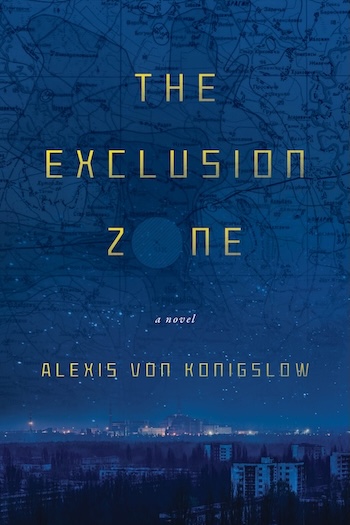
 Today we have an excerpt from The Exclusion Zone by Alexis von Konigslow. Due to be published by Wolsak & Wynn, on May 6th. It is a novel that takes a look at the impact of politics on science, and women in science in particular. It has been described as “part ghost story, part literary thriller”, and I am looking forward to giving it a try. Here’s the synopsis:
She would harness fear. And this terrifying place would help her do it.
Renya, a scientist who studies how people react to fear, flees a troubled marriage to conduct research on the scientists working in the “exclusion zone” around Chernobyl. In the eerily silent forests surrounding the research station, she finds more is haunting her than the dangers of radiation exposure. As she gathers data from her colleagues and probes historical records of the Chernobyl disaster, unsettling questions rise to the surface. Who is funding her research? Why are all the scientists’ findings off? And what do those who stalk the ruins of the abandoned city nearby want?
*
“Come on in,” Dima called out from inside the empty pool. He stood, and she could see him clearly for the first time. He was taller than Yuri. He was sturdier too. “Don’t be shy.” And his accent was different. It was more refined, his English more practiced. He was from a different background from Yuri clearly. They wore similar clothing, but this one was born to money, quite obviously, even if he pretended otherwise.
Renya picked her way around the deck. There were large picture windows. Maybe it was safer to be close to the outdoors. If she was determined to take risks, maybe she could still minimize them.
Dima scrambled out of the pool, hauling his finds. She tried not to breathe the cloud of dust that billowed out around him. Renya glanced at Yuri. They’d be photographing those things surely. Surely, they’d be bringing them back. Yuri talked about documenting all the time. This must be their unofficial documentation. “Why do you say nothing?” said Dima. His smile didn’t belay that his every utterance was a demand.
“Why do you explore in here?” she said.
“I want to know what it was like.”
“Life before the explosion?”
“Life lived in fear,” he said.
“Fear?” breathed Renya.
“Everything stopped here, and it stopped in terror. These people, they weren’t stupid. They were nuclear workers, nuclear worker families, and they knew what explosions in the containment unit meant. They knew the stakes when they moved here, and yet they came.”
Renya couldn’t look away. “You’re interested in fear?”
“They lived in fear before this,” Dima replied. “They knew that there are risks. Then it happened, the thing they were afraid of most. You can feel it in the air, can you not?” He took a deep breath. Renya watched him, astonished, impressed despite herself. This Dima loved fear. He was resistant to it too, it seemed. He breathed freely here, in this place where the dust could kill you.
“I’m studying fear,” said Renya. “That’s the focus of my project.”
Yuri laughed from somewhere else in the room. Renya couldn’t see him. She felt frozen in place. “Dima isn’t just interested in fear,” said Yuri. “He creates it.”
“That’s interesting,” muttered Renya.
“That he creates terrors?” Yuri’s voice had an edge to it.
“That this is a world that stopped in fear,” said Renya.
Time had indeed stopped in terror and loss, but for the landscape only, not for the people. The city was frozen in time, but the people weren’t. The people had moved on, propelled by terror, maybe, but their lives had changed and progressed. Fear had made these people move. It had made them go. It had made them pack up and leave and face whatever came next. It had forced them to make unbearable decisions that wouldn’t have been possible in any other context. Because who would just pick up and leave their life, and abandon all their things? People always said they’re just things, like worrying about stuff makes people small and petty, but these were the small but very necessary articles that people couldn’t live without in this world, like clothes and plates and blankets and cutlery. And she’d seen pictures. You weren’t petty if you didn’t want to leave your family picture albums behind. And now people were perhaps making impossible decisions again, moving back into a forest cut off and radioactive and uninhabitable, and they weren’t doing it because they were happy or content. Dima reached up a hand and Renya took it. Dima smiled, his eyes flashing like emergency lights in the gloom. Renya stepped into the dust and debris strewn pool.
“The people who lived here,” Dima said, “they knew fear.”
Renya touched the old tiles. She’d faced fear. It had made her more than what she’d been.
After that, Renya’s visit to Prepyat had ended quickly. Yuri had ushered her right to the bike, and now she was speeding through the forest once again. As the trees whirred past her, she realized that Dima was right. This was a place suffused in fear.
Renya squeezed Yuri’s torso as soon as the path came into view. Fear had infused this landscape. Fear was informing everyone’s lives here. Fear was informing all their work. Fear was forcing progress.
Yuri slowed his motorcycle. He put out his legs to stop. Renya extricated herself and stumbled off. Yuri bowed slightly. “I will see you soon,” he said.
He winked. Then, as he swung the motorcycle around and sped off again, Renya took off.
She listened to the squeak and whisper of her sneakers on the hard pressed dirt, and watched as the forest flew by. She felt the adrenaline and endorphins pump to her every extremity. Happiness was for suckers. It was stupid. It led nowhere. Contentment meant decay. Satisfaction was complacency. Nobody invented vaccines because they were fucking content. Nobody invented new technologies because they were into the status quo. Fear was motivating. Fear made you think, made you search, made you seek and find and move and work. In terror, you found power. This was progress. This was living.
*
Alexis von Konigslow’s The Exclusion Zone is due to be published by Wolsak & Wynn, on May 6th.
Follow the Author: Goodreads
 Civilian Reader