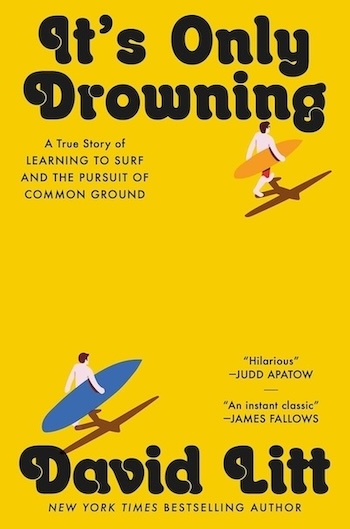
 An engaging, thoughtful memoir about trying new things and attempting to find common ground
After moving from Washington, DC, to the Jersey Shore, a former speechwriter for President Obama starts surfing at the age of thirty-five — the rough equivalent of beginning guitar lessons on your deathbed — and must turn for help to the only other surfer he knows: a tattooed, truck-driving, Joe Rogan superfan who happens to be his brother-in-law.
David Litt, the Yale-educated writer with a sensible fear of sharks, and Matt, the daredevil electrician with two motorcycles and a passion for death metal, had always coexisted from a comfortable distance as brothers-in-law. Yet in 2021, as David wallowed in existential dread while America’s crises piled up, he couldn’t help but notice that Matt was thriving. When he wasn’t making money rewiring New Jersey beach homes, Matt was riding waves at his favorite spots in the state.
Quietly, David started taking surfing lessons. For a few months, he suffered through wipeouts on waves the height of daffodils. But to his surprise, he soon became obsessed. And once he got a sense of the ways that fully committing to surfing could change him both in the water and on land, he set his sights on an unlikely goal: riding a big wave at Hawaii’s famously dangerous North Shore. To get there, he’d need Matt’s help.
At a moment when the fault lines of class, education, and culture threaten to tear our country apart, It’s Only Drowning is a blueprint for becoming braver at a time when it takes courage just to read the news, a love letter to surfing in the vein of William Finnegan’s Barbarian Days, and a poignant buddy comedy in the tradition of Bill Bryson’s A Walk in the Woods.
This is David Litt’s third book, and it offers much of what I’ve come to expect from the author: solid and informed political and social commentary, coupled with self-deprecating personal insights. I very much enjoyed this.
“It is said that Shakespeare wrote King Lear during a pandemic. Good for him. I bought a PlayStation and drank lots of wine.”
It’s Only Drowning is an engaging and often endearing read. Litt takes us on his journey from pandemic-born stasis and ennui, to surfing in Hawaii. Contemporary America seems to fetishize optimizing one’s life; every moment has to be designed to improve yourself, your career, or whatever other passion/obsession you possess. One of the themes in It’s Only Drowning is doing something for no other reason than to do it. I wasn’t surprised, therefore, when the author writes about Matt’s love of surfing, and how he “seemed to surf for no higher purpose whatsoever. He did it simply because he enjoyed it. That made no sense to me.” It is something modern culture seems to frown upon, especially if you are a “coastal elite” in the United States.
I am going to resist the urge to share many of my favourite moments and lines from the book (it’s clear why he’s a sought-after speechwriter), but I will include a few. I found his initial forays into learning about surfing, and then learning how to surf particularly funny. Here are just two great moments:
“Learning to surf is like learning a language that wants to kill you. With the sole exception of being a person in the world in the late-early twenty-first century, it’s the hardest thing I’ve ever tried to do.”
“According to the articles I read on the subject, the key to surviving one of these brutal “hold-downs” was to relax. This was a roundabout way of saying I would not survive.”
These two quotations are good exemplars of Litt’s self-deprecating sense of humour, present throughout the book.
It’s not all humorous self-deprecation, however. It’s Only Drowning offers plenty of social, cultural, and political commentary on contemporary America, from the pandemic through the Trump years. Another theme of the book is the growing divide between “right” and “left”, of various types and stripes; and how these divides can be self-reinforced. Litt’s observations are sharp, often passionate, but not patronizing. Litt is forced to confront his own misconceptions and misimpression of people who hold different opinions or politics to his own. He’s honest about his own blindspots and mistakes. For example: when he has a conversation with his brother-in-law about a contentious issue, which Litt thinks goes very well, he later realizes that he never asked Matt what he thought.
There’s a moment during the book which really stuck out to me. It perfectly encapsulated, in my opinion, the mentality of many who enjoy the Joe Rogans of the world. The author sees “an impish grin” flash across Matt’s face when he offers a ‘contrarian’ opinion. This was telling for me: so often, it seems like those who end up falling down the right-wing rabbit hole start their journey as something akin to a prank. ‘Just asking questions’, ‘playing devil’s advocate’, or just trying to tweak their more liberal/progressive friends and family. However, as has been suggested by various studies, long-term exposure to it will eventually change the way you think. Nevertheless, over the course of the book, it becomes clear that Litt and Matt end up affecting each other in myriad ways — the final chapter in the book is quite moving, on this subject.
I found in interesting that I shared Litt’s politics, but Matt’s music taste. (That being said, when Matt recommended a particular band, I wondered if he really liked the music/genre — they’re kind of a “comedy” metal band — but this, too, could have been an instance of Matt slightly trolling his brother-in-law.)*
“This reminds me of that death-metal song ‘Pineapple on Pizza,’” Matt said, taking a second slice. “Have you heard it?”
“I have not.”
“I’ll play it!” Our condo was soon filled with the sound of a hundred thousand droning bees, and the track lasted, if I remember correctly, millennia.
The author’s prose is excellent, as one can expect from a professional speechwriter. The humour is well-controlled, well-deployed, and mostly self-deprecating. The portraits of the people he comes into contact, even fleetingly, are well-drawn. His descriptions of surfing are often evocative — even though I generally don’t find it particularly interesting to read about (especially multiple times), I never found myself bored or skipping these passages. If you wanted a more-humorous, contemporary version of William Finnegan’s Barbarian Days, this could suit your needs. Reading about Litt’s progress and his changing impression and interpretation of what it means for him are engaging and worthwhile, and I found myself rooting for him throughout.
Overall, It’s Only Drowning is an engaging, thought-provoking memoir about finding one’s way in today’s strange America. Plenty of what Litt discusses will resonate with non-Americans, too. As someone who is a little older than the author, there were many moments that I connected with — particularly the desire to try something new and unexpected (though, in my case, definitely not surfing); and to do it just because you want to, or because it might be fun.
Definitely recommended.
*
David Litt’s It’s Only Drowning is due to be published by Gallery Books in North America and in the UK, on June 24th.
Follow the Author: Website, Goodreads, Instagram, BlueSky
Review copy received via Edelweiss
 Civilian Reader